








The Neutrogena Marketing: How a Skincare Brand Became a Household Name
Neutrogena marketing is one of those rare strategies you’ve probably experienced without consciously noticing it. If you’ve ever stood in the skincare aisle at CVS comparing moisturizers or scrolled through TikTok and paused on a glowing Hydro Boost review, you’ve seen it in action.
Founded in 1930 by Emanuel Stolaroff, Neutrogena began as a cosmetics company (obviously.) The real inflection point came when the brand pivoted toward “dermatologist-recommended skincare.” It was a strategic repositioning that anchored the brand in science and credibility.
And its acquisition by Johnson & Johnson back in 1994 further accelerated global expansion and distribution power totally.
Today, Neutrogena is sold in more than 70 countries and is the #1 dermatologist-recommended skincare brand in the United States.
In this blog, I will analyze Neutrogena marketing strategy; its 4P marketing mix, social media strategies, notable campaigns, and a comprehensive SWOT analysis to reveal the key factors behind the brand’s success.
Let’s take a closer look at how Neutrogena makes it work.
What’s Inside
- Who Is Neutrogena’s Target Market?
- The 4P Marketing Mix: Product, Price, Place, Promotion
- Neutrogena SWOT Analysis
- Neutrogena’s Digital Marketing Strategy
- Neutrogena Marketing Campaigns: What Actually Happened
- FAQ about Neutrogena Marketing
Who Is Neutrogena’s Target Market?
Before we talk about strategy, we need to talk about people.
The Neutrogena target market is broader than you might think, and that breadth is actually one of its greatest competitive advantages.
At its core, you may think that Neutrogena “only” targets women between the ages of 18 and 49 who care about skincare and are looking for products that are both affordable and effective. But it doesn’t stop there.
The brand also actively targets:
- Teenagers and young adults dealing with acne concerns,
- Men seeking simple, no-fuss skincare routines,
- Mature adults looking for anti-aging and sun protection products,
- People with sensitive skin who need dermatologist-approved formulas.
Geographically, the primary market is the United States, but Neutrogena has strong traction across Latin America, Asia-Pacific, and Europe as well.
What makes the Neutrogena target market especially interesting right now is the Gen Z pivot.
According to a 2023 McKinsey & Business of Fashion study, Gen Z consumers account for nearly 40% of global beauty industry spending, with a strong preference for brands that integrate digital engagement and real-world experiences. Neutrogena has clearly gotten the memo.
Statista data f tells a compelling story about where the brand stands with its audience:
Neutrogena holds an 88% brand awareness rate among face care users in the United States. Of those who know the brand, 47% say they like it, and 87% of current users say they’re likely to use it again.
The brand’s identity is anchored in trust. Specifically, the trust that comes from a dermatologist’s endorsement.
The 4P Marketing Mix: Product, Price, Place, Promotion
Let’s walk through the classic Neutrogena marketing framework and see how the brand executes each element with precision.
Product
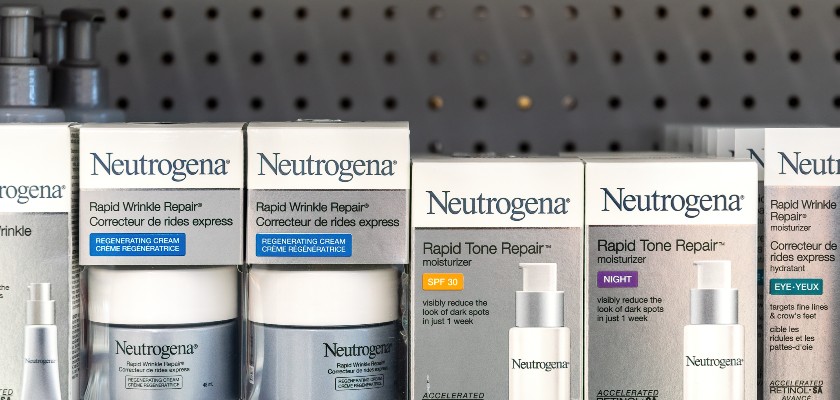
Neutrogena’s product portfolio covers the full skincare lifecycle.
Their lineup includes:
- facial cleansers (foaming, gel, and micellar water formulations),
- moisturizers for every skin type,
- acne treatments using salicylic acid and benzoyl peroxide,
- anti-aging serums,
- broad-spectrum sunscreens,
- makeup products with skincare benefits,
- body care lines,
- haircare products like the T/Sal Scalp Shampoo (which has recently become a major player in that category.)
On Amazon alone, Neutrogena’s Makeup Remover Wipes lead the pack with nearly 100,000 monthly unit sales, and the Hydro Boost Water Gel follows closely with 86,900 monthly sales and over 66,000 customer ratings. Their sunscreen line has climbed from the #6 spot in 2024 to #3 in 2025. It’s a signal that consumers are increasingly prioritizing SPF in their daily routines.
One of the most interesting beauty marketing campaigns related to products in recent years was the Neutrogena Light Therapy Acne Mask; it’s an FDA-cleared, LED-based acne treatment device that completely broke from the brand’s traditional cream-and-gel format.
Price
Neutrogena sits in the mass-premium pricing spot; it means it is accessible enough to sell at Walgreens and Target but priced slightly above store brands and budget competitors to signal quality.
On Amazon, the average order value on neutrogena.com ranges from $25–$50 which puts it squarely in the affordable-but-not-cheap zone. Individual products range from about $8 for a basic cleanser to $60+ for devices and advanced treatment kits.
This dual pricing approach is intentional.
By maintaining accessible prices on hero products like cleansers and moisturizers while also offering premium SKUs in the acne treatment and anti-aging categories, the brand appeals to both value-conscious shoppers and those willing to invest more in their skin health.
Last thing about Neutrogena marketing: the brand avoids excessive price promotions and discounting. That strategic restraint protects the brand’s perceived value and dermatologist-endorsed equity.
Place
Distribution is a serious competitive advantage for Neutrogena. The brand has what marketing professionals call omnichannel presence. It means you can find it “almost” everywhere:
- Mass retail: Walmart, Target, Costco
- Drug chains: CVS, Walgreens, Rite Aid
- Online: Amazon, Neutrogena.com, and dozens of other e-commerce platforms
- Specialty: Sephora, Ulta Beauty
- Healthcare settings: Doctors’ offices, dermatology clinics
That last one is particularly important. By strategically placing products in clinical environments, Neutrogena earns recommendations from the most trusted voices in skincare.
As the paper titled “Differentiation: The Quintessence of Strategy” notes:
With a large sales force calling on dermatologists, Neutrogena’s marketing strategy looks more like a drug company’s than a soap maker’s.
On the digital shelf, Johnson & Johnson has invested significantly in building out Neutrogena’s ecommerce product detail pages. The Syndigo partnership alone manages hundreds of Neutrogena product detail pages across retailer ecommerce sites, ensuring consistent, rich content everywhere consumers encounter the brand.
Promotion
Neutrogena marketing story gets really interesting here.
Promotion is the one area where the brand has had to evolve most dramatically and where they’ve shown the most ambition.
Historically, Neutrogena relied on TV commercials featuring celebrities like Jennifer Garner, Emma Watson, Mischa Barton, John Cena, and later Olivia Holt to drive awareness.
Those Neutrogena commercials built enormous brand recognition. But as TV viewership among 12-24-year-olds plummeted, the brand had to rethink its media mix fundamentally.
But that’s only part of the story; let’s look at how it plays out in Neutrogena’s digital marketing later in the article.
Neutrogena SWOT Analysis
Neutrogena’s SWOT is particularly interesting because it shows how a mature brand navigates a rapidly changing marketplace.
Strengths
Dermatologist credibility is Neutrogena’s most powerful asset, as you can predict.
That “#1 dermatologist-recommended” tag is the result of clinical partnerships, formulation standards, and healthcare professional education. It builds trust at the point of decision, especially for consumers with sensitive or acne-prone skin.
As I mentioned above, brand awareness at 88% among U.S. face care users is extraordinary. Most brands spend billions just trying to get people to know they exist.
Parent company backing gives Neutrogena financial muscle, global distribution, and R&D resources that most competitors simply can’t match.
Portfolio breadth spanning cleansers, moisturizers, acne treatments, sunscreens, anti-aging products, makeup, body care, and haircare means Neutrogena can be a one-stop skincare destination for a huge range of consumer needs.
And, strong distribution in nearly 70 countries with presence in mass retail, drug chains, e-commerce, specialty beauty, and clinical settings creates great accessibility.
Weaknesses
Portfolio complexity is a double-edged sword. As marketers know, having several similar products can cause consumers to switch within the brand instead of upgrading.
Western-centric product development limits Neutrogena’s effectiveness in major markets like India, Southeast Asia, and Sub-Saharan Africa where skin tone diversity, climate considerations, and cultural preferences require localized formulations and messaging.
Price sensitivity in emerging markets can be a barrier. In countries with large middle-market and budget-friendly skincare alternatives, Neutrogena’s mass-premium positioning can leave it squeezed from below.
Neutrogena’s reliance on mass retail and drugstore channels exposes the company to ongoing pressure from price promotions, private label competition, and margin demands.
Opportunities
Gen Z engagement is the big opportunity. Neutrogena’s marketing strategy covers digital targeting for younger generations, actually; recent investments in TikTok, concert activations, and music partnerships are all aimed squarely at this window.
Sunscreen and sun protection is an under-penetrated category with massive upside. As Kenvue CEO Thibaut Mongon noted, “Only half of Americans use sunscreen on a regular basis, when we know that it’s a major source of melanoma.” With Neutrogena’s clinical credibility in sun care, that gap represents a significant opportunity to expand household penetration.
TikTok Shop, shoppable YouTube ads, and Instagram checkout features are creating new revenue streams that connect content directly to purchase.
Sustainability is an opportunity to lead for Neutrogena marketing strategy. Recyclable packaging, post-consumer recycled materials, concentrated formats, and digital product passports can address rising consumer expectations while also reducing costs over time.
Threats
Indie and DTC skincare brands have disrupted the legacy mass-market model. Brands like CeraVe (also collaborated with John Cena), La Roche-Posay, The Ordinary, and countless TikTok-viral startups compete aggressively for the same consumers.
Growing competition from private labels at mass retailers like Target (Up&Up) and CVS (Health) puts pressure on pricing and shelf space.
Ingredient transparency expectations from educated Gen Z and millennial consumers mean brands face more scrutiny over formulation choices, sustainability claims, and supply chain practices. A misstep can go viral for all the wrong reasons.
Regulatory risks in sunscreens and active ingredient categories continue to evolve, particularly in the U.S. and EU, requiring ongoing formulation reviews and marketing claim adjustments.
Neutrogena’s Digital Marketing Strategy
Here’s the honest truth about Neutrogena’s digital marketing: for a brand that’s nearly 100 years old, it has quietly become very good at operating online. Over time, the brand expanded its presence across different digital channels; from paid search and personalized experiences to streaming ads and TikTok Shop.
Let’s take a closer look at how Neutrogena’s digital marketing strategy works.
From TV-First to Digital-First
Classic Neutrogena commercials featuring a fresh-faced celebrity washing her face with a bar of soap were a fixture of primetime TV, and they worked.
But now…
The brand’s use of programmatic advertising and first-party data to deliver the right Neutrogena ads to the right person at precisely the right moment.
One example of Neutrogena’s data-driven marketing came from a campaign with UM J3 and Catalina. The team found that 75% of loyal customers only bought from one product segment, so they used shopping-basket data to promote complementary items; like pairing mascara buyers with Neutrogena makeup remover wipes.
Personalized ads were served programmatically across beauty sites based on each shopper’s purchase history. The campaign reached 18.1 million households, delivered 83 million impressions, and generated a £5.84 ROAS.
On the other hand, Neutrogena’s advertisement strategy doesn’t stop when people put their screens down.
The brand has invested in digital audio advertising on Spotify to reach consumers during commutes, workouts, and cooking sessions.
The Stubborn Acne Spotify campaign targeted millennials and multicultural consumers interested in wellness and beauty during music-streaming sessions.
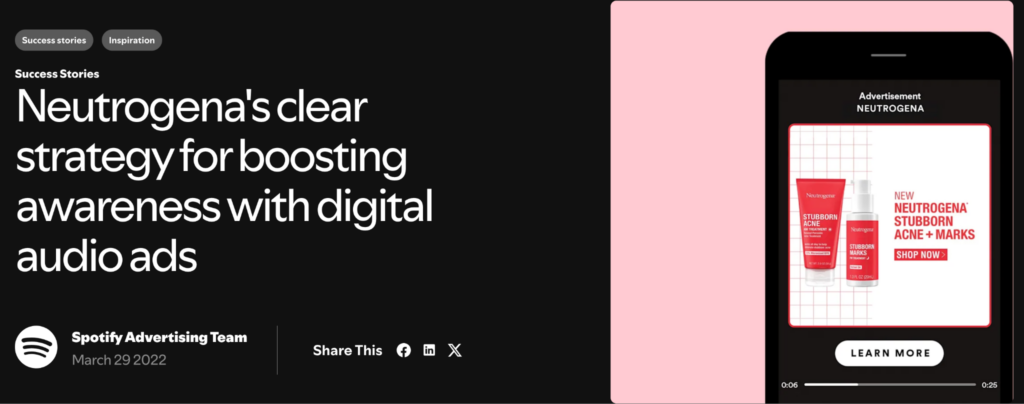
Source: https://ads.spotify.com/en-US/inspiration/neutrogena-case-study/
That campaign delivered a 40% lift in brand awareness, reached 2 million unique listeners, achieved a 15% click-through rate on display ads, and generated a 32% uplift in purchase intent for the Stubborn Acne + Marks product line, according to the source above.
Speaking of digital marketing, we should mention AI-powered ads. Perhaps nowhere is Neutrogena’s digital ambition more apparent than in the Skin360 ecosystem.
As you may know, it is a fully software-based AI-driven skin analysis and recommendation engine. The current Skin360 experience uses a smartphone selfie to analyze over 100,000 skin pixels across more than 2,000 facial attributes, assessing eight specific skin indicators: hydration, smoothness, even skin tone, radiance, firmness, dark spots, wrinkles, and clarity.
At the heart of the app is NAIA™ (a.k.a. Neutrogena’s AI Assistant) which combines skin analysis data with behavioral coaching to build an 8-week personalized skincare plan.
From a digital marketing perspective, Skin360 is brilliant because it generates first-party data at enormous scale. Every skin scan tells the brand something about a consumer’s skin concerns, lifestyle habits, and product needs. That data feeds directly into Neutrogena’s Salesforce Marketing Cloud audience segmentation.
Social Media Management: What Neutrogena Does Day-to-Day
YouTube remains central to Neutrogena’s digital advertising approach. The brand uses the platform architecturally, like pairing long-form storytelling with short, punchy Neutrogena ads in a format sequence designed to move consumers through the funnel.
This approach also supports retail social media strategies by driving viewers from video content toward product discovery and purchase.
On the other hand, one of the most crucial platforms in Neutrogena’s digital marketing mix is TikTok, which the company uses far more skillfully than the majority of its rivals. Not using standard TikTok Neutrogena advertisements; the company has established a true social commerce infrastructure on the platform.
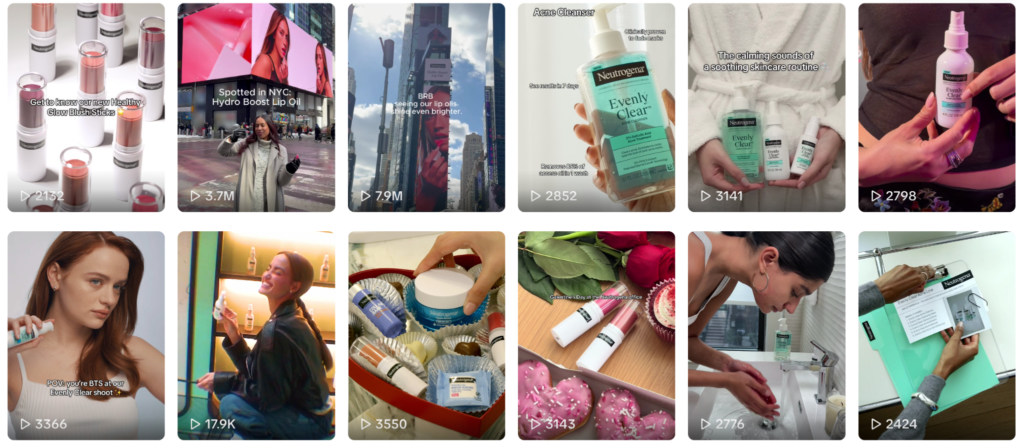
During Tate McRae’s Miss Possessive Tour, Neutrogena activated TikTok live-streaming directly from McRae’s channel, embedded Hydro Boost into her Brand Showcase, and drove purchases through Neutrogena’s own TikTok Shop. All in a single coordinated activation.
As Mary Tomaschko, Director of Marketing at Neutrogena Megabrand, explained:
The goal was to not only show up during a live stream on Tate’s handle, but also integrate our products within her Brand Showcase and drive support behind our own Neutrogena TikTok shop.
What’s more, the brand’s TikTok strategy also leans heavily on the “dermfluencer” tier: dermatologists and skincare professionals with massive followings who create authentic educational content about ingredients, routines, and results.
What about Instagram? On that platform, Neutrogena’s digital marketing strategy operates on several levels at once. Polished brand content (like product launches, ambassador features, clinical claims illustrated beautifully) sits alongside user-generated content reposts, creator collaborations, and Reels that punch into trending audio formats.
Let’s be more specific: Instagram Reels have also become a key distribution channel for shorter Neutrogena ads and product content, particularly for younger demographics who engage heavily with short-form video.
In terms of organic reach, creator-generated content (like skincare regimens, beauty tutorials, and “get ready with me” videos showcasing Neutrogena products) performs better than traditional brand-produced content.
Neutrogena Marketing Campaigns: What Actually Happened
Let’s look at the campaigns that show Neutrogena’s marketing strategy in action.
What’s remarkable here is the sheer variety; you can see serious documentary content, WWE-inspired comedy, concert activations, or Super Bowl commercials…
Campaign 1: Power of Light (2017)
This campaign for the Light Therapy Acne Mask was Neutrogena’s first digital-first U.S. product launch and a genuine turning point for the brand.
The creative ecosystem included a hero video and a six-second bumper ad starring actress Olivia Holt, co-branded “acne hacks” and “beauty hacks” content with YouTube influencers, and consumer testimonial videos.
The campaign’s lead creative line was sharp, memorable, and perfectly suited to short-form video:
Turn the light on, turn acne off.
The media framework of Google Preferred, TrueView, and bumper ads, mapped directly to the consumer funnel. Neutrogena tripled its digital investment and delivered a 5X lift in ad recall and a 13X lift in product awareness compared to the Johnson & Johnson portfolio average, according to the Think with Google document.
Campaign 2: Tate McRae — “Hydrating Like Tate” (2025)
When Neutrogena named Canadian pop star Tate McRae as its Global Brand Ambassador in early 2025, the announcement alone generated $792,000 in media impact value within a single week.
But this was never just a celebrity face swap. The campaign was designed to travel across every platform and real-world touchpoint imaginable. The hero TV spot, called “Metaphor,” is a genuinely funny piece of work.
That Neutrogena ad ran as a Super Bowl LX spot; however, it didn’t stop at the TV screen. Neutrogena’s “We’re Hydrating Like Tate” messaging ran across winter sports and the Milan Cortina Winter Games window, tying Hydro Boost’s hydration story to the cold, dry-skin conditions of winter athletes.
McRae’s cultural reach was so significant during this period that her appearance in a separate NBC Olympics ad promoting Team USA and the Super Bowl went viral, sparking a public debate in Canada about national loyalty.
The Ambassador partnership also extended into McRae’s Miss Possessive Tour, with in-venue brand activations, on-stage product integration, TikTok live shopping, and the sampling of 7,000+ Hydro Boost products at her Kia Forum show.
Campaign 3: John Cena — “Sunscreen You Can’t See” (2025)
If you need a Neutrogena campaign to prove that it has fully embraced the art of meme-driven, culturally intelligent marketing, this is it.
Launched on March 31, 2025, the “Sunscreen You Can’t See” campaign introduced the Neutrogena Ultra Sheer Face Liquid Mineral Sunscreen SPF 70 by partnering with WWE Superstar and actor John Cena. As you may be aware, Cena is well-known for his legendary “You Can’t See Me” catchphrase, which is one of the most popular phrases in internet culture.
“Turns out John Cena did show up…but just like our sunscreen, we can’t see him.”
The campaign extended well beyond the TV spot. Neutrogena used the launch to activate as the official sun care sponsor of Coachella and Stagecoach Festival, providing free sunscreen stations for festival-goers.
Campaign 4: Joey King — Evenly Clear (2026)
Announced in February 2026, Neutrogena’s newest global ambassador campaign marks one of the smartest retail marketing campaigns & pieces of target market expansion.
Joey King, “The Kissing Booth” star fronted the launch of Evenly Clear, the brand’s first-ever acne collection formulated specifically for adults.
The collection was co-designed with the brand’s global innovation partners Dr. Dhaval Bhanusali and Dr. Muneeb Shah, along with a wider community of dermatologists.
As for the campaign creative; it’s fun. The Neutrogena ad features King playing a game show host alongside Dr. Bhanusali, making the “adulting and acne” conversation feel playful and relatable rather than clinical and embarrassing.
King’s appointment follows ambassador announcements like Tate McRae, Nicola Coughlan, and Hailee Steinfeld. All aimed at reaching young women who are culturally connected and open about their skin (Gen Z targeting!)
Campaign 5: Neutrogena Studios — “In the Sun” Documentary
Less of a traditional Neutrogena advertisement, and more of a content marketing play, Neutrogena collaborated with Neutrogena Studios to produce a short documentary called “In the Sun” focused on driving behavior change around sun protection and raising awareness of skin cancer risk.
It’s exactly the kind of purpose-driven content that builds long-term trust with consumers.
FAQ about Neutrogena Marketing
What is Neutrogena’s marketing strategy?
Neutrogena’s marketing strategy focuses on trust, science, and accessibility. The brand highlights its “#1 dermatologist-recommended” positioning while supporting it with strong retail presence and a growing digital ecosystem. Through celebrity ambassadors, dermfluencers, programmatic ads, and social commerce, Neutrogena guides people from discovery to repeat purchase. Rather than chasing every trend, the brand focuses on credibility—helping it stay relevant with longtime customers and younger audiences alike.
Who is Neutrogena’s target market?
Neutrogena’s primary target market is women aged 18–49 who care about effective, accessible skincare, but the brand deliberately casts a wider net; actively pursuing teenagers dealing with acne, men seeking simple routines, mature adults focused on anti-aging and sun protection, and people with sensitive skin who need dermatologist-approved formulas.
How does Neutrogena position itself in the skincare industry?
Neutrogena occupies a carefully defended “mass-premium” position. It means that it is accessible enough to sit on shelves at Walgreens and Target, but priced and presented with enough clinical authority to feel meaningfully above store-brand alternatives. Its core positioning idea is that effective skincare shouldn’t require a dermatologist’s price tag: the brand brings dermatologist-grade formulations and endorsement to everyday consumers at everyday prices.
What channels does Neutrogena use in its advertising strategy?
Neutrogena runs a true multi-channel advertising strategy. The brand appears across YouTube, TikTok, TikTok Shop, Instagram Reels, and creator content, while also using programmatic ads powered by AI and first-party data. It extends beyond social media with connected TV, Spotify audio ads, major moments like the Super Bowl, festival activations such as Coachella, and strong eCommerce content across retailer product pages.
How does Neutrogena differentiate its products from competitors?
Neutrogena differentiates both through product formulation and its entire system of value delivery; actually, the brand’s marketing approach has historically resembled a pharmaceutical company more than a typical soap maker. Where competitors compete on the same parameters, Neutrogena creates new categories entirely, as it did with the Light Therapy Acne Mask, and addresses unmet needs others ignore, as it did with the adult-specific Evenly Clear acne line. The combination of clinical validation, proprietary technology (MicroClear, BarrierCare, AI-powered Skin360), and dermatologist co-development makes imitation structurally difficult.
How does Neutrogena use dermatological credibility in its marketing?
Dermatological credibility is the structural backbone of the brand’s entire marketing strategy. The brand maintains active relationships with dermatologists through its clinical sales force, co-develops products with partners like Dr. Dhaval Bhanusali and Dr. Muneeb Shah (who has over 17.7 million TikTok followers). The brand also embeds dermatologists as co-stars in major Neutrogena commercials like the Super Bowl LX “Metaphor” spot, and uses doctor endorsements throughout its Neutrogena ads and product packaging.
How has Neutrogena adapted its marketing for digital and social media platforms?
Neutrogena has made a dramatic shift from TV-dependent Neutrogena commercial strategy to a fully integrated digital ecosystem. The transformation began in earnest in 2017 with the first-ever digital-first U.S. product launch (the Light Therapy Acne Mask). Since then, the brand has built out TikTok live-shopping infrastructure, deployed AI for personalized programmatic Neutrogena ads, activated connected TV through Roku, invested in Spotify audio advertising, launched the Skin360 AI skin analysis app with 2.5 million possible personalized product recommendations, and shifted ambassador strategy toward culturally embedded partnerships that generate organic social conversation rather than just paid reach.