













Godiva Advertising Campaigns: Marketing the Art of Gifting
Godiva advertising is one of the most fascinating long-running case studies in branding. Before we get into strategies, numbers, and campaigns, let’s start with something most people already know without realizing it: if you close your eyes and picture a gold box of chocolates tied with a ribbon, you’re already experiencing the power of Godiva’s brand.
That kind of brand recognition doesn’t happen by accident. It takes decades of consistent and often brilliantly executed advertising and marketing decisions.
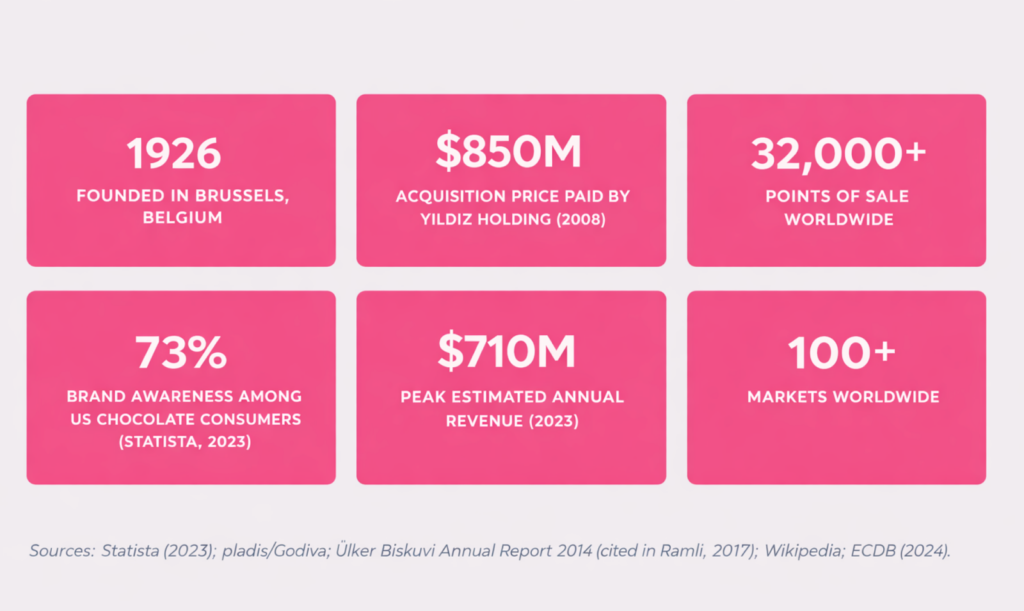
And it takes the willingness to evolve; to go from TV spots to multimillion-dollar campaigns with Hollywood stars, from airport boutiques to 32,000 retail touchpoints around the world.
In this deep-dive blog, I’m going to break down the full Godiva marketing strategy; its advertising campaigns, SWOT analysis, 4P marketing mix, target audience, social media management, digital marketing approach…
So let’s go, from Brussels, with gold.
Inside Godiva Advertising
- Godiva Target Market: Who Are They Actually Selling To?
- The 4P Marketing Mix: How Godiva Thinks About Its Business
- Godiva SWOT Analysis: The Honest Picture of Brand Position
- Godiva Advertising Campaigns: The Greatest Hits
- Digital Marketing Management: How Godiva Wins Online
- FAQ about Godiva Advertising
Godiva Target Market: Who Are They Actually Selling To?
Today, Godiva operates across 100+ markets, with its biggest commercial presence in the United States and China. Its major competitors in the premium segment include Lindt & Sprüngli, Ferrero Rocher, and an ever-growing wave of artisan craft chocolatiers.
But in the global chocolate hierarchy, Godiva’s brand recognition remains extraordinary, in consumer surveys, it ranks among the top four most familiar and favorable chocolate brands worldwide, with 68.7% favorable votes on the Ranker consumer platform.
Let’s be more specific:
This is actually a chocolate brand; however, I cannot say it is for “kids.”
Godiva target audience is adults aged 25–55, skewing slightly female, with disposable income and an appreciation for elevated experiences. These are consumers who view chocolate as an emotional act: a gift, a luxury treat, a marker of good taste.
They buy Godiva for Valentine’s Day, Christmas, Mother’s Day, corporate gifting, and special occasions. That’s why the brand teams up with well-known names for special day ads; remember its collaboration with Leighton Meester for the 2026 Valentine’s Day campaign:
However, since around 2021-2022, Godiva has been on a deliberate mission to expand its target audience to include younger consumers, millennials and Gen Z, who want premium treats for everyday moments, not just special occasions.
This repositioning is literally embedded in the taglines of these campaigns:
- “Godiva is Chocolate”
- “Godiva is Whenever You Need Chocolate Chocolate”
- “Godiva is Buy It As A Gift, Or Keep It For Yourself Chocolate.”
These aren’t subtle messages. They’re explicit invitations to buy Godiva outside of gifting contexts.
What about geographic targeting?
The United States is Godiva’s largest and most important market. (The US premium chocolate segment is expected to grow at 5.5% CAGR through 2034. These are the waters Godiva needs to own more of.) China is the most strategically exciting growth market.
The 4P Marketing Mix: How Godiva Thinks About Its Business
If you studied marketing at any point, you know the 4Ps: Product, Price, Place, Promotion. Let’s apply each to Godiva and see what the brand’s choices reveal about its advertising strategy.
👉🏻 The First P: Product
Godiva’s product strategy is built on the iron principle that quality is non-negotiable.
The portfolio includes the Classic Gold Collection (the iconic gift assortment), Masterpieces (artfully crafted chocolates with indulgent fillings), Chocolate Domes (three textured layers of sensory pleasure), Signature Mini Bars (eight individually wrapped bars for on-the-go occasions), and café offerings including beverages and pastries.
The key strategy is to diversify without diluting. It means that newer CPG formats at lower price points coexist with the luxury gold box, serving different purchase occasions without undercutting each other.
👉🏻 The Second P: Price
Godiva is unapologetically premium-priced.
A Classic Gold Collection 12-piece box typically retails between $20 and $35. The 18-piece box can reach $36 or more. The Signature Mini Bar pack offers an entry point of $5–$8.
So, yes, Godiva is classified as “highly priced” alongside Lindt and Ferrero Rocher.
And yet demand remains strong.
Because country-of-origin perception (Belgian heritage = superior quality) enables the brand to charge premiums that mass-market competitors cannot. This pricing strategy is sound: it broadens entry without weakening the premium tier.
👉🏻 The Third P: Place
Godiva’s distribution strategy is an omnichannel powerhouse.
It started with branded boutiques (maintaining the jewelry-store-for-chocolate feel). Over the last decade, the brand has evolved this into a hybrid “accessible luxury” placement model. Today, Godiva products are available not just in boutiques but also through supermarkets, fine retailers, online marketplaces, and club stores globally. It’s dramatically widening reach while maintaining premium cues in packaging and pricing.
It’s a part of the brand’s “Godiva is Chocolate” campaign. Highlighting that, Godiva Global CEO Nurtac Afridi stated as follows:
This campaign signals an important expansion of the Godiva premium-ness to the global marketplace with exciting, relatable, creative concepts that help position our iconic brand as part of our consumers’ daily lives.
👉🏻 The Fourth P: Promotion
Another thing that transformed dramatically in Godiva’s marketing mix is its promotion strategy.
It evolved from slow-motion luxury ads (sensory, aspirational, candlelit) to multi-channel, humor-forward, celebrity-voiced campaigns designed for full-funnel reach.
As I stated above, instead of chasing mass-reach FMCG tactics, Godiva builds campaigns around key emotional purchase moments like Valentine’s Day, Mother’s Day, Eid, Christmas, and Lunar New Year.
In recent years, the brand has layered in more digital-first promotion to stay relevant with younger audiences. Especially across Instagram, TikTok, and e-commerce platforms.
You’ll see Godiva collaborating with lifestyle creators, launching social-media-friendly packaging, and using short-form video to position its products as “self-care treats” rather than formal gifts.
Godiva SWOT Analysis: The Honest Picture of Brand Position
Even the world’s most iconic chocolate brand has vulnerabilities. Here’s a SWOT analysis of Godiva:
Strengths
- Nearly 100-year Belgian heritage (The world’s most trusted origin story for premium chocolate)
- Strong brand presence and consumer awareness among US consumers (Knowledge score: 80)
- 32,000+ global points of sale across 100+ markets
- Premium pricing power: $20–$35 per box remains aspirationally justified
- Dominant travel retail/airport presence (a high-margin, gifting-primed channel)
- Consistent top-tier global brand familiarity (68.7% favorable votes in global consumer ranking).
Weaknesses
- Heavy seasonal dependence: Sales heavily weighted toward Valentine’s Day, Christmas, Mother’s Day
- Premium pricing creates barriers during economic downturns (Godiva is priced close to artisan chocolatiers but offers a mass-produced product)
- No sub-brand diversification — unlike Ferrero Rocher (Nutella, Kinder, Tic Tac) or Cadbury (multiple brand lines)
- Smaller DTC brands are experimenting with vegan, low-sugar, ethically sourced, and functional chocolates (e.g., adaptogens, protein blends), while Godiva’s core range still feels traditional
- Low recent media buzz. Compared to craft chocolate startups or viral TikTok-native confectionery brands, Godiva lacks a strong presence in social-commerce ecosystems.
Opportunities
- China expansion (already the largest market outside US, with ongoing growth)
- De-seasonalization strategy, like unlocking everyday purchase occasions is a massive revenue opportunity
- eCommerce still has substantial headroom for growth in direct-to-consumer gifting
- Centennial anniversary (2026) — a once-in-a-century brand marketing moment
- Brand reset with new logo, packaging and Leighton Meester campaign positions brand for new era
- Social commerce on Instagram, TikTok, and Pinterest still largely untapped.
Threats
- Intense competition from Lindt & Sprüngli, Ferrero Rocher, and artisan craft chocolatiers
- Cocoa price volatility: cocoa prices hit record highs in 2024, squeezing chocolate industry margins globally
- Economic downturns push consumers toward lower-priced alternatives
- Growing craft/artisan chocolate segment challenging Godiva’s premium quality narrative
- Changing consumer preferences; demand for healthier, lower-sugar, functional foods or vegan & vegetarian options.
Godiva Advertising Campaigns: The Greatest Hits
If you look at Godiva’s advertising over the years, you’ll notice something interesting.
The tone changes, the faces change, the cities, the visuals, even the pace of storytelling changes.But the essence stays intact.
Godiva’s campaigns are actually a “training course” in how a premium FMCG brand can evolve its voice without losing its soul. And that’s not easy.
As you may know, these kinds of brands often face a tough balancing act while creating their food marketing campaigns: modernize too much and you drown out the heritage; cling too tightly to tradition and you fade into irrelevance.
Godiva has navigated that tension in fascinating ways, from cinematic heritage storytelling to globe-trotting culinary narratives to a bold, Hollywood-powered repositioning.
So instead of talking about “brand evolution” in theory, let’s make this practical.
Godiva — Wonderful City Dreams
2018 · Product Launch Campaign · London, New York, Tokyo, Shanghai, Brussels
I’m starting with a campaign that is a perfect example of Godiva advertising at its most inventive.
Actually, the “Wonderful City Dreams” collection was a limited-edition range created by five of Godiva’s master chef chocolatiers, each representing a city they personally call home: Tokyo (Chef Yannick Chevolleau, a caramel, orange and Yuzu milk chocolate ganache), New York (Chef Thierry Muret, a cheesecake mousse with crumble in blonde chocolate), Shanghai (Chef Philippe Daue, white chocolate ganache with lychee and roasted hazelnut nibs), London (Chef Jean Apostolou, strawberry ganache and white chocolate mousse with a hint of lavender), and Brussels (Chef Ilse Wilmots, the classic Godiva dark chocolate heart with caramel-hazelnut praliné).
The collection also launched with an experiential marketing activation in London: Godiva wrapped the city’s iconic red double-decker buses in bespoke gold branding and treated guests to a complimentary “Journey of Discovery” sunset dining tour through London’s most iconic landmarks — all while sampling the new collection.
What’s more, the packaging itself was a marketing statement (as you can see in the video): Godiva commissioned renowned French illustrator and comic artist Pénélope Bagieu to design a vibrant, landmark-filled skyline for the gift box. That of course transformed the product into a collectible.
Godiva Masterpieces — Wonder Awaits
2020s · Product Line Campaign · Masterpieces Collection
The Godiva Masterpieces line represents the brand at its most artisanal and premium. That line includes individual chocolates designed with the care of fine jewelry, featuring indulgent fillings and visually striking designs.
The “Wonder Awaits” campaign was crafted to communicate the sense of discovery and sensory anticipation that comes with unwrapping a Masterpieces chocolate.
This Godiva chocolate advertisement leans heavily into the experiential dimension of premium chocolate and says it’s about the feeling of anticipation.
The creative direction emphasizes craftsmanship and visual beauty. So much so that each chocolate piece is essentially a small work of art, and the advertising reflects that. The campaign speaks directly to consumers who see premium chocolate as a form of “self-expression.”
What’s more, the Masterpieces line is a cornerstone of Godiva’s product strategy for reaching consumers who want a step above the Classic Gold Collection.
Godiva Masterpieces — Chocolate Never Felt So Good
Ongoing · Sensory Campaign · Product Experience Focus
This is classic Godiva advertising in its most sensory, aspirational register. This campaign leans into the full physical and emotional experience of premium chocolate; the texture, the snap, the way a ganache-filled piece melts differently from a mass-market product.
Godiva chocolate advertisement strategies like this one work because they remind consumers exactly why $20–$35 for a box of chocolates makes emotional sense: it’s the price per moment of genuine pleasure.
On the other hand, this approach reflects a broader insight in Godiva’s marketing philosophy: the product should never be separated from the experience of the product. Packaging, advertising, point-of-sale: Everything should back up the idea that choosing Godiva is choosing to give yourself something genuinely special.
GODIVA Global 90th Anniversary Launch
2016 · Milestone Campaign · Global Travel Retail & Retail Rollout
Here is one of Godiva’s most strategically layered advertising campaigns of all time. I’m talking about a marketing act in which an official minister was included!
Launched back in February 2016 with a stunning multi-sensory celebration at the art deco Albert Hall in Brussels. Attended by 140 guests including Belgium’s then-Foreign Affairs Minister Didier Reynders, the campaign announced that Godiva was actively celebrating heritage and innovating from it.
The centerpiece product was the limited-edition Gold Anniversary Collection: eight of Godiva’s most iconic chocolates (one for each decade of the brand’s existence since 1926) plus a bold new creation, the Egérie Noir.
And, the social media component used the hashtag #Godiva90 across all platforms. In the United States, the 9-piece box retailed at $20 and the 18-piece at $36.
So, yes, this campaign is a textbook example of how milestone anniversaries can be turned into marketing moments.
The Godiva Giant Atelier Easter Egg 2017
2017 · Seasonal / Experiential Campaign · Easter
Let me continue with an experiential campaign of Godiva.
The Giant Atelier Easter Egg campaign combined product craftsmanship, experiential retail, and content marketing in a package that was literally giant… Designed to generate social sharing, press coverage, and a sense of wonder that no traditional TV spot could achieve with the same budget.
By making an Easter egg on a monumental scale, the brand turned what could have been an ordinary seasonal product launch into a conversation piece and a shareable moment. This is a form of earned media generation through craft storytelling.
Lady Godiva Returns: A Modern Masterpiece is Born
September 2025 · Centennial Brand Reset · With Leighton Meester
The most recent chapter in Godiva advertising history launched on September 30, 2025. As the brand prepares for its 100th anniversary in 2026, it launched a full brand reset campaign starring actress Leighton Meester, best known for her role in Gossip Girl, in the first-ever portrayal of Lady Godiva herself in the brand’s advertising history.
In a cinematic 60-second video, Meester navigates a web of alarm-linked lasers to break into an art museum, deposit Godiva chocolate, and admire a portrait of Lady Godiva before escaping on the legend’s iconic white horse.
The reset included a new logo (more cleanly integrating the Lady Godiva on horseback icon), modernized packaging, refreshed product offerings, and reformulations of select products.
The timing, synchronized with Netflix’s “Gossip Girl” streaming popularity and Meester’s upcoming romantic series, demonstrates how modern brand campaigns are now engineered around cultural moments.
Digital Marketing Management: How Godiva Wins Online
The first thing you notice in Godiva’s marketing strategy is that the digital ecosystem is structured around occasions, not products.
Search behavior, paid campaigns, landing pages, and merchandising are aligned to moments:
- Valentine’s Day
- Mother’s Day
- Lunar New Year
- Holiday gifting
Occasion-based search intent carries higher purchase motivation and stronger price elasticity. In other words, instead of competing on “best chocolate” keywords alone, the brand competes on “luxury Valentine’s gift” or “premium holiday gift box” intent clusters.
You may think that digital growth often pushes brands into price-led acquisition cycles. However, the Godiva advertising strategy avoids this trap by using seasonal launches to drive urgency and leveraging limited-edition collections
What about eCommerce?
The brand treats its website as a curated gifting engine. Key mechanics include pre-curated premium bundles, customizable gift boxes, and upsell prompts tied directly to occasion framing.
So, it is possible to say that the digital experience is engineered around higher-value purchases: gifts, celebrations, and limited-edition drops.
For food marketing agencies advising premium brands, this is the takeaway: eCommerce is a controlled brand environment where pricing power, perception, and performance strategy intersect.
Social Media Management of Godiva
Godiva’s social media management sits at an interesting intersection: the brand’s product is inherently visual and beautiful, which should make social easy. But premium brand social media is harder than it looks. Like, too much selling and you lose the aspiration; too much aspiration and you become irrelevant.
Here’s how Godiva navigates this across platforms.
Instagram: The Visual Flagship
Instagram is Godiva’s natural home.
Chocolate photography is a genre unto itself, and Godiva’s gold packaging, rich textures, and artisan product design were practically made for a visual-first platform.
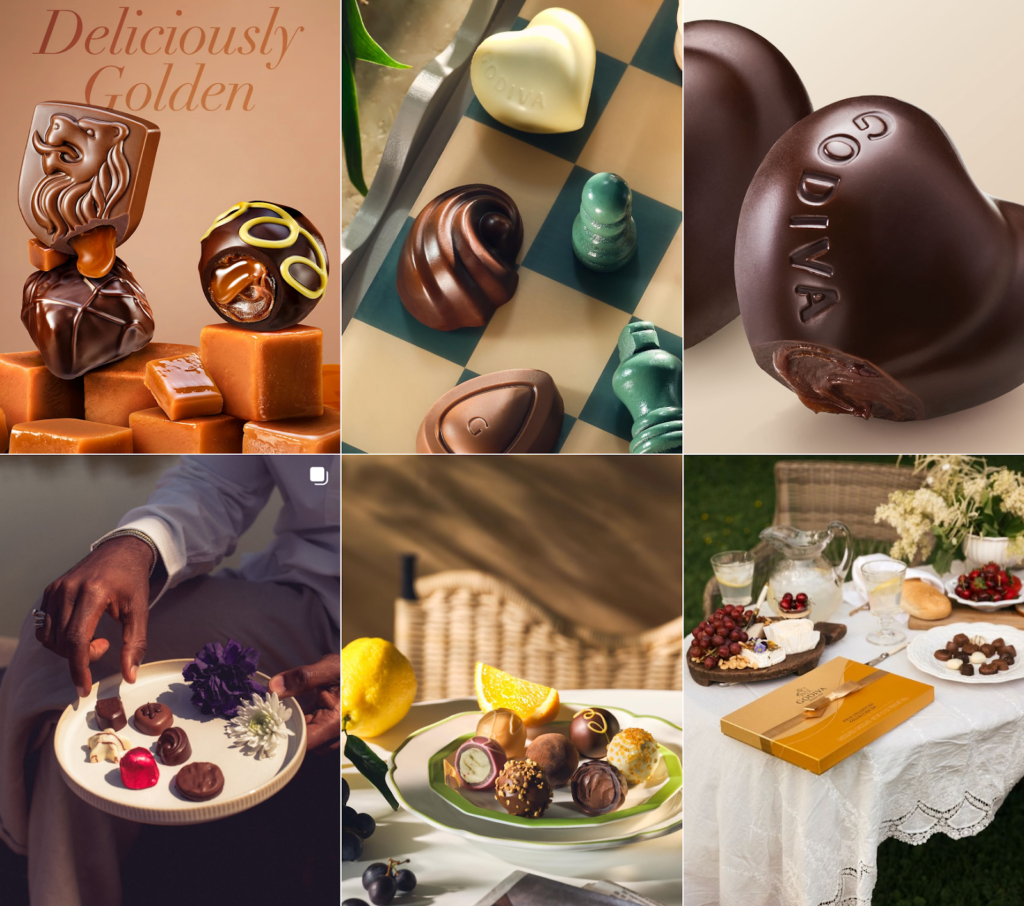
Source: https://www.instagram.com/godiva/
The brand’s Instagram strategy focuses on product showcasing with premium aesthetics, seasonal campaign assets (Valentine’s Day and Christmas content is hugely important to the business), behind-the-scenes chocolatier content reinforcing the artisan narrative, and lifestyle imagery showing Godiva integrated into aspirational moments.
The “Godiva is Chocolate” campaign explicitly named Instagram as a core media channel, running campaign assets and spots natively on the platform. The 2025 “Lady Godiva Returns” campaign added influencer activations to the mix.
Facebook: The Gift-Giver’s Platform
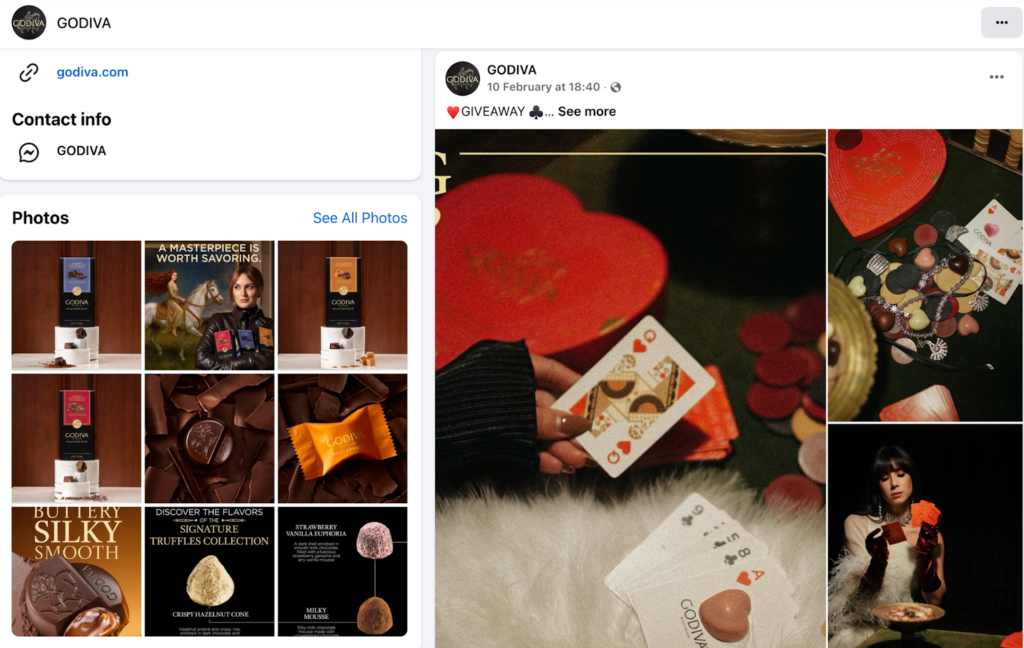
Despite its aging reputation among younger demographics (especially GEN Z), Facebook remains strategically critical for Godiva because its core gifting audience (35–55, higher income) is still highly active there.
Godiva uses Facebook for seasonal gifting promotions, ad retargeting (reaching people who’ve visited godiva.com or engaged with previous campaign content), and community building.
TikTok and Social Commerce: The Frontier
Premium food content on TikTok performs extraordinarily well, you know, chocolate-making videos, product reveals, sensory ASMR content, and gift-box opening content all generate organic engagement.
When you look at Godiva on TikTok, you can see that this isn’t a platform where the brand dominates in scale. Compared to viral beauty brands, snack disruptors, or creator-led food startups, Godiva’s follower count is relatively modest.
As you may know, luxury brands often struggle on TikTok because the platform thrives on imperfection. The “polished European chocolatier” aesthetic doesn’t automatically translate into scroll-stopping short-form content. While brands like Duolingo or Ryanair lean into absurd humor and chaotic self-awareness, Godiva has largely stayed within safe, visually refined content formats.
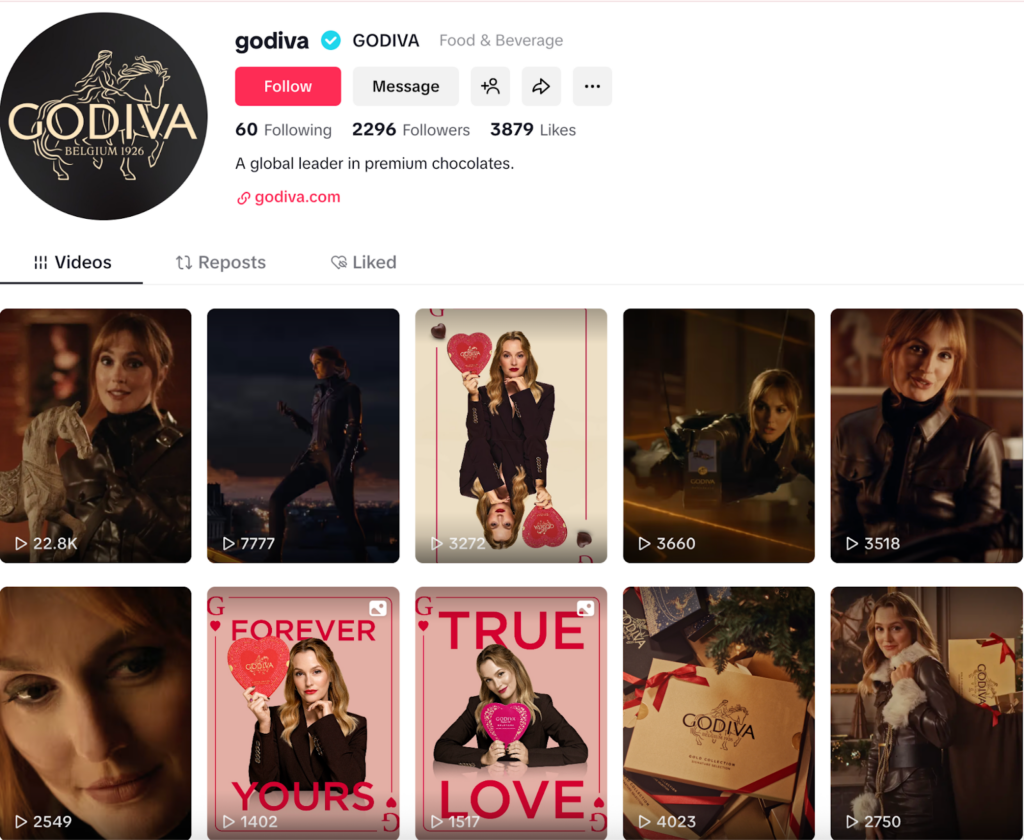
Source: https://www.tiktok.com/@godiva?lang=en
FAQ about Godiva Advertising
What is Godiva’s marketing strategy?
Godiva’s marketing strategy includes advertising campaigns that highlight its Belgian heritage, premium ingredients, and elegant packaging. It positions the brand as an affordable indulgence rather than just another chocolate bar. Over the years, Godiva has balanced exclusivity with accessibility, selling through upscale boutiques and gifting channels while also expanding into supermarkets and e-commerce to reach a broader audience. Its campaigns focus heavily on emotion, romance, and gifting occasions. Digitally, the brand invests in social media storytelling, seasonal launches, and visually rich content that highlights craftsmanship and luxury. In short, Godiva markets a premium experience wrapped in heritage, emotion, and beautifully designed boxes.
Who is Godiva’s target market?
Godiva’s traditional core customer is an affluent adults who treats premium chocolate as a gifting experience; think someone who wouldn’t think twice about spending $30 on a beautifully packaged box for a colleague’s birthday or a romantic occasion. But the brand has been actively expanding that definition since 2022, using campaigns like “Godiva is Chocolate” to court younger millennials and Gen Z consumers who want a premium everyday treat. In geographic terms, the US remains the largest market, with China the most exciting growth frontier.
How does Godiva position itself in the luxury chocolate market?
The Belgian founding story, the gold packaging, the boutique retail environments, and the consistently premium price point all signal this is not ordinary chocolate. But unlike pure luxury brands that keep themselves deliberately out of reach, Godiva has expanded into airports, supermarkets, and eCommerce, making the brand findable without making it feel cheap. The positioning essentially says, “You deserve something genuinely special, and we’ve made it easy for you to get it.”
What makes Godiva’s advertising strategy different from other chocolate brands?
What sets Godiva’s advertising apart is that it almost never leads with the product; but with the feeling. While competitors like Hershey lean on nostalgia or Lindt uses sensory slow-motion aesthetics, Godiva consistently tells a story: a centuries-old legend, a globe-trotting chocolatier, a woman breaking into a museum to leave someone chocolate. The brand also invests in creative work that is genuinely cinematic and built for the platform it lives on. That combination of emotional storytelling and platform-smart execution is what makes Godiva advertising feel like a different category from standard confectionery marketing.
What are some of Godiva’s most successful advertising campaigns?
Godiva’s modern advertising journey can be traced back to its 2016 90th Anniversary campaign, where the brand transformed a milestone into a global celebration with limited-edition collections designed by Belgian artist Oli-B. By 2022, the tone became more assertive with the multimillion-dollar “Godiva is Chocolate” campaign, a full-funnel push across OTT, social media, digital, and out-of-home that repositioned the brand with confidence and scale. Most recently, the 2025 “Lady Godiva Returns” campaign, starring Leighton Meester, reintroduced the iconic Lady Godiva figure for the first time in the brand’s advertising history. It’s also setting the stage for Godiva’s 100th anniversary in 2026 with its most ambitious campaign to date.
How does Godiva use emotional branding in its chocolate advertisements?
Godiva’s emotional branding strategy rests on that: “People don’t buy premium chocolate, they buy what it means.” The Lady Godiva legend is a story of generosity and courage, which is always the emotional undercurrent in the advertising even when it isn’t stated directly. Campaigns like “Wonder Awaits” use love-story narratives, the Wonderful City Dreams collection frames chocolate as a form of cultural exploration, and the Giant Atelier Easter Egg turns craftsmanship into emotional spectacle. The consistent message across all of it is that choosing Godiva is a meaningful act.
How has Godiva adapted its marketing strategy for digital and global markets?
Godiva has shifted from relying on boutique stores to embracing a more digital, global mindset. After closing many physical locations, the brand doubled down on eCommerce, retail partnerships, and social media storytelling to stay visible and accessible. It creates visually rich, gift-focused content for platforms like Instagram and adapts products and campaigns to fit local tastes (especially in fast-growing Asian markets) while highlighting its Belgian heritage. In simple terms, Godiva evolved from a mall-based luxury chocolate brand into a more agile, digitally driven global player.