












Is the Uniqlo Marketing Strategy Anti-Marketing? The Campaigns & Advertising Revealed
Uniqlo marketing strategy comes into sharp focus when we look at a fashion industry obsessed with fleeting trends, celebrity endorsements, and high-velocity fast fashion; Uniqlo stands as a strategic anomaly.
While competitors (including Zara, Mango, Bershka, SHEIN, and more) battle for viral fame with disposable garments, this global brand quietly champions simplicity.
The real question, then, is not whether Uniqlo invests in marketing or advertising, but whether its conscious refusal to follow industry conventions is, in itself, a highly calculated form of anti-marketing.
In this piece, we take a closer look at Uniqlo’s marketing strategy. We walk through the brand’s marketing mix, unpack its SWOT analysis, and examine how Uniqlo manages social media and executes campaigns in a way that stays true to #LifeWear. Along the way, we show how this long-term philosophy naturally filters out trend-chasing consumers and resonates with those who value function; ultimately shaping the brand’s approach to marketing, advertising, and sustained growth.
Table of Contents
-
- Why This Uniqlo Marketing Strategy Analysis Is Different
- What is Anti-Marketing?
- Uniqlo Marketing Mix – The 4Ps
- SWOT Analysis of Uniqlo
- Market Segmentation of Uniqlo
- Uniqlo Marketing Strategy & Advertising Campaigns
- Uniqlo Advertising Strategy: Why It Doesn’t Look Like Advertising
- FAQ about Uniqlo Marketing Strategy
Why This Uniqlo Marketing Strategy Analysis Is Different
Most articles about Uniqlo marketing focus on what the brand does, as you already know. Like campaign highlights, seasonal collaborations, or quick info on social media usage. That kind of coverage is useful, but it often stops at the surface for marketers and brands. Our analysis deliberately goes further.
Here, we’re not reviewing individual campaigns in isolation or listing tactics for the sake of it. But, looking at Uniqlo’s advertising as a system. The thinking behind its decisions matters more than the decisions themselves.
This perspective brings together three layers that are rarely connected in one place:
- First, we lean on brand strategy theory, like anti-marketing and contra-signalling, to explain why Uniqlo’s restraint is strategic.
- Second, we drew on examples from across the fashion industry to show what typically happens when brands prioritise visibility, speed, and cultural relevance
- And third, we ground the analysis in statements from Uniqlo leadership and official brand materials. So the conclusions reflect how the company actually thinks about its role in the market.
In other words, this marketing analysis isn’t about cataloguing touchpoints or applauding creative executions. Actually, this analysis is designed to help marketers, brand leaders, and teams running fashion brands and advertising see the strategic logic. So you can understand not just why Uniqlo’s choices keep working, but how similar principles can be applied to build durable differentiation and sharper positioning.
Let’s start now.
What is Anti-Marketing?
In today’s market, every brand is constantly shouting “buy me,” “apply now,” or “try me,” no doubt. In that environment, what if the best strategy was to tell some people no?
Anti-marketing is actually about it. It’s a counterintuitive approach that focuses on discouraging the wrong audience to better attract the right one.
That marketing strategy is the deliberate act of identifying who your company doesn’t want as a customer (the Negative Persona) and then using clear, honest messaging (Contra-Signalling) to help those people opt out early.
The goal is to manage demand, save resources, and ensure your limited marketing efforts are focused only on those who are a perfect fit.
Let’s see a simple example of anti-marketing:
In case your company & brand sells subscription-based collaboration software that requires mandatory team licenses, administrator setup, and reliance on customer support, your marketing messaging would constantly emphasize:
- Built for seamless team integration
- Requires mandatory use of official support channels
- Your success is tied to your team’s adoption
This clearly signals: “If you’re a lone-wolf user who won’t follow rules or use support, this software will frustrate you and you won’t like it.”
While Uniqlo’s marketing strategy is “Made for All” (a concept that initially sounds like the opposite of anti-marketing), they absolutely employ several tactics that function as anti-marketing to repel certain segments of the audience.
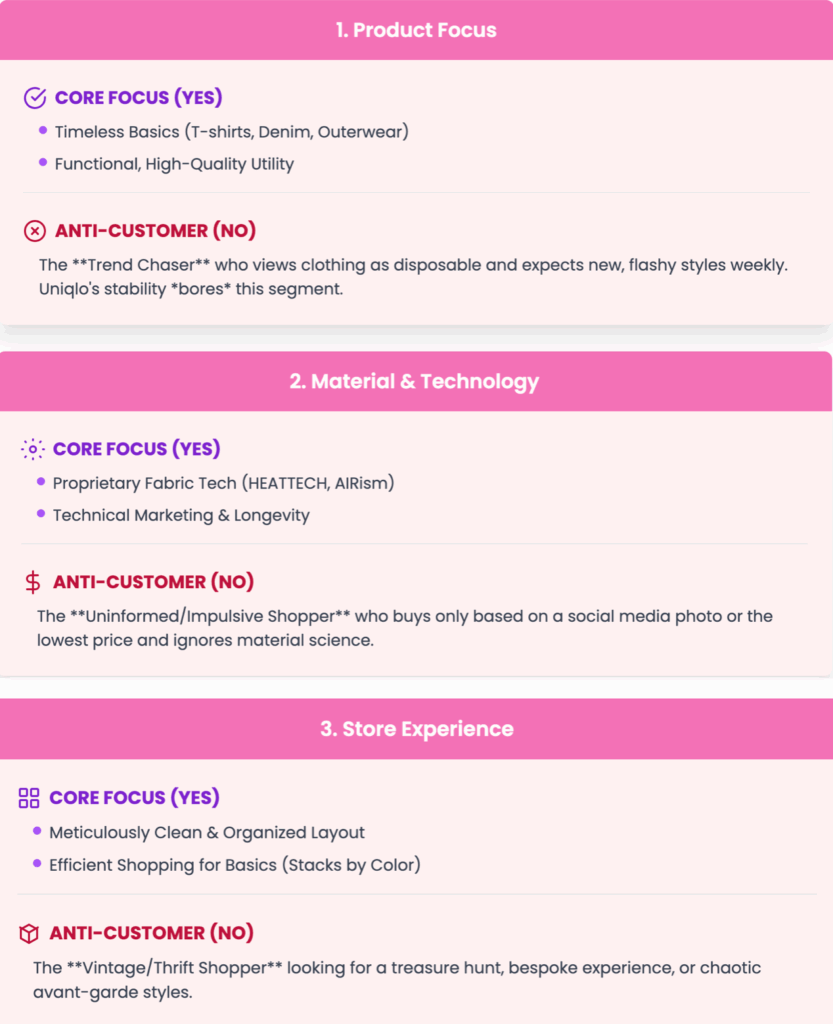
For instance, the brand “always” rejects the “fast fashion” negative persona. They use contra-signalling to reject the customer persona who is obsessed with micro-trends, disposable clothing, and low-quality items.
On the other hand, Uniqlo’s marketing strategy includes explicit statements against the fast fashion industry itself. Uniqlo’s parent company CEO, Tadashi Yanai, said in a statement:
We don’t chase trends. People mistakenly say that Uniqlo is a fast-fashion brand. We’re not. We are about clothing that’s made for everyone.
By constantly promoting their products as “simple, essential yet universal,” they are explicitly saying their clothes are not for the customer looking for a fleeting, unique, or complicated fashion statement.
Finally, while Uniqlo is often cited for “affordable prices,” their high-quality fabric and functional innovation (HEATTECH, AIRism) allow them to maintain a higher, more stable price point than ultra-low-cost competitors like Shein.
This pricing strategy acts as a filter:
- It’s affordable enough for the mass market – “Made for All”
- It’s expensive enough to repel the Hyper-Price Shopper (the negative persona who only buys the absolute cheapest item, regardless of quality).
Inspired by Uniqlo’s Strategy? Your Brand Can Stand Out Too.
With the right creative partner, marketing stops feeling like marketing. We dug into the case studies, and what stood out wasn’t loud campaigns or trend-chasing—it was restraint.
So, we now know that Uniqlo is one of the top brands that nail anti-marketing. Let’s learn more about Uniqlo’s marketing strategy and advertising campaigns.
Uniqlo Marketing Mix – The 4Ps
Uniqlo’s remarkable success isn’t built on fleeting trends, as we mentioned above. But, it’s anchored in the 4 Ps. By operating as a specialty retailer of Private-label Apparel (SPA), Uniqlo controls every step from design to sale, giving it unparalleled control and consistency. Let’s be more specific:
👚Product:
Uniqlo’s product strategy & collections emphasize timeless, high-quality basics, like simple t-shirts, quality denim, and functional outerwear. This deliberate simplicity repels the “Trend Chaser” negative persona.

Source: https://www.uniqlo.com/us/en/
When it comes to technological IP, the brand invests heavily in proprietary material technologies, making their products functional innovations: HEATTECH, AIRism, Dry Ex, and ULDs (Ultra Light Downs).
And as a great number of fashion brands do, Uniqlo also promotes itself as a company that focuses on sustainability at a high level as a part of its product strategy.
UNIQLO exists to improve the lives of our customers and local communities. We create simple, high-quality clothing that lasts using practices that prioritize people, the planet, and society.
💲Price:
Uniqlo aims for affordable pricing that reflects the high quality and advanced technology in its products. That positions them as an exceptional value-for-money proposition.
As we stated before, the pricing strategy of Uniqlo is set to be accessible across a wide demographic, aligning with their “LifeWear for all” philosophy. For example, the spring/summer collection prices ranged from $5.90 for kids/babies up to $69.90 for men’s items.
So, yes, it’s affordable enough for the everyday shopper, but high enough to filter out the hyper-price-sensitive customers who only seek the absolute cheapest, lowest-quality items. This focus on value aligns with the core need of customers who prefer value-for-money purchases, not cheap buys.
🌐Place:
Uniqlo exercises control over the entire supply chain, which ensures consistent quality and efficiency across its distribution channels.
The brand’s distribution is supported by a massive global retail presence, boasting more than 2,000 stores in 21 countries.
What’s more, their sales strategy is entirely omni-channel, merging the physical experience with e-commerce. The brand drives customers to its online channels, such as Uniqlo.us, while using key physical locations like the Uniqlo NY or Tokyo stores for promotional activities.
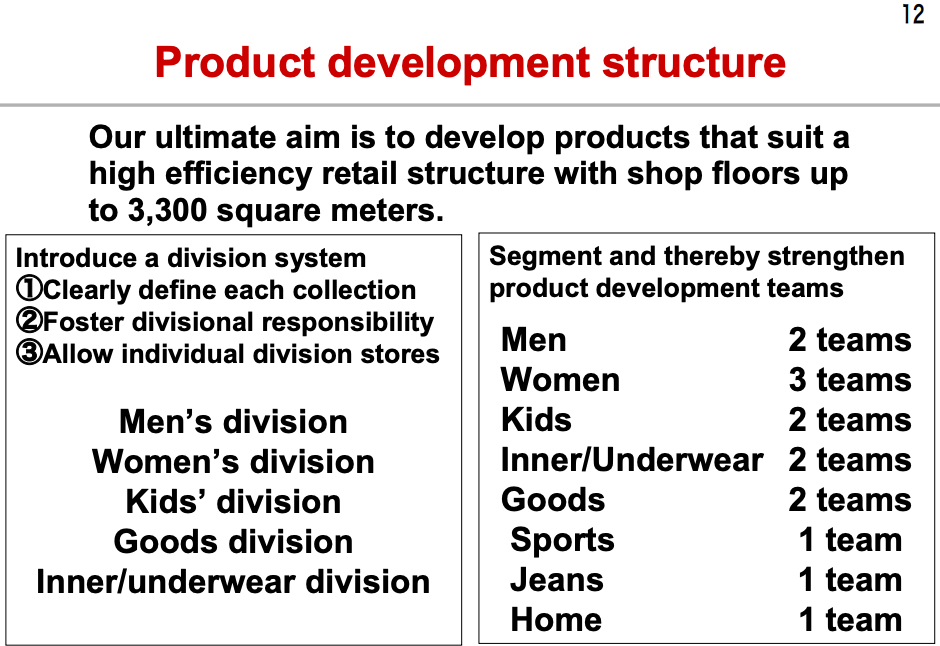
In the paper titled “FAST RETAILING’s New Business Strategy,” store placements & teams are explained as follows:
📢 Promotion
Uniqlo’s promotional efforts are highly targeted and digitally focused. In other words, Uniqlo advertisement uses an integrated marketing approach, combining sales promotion and public relations. While doing so, the ultimate goal is to increase brand awareness and promote the quality and functionality.
As you can see on the brand’s online channels, promotions heavily feature proprietary fabrics like HEATTECH and AIRism. The communication often explains how the clothing improves daily life; it prioritizes functional benefits over transient style.
Speaking of online channels; Uniqlo uses Instagram, Facebook, TikTok, and its official websites to create consistent promotion with its biweekly deals and content drops.
As a part of its marketing strategy, the brand engages in selective partnerships, such as the collaboration with HYPEBEAST, to catch a niche audience interested in contemporary design and culture. They also partner with figures like The Stauffer Family to universally promote the “LifeWear for all” message.
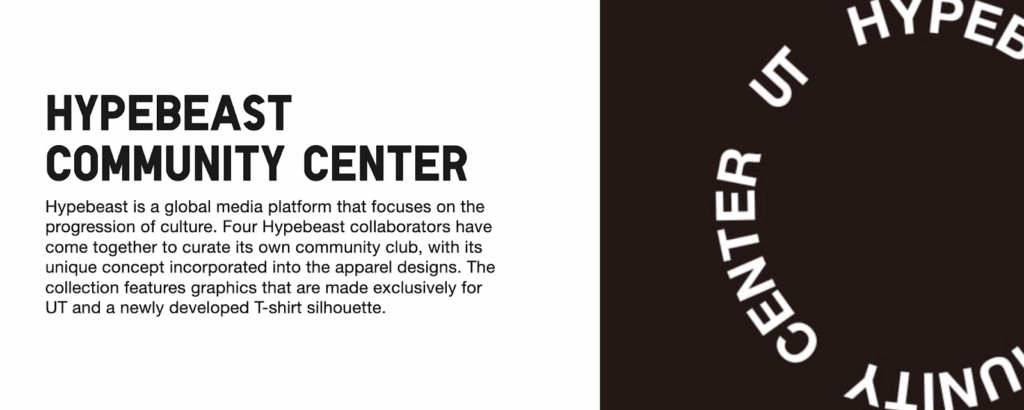
Source: https://www.uniqlo.com/my/en/spl/ut/hypebeast-community-center
And, the physical retail space is also a key promotional tool. Stores are designed to be spacious and highly organized, allowing the products and their functional features to take center stage.
SWOT Analysis of Uniqlo
A SWOT analysis of Uniqlo is essential for understanding the strategic position of the company: Its internal strengths and weaknesses alongside external opportunities and threats.
💪Strengths
- Uniqlo’s primary strength is its proprietary, high-tech fabric technology. These fabrics offer unique functional value and longevity, which makes the product itself the most powerful marketing tool, justifying its price point.
- The brand offers its customers strong cost control ability. It is easy for consumers to compare commodity prices online. And, as marketers already know, the cost advantage is the embodiment of competitiveness.
- Uniqlo controls the entire supply chain, from raw material procurement and design to manufacturing and final retail. This control allows for faster response to inventory needs and provides significant cost efficiencies.
- The conscious focus on simple, essential basics (the “anti-marketing” effect) provides stability. This strategy reduces the high inventory risk associated with chasing ephemeral fast fashion trends and appeals to a broad audience.
- Uniqlo has the substantial financial capital necessary to invest aggressively in R&D, advanced supply chain technology, and costly global flagship store expansion.
🤏Weaknesses
- A significant majority of Uniqlo’s sales and profit are still generated in Japan and Greater China. This over-dependence makes the company vulnerable to economic fluctuations, geopolitical risks, or localized consumer sentiment.
- The focus on basics and utility can make the brand seem stylistically predictable or “boring” to trend-driven consumers (particularly among Gen Z). This limits its ability to generate the intense social media buzz or viral hype achieved by fast-fashion competitors.
- Brand recognition in key Western markets (the U.S. and Europe) remains lower compared to dominant local players like Zara and H&M. It necessitates high, sustained marketing investment to gain market share.
- Since the clothing is designed for longevity and quality, customers do not need to replace items frequently. This commitment to quality can paradoxically reduce repeat purchase cycles.
🌟Opportunities
- There is significant room to enhance the omnichannel shopping experience globally. It leverages data analytics to optimize inventory, personalization, and targeted digital marketing campaigns.
- The North American and European markets present major growth avenues by expanding the number of large-format flagship stores to build brand authority and familiarity among new consumer groups.
- The global shift toward conscious consumption offers a massive opportunity. Uniqlo can leverage its quality-over-quantity approach and supply chain control to promote its ethical sourcing and recycling programs.
- Expanding product lines and collaborations to better capture niche demographics, such as a more stylized approach for younger Gen Z consumers or specialized lines for the growing senior population.
According to “UNIQLO: A Case Study of a Global Fashion Brand,” the brand can improve its social media strategies for retail:
While UNIQLO does a good job at keeping a presence on social media platforms, the company could benefit by having more promotions or highlighting its current one, “When you purchase a sustainable style, we will donate $2 to our non-profit partners.” This can be done by creating a banner on their website to ensure it does not go unseen, as it currently lies as small and very hidden text on their website page. Certain promotions could also be beneficial such as H&M’s 25% off on $100+ and free shopping. This could encourage more online sales and attract more customers.
⛈️Threats
- Uniqlo faces intense rivalry from low-cost, high-speed players like SHEIN that can undercut prices, as well as from established giants (Zara, H&M, Gap) that command trend visibility.
- Uniqlo is exposed to escalating tensions, tariffs, and trade disputes between major manufacturing hubs (especially in Asia) and its consumer markets (US, EU).
- Reliance on materials like cotton, synthetic fibers, and volatile global labor wages means profitability can be easily squeezed by global supply chain disruptions or inflationary pressures.
- Competitors can quickly attempt to replicate or mimic Uniqlo’s popular functional technologies, potentially undermining the uniqueness of its core product advantage if its patents are not robustly defended globally.
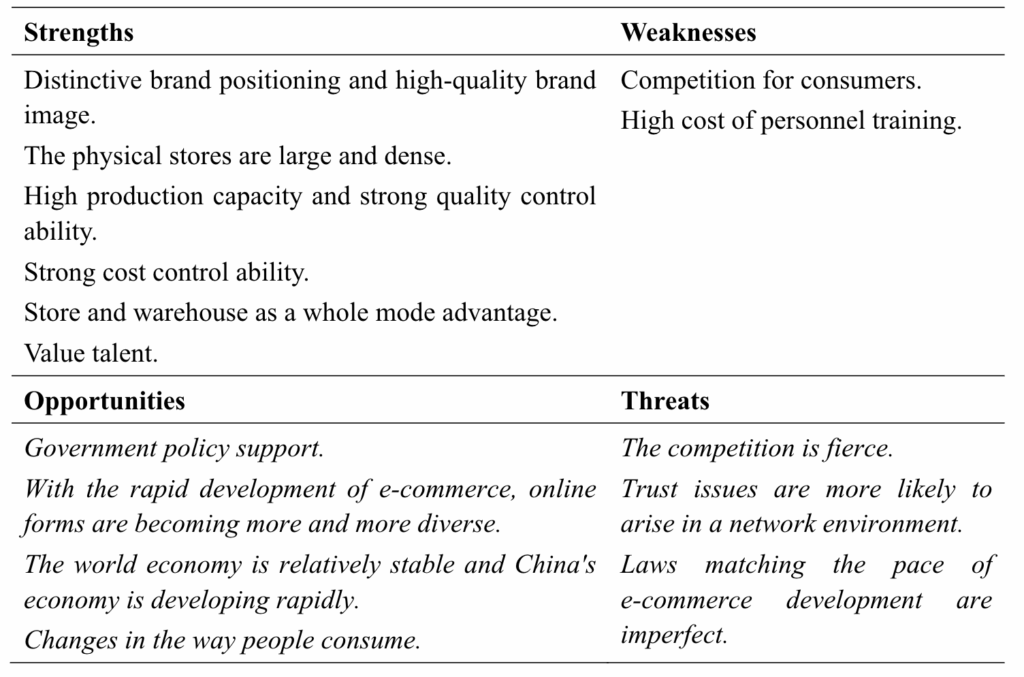
In addition to our SWOT analysis interpretation, here is a table from the research titled “On Marketing Strategies of Uniqlo: An Analysis of Online and Offline Integration:”
Market Segmentation of Uniqlo
Uniqlo’s market segmentation actually can be summarized by its tagline: “Made for All.”
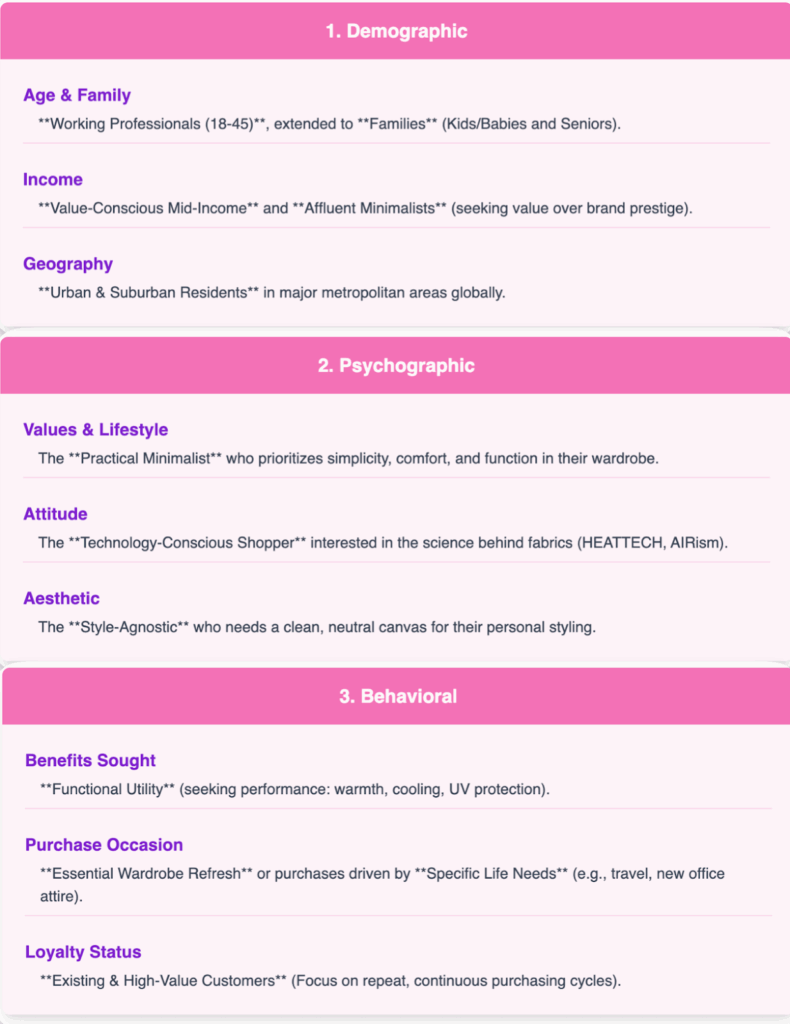
You may think that this suggests a mass market approach; however, Uniqlo uses a subtle, nuanced segmentation strategy that targets people across all traditional demographic lines based on shared psychographic and behavioral values.
Details?
Demographic Segmentation
- Age: From kids and babies all the way up to middle-aged and senior adults. Their primary focus, however, is on young adults and working professionals (typically 18 to 45) who are seeking functional and affordable work or casual attire.
- Gender: The brand offers distinct lines for men, women, and kids & babies.
- Income: Uniqlo targets the low and middle-income consumer while also attracting higher-income individuals who appreciate minimalism, functional technology, and durable wardrobe staples
- Geography: Uniqlo heavily targets densely populated urban and suburban areas worldwide, such as major metropolitan hubs like Tokyo, New York, and Paris.
Psychographic Segmentation
- The Value Seeker: People who prioritize quality and durability over low cost. They are not looking for the cheapest clothes but the best value for money.
- The Practical Minimalist: They prefer simple designs, solid colors, and clothing that can be effortlessly mixed and matched for different occasions.
- The Technology-Conscious: This segment is highly responsive to Uniqlo’s campaigns that focus on the technical benefits of fabrics like UV protection, moisture-wicking, or thermal insulation.
- The Style-Agnostic/Versatile Shopper: They need a simple, reliable canvas upon which they can layer and express their own individual style.
As you can see, Uniqlo targets a wide range of people. Regarding that issue and the brand’s growth, shortly before, CNBC released a video:
Behavioral Segmentation
- Product Usage/Benefit Sought: Customers are segmented by the specific functional benefit they seek.
- Purchase Occasion: The brand effectively captures consumers shopping for specific life needs, such as work attire or essential travel gear.
As a summary:
Uniqlo Marketing Strategy & Advertising Campaigns
Uniqlo’s marketing strategy is a powerful departure from the fast-fashion model, focusing on product-centric innovation.
This approach positions the brand not just as a clothing retailer, but as a provider of technological solutions for everyday life. The ultimate goal is to become the world’s number one casual wear group by creating a “revolutionary casual clothes” model that offers world-class quality at affordable prices.
The primary pillar of the Uniqlo marketing strategy is the product itself. The brand’s “LifeWear” is a promise of clothing that possesses simplicity, high quality, and ingenious details, designed to transcend trends.
What about Uniqlo’s advertising campaigns? Actually, these campaigns are distinct because they emphasize functionality and utility over the superficial glamour often seen in retail marketing campaigns.
Their campaigns, such as the famous “Science of LifeWear” series, are centered on storytelling that explains how the technology works and why it improves the customer’s daily comfort and performance. This content-driven approach builds brand trust and strengthens the association between Uniqlo and innovation.
While maintaining a consistent global brand voice, Uniqlo adapts its messaging to local markets (known as “glocalization”). For example, promotions in Southeast Asia may heavily focus on the cooling properties of AIRism, while European campaigns emphasize HEATTECH warmth.
The brand uses collaborations not just for hype, but to reinforce its values and reach specific demographics. They team up with global athletes like Roger Federer (representing performance and longevity) or renowned designers like Jil Sander (representing elevated minimalism).
Let’s close that section with some Uniqlo social media posts.
As you can see clearly, Uniqlo’s social media strategy is a sophisticated mix of minimalism, education, and community engagement.
Unlike other fashion brands, Uniqlo operates separate social media accounts for different markets (and it’s easy to see that the most-loved one is for Indonesia). This approach allows for localized content plans: regional weather, culture, and lifestyle.
However, almost all the content on each account features neutral backgrounds, ensuring the clothing and its functionality take center stage, reflecting the brand’s Japanese roots.
Regarding content creators & influencers, the brand can be said to be quite selective; Uniqlo just teams up with names in fashion. Take its collaboration with content creator Lara (@lara_bsmnn): Featured prominently in Uniqlo’s LifeWear magazine and digital channels, the partnership highlights Lara’s expertise in styling under the theme “My Standard.”

Uniqlo Advertising Strategy: Why It Doesn’t Look Like Advertising
So far, we have discovered clearly that Uniqlo doesn’t appear to advertise in the way most fashion brands do.
As you can see, there’s no constant push for virality, no reliance on celebrity-fronted storytelling, and no urgency-driven messaging built around seasonal hype, while other fashion brands heavily invest in these, naturally. And that’s precisely the point.
Uniqlo’s advertising strategy is designed to de-emphasise persuasion. Instead of trying to convince consumers to want something new, it focuses on making the product itself feel inevitable. Function and usefulness take precedence over aspiration or spectacle. The clothing explains itself.
Take the following social media post as an example; the brand clearly promotes wearing the same sweatshirt multiple times instead of trying to sell new one:
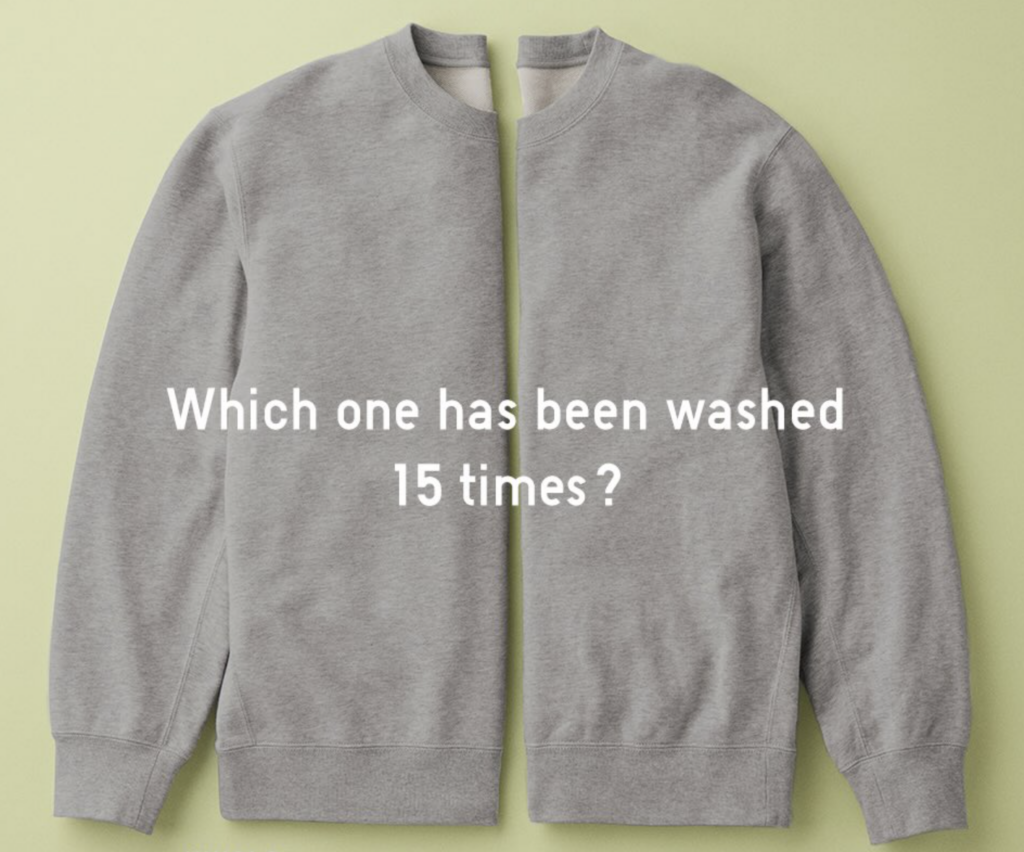
Source: https://www.instagram.com/p/DTRiiSek_Vl/?utm_source=ig_web_copy_link&igsh=MzRlODBiNWFlZA==
By avoiding the visual and emotional signals typically associated with fashion advertising, the brand sends a different message, saying that they do not need to shout. That restraint acts as a form of contra-signalling, and it positions Uniqlo as uninterested in competing for short-term attention.
You see this play out across Uniqlo’s advertising formats. Campaigns are often instructional rather than emotional. Product benefits are explained plainly. Visuals are clean, repeatable, and consistent across markets. Even when Uniqlo invests heavily in media, the output rarely feels like advertising in the traditional sense.
Crucially, this doesn’t mean Uniqlo avoids advertising. Advertising becomes a delivery mechanism for the LifeWear philosophy. So the objective is quietly embed the brand into everyday life.
So, Uniqlo shows that effectiveness doesn’t always come from louder messaging or faster creative cycles. Sometimes, the strongest signal a brand can send is the confidence to let the product do most of the work.
As we stated above, the power of Uniqlo’s strategy lies in what it chooses not to do. And in advertising, that restraint is exactly what makes it work.
FAQ about Uniqlo Marketing Strategy
What is the Uniqlo marketing strategy?
Uniqlo’s marketing strategy is built on the #LifeWear philosophy. The core of this strategy is the pursuit of functionality and simplicity. This approach is made possible by its integrated supply chain, which gives Uniqlo complete control from R&D to retail. Uniqlo’s marketing strategy also emphasizes the value and durability of its products. And finally, the brand uses targeted digital marketing and flagship Uniqlo stores as brand embassies to deliver a consistent message.
How does Uniqlo marketing differ from other fashion brands?
Fundamentally, Uniqlo’s marketing differs from most fashion brands by adopting an anti-trend stance. While competitors thrive on fast seasonal turnover, Uniqlo avoids chasing micro-trends. Instead, its messaging focuses on product utility. So, the advertising is clean, minimal, and often educational, utilizing content like “The Science of LifeWear” to explain fabric technology. This focus on the target market values enduring quality and the total Uniqlo experience across both digital and physical touchpoints.
What are some famous Uniqlo advertisement examples?
Uniqlo creates advertising campaigns that prioritize product functionality over fleeting fashion trends. The most prominent example is the ongoing global campaign, “The Science of LifeWear,” which uses documentary-style storytelling to educate consumers on the technical benefits of fabrics. It positions the brand as a science-driven solution provider rather than just a clothing retailer. Beyond product function, Uniqlo also gains publicity through high-profile limited edition collections with designers like the +J collaborations with Jil Sander and artists like KAWS. These advertisements have generated social media buzz and driven traffic and excitement to the brand’s core minimalist offering.
How does a Uniqlo advertising campaign reflect the brand’s global identity?
A Uniqlo advertising campaign reflects the brand’s global identity through a message of simplicity, quality, and universal function while practicing glocalization. The minimalist aesthetic and the clean, red-and-white logo universally communicate its Japanese origins and focus on essentials. However, this global message is adapted locally through specific partnerships and localized social media content.
Does Uniqlo Use Influencer Marketing?
The short answer is yes, but not in the way most fashion brands do.
The brand does collaborate with influencers, but it avoids scale-driven seeding, constant creator turnover, or campaigns built purely for visibility. Instead, Uniqlo tends to work with a smaller, more consistent group of creators whose lifestyles naturally align with LifeWear—stylists, creatives and everyday professionals who can show how the clothes function in real contexts.