














Maison Margiela Advertising Strategy: The Anti-Ad That Sells Everything
Maison Margiela advertising poses an interesting question for marketers: how did a brand that rejected traditional advertising become one of the most recognizable names in luxury fashion?
Since its founding in Paris in 1988 by Martin Margiela, the brand has built its reputation through tactics that feel closer to artistic statements than marketing campaigns.
Its runway shows, as an example in particular, became cultural moments, models walked with covered faces, distorted silhouettes, or unusual prosthetics that turned the human figure into something strange and almost surreal.
Once startling on the runway, these unexpected images are now widely shared on social media sites like TikTok and Instagram, where videos of Margiela shows frequently go viral due to their eerie, dramatic model appearances. What started out as avant-garde experimentation has developed into one of the most potent forms of organic advertising in fashion, which is essentially what expert luxury marketing agencies do.
Turning back to the prior question: so how does a brand with almost zero conventional advertising become one of the most talked-about names in luxury fashion? That’s exactly what I’m breaking down today.
Together, we’re going to look at the Maison Margiela advertisement strategy, who makes up the Maison Margiela target market, and all the real-world campaigns, data, and frameworks that explain how this wildly unusual brand actually works.
Let’s get into it.
Inside Maison Margiela Advertising Strategy
- Margiela SWOT Analysis: Where the Brand Really Stands
- The Maison Margiela Target Market: Who Actually Buys This?
- The 4P Marketing Mix of Maison Margiela
- Maison Margiela Digital Marketing Strategy
- Maison Margiela Advertising Campaigns
- FAQ about Maison Margiela Advertising
Margiela SWOT Analysis: Where the Brand Really Stands
Before we can talk marketing, we need to talk philosophy, because Margiela’s entire business model is built on one.
The brand’s core idea is deconstructionism: taking fashion apart, questioning its assumptions, and rebuilding it into something that challenges the status quo.
Martin Margiela famously drew inspiration from Japanese tabi socks during his travels in Japan. He split the toe of a boot, added a chunky heel, had models walk through red paint on a white cloth at his Spring/Summer 1988 show, and left red footprints that became one of fashion’s most iconic images, according to Zou.
That show was itself a marketing masterpiece: zero advertising budget, maximum cultural impact.
The brand’s other defining marketing move was anonymity. Martin Margiela gave no interviews for decades. The design team communicated collectively as “we.” The label on every garment was blank; just four white stitches on white fabric, sewn through the lining.
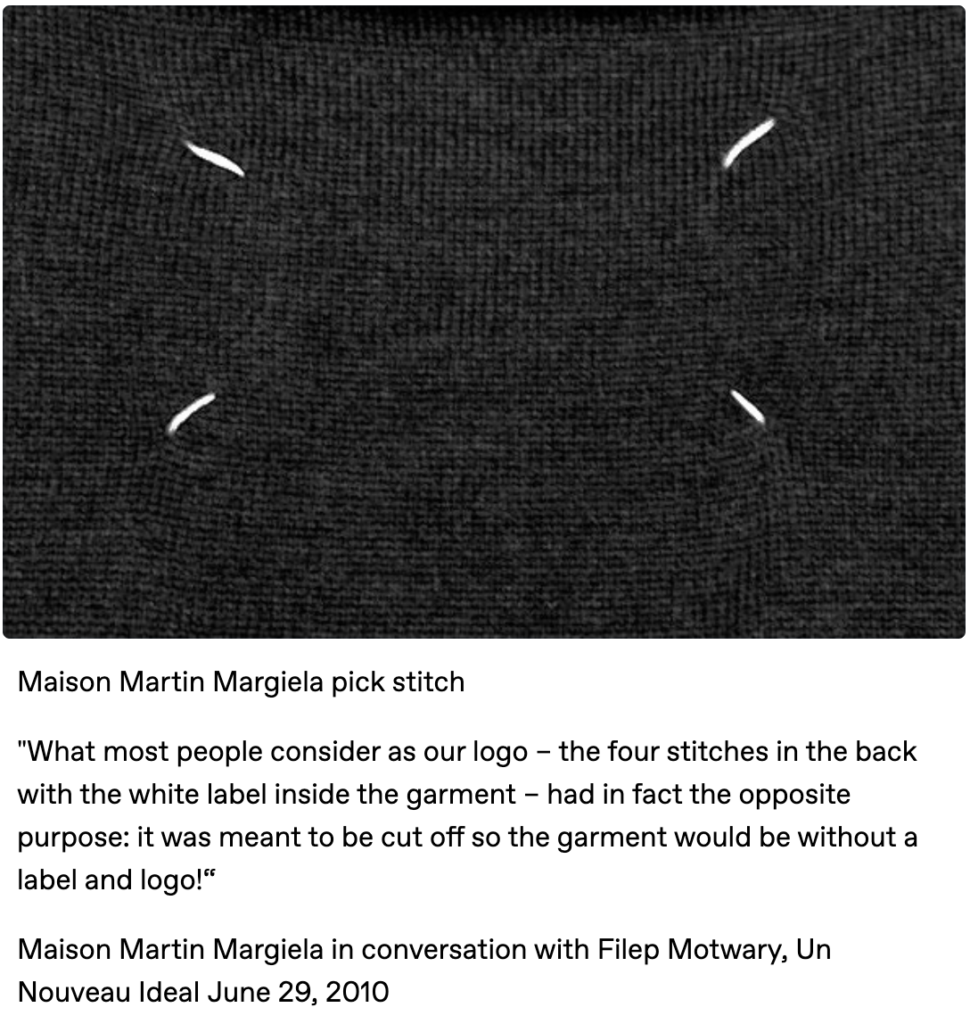
It was a deliberate philosophical statement: the clothes matter, not the celebrity behind them. And that philosophy is the foundation of every advertising decision Margiela has made since.
Let’s get analytical. Here’s an honest look at the brand’s position & SWOT analysis:
Strengths
- Iconic deconstructionist brand philosophy,
- Tabi Boots (instantly recognizable product icon, as I stated above),
- Deeply loyal niche consumer base,
- Designer anonymity as a competitive differentiator,
- High regard in fashion and art communities,
- Genuine sustainability practices (recycled/upcycled materials).
Weaknesses
- Passive, near-absent marketing approach,
- Polarizing design limits mass accessibility,
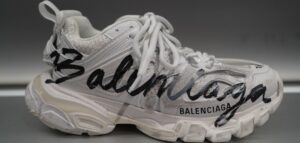
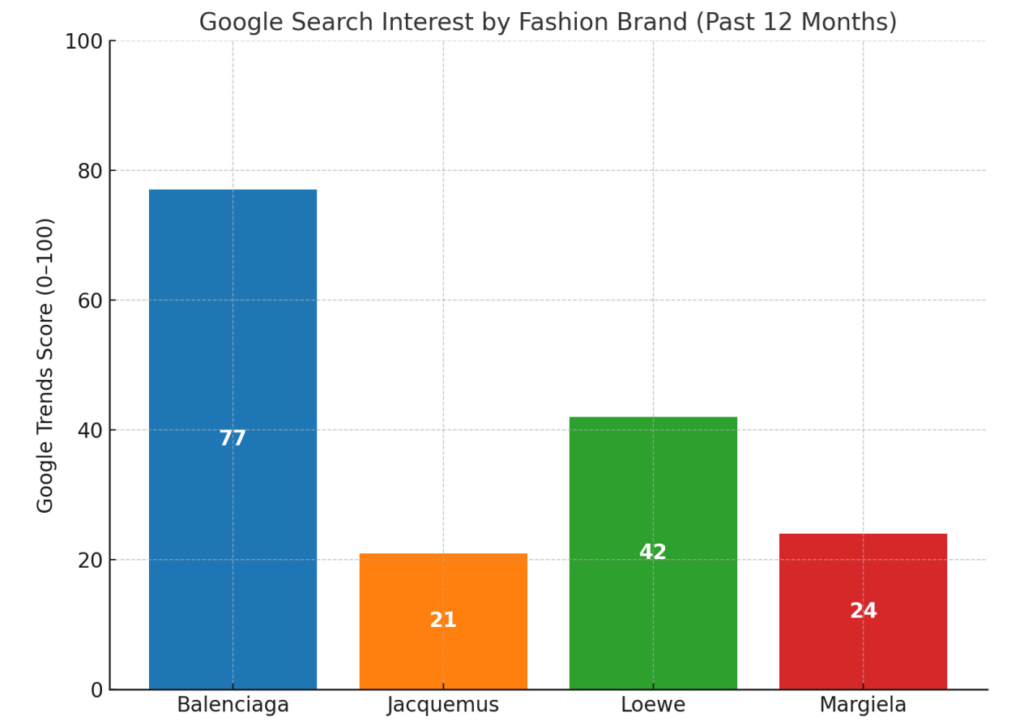
- Only 5M Instagram followers vs. Balenciaga‘s 15M,
- Google Trends score of 24 vs. Balenciaga’s 77 (source: Maison Margiela’s Brand Positioning and Market Influences)
Opportunities
- Expanding the Replica fragrance line globally (Replica is already a major revenue driver and offers strong opportunities for global growth through new scents, limited editions, and experiential retail),
- Reaching younger luxury consumers (Gen Z and Millennials),
- Growing interest in conceptual and artistic fashion,
- Expanding accessories and footwear lines,
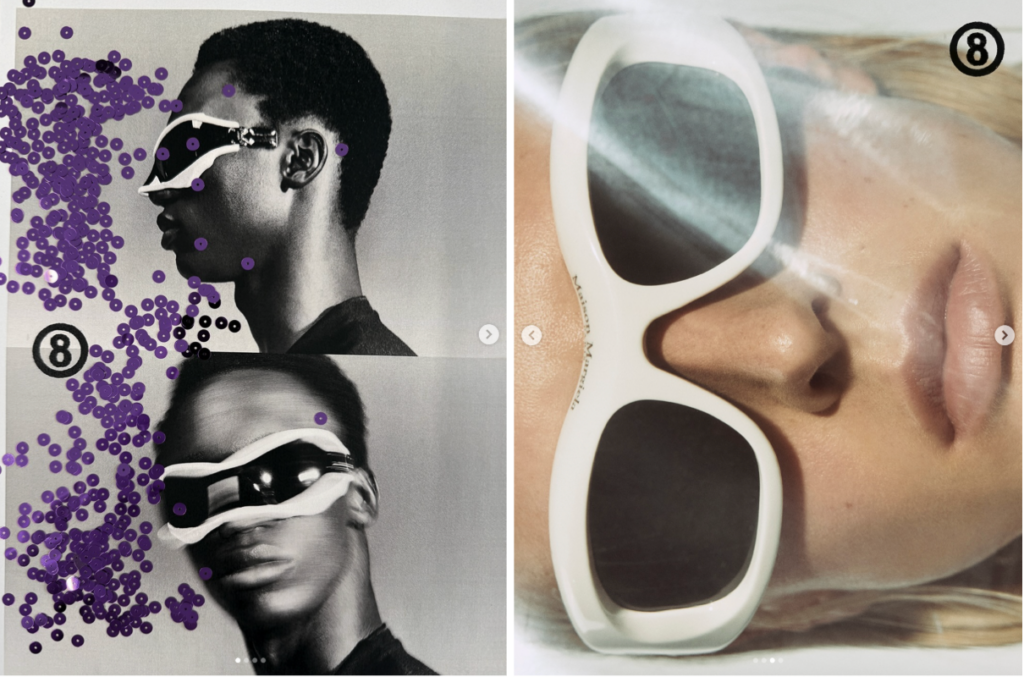
- Expanding collaborations with other brands and creatives (collaboration with Gentle Monster and more).
Threats
- Competitors are spending aggressively on influencer marketing,
- Creative director uncertainty after Galliano’s departure,
- Brand dilution risk as popularity grows,
- Omnichannel demands outpace Margiela’s current pace.
The Maison Margiela Target Market: Who Actually Buys This?
First things first: Margiela’s target market isn’t a single demographic; it’s a constellation of overlapping consumer profiles who share one thing: they don’t want what everyone else has.
The core of Margiela’s growth opportunity sits squarely in Gen Z, born roughly 1995–2010.
As you may know, as a marketer, this generation isn’t buying luxury the way their parents did. They’re not purchasing a Louis Vuitton bag to signal wealth. They’re buying things that express who they are, align with their values, and connect them to communities that feel authentic.
Beyond Gen Z in general, Margiela has a devoted core fan base that includes fashion scholars, art world consumers, and those who view the H&M partnership as an artistic gesture rather than a sell-out.
These are the customers who will spend between $1,200 and $1,500 on Tabi boots because they make an intellectual and artistic statement rather than because a celebrity told them to.
The 4P Marketing Mix of Maison Margiela
🧩Product: Conceptual Luxury and Deconstruction
Maison Margiela’s product strategy centers on avant-garde fashion, anonymity, and conceptual design. As I stated above, the brand became famous for deconstructed garments, unconventional materials, and artisanal craftsmanship.
Key characteristics of the product strategy include:
- Deconstruction and experimental design,
- Limited production runs,
- Artisanal craftsmanship,
- Anonymous branding (no visible logo).
What about products? They are:
- Ready-to-wear collections,
- Couture (Artisanal line),
- Accessories and handbags,
- Fragrances (Replica collection).
A defining philosophy of the brand is explained by Martin Margiela himself:
Luxury is not about logos or visibility; it’s about the quality of ideas and craftsmanship.
🧩 Price – Premium Luxury Pricing Strategy
Maison Margiela follows a premium pricing strategy, consistent with luxury positioning.
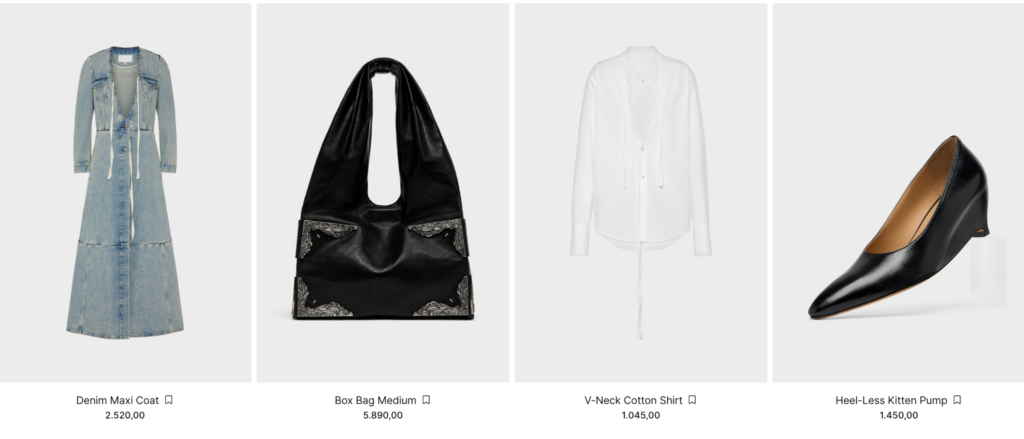
- Margiela Tabi boots: $1,000 – $1,500
- Ready-to-wear pieces: $600 – $3,000+
- Haute couture Artisanal pieces: $10,000+
The brand belongs to OTB Group (Only The Brave), which also owns Diesel, Marni, and Jil Sander.
🧩Place – Selective Global Distribution
Maison Margiela uses a selective distribution strategy, meaning products are sold only through carefully curated channels. Main distribution channels:
- Flagship boutiques
- Luxury department stores
- High-end online retailers
- Brand-owned e-commerce
Examples of retail partners include Dover Street Market, Selfridges, SSENSE, and Farfetch.
On the other hand, Margiela operates flagship stores in global fashion capitals such as Paris, Milan, London, Tokyo, and New York. And yes, that kind of selective distribution reinforces the brand’s exclusivity.
🧩Promotion – Conceptual Storytelling & Influence
Maison Margiela’s promotion strategy differs significantly from traditional luxury advertising. The brand relies heavily on:
- Conceptual fashion shows
- Artistic collaborations
- Celebrity placements
- Social media storytelling
Historically, the brand avoided traditional advertising entirely and instead focused on concept-driven runway shows.
For example:
- Models sometimes walked with covered faces to maintain anonymity.
- Invitations to shows were often handwritten or unusual objects.
This philosophy was explained by Martin Margiela:
The focus should always be on the clothes, not the designer.
Maison Margiela Digital Marketing Strategy
Margiela’s digital marketing strategy is notably thoughtful in its execution.
From the view of ecommerce, the brand uses subtle motion and restrained animations on its website, enhancing product presentation without overwhelming the minimalist aesthetic. 360-degree product views allow customers to examine items comprehensively, building purchase confidence.
One aspect of Maison Margiela digital marketing narrative that hardly anyone is aware of is its Web3 activity.
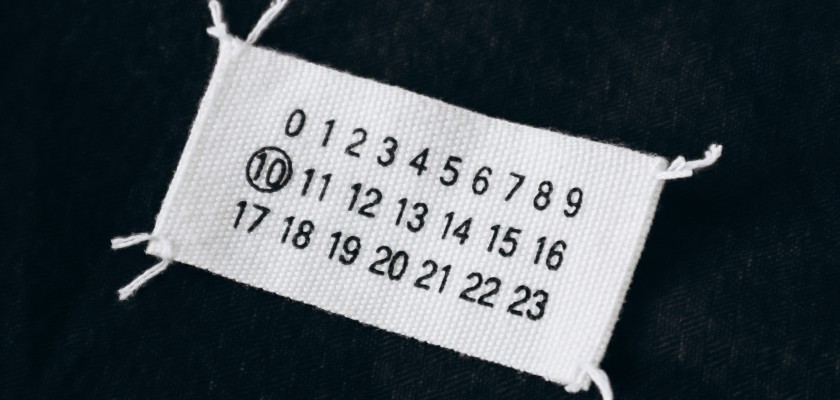
Back in late 2023, Margiela launched a blockchain-based game called “Numbers.” It was a gamified minting experience inspired by the brand’s iconic 0–23 collection numbering system. The game was free to enter, globally accessible, and utterly on-brand: mysterious, number-based, and requiring patience and strategy rather than wealth to win.
Building on the “Numbers” game, Margiela launched the MetaTABI collection in March 2024 in collaboration with digital fashion house The Fabricant, supported by Aura Blockchain Consortium.

This is genuinely forward-thinking digital marketing. The MetaTABI campaign achieved several things simultaneously:
- It extended Tabi’s cultural life into digital spaces, created a new tier of ultra-exclusive ownership that money alone couldn’t buy,
- It generated enormous press coverage in both fashion and tech media, and built a Web3 community around the brand’s iconic numerical code system.
What more about Margiela’s advertising in digital environments? The brand has actually used collaborations as de facto digital marketing campaigns; products that generate news, social coverage, and search volume without a single paid ad. The brand’s approach is deliberately diverse:
Margiela Social Media Management: Doing Less, on Purpose
Let’s start with a number that will make every social media manager’s eye twitch:
Maison Margiela has 223.8K followers (as of March 2026) on TikTok (the platform where Gen Z users actively spend their time) and just 5.1 million on Instagram.
Compare that to Balenciaga’s 15 million Instagram followers, Loewe‘s 6.7 million, and Jacquemus’s 6.8 million, and you start to understand that these brands just chose to show up.
Actually, Margiela treats it as a curated exhibition space. In a landscape where social media for fashion brands often revolves around high-frequency content and trend participation, Margiela focuses instead on selective storytelling and artistic presentation.
So much so that the brand posts infrequently compared to its peers and avoids the hyperactive content cycle common in fashion marketing today. This approach mirrors the philosophy established by founder Martin Margiela, who famously avoided interviews and rarely appeared in public.
The brand’s digital presence reflects that same approach. Look at the way Margiela uses Instagram and TikTok.
Not daily posts or influencer-heavy campaigns, the brand focuses on show moments, campaign imagery, conceptual videos, and runway storytelling.
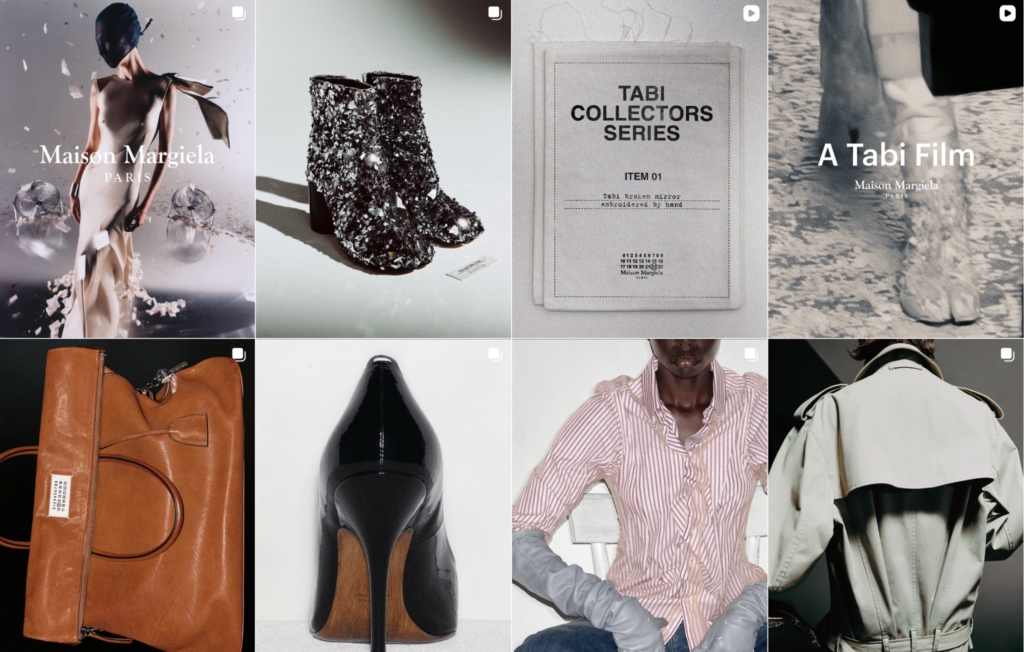
For example, the viral response to John Galliano’s 2024 couture show for Maison Margiela generated millions of views across fashion media, despite the brand’s relatively small owned audience.
So, we can say that Margiela often dominates cultural conversation without dominating follower counts. In other words, the brand leverages earned media amplification instead of owned media scale.
And you can see “anti-algorithm branding” on Margelia’s social media channels. As you already know, luxury branding usually focuses on designing content to please algorithms. Margiela does the opposite.
You rarely see trend participation, influencer seeding at scale, meme-based content,t and TikTok-native formats. And, of course, that absence is intentional.
The brand protects its conceptual identity by avoiding the performative behaviors that dominate social platforms. From a marketing perspective, this is almost an anti-growth strategy. But in luxury, exclusivity frequently outperforms accessibility.
Before closing that section, I need to mention that the brand has an extraordinarily powerful organic user-generated content engine. The fragrance line alone generated massive organic traction. The hashtag #SmellsLikeMemories collected $4.2 million in EMV as Margiela’s single top-performing hashtag in 2023.
Celebrity organic endorsements have similarly driven enormous reach at zero cost. When Zendaya wore Tabi boots, and when Greta Gerwig was photographed in them during the Barbie press tour, every fashion account on every platform covered it.
Maison Margiela Advertising Campaigns
So far, we’ve explored that Maison Margiela has never followed the traditional rules of luxury advertising. No glossy celebrity endorsements or predictable seasonal promotions…
Over the years, Margiela’s advertising has blurred the line between fashion, art, and cultural commentary, often focusing on concept, atmosphere, and storytelling rather than straightforward product promotion.
The result is a series of distinctive fashion marketing campaigns that feel mysterious and intellectual.
Now, let’s see some of these Margiela campaigns.
#1 The Spring/Summer 1989 debut
Martin Margiela’s first show, held in a Parisian playground, was invited by handwritten note, attended by both fashion editors and local children.
It was the original Maison Margiela advertisement. The Tabi boots left red split-toe footprints on a white cloth that became one of fashion’s most iconic images.
Zero advertising budget.
The show itself was the campaign.
#2 The H&M collaboration (2012)
When Margiela collaborated with H&M in 2012, it could have looked like a brand selling out.
Instead, it was perceived almost universally as an artistic gesture; a democratization of avant-garde design.
In other words, the collaboration was widely seen as an artistic effort to bring the brand’s creative ideas to new audiences.
The collaboration with H&M presents a re-edition of iconic Maison Martin Margiela garments and accessories for men and women. Each piece is specifically labeled with a unique tag indicating the season from which it originated, spanning 23 years since the Maison’s founding.
The most representative pieces of Maison Martin Margiela are reproduced in updated shapes and materials and offered to the broad public as an exclusive synopsis of their history.
The brand narrative was so strong that it turned a commercial deal into a philosophical statement.
#3 Joy (Spring/Summer 2026)
Released in March 2026 and directed by Thibaut Grevet, the campaign tells you everything about how Margiela thinks about advertising.
The brand transported an orchestra of children to the Théâtre de la Villette in Paris and filmed what happened when you give 43 young musicians a climbing frame.
“Starring composer and pianist Max Richter and the Association Orchestre à l’École, the same orchestra that performed at our Spring Summer 26 show.
Inspired by the collection and show theme: a chaotic opera, Max Richter composed an original score for the campaign titled “Joy”, which he performs in this film at the harpsichord alongside the 43 young musicians.
The reference point: Martin Margiela’s 1990s presentations, in which local neighborhood children walked the runway alongside professional models.
This is deconstruction applied to advertising itself: take the conventional luxury campaign format, strip it back, rebuild it as something that feels like collective art rather than commercial promotion.
#4 Miley Cyrus AW25
Here is the end of 37 years of celebrity-free Maison Margeila advertising.
Back in 2025, Maison Margiela did something it had never done in nearly four decades of existence: it put a celebrity’s face on its campaign: Miley Cyrus.
The announcement sent a genuine shockwave through the fashion industry. Since its founding in 1988, Margiela has built its entire identity on the absence of celebrity. Martin Margiela himself refused interviews, declined to appear at his own shows, and communicated with the press exclusively by fax.
What’s remarkable about the Miley Cyrus campaign is how Margiela managed to make this unprecedented decision feel distinctively on-brand. In several images & videos within the campaign, her face is partially obscured by lighting, paint, and clothing. It’s a way to maintain the brand’s long-held ethos of obscured identity even while using a famous face.
FAQ about Maison Margiela Advertising
What defines Maison Margiela advertising and how does it differ from traditional luxury fashion campaigns?
What defines a Maison Margiela advertisement is, first and foremost, the absence of everything that traditional luxury advertising relies on. Where brands like Chanel, Louis Vuitton, and Dior pour tens of millions of dollars into celebrity-fronted campaigns, Margiela has historically done the opposite. For most of its history, there was no brand ambassador, no press spokesperson, no designer interview, no visible logo. The label on every garment was blank. While competitors were spending $2–$10 million per year on a single celebrity deal, Margiela was spending nothing on paid promotion and relying entirely on the products and the cultural conversations they generated to do the work. The result is advertising that doesn’t look like advertising: campaign films that feel like art installations, in-store experiences that function as philosophical statements, and a fragrance line marketed not around notes or ingredients but around memory and emotion.
What are the most notable Maison Margiela advertisement examples that shaped the brand’s identity?
Maison Margiela’s most defining “advertisements” often don’t feel like advertising at all. In 1997, the brand staged a performance where garments were grown with mold using agar gel (a critique of fashion’s obsession with newness that generated global press). The collaboration with H&M strengthened the brand’s credibility by framing mass retail as an artistic gesture. In 2020, a Shanghai fragrance pop-up with concept store Little B recreated a “Lazy Weekend” bedroom experience where visitors customized scents and typed their names on fabric labels with vintage typewriters. Similar cultural moments followed, from a Travis Scott sneaker collaboration that sold out instantly to the SS26 campaign film Joy, where art and music take center stage while the clothing barely appears.
What is the core Maison Margiela marketing strategy behind its unconventional brand positioning?
The core Maison Margiela marketing strategy can be summed up as philosophy over promotion. Not by relying on celebrity endorsements, large ad budgets, or traditional campaigns, the brand focuses on a strong creative identity that naturally attracts cultural attention and media coverage. After years of prioritizing artistic credibility over profit, the brand gained commercial momentum when John Galliano became creative director in 2014, introducing collaborations and broader collections while preserving Margiela’s deconstructionist DNA. Since then, the strategy has relied on carefully chosen cultural moves, proving that fewer, more intentional initiatives can generate global attention without conventional advertising.
How does Maison Margiela advertising reflect the brand’s avant-garde philosophy?
Maison Margiela’s advertising mirrors its avant-garde philosophy by treating campaigns as extensions of its deconstructionist design approach. Not traditional fashion advertising, the brand removes many typical elements, allowing garments to exist within a broader conceptual narrative. Its Replica fragrances follow the same idea, marketing scents as memories like “Jazz Club” or “By the Fireplace,” encouraging emotional connections. Even the AW25 Miley Cyrus campaign, the brand’s first celebrity campaign in 37 years, partially obscured her identity with paint and shadow.
Who is the primary Maison Margiela target market, and what attracts them to the brand?
The primary Maison Margiela target market is Gen Z consumers who value individuality, design, and authentic brand philosophy over logos or celebrity influence. This audience & generation chooses products that reflect personal identity and creative expression. Margiela appeals to them through distinctive design icons like the Tabi boot, which signals individuality without visible branding.
How does Maison Margiela marketing strategy balance exclusivity with global brand awareness?
By fusing scarcity with visibility, Maison Margiela strikes a balance between exclusivity and global awareness. Limited distribution, a restrained social media presence, and unique designs like the Tabi boot (which appeal to a niche market rather than the general public) all help the brand maintain exclusivity. At the same time, high-profile partnerships with companies like Supreme, Travis Scott, and The Fabricant all contribute to the natural growth of global awareness.