














Gillette Marketing Strategy: The Rules of Stadium Marketing & Masculine Branding
No doubt that “The Best A Man Can Get” is one of those lines everybody knows.
It’s a phrase that shaped how generations understood Gillette’s mix of performance and everyday grooming. Within the wider Gillette marketing strategy, the brand has always paired product innovation with a clear point of view on what grooming represents.
In this blog, we explore how Gillette marketing continues to evolve through stadium visibility, athlete partnerships, and masculine branding. These elements show how the brand uses cultural touchpoints and physical spaces to stay relevant.
Keep reading.
What’s Inside
- Gillette’s Marketing Mix
- Gillette’s SWOT Analysis
- Gillette’s Market Segmentation
- Stadium Marketing and Masculine Branding
- Gillette’s Marketing Strategy & Campaigns
- Gillette’s “We Believe: The Best Men Can Be”
- Gillette’s Social Media Strategy
- FAQ about Gillette’s Marketing
Gillette’s Marketing Mix
Recognizing how product, place, price, and promotion work together provides insight into how Gillette sustains its leadership and positions its Gillette advertisements.
Product
Gillette’s product offering is built around high-quality razors, blades, gels, and related male grooming items, as you already know. According to a 2016-dated thesis titled “The Future of Shopping – New Sales and Marketing Strategies for Gillette to Grow Market Penetration Among Men in 2030” the brand “operates worldwide and is the market leader in the male grooming product category.”
Gillette has more than 15 different razor types; however, in the paper titled “Gillette Product and Marketing Innovation,” there is a statement that the brand expanded its product portfolio to create the full “shower experience”:
The launch of Gillette Hair Care and Body Wash for men, as well as its Clinical Strength deodorant, represented the most significant Gillette brand extensions outside of the razor and blades division, and aimed to reinforce the brand’s standing as the world’s leading male-grooming authority.
Regarding the launch of Gillette Hair Care and Body Wash for men, as well as its Clinical Strength deodorant, Chip Bergh, group president, Global Personal Care, Procter & Gamble, said in an interview:
We’ve earned the trust of the more than 600 million men who start their day with a Gillette razor. By offering superior deodorant, body washes, and shampoos, we are able to reward that trust by giving guys what they want and need in other areas of their grooming routines.
Price
In the Gillette marketing mix, pricing is one of the differentiators.
The said 2016-dated work notes that Gillette’s offerings are “more expensive than its competitors, since it positions itself as a high quality brand.”
The higher price is consistent with the premium brand positioning and supports the claims made in Gillette advertisements about performance and quality.
It also creates a buffer that allows the brand to invest in marketing and maintain margins. However, marketers are also aware that the wet shaving category is declining, and cheaper private labels are increasing their share. That means the pricing strategy must be balanced with value communication and promotion (we will look at it in the SWOT-threats section deeply.)
Place (Distribution)
For the place component of the marketing mix, Gillette uses extensive distribution channels.
Gillette’s products are sold in more than 200 countries and territories, and the primary retail channels for razors and blades are drugstores (which account for over half of all sales in that category) and supermarkets/discounters.
From a Gillette marketing strategy, wide physical presence is essential since it supports brand availability and the premium narrative (that you can find the brand everywhere) and promotional tie-ins (for example, in-store displays or bundled offers).
Gillette demonstrates strong adaptability in the context of digital transformation and e-commerce; subscription models, such as the Gillette Shave Club, are highlighted as key strategic opportunities.
Promotion
The promotion arm, which includes Gillette advertisements, is where many of the strategic insights come together.
Gillette uses high-visibility campaigns, strong brand cues around performance and masculinity, and often large media investments. In other words, the brand has rooted its success in strong investments in marketing activities.
In addition, to sustain its Gillette marketing strategy, the brand segments its target audiences & market share: The study identifies 4 segments with different needs and sales objectives for growth. That means Gillette emphasizes product benefits (precision, quality), and uses channels that support those narratives.
Gillette’s SWOT Analysis
⚔️ Strengths
- Gillette has been the gold standard for over a century, so much so that it maintains a leading market share in the wet shaving category. The name itself is synonymous with razor & blades. It offers an almost unparalleled level of brand recognition.
- The brand follows a successful “razor-and-blade” business model; every new multi-blade system (like Mach3 and Fusion) and technology (like FlexBall) allows for a premium pricing structure.
- As a flagship brand of P&G, Gillette has a powerful, global distribution and retail presence. That ensures its products are readily available in supermarkets, pharmacies, and small local shops across hundreds of countries.
- The brand has a history of iconic, high-budget campaigns like “The Best a Man Can Get” that build strong emotional connections. The backing of P&G provides deep market research and media planning resources.
📉 Weaknesses
- Gillette’s premium pricing, particularly for replacement cartridges, creates an opening for low-cost challengers to position themselves as value alternatives.
- The high cost and disposable nature of the multi-blade cartridges make the brand vulnerable to price-sensitive consumers and environmentally conscious consumers.
- Some consumers view the new product products that include more blades and more features as an excuse for higher prices.
- While a leader in razors, Gillette is not the market leader in all men’s toiletries.
📈 Opportunities
- The men’s personal care market is growing beyond just shaving. There’s a chance to fully diversify the portfolio into skincare, beard care, and men’s specialized hair care.
- Many developing economies are seeing a surge in consumer demand for personal grooming products. Tailoring products and marketing to meet local consumer needs and affordability offers significant growth potential.
- While challenged by DTC brands, Gillette has an opportunity to solidify its own subscription services and enhance its digital marketing to regain control of the customer relationship.
- Developing and promoting a line of more sustainable, reusable, or recyclable products would appeal to the growing segment of consumers who are willing to pay a premium for environmental responsibility.
🚨 Threats
- The increase in high-quality, low-cost private label blades from major retailers provides a cheaper substitute, putting constant downward pressure on Gillette’s pricing power.
- Trends like the rise of beards and varied facial hair styles reduce the frequency of shaving. It also decreases the consumption rate of replacement cartridges and impacts the core business model.
- High-profile campaigns (particularly “The Best Men Can Be” campaign) can spark controversy and lead to consumer backlash and temporary negative publicity that can hurt brand image.
According to the paper titled “Gillette Marketing Evolution,” there is one more threat to the price:
One of the greatest dangers is the decreased frequency of men who shave. There is an ongoing trend of men who prefer to grow and maintain beards than to shave it off, which may lead to a decrease in sales. Additionally, Gillette faces competition from companies like Dollar Shave Club and Harry’s for its price.
How does a brand manage to stay relevant in a category that rarely stands still? Gillette gives us a useful answer.
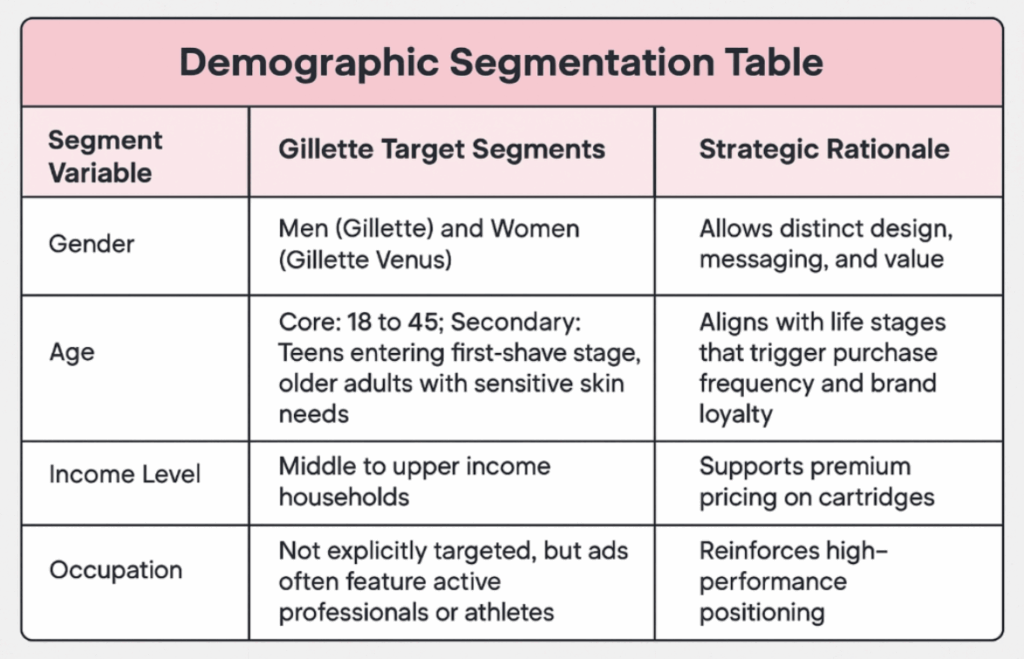
The company has built its reputation on a clear, layered approach to segmentation that moves across demographics, psychographics, behaviors, and pricing. For marketers, it shows how a long-standing brand can rethink who it serves and how it speaks to them.
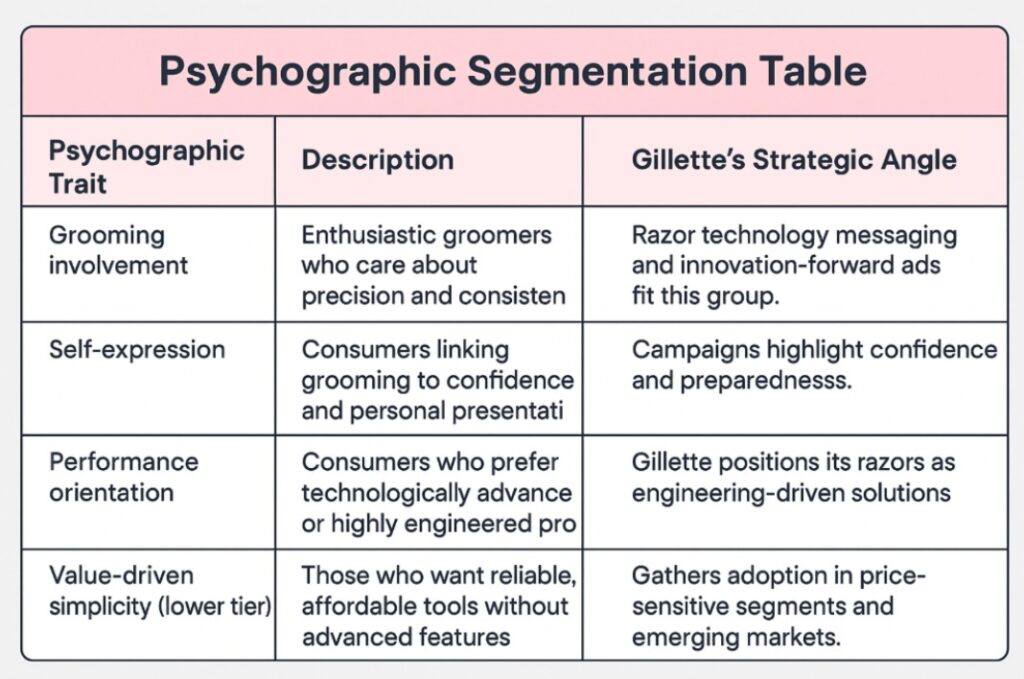
Below, you will find Gillette’s market segmentation; demographic and psychographic.
Psychographic segmentation of Gillette focuses on the mindset of grooming-conscious consumers and their self-image.
Stadium Marketing and Masculine Branding
Have you ever asked yourself why certain environments feel naturally powerful for a brand?
Think about the last time you watched a match and felt the crowd shift—the moment when everyone is focused on the same thing. Stadium marketing is about that shared attention. At its core, it means placing a brand inside an environment where people are fully engaged. And that kind of marketing is what Gillette’s been doing for years.
As we explained earlier, the brand chooses spaces that echo its core message: precision. Stadiums are perfect for that. Every action in a stadium is judged closely, and that sense of performance aligns with the story Gillette has told for decades.
At that point, we must remind you that placement is a storytelling decision, not just about media.
Masculine branding works on similar cues. It reflects ideas tied to discipline, control, performance, and self-presentation. These themes give a brand a clear structure for how it speaks and what it represents.
Moreover, masculine branding is rooted in behaviors linked to deliberate effort. Gillette has kept this tone because it offers consistency, something many brands find hard to maintain over time.
When we view stadium marketing and masculine branding side by side, the connection becomes clear. Both rely on symbols and moments that tell the audience, “This is about intention.” And intention is something Gillette works to communicate.
Gillette’s Marketing Strategy & Campaigns
When it comes to marketing strategy, Gillette outlines five integrated strategic choices that guide its business: a focused product portfolio, superiority across brand touchpoints, productivity, constructive disruption, and an agile organization. These choices create what the company calls “balanced growth and value creation.”
In other words, Gillette has always centered its brand on performance. The Gillette Annual Report supports this by stating that Gillette’s portfolio depends on “performance [that] drives brand choice.”
Instead of relying only on mass media (Gillette is known for its traditional advertising efforts), the brand now uses short-form video, creator-led tutorials, digital-first storytelling, and platform-specific product demonstrations to show how each product works. This turns product features into social-friendly content that fits the pace of digital marketing.
Recent moves in stadium marketing and refreshed masculine branding demonstrate how the company continues to adapt.
Athlete partnerships adapted for Gillette’s Marketing
Gillette’s history with global icons like Roger Federer, Thierry Henry and Tiger Woods was built on traditional advertising, but the relevance of these partnerships has shifted.
Today, athlete content sits within a digital ecosystem where clips, behind-the-scenes footage, training routines, and personal grooming rituals reside.
The best part is that these ambassadors are not just faces of the brand, but social assets. Their global influence strengthens the brand’s credibility for younger audiences seeking authenticity rather than scripted endorsement.
As we stated above, Gillette has been investing in high-impact physical spaces, including stadium placements, athlete-centric events, and in-venue branding.
And yes, stadium marketing serves three functions for Gillette:
- It reinforces legacy associations with athletic excellence.
- It generates organic social content.
- It responds to modern media fragmentation.
Addressing cultural tension with intentional communication
Gillette’s marketing strategy also addresses masculinity; in a media environment shaped by conversation, critique, and shared commentary, the brand has moved from traditional depictions of confidence and performance to a more reflective version of male identity.
The communication strategy behind the brand now considers:
- How men see themselves
- What behaviours are celebrated or questioned in culture
- How does grooming connects to identity, not just utility
This shift is not about distancing from masculinity. Instead, it reframes masculine branding into something more modern and accountable.
However, it is not possible to say that Gillette’s marketing strategy is always good at creating acclaimed advertisements about masculinity. Let’s see “that ad” which caused a public backlash.
Gillette’s “We Believe: The Best Men Can Be”
Back in 2019, Gillette launched a short film on YouTube titled “We Believe: The Best Men Can Be.” It was a campaign in response to the #MeToo movement and addressed negative behavior among men that perpetuates toxic masculinity.
However, the video faced heavy backlash, with more than 1 million downvotes on YouTube and thousands of negative comments. It has even received criticism on social media channels, with many men calling for a “boycott of the brand.”
As we stated before, for decades, Gillette portrayed confidence and performance through ambassadors like Federer and Woods. That history created expectations: Gillette was the brand of high-performance men.
The said campaign shifted dramatically from this familiar framing. Instead of celebrating men, it highlighted negative behaviors like bullying, harassment, and certain forms of aggressiveness—and linked them to toxic masculinity.
Gillette’s ad intended to encourage better behavior. But for a portion of the audience, the message felt more like criticism than encouragement.
The central tension was this: Consumers expect brands to reflect them, not correct them.
What’s more, the research titled “Gillette ‘We believe: the best men can be’ – the advertisement that shaved itself off the market,” noted the following about Gillette’s marketing campaign:
People also reacted negatively to the advertisement due to the brand’s general involvement in political debates as well as the perception that Gillette was taking a ‘leftist’, woke side. Moreover, commenters identified and disapproved of many activities carried out by Gillette that did not align with the cause they were supporting in their advertisement, such as the implementation of the pink tax and employing child labor.
Gillette’s Social Media Strategy
Gillette’s social media presence totally reflects the same principles that shape the wider Gillette marketing strategy: product performance, cultural relevance (father and son relationship), and athlete-driven credibility. No need to say, social media for retail is a key component; it enables the brand to use these themes on platforms to drive direct engagement and manage campaigns (like #TheBestMenCanBe).
A central element of Gillette marketing is the brand’s long-standing claim of technological superiority. On social platforms, this is translated into:
- quick demonstrations of razor features
- close-up grooming tutorials
- comparisons that highlight comfort, smoothness, or engineering
- creator-led reviews that feel more personal than traditional ads
Take numerous how-to-shave videos on YouTube:

Why does this format work? Shaving is visual, practical, and easy to show in a 15-second clip.
After the said “We Believe” campaign, Gillette has used social media to frame masculinity in an everyday way. The brand focuses on themes such as self-care as a normal routine, father-son moments appear and grooming tutorials as user generated content.
The following video, as another example, got almost 90 million views; that means universal experiences like parents teaching children life rituals work great in that industry.
Similar to its traditional marketing strategy, on social media, Gillette aligns with footballers (Premier League, international players, rising talents), cricketers (India-specific partnerships, especially with younger stars), Olympic athletes, esports and gaming personalities, fitness creators and performance coaches.

Finally, Gillette uses social platforms to connect new product launches with digital commerce touchpoints, as we can see in successful retail marketing campaigns. This includes:
- retailer-tagged posts
- direct-link ads for refills or subscriptions
shoppable content aligned with new product drops
It supports the brand’s broader focus on category leadership and creates quick pathways from awareness to purchase.
FAQ about Gillette’s Marketing
What is Gillette’s overall marketing strategy and brand positioning?
Gillette focuses on performance, grooming expertise, and a more current view of masculinity. The brand mixes product launches with personal storytelling, which helps it feel both familiar and relevant. This balance supports gilette market share by keeping the brand connected to real grooming moments.
How does Gillette use advertising to maintain its global market share?
Much of Gillette advertising blends clear product demonstrations with emotional themes. A normal Gillette advertisement highlights precision, comfort, or a new feature, then ties it to confidence or everyday care. This combination helps the brand defend its leadership.
What role does sponsorship, such as Gillette Stadium, play in its marketing approach?
Gilette stadium marketing keeps the brand present in major sports moments. Stadium visibility travels far beyond the venue through fan photos, highlight clips, and creator content. This gives Gillette a steady stream of relevance that strengthens its identity.
How has Gillette adapted its marketing strategy to reach younger audiences?
Younger audiences (particularly Gen Z) meet the brand via short-form videos, creator routines, and more relatable grooming stories. Father–son moments, everyday shaves, and softer expressions of masculinity help the brand feel approachable.
What are the key elements of Gillette’s digital and social media marketing campaigns?
Gillette uses quick shaving demonstrations (how-to-shave tutorials), athlete-led content, shoppable posts, and user-generated moments. The brand shows how their products work in simple, real settings, which fits the pace of modern feeds and keeps grooming conversations active.
How does Gillette differentiate its brand from competitors in the shaving industry?
Gillette stands out through innovation, history, sports partnerships, and emotional storytelling. Competitors often focus on price or simplicity. Gillette focuses on performance, identity, and trust, giving the brand a stronger point of difference.