
















Wayfair Marketing Strategy: How the Ecommerce Giant Dominates Home Goods
Wayfair marketing strategy turned a simple online furniture store into a $14 billion ecommerce powerhouse. You know that catchy jingle: “Wayfair, you’ve got just what I need.” But there’s so much more happening behind the scenes that made this company a household name.
Think about the last time you shopped for furniture. Did you spend hours driving from store to store, only to find limited options that didn’t quite match what you had in mind? That’s exactly the problem Wayfair set out to solve. And their marketing strategy? Well, it’s been absolutely crushing it.
Here’s something that might surprise you: Wayfair manages to connect over 22 million active customers with more than 20,000 suppliers. And it means the brand is one of the largest online home goods marketplaces in the world.
While traditional furniture retailers struggled with the shift to online shopping, Wayfair generated nearly 140 billion impressions and attracted 3 billion site visits in 2023 alone. Not bad for a company that started in 2002, right?
According to the 2024-dated annual report of the brand, despite spending a whopping $1.472 billion on advertising in 2024, Wayfair isn’t just throwing money at the problem. They’ve created a sophisticated marketing machine that tracks every click, every purchase, and every customer interaction to make sure their marketing dollars actually work.
So how exactly does Wayfair’s marketing strategy work? What makes them different from Amazon, IKEA, or your local furniture store? And more importantly, what can we learn from their approach?
In this blog, we’re going to pull back the curtain on Wayfair’s marketing strategy. We’ll explore everything from their clever use of the 4Ps of marketing to their social media tactics, their customer acquisition secrets, and even how they turned 80% of their orders into repeat purchases.
What’s Inside
- Wayfair Marketing Mix: 4Ps
- SWOT Analysis of Wayfair
- Wayfair Target Audience & Target Market
- Wayfair Marketing Strategy
- Wayfair vs IKEA: Competitive Positioning in the Home Goods Market
- FAQ about Wayfair Marketing Strategy
Wayfair Marketing Mix: 4Ps
As marketers, we all know that the foundation of any successful marketing strategy lies in its marketing mix. And Wayfair orchestrates the 4Ps (Product, Price, Place, and Promotion) to create a bold value proposition for both customers and suppliers.
⭐️Product Strategy
Wayfair’s product strategy focuses on providing an unrivaled selection of home furnishings.
According to the company’s 2024 investor presentation, Wayfair provides access to “more than 30 million products from over 20 thousand suppliers.” And this vast catalog addresses a critical pain point in the home goods shopping experience: the need for variety and uniqueness.
The company operates through a multi-brand portfolio strategy, which includes:
- Wayfair.com: The flagship mass-market brand serving households with incomes between $60,000 and $175,000,
- Joss & Main: The ultimate style edit for home with a curated selection,
- AllModern: Specializing in modern design, made simple,
- Birch Lane: Focusing on classic style for joyful living,
- Perigold: Targeting the luxury segment.
Additionally, Wayfair has developed over 20 house brands that curate unbranded supplier products. It makes it easier for customers to discover items that match their style preferences.

⭐️Pricing Strategy
Wayfair’s pricing strategy reflects its marketplace business model; it has been designed to offer competitive prices while maintaining healthy margins. The company employs several pricing tactics:
- Premium Pricing: Through Perigold, Wayfair captures the high-end luxury market,
- Bundle Pricing: Offering product combinations at discounted rates,
- Geographical Pricing: Adjusting prices based on regional market conditions,
- Promotional Pricing: Running special sales and limited-time offers,
From the brand’s annual reports, we know that Wayfair is growing each year. This reflects Wayfair’s success in optimizing its logistics network and supplier relationships while maintaining competitive pricing.
At this point, we need to mention the company’s commission-based revenue model. It allows the brand to generate income without holding extensive inventory. As the St. Edward’s University paper explains:
Wayfair does not handle more than 95% of goods offered on its website. This enables the business to create income from commissions, which are calculated as a percentage of each sale.
⭐️Place Strategy
Wayfair’s place & distribution strategy represents a hybrid approach that combines e-commerce efficiency with strategic physical retail expansion.
The company operates primarily through:
- E-Commerce Platforms: Websites and mobile applications across multiple brands,
- Physical Retail: Opening stores to provide tangible shopping experiences,
- Proprietary Logistics Network: Including CastleGate fulfillment centers and the Wayfair Delivery Network (WDN).
The logistics infrastructure is imposing. According to the 2024 investor presentation, Wayfair’s proprietary supply chain includes:
- CastleGate Forwarding (CGF): Ocean transport service bringing products from Asia to end markets,
- CastleGate: Forward-positioning fulfillment centers across North America and Europe,
- Wayfair Delivery Network (WDN): Proprietary middle- and last-mile delivery service for large parcel products.
⭐️Promotion Strategy
Wayfair’s promotional strategy contains multiple channels and tactics designed to drive awareness and acquisition.
- Seasonal Sales: Regular promotional events throughout the year,
- Email Marketing: Personalized communications based on customer behavior,
- Advertising Across Channels: Both digital and traditional media.
According to the brand’s official papers, advertising expenses totaled $1.472 billion in 2024, representing 12.4% of net revenue. This investment supports Wayfair’s multi-channel approach to reaching potential customers.
<h2 id=”wayfair-swot”>SWOT Analysis of Wayfair</h2>
So far, we’ve explored Wayfair marketing mix; however, understanding the brand’s strategic position requires examining its strengths, weaknesses, opportunities, and threats in the competitive home goods marketplace. It’s a SWOT analysis.
Let’s start.
🦾Strengths
- Market-Leading Selection: As we stated before, Wayfair’s catalog of over 30 million products from 20,000+ suppliers provides unmatched variety. Just in 2023, Wayfair brought “nearly 140 billion impressions and 3 billion site/app visits over 2023” (Source: 2024 Investor Presentation).
- Technology Infrastructure: The company has invested heavily in proprietary technology.
“Wayfair’s custom-built CRM system analyzes relevant data to understand and communicate with their existing customers while continuing their work to grow a loyal base of high-quality customers.”
- Strong Brand Recognition: The company has achieved “>80% aided brand awareness in North America,” according to the brand’s annual reports. It demonstrates significant brand equity built through consistent marketing efforts.
- Proprietary Logistics Network: With approximately 25 million square feet across 75+ buildings, Wayfair’s logistics infrastructure provides competitive advantages in cost, speed, and customer experience.
- High Customer Loyalty: According to the said 2024 dated annual report, “approximately 60-65% of Wayfair’s sales come from existing purchasers” and “80.1% of orders came from repeat buyers” in 2024.
🚫Weaknesses
- High Operating Costs: Significant investments in logistics, technology, and marketing create substantial fixed costs. The company spends almost $1.5 billion on advertising each year.
- Limited International Presence: While expanding, Wayfair’s international segment represented only nearly 10% of total net revenue.
- Dependency on Housing Market: Home goods purchases are tied to housing market conditions. And that makes Wayfair vulnerable to macroeconomic fluctuations.
🤝Opportunities
- Online Growth: The home goods category has significant room for online growth. So much so that furniture and home furnishings e-retail penetration is estimated at 8.36% of overall US e-commerce sales in 2025, projected to dip slightly to 8.13% by 2026 amid broader e-commerce expansion.
- Market Expansion: With a total addressable market expected to exceed $1 trillion by 2030 across North America and Western Europe.
- Physical Store Expansion: The company opens new physical retail stores and outlet stores each year, and this creates an omnichannel experience that can drive additional growth.
- B2B Market: Wayfair Professional targets business customers, representing an untapped segment with significant potential.
👀Threats
- High Competition: Wayfair faces competition from Amazon, traditional furniture retailers, big-box stores like Home Depot and Target, and specialty retailers.
- Supply Chain Disruptions: Global events can impact supplier operations and delivery capabilities, as evidenced by recent pandemic-related challenges.
- Rising Customer Acquisition Costs: As digital advertising becomes more competitive, maintaining cost-effective customer acquisition becomes increasingly challenging.
- Regulatory Challenges: Sales tax collection requirements following the South Dakota v. Wayfair Supreme Court decision and evolving privacy regulations create compliance burdens.
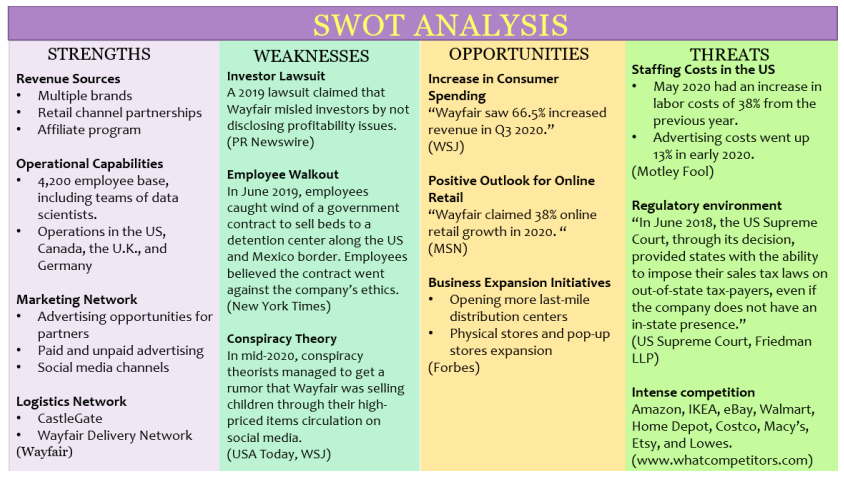
The said St. Edward’s University paper visualizes Wayfair’s SWOT analysis as follows:
Wayfair Target Audience & Target Market
No need to say, Wayfair’s marketing strategy success stems from its clear understanding of the target audience.
So much so that, company has developed sophisticated customer segmentation strategies that inform all marketing decisions.
According to the same university research:
Wayfair’s five lifestyle brands focus on the mass market customer, targeting female customers from ages 35 to 65 with a household income ranging from $50,000 to $250,000.
The target market characteristics include:

What’s more, Wayfair’s target customers exhibit specific shopping behaviors, obviously:
- Research-Oriented: 82% of Wayfair customers do research online before making significant purchases.
- Mobile-First: Recognizing that 79% of their customers use their phones to shop online.
- Value-Seeking: Customers look for competitive pricing combined with convenience, quality, and selection.
- Repeat Purchasers: Strong loyalty patterns emerge, with repeat customers visiting on average after making four or more orders.
Wayfair Marketing Strategy
The time has come to discover how Wayfair’s marketing strategy dominates the entire home goods industry.
Before diving into the details, we can simply say that Wayfair’s marketing strategy integrates multiple channels and tactics, from data-driven decision-making processes to creative brand building. These marketing tactics include:
- ROI Focus: Wayfair marketing campaigns are carefully tracked and monitored to maintain appropriate return targets.
- Customer Lifecycle Management: The company uses CRM systems to move customers through the buyer’s journey and encourage repeat purchases (and the brand perfectly achieves it).
- Omnichannel Integration: Marketing efforts span digital and traditional channels, creating a unified brand experience, both in-store and online experiences.
- Brand Portfolio Strategy: Different brands (we mentioned above) target specific customer segments with tailored messaging.
As we stated above, Wayfair invests heavily in acquiring new customers; remember the advertising expenses worth almost $1.5 billion for only a year. That, indeed, represents a significant commitment to customer acquisition.
Let’s be more specific about Wayfair’s marketing strategy by looking at acquisition tactics:
- Paid Search Advertising: Using targeted keywords and compelling call-to-action extensions.
- Display Advertising: Banner ads across relevant websites and platforms.
- Social Media Advertising: Paid Wayfair marketing campaigns on Facebook, Twitter, Pinterest, and Instagram.
- TV Advertising (Traditional Marketing): The company has aired 206 television ads, and that’s big when compared to other home goods brands.
In addition to “direct” TV ads, the brand also prefers product placements on well-known TV shows, like The Kelly Clarkson Show.
- Direct Mail: Physical catalogs and promotional materials sent to targeted households.
- Comparison Shopping Engines: Presence on platforms where customers research purchases.
The company also benefits from organic acquisition through:
- Word-of-Mouth Referrals: Satisfied customers recommend Wayfair to friends and family.
- Search Engine Optimization: High organic rankings for home goods-related searches.
- Brand Recognition: Strong awareness driving direct traffic to sites.
And retention is a critical part of Wayfair’s marketing strategy; as we stated above, it is possible to say that a major part of the sales comes from existing purchasers. It’s not surprising that the brand has bold retention initiatives like the Wayfair Rewards Program.
Launched in October 2024, this loyalty program offers great benefits to members in return for payment of a membership fee:

Source: https://www.wayfair.com/wayfair-rewards
Apart from that, private label credit cards are great at building loyalty via cash-back rewards on purchases.
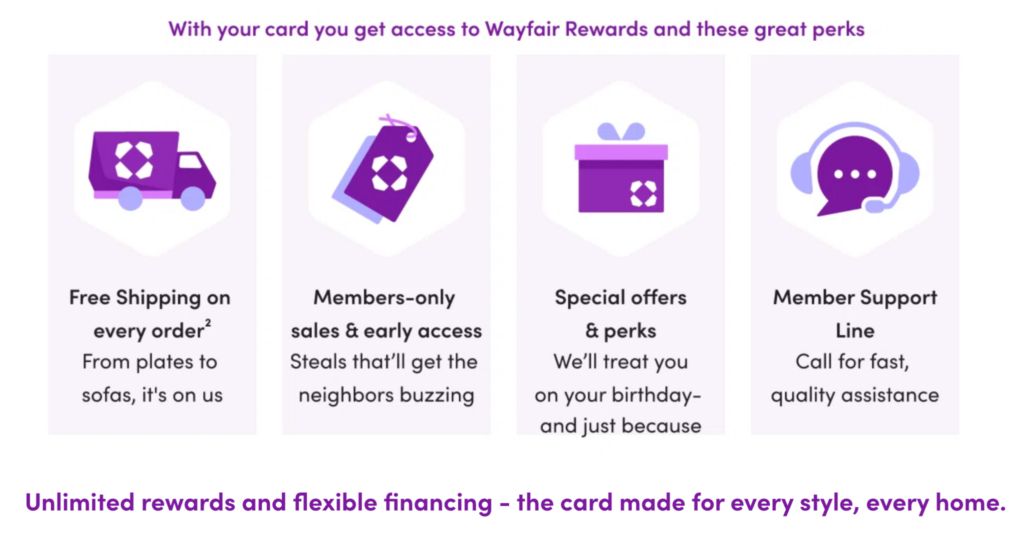
Source: https://www.wayfair.com/wayfaircard
What’s more, with more than 2,000 full-time customer service employees, the brand provides 24/7 customer care.
Finally, the free shipping threshold and flexible return policy are excellent marketing initiatives that encourage people to purchase from Wayfair.
Wayfair Digital Marketing Strategy
Wayfair’s overall marketing strategy works well, right? The brand is also good at digital marketing; the company has built sophisticated capabilities across multiple digital channels to reach and convert customers throughout their journey.
Take Wayfair’s website as an example:
Wayfair’s websites serve as the primary customer touchpoint. The company invests continuously in improving user experience by investing in:
- High-quality imagery and styling help customers envision products in their homes.
- Advanced search and filtering capabilities enable customers to find items matching their needs from the vast catalog.
- Mobile app with enhanced functionality for on-the-go shopping.
- AR and VR power to enhance the shopping experience.
Speaking of AR/VR technology, remember the “View in Room 3D” campaign:
This Wayfair marketing campaign showcases interactive product visualization, a reduction in returns through better purchase decisions, and social media sharing of room designs.
At this point, we need to mention Wayfair’s biggest digital marketing push: the Way Day Annual Sale Event. You may know, Way Day, which typically takes place in April, features 36 hours of doorbusters and deals.
And what about Wayfair’s digital advertising efforts? Actually, paid search represents a major component of Wayfair’s digital strategy. The approach includes keyword targeting, shopping ads (product listings), and dynamic bidding for home goods.
Especially, display ads extend Wayfair’s reach across the web:
- Retargeting Campaigns: Showing ads to users who have visited Wayfair sites,
- Prospecting Campaigns: Reaching new audiences based on demographics and interests,
- Dynamic Product Ads: Displaying specific products users have viewed,
- Programmatic Buying: Automated ad purchasing optimizes reach and efficiency.
In addition to that, organic search traffic is also important for the brand since it offers cost-effective customer acquisition: quality content creation, technical SEO, product page optimization, and brand authority building are part of that approach.
And email marketing remains a powerful channel for Wayfair as a part of its digital marketing strategy.
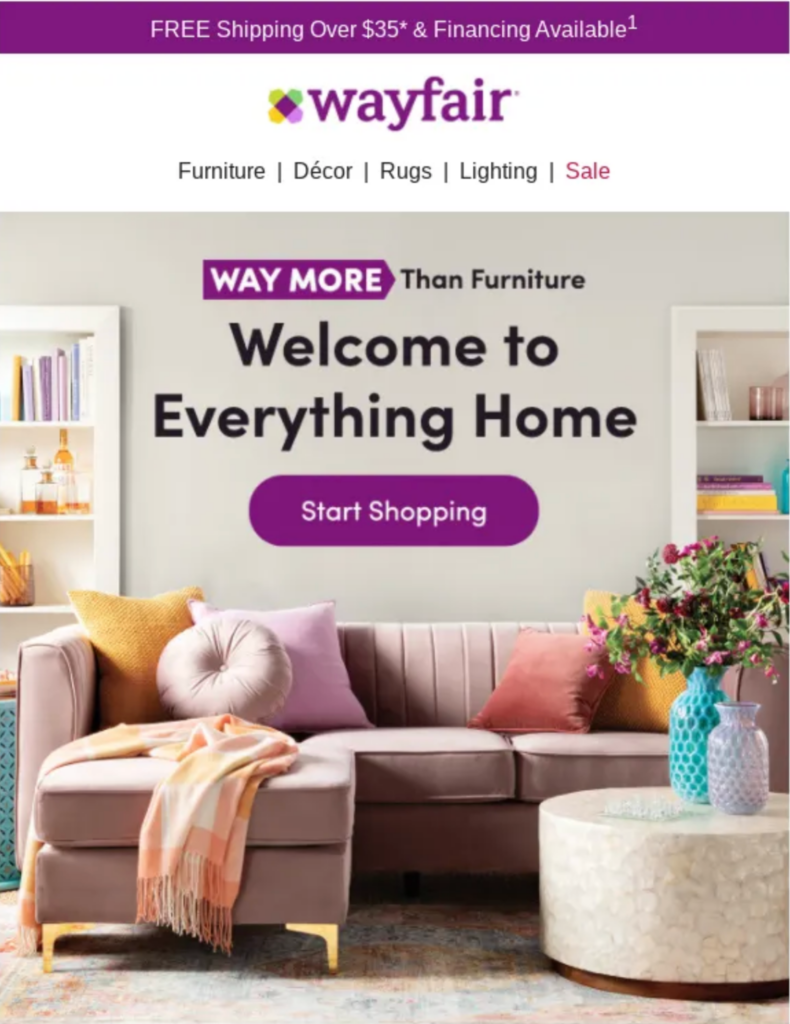
Wayfair states on its website that it sends out daily emails “to millions of customers,” and it has even developed an email platform for the purpose of optimizing email cadence:
“Wayfair and its subsidiary brands operate globally, and we send out millions of marketing emails every day to communicate with our customers. To improve customer satisfaction and increase customer engagement, we have developed a new generation of daily sales email models (Nightingale) to make email sending decisions.”
Nightingale’s working principle is as follows:
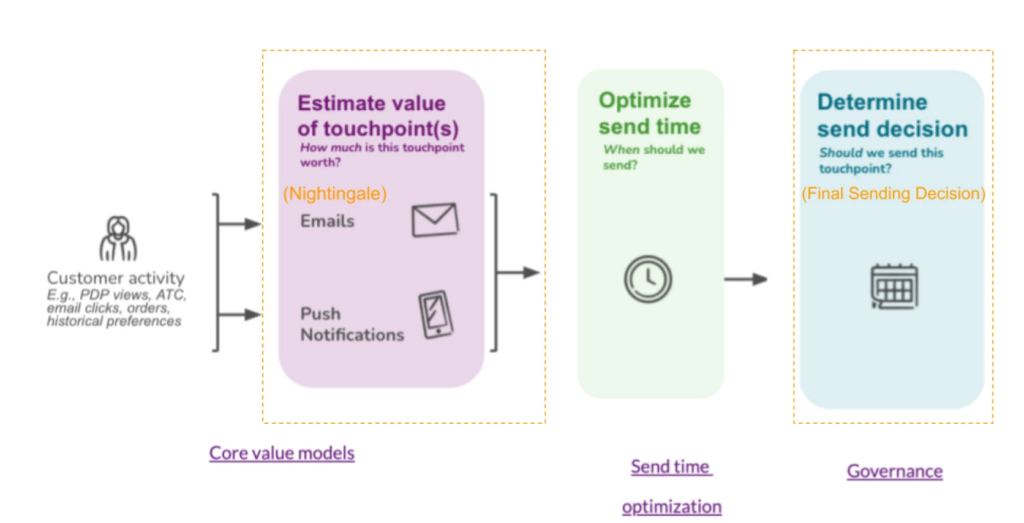
With that model, Wayfair “balances customer engagement benefits and unsubscribe costs” while “predicting whether each customer will.”
Finally, mobile marketing strategy offers a seamless shopping experience for customers. Wayfair’s mobile strategy includes:
- Mobile App Development: Dedicated iOS and Android applications with enhanced features.
- Push Notifications: Timely alerts about sales, shipping updates, and recommendations.
- Mobile-Optimized Sites: Responsive design & excellent mobile web experiences.
- App-Exclusive Features: AR visualization and other capabilities drive app adoption.
Wayfair Social Media Strategy
It could be a mistake not to mention Wayfair’s social media strategy when discussing digital marketing.
What makes Wayfair’s social media strategy so effective is how genuinely they connect with real people living real lives. Scroll through their Instagram feed, and you won’t see a bunch of sterile showroom shots. Instead, you’ll find cozy morning coffee routines, families gathered around dining tables, and dogs lounging on new sofas.

Source: https://www.instagram.com/wayfair/
It feels less like advertising and more like peeking into a friend’s beautifully decorated home.
In other words, Wayfair masters the art of showing products in action within everyday moments. Not by shouting “buy this couch,” they show you someone curled up reading a book on that couch on a rainy afternoon.
Check out this perfect example of their approach:
In fashion & retail marketing, this type of content always works because it’s relatable. Also, the vibe is always friendly and sincere, never pushy. Wayfair understands that people want to imagine their family gathering around it for Sunday brunch.
Another social media tactic where Wayfair really shines is its micro-influencer strategy. In addition to working with a few mega-celebrities like Kelly Clarkson and Blake Griffin, they partner with hundreds of smaller creators. They are everyday people with 10,000 to 100,000 followers who have genuine connections with their audiences.
Why does this work so well? Because these micro-influencers feel authentic. When @the_real_lin_shady (70K followers) shows off her Wayfair products in her kitchen, her followers trust her opinion. She’s just like them, a real person decorating her home on a real budget. The content doesn’t feel like an ad; it feels like advice from a friend.
Perhaps Wayfair’s smartest move is encouraging customers to share their own content (UGC strategy). When someone receives their new couch and posts about it on Instagram, Wayfair often reposts it (with permission).

It’s authentic social proof at scale. Real customers, real homes, real recommendations.
Unlike many other home goods brands, Wayfair does not separate its Instagram and TikTok content strategies from each other. You can see the same videos & images on these two platforms in the same order. However, the brand is authentic when it comes to Pinterest, where it has almost 3 million followers.
Wayfair creates boards organized by style and room type, making it easy for users to discover and save ideas. Every pin links directly to purchasable products, turning daydreaming into shopping effortlessly.

Source: https://tr.pinterest.com/wayfair/
Wayfair vs IKEA: Competitive Positioning in the Home Goods Market
When it comes to home furnishings, IKEA comes to mind immediately. And it is impossible not to compare a brand with IKEA in that case.
Let’s start with the bottom line. IKEA generated €45 billion (approximately $49 billion) in revenue for fiscal year 2024, making it nearly four times larger than Wayfair’s $12 billion in annual revenue. It’s not surprising when considering IKEA has been in business since 1943, operates 483 stores across 63 countries, and employs over 216,000 people globally. Wayfair, founded in 2002, operates primarily online with minimal physical presence and a much leaner workforce.
The fundamental difference between Wayfair and IKEA lies in their business models, and this shapes everything about how they market themselves.
IKEA’s brand is synonymous with affordable, functional design. Decades of consistent messaging, iconic product names, and memorable in-store experiences have created powerful brand equity globally. IKEA marketing emphasizes minimalist design and sustainability.
On the other hand, Wayfair has built impressive brand awareness rapidly through aggressive marketing. As we mentioned before, the company greatly aided brand awareness through multi-channel campaigns including television advertising, digital marketing, and social media.
What’s more?
IKEA designs and manufactures most of its products, then sells them through company-owned stores and websites. And the brand generates 71% of its revenue from physical stores, 28% from online stores, and 3% from customer services like delivery and assembly.
Wayfair, by contrast, operates a fundamentally different marketplace model. So much so that the company does not handle more than 95% of the goods offered on the website. This asset-light approach enables Wayfair to offer exponentially more variety without the inventory risk and capital requirements of traditional retail.
Perhaps the most distinguishing feature of the IKEA vs. Wayfair battle is the shopping experience.
As you are already aware, shopping at IKEA is a memorable experience. That became so popular that a term was coined: IKEA dating. People visit stores and imagine their future homes with their “significant others.” Sounds Gen Z, right?
When we look at Wayfair marketing strategy, we cannot mention that kind of in-store experience since the brand is built for people who want convenience. It means you can browse 30 million products from your couch, read thousands of customer reviews, use augmented reality to visualize furniture in your room, and order with one click. From a marketing perspective, there is no romantic thing about it; however, it’s highly pragmatic.
For a marketer, the most important difference between these two brands is how they approach marketing campaigns.
Each year, we witness a groundbreaking IKEA ad. Remember the Simpsons Living Room Recreation or the Bookbook ad? Or this year’s viral campaign, Hidden Prices? Price tags were blurred in print in that campaign, shot by Marloes Haarmans for Mother London, and sparked instant media attention by flipping low-cost tropes to highlight quality.
And all are discussed, applauded, and praised by both marketing professionals and consumers.

Source: Hidden Prices campaign, Ikea, Mother
So, we can simply say that IKEA invests in storytelling and humor for cultural impact, often going viral through TV/print/outdoor ads. Wayfair prioritizes ROI-focused digital ads, SEO, and personalization to drive direct sales.
What about other differences? Take a look at the following comparison table:

FAQ about Wayfair Marketing Strategy
How does Wayfair acquire new customers cost-effectively?
Wayfair’s marketing strategy centers on “aggressive” digital advertising and customer-centric approaches that have made it a dominant force in online retail. The company drives furniture sales at scale through multi-channel digital campaigns, including search engine marketing, display advertising, social media,kmı and email marketing. Their Wayfair marketing strategy emphasizes personalization, using browsing behavior and purchase history to serve targeted product recommendations. So, the company invests in brand awareness campaigns while running performance marketing that directly drives conversions in the online home goods industry.
How does Wayfair’s marketing strategy and analytics work together to optimize customer acquisition?
The Wayfair marketing strategy relies on sophisticated analytics to optimize customer acquisition costs and conversion rates, as we mentioned above. The brand integrates real-time data analysis into every Wayfair promotion and campaign, tracking metrics like CAC, ROAS, and conversion rates across channels. Their analytics platform identifies which marketing touchpoints are most effective. This means each online retail initiative is refined based on performance metrics.
What is the difference between Wayfair’s market strategy and its overall business model?
While Wayfair’s market strategy is concerned with how it positions itself and attracts customers in the online retail furniture market, its business model describes how it generates revenue and operates. The Wayfair marketing strategy (market-facing) focuses on competitive pricing, vast selection, and convenient delivery as key differentiators. In contrast, the business model operates primarily as a drop-ship marketplace connecting suppliers with consumers, minimizing inventory costs. So, the market strategy is the customer-facing execution, while the business model is the underlying operational and financial structure.
How does Wayfair’s promotion marketing strategy influence repeat purchases and customer lifetime value?
Wayfair’s promotion marketing strategy simply influences repeat purchases and customer lifetime value through carefully designed incentive programs. Their Wayfair promotion tactics include first-time buyer discounts, email-based promotional codes, flash sales, and loyalty rewards that encourage customers to return. This online retail promotional approach balances customer acquisition with retention, using personalized Wayfair promotion offers based on past purchases to increase basket size and purchase frequency.
How does Wayfair approach advertising across digital channels compared to competitors?
While legacy retailers (like IKEA) split budgets between print, television, and digital, Wayfair marketing concentrates exclusively on digital channels, apart from a few TV ads and TV show appearances. Unlike competitors who may rely on brand heritage, Wayfair marketing focuses on product variety and competitive pricing in its messaging. So much so that the company outspends many competitors in Google Shopping and Facebook advertising. It enables them to rapidly acquire customers from various demographic segments.
Wayfair vs IKEA: How do their marketing strategies differ in terms of e-commerce and brand experience?
Actually, the Wayfair marketing strategy and IKEA’s approach represent “fundamentally different philosophies” in e-commerce and brand experience. IKEA’s marketing emphasizes the in-store treasure hunt experience, showroom immersion, and democratic design philosophy, with e-commerce as a supplementary channel. In contrast, Wayfair marketing is built entirely around digital-native experiences, like virtual room planning tools, augmented reality features, and extensive online reviews. Wayfair advertising highlights convenience, selection breadth (millions of products versus IKEA’s curated thousands), and doorstep delivery, while IKEA markets affordable Scandinavian design and the satisfaction of self-assembly. Where IKEA’s brand experience creates destination shopping, Wayfair marketing eliminates friction through search functionality and personalization.
How does Wayfair’s data-driven marketing strategy support personalization and pricing decisions?
According to their annual reports, the company collects extensive behavioral data (browsing patterns, search queries, time spent on products, cart abandonment). And it obviously feeds into their Wayfair advertising personalization engine. This approach also means serving individualized product recommendations, customized email campaigns, and tailored Wayfair advertising creative. For pricing decisions, the data-powered marketing approach analyzes competitor pricing, demand elasticity, inventory levels, and customer segments in real time. Wayfair advertising can dynamically adjust promotional messaging based on these insights, showing different offers to different customers.