















The Charles on GEO: From Rankings to Citations in AI-Driven Search
As generative AI continues to reshape search, one of the most important shifts lies in how visibility is earned. Rankings still matter, but they are no longer the end goal.
In this final edition of The GEO Series, James Ward, Associate Media Director at The Charles Group, shares a perspective that reflects how agencies are adapting to this shift in real time. GEO is not treated as a separate discipline, but as an evolution of SEO within existing structures.
Based in Los Angeles, The Charles Group approaches GEO as a core growth driver, with strong demand from clients who are already navigating the impact of AI-generated answers.
GEO Strategy & Services
At The Charles Group, GEO is integrated directly into SEO services.
The foundations remain familiar: strong content structure, authoritative sourcing, and topical relevance. What changes is how those foundations are applied within AI-driven environments.
GEO becomes part of the same system, shaped by how content is interpreted, selected, and surfaced across generative platforms.
Client demand reflects this shift.
Most clients are already asking about GEO, signaling that awareness has moved beyond early experimentation and into active adoption.
What The Charles Group’s GEO Services Include
According to James Ward, GEO builds directly on SEO principles, extending them into AI-driven discovery.
On-site, the focus is on optimizing content for AI readability, ensuring information is structured, modular, and easy to extract.
Off-site, attention shifts toward citation presence, strengthening how brands appear across the sources AI models rely on.
This includes:
- Improving content structure and clarity
- Strengthening topical authority
- Increasing third-party mentions and citations
- Aligning content with how AI systems synthesize information
Commercially, GEO is scoped flexibly, following a model similar to SEO, allowing it to scale based on client needs and maturity.
How The Charles Group Structures GEO Services
GEO at The Charles Group is supported by a cross-functional model, with responsibilities evolving across teams.
Rather than assigning ownership to a single function, GEO is shared across disciplines, enabling:
- Alignment between SEO, content, and media teams
- Consistent messaging across channels
- More adaptive execution
This structure reflects how GEO operates in practice.
Visibility is not created in isolation. It emerges from how multiple signals work together across the ecosystem.
How GEO Actually Works
James Ward describes one of the most important shifts in clear terms:
“Search engines rank pages based on keywords and authority. Generative AI systems synthesize multiple sources into a single response and this changes the nature of competition.”
Instead of competing to rank, brands are competing to be cited within the answer itself.
That visibility is built through:
- Third-party mentions
- Reviews and directories
- Authoritative publications
Content still plays a critical role, but its purpose expands. It must be structured in a way that allows AI systems to interpret and reuse it effectively.
Measuring GEO Performance
Measurement at The Charles Group focuses on how brands appear within AI-generated environments.
The primary KPIs include:
- AI Share of Voice (brand visibility in AI answers)
- AI-assisted traffic quality and conversion influence
To deepen this analysis, the team combines performance data with sentiment analysis and funnel-based tagging. This allows them to understand how the brand is positioned across different stages of the discovery process.
Two challenges continue to shape this area:
Reporting GEO performance in a meaningful way
Educating clients on what GEO actually is
Generative Engine Optimization Tools & Platforms
For The Charles Group, GEO spans a broad set of AI platforms.
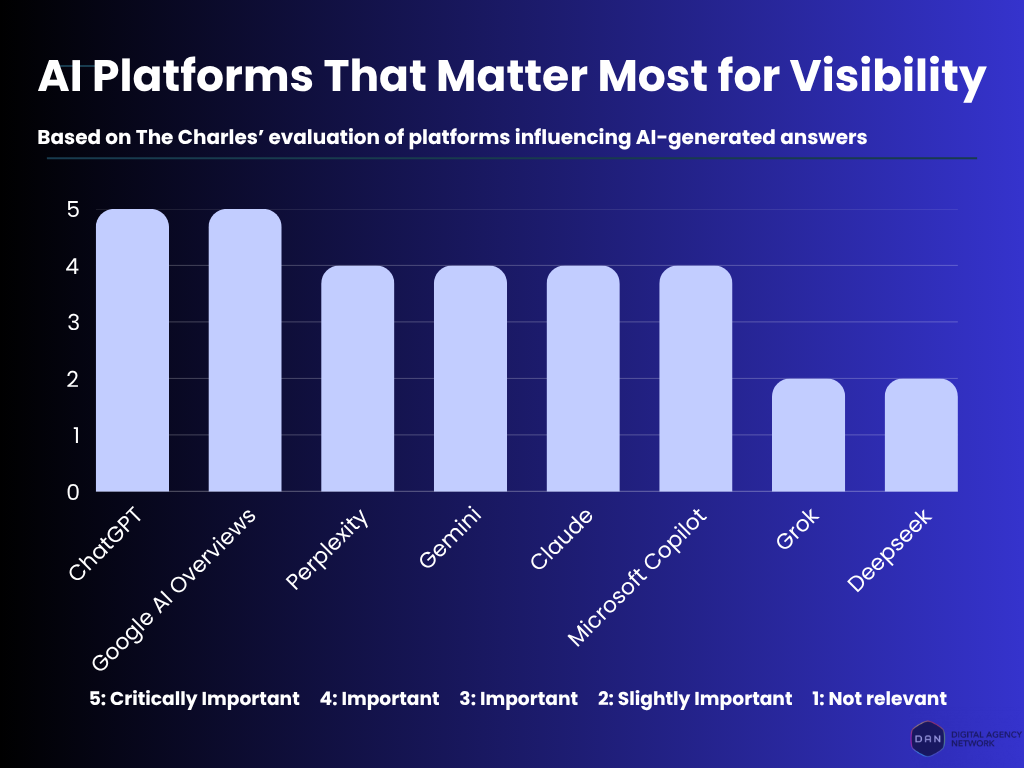
Today, ChatGPT and Google AI Overviews are considered critically important, while platforms like Perplexity, Gemini, Claude, and Microsoft Copilot play a supporting role.
To support this, the team relies on:
- Google Search Console and Google Analytics
- SEMrush
- GEO-specific tools such as SEMrush AI Visibility Toolkit and HubSpot’s AEO Grader
A key limitation remains consistent here as well. According to James Ward, one of the biggest limitations of current GEO tools is limited transparency from AI platforms.
Without clear insight into how content is selected and cited, optimization depends on continuous testing and interpretation.
The Future of GEO
Looking ahead, James Ward sees GEO evolving as a natural evolution of SEO within existing structures.
This perspective brings the series full circle.
GEO is not replacing SEO. It is reshaping how its principles are applied.
As AI continues to influence how users discover and evaluate information, success will depend on how well brands can:
- Structure their content
- Build authority across sources
- Maintain consistency across platforms
Closing Thoughts: What The GEO Series Reveals
Across 11 agencies, GEO is no longer being explored, it is being operationalized.
What stands out is not a single unified approach, but a clear acceleration in maturity. Agencies are moving beyond defining GEO and are now actively structuring, packaging, and delivering it in different ways.
Some embed it within SEO, while others build it as a standalone service. Or even, some formalize it through frameworks and internal models.
Despite these differences, a set of consistent patterns emerges:
-
✅ Visibility is no longer about ranking, it is about being selected and cited within AI-generated answers
✅ Authority is increasingly built off-page, through third-party mentions, citations, and brand signals
✅ Content is shifting from page-level optimization to structured, modular information designed for extraction
✅ GEO is moving closer to performance, influencing consideration, trust, and conversion, not just awareness
✅ Measurement remains directional, with agencies balancing emerging KPIs against limited platform transparency
Taken together, these shifts redefine the role of search.
Search is no longer a system that retrieves links. It is a system that interprets, synthesizes, and delivers answers.
In that environment, visibility is no longer earned once. It is continuously shaped by how consistently a brand is understood across sources, platforms, and contexts.
The agencies leading this shift are not the ones experimenting with GEO.
They are the ones building systems around it.