















GEO Service Pricing: Structuring Your Agency’s AI Search Packages
If you’re running an agency and advising brands/clients or AI visibility, you’ve probably felt the tension already. Everyone agrees that generative engine optimization matters. Few agree on what GEO service pricing should actually look like.
We’re at an inflection point. AI-driven search experiences are reshaping discovery, trust, and decision-making at speed. McKinsey estimates that generative AI could unlock $4.4 trillion in annual productivity gains across industries, with marketing and sales among the most impacted functions. At the enterprise level, 34.7% of organizations use AI for marketing or sales purposes. All of these confirm how central these technologies have become for revenue-generating functions.
This blog examines AI search service pricing, actual costs, practical GEO pricing models, and how agencies can package and sell generative engine optimization without overpromising.
What’s Inside
- Why GEO Is a Strategic Service
- What Agencies Are Actually Pricing in GEO Services
- Common GEO Pricing Models Agencies Use
- How to Package GEO Services Without Overpromising
- Pricing GEO for Different Client Types
- FAQ about GEO Service Pricing
Why GEO Is a Strategic Service
GEO exists because search behavior has changed faster than pricing frameworks.
As we explained in detail in our blog titled Do You Need a GEO Agency, traditional SEO assumed a user typed keywords, scanned blue links, and clicked through. Generative search compresses that journey into a single synthesized answer. Whether it’s ChatGPT with browsing, Google AI Overviews, or Gemini- or Perplexity-style engines, the outcome is that brands are either cited, summarized, or invisible.
So, from an agency perspective, generative engine optimization is not emerging because it’s fashionable. It’s emerging because the mechanics of visibility have changed, and agencies are now being asked to defend, extend, and future-proof brand presence inside systems they do not control.
The GEO Best Practices Guide from Orange 142 captures this shift clearly:
Generative AI is upending the traditional customer journey by collapsing research, comparison, and decision-making into a single interaction.
If a brand is not present in the AI-generated answer, no amount of downstream optimization matters. That’s why GEO is a strategic positioning for AI-mediated markets.
What Agencies Are Actually Pricing in GEO Services
Since GEO is a “relatively new marketing service,” you may think that GEO pricing is a little bit chaotic. One reason for this is that many agencies continue to sell outcomes without clearly defining the inputs.
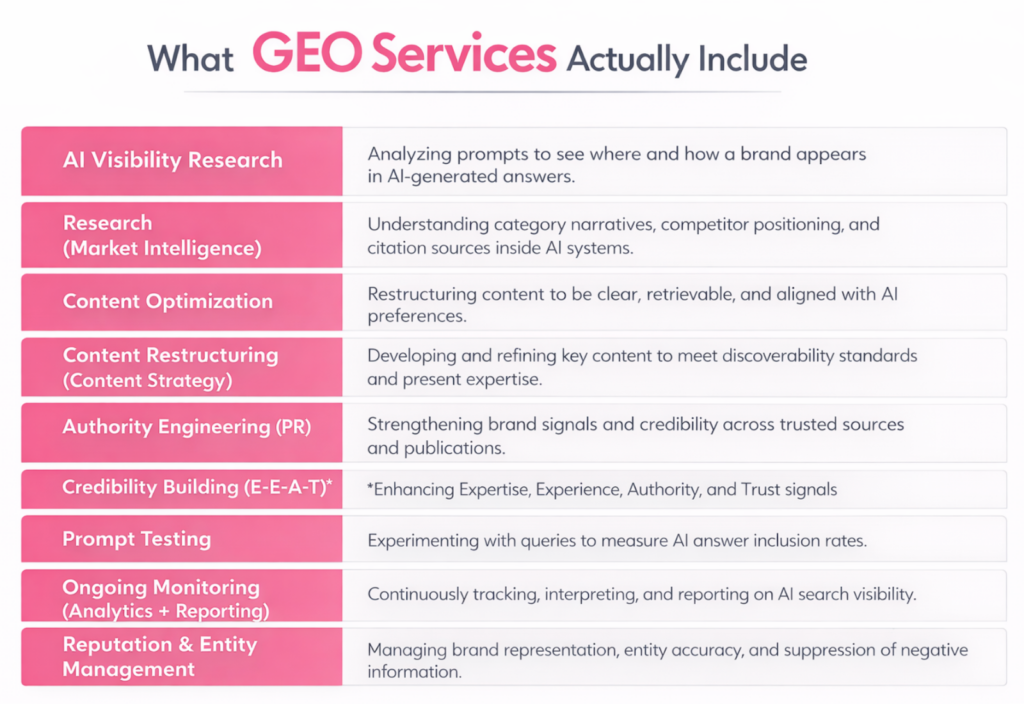
So, GEO is not one service; it’s 3–4 services collapsed into one scope.
What’s more, building a bold GEO plan and execution requires senior strategists, SEO leads, content architects, AI and prompt engineers, and PR/authority specialists to work together in some cases. Not juniors executing checklists.
Before we unpack the figures, we want to express that generative engine optimization looks expensive because it is bundling multiple senior-level services that used to be sold separately.
Not specific enough? Let’s see how agencies price GEO services:
AI Search Research and Prompt Mapping
This is the foundation of any credible GEO engagement.
Unlike SEO keyword research, GEO research focuses on:
- How users phrase questions in natural language,
- Which prompts trigger AI answers?
- Where brands appear (or don’t) in those responses,
- Which sources do AI systems cite repeatedly?
In some research & documents, it can be described as “reverse-engineering visibility.” It emphasizes that prompts are largely invisible and must be inferred through testing and pattern analysis.
Content and Knowledge Restructuring for AI Retrieval
As we mentioned before, AI systems don’t read content the way humans do.
They prioritize:
- Clear entity relationships,
- Structured explanations,
- Authoritative tone,
- Consistency across sources.
Otterly.ai notes that AI search engines heavily favor content that explains concepts holistically rather than targeting isolated keywords. That means restructuring blogs, guides, FAQs, and even product pages to serve as machine-readable knowledge assets.
This work often includes:
- Content rewrites,
- Schema and metadata refinement,
- Knowledge hub creation,
- FAQ and explainer expansion.
Authority and Source Trust Engineering
Here’s where GEO diverges sharply from traditional SEO pricing.
AI systems weigh authority differently. They look for:
- Brand mentions across trusted domains,
- Consistent factual alignment,
- Citations from reputable sources,
- Demonstrated expertise.
The GEO best practices address that PR, thought leadership, and third-party validation are now core GEO levers. Otterly.ai highlights that within earned media, positioning, PR, and comms mean so much in GEO.
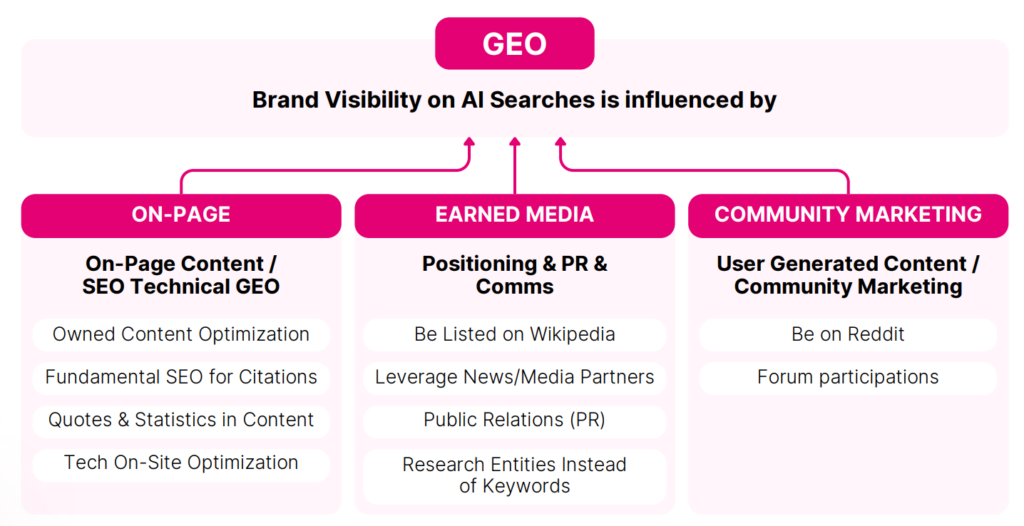
This means agencies are pricing:
- Digital PR campaigns,
- Expert content placements,
- Source alignment audits,
- Wikipedia and knowledge graph hygiene (where appropriate).
Ongoing Testing, Monitoring, and Iteration
GEO is not set-and-forget. According to OpenAI’s Identifying and Scaling AI Use Cases report, 39% of adults have already used AI within just two years, and it is expected to double in a few years.
Not only is the usage percentage changing.
AI models change frequently, as well. Prompt behavior shifts. Source preferences evolve. According to McKinsey’s Superagency research, AI systems are improving task performance at an exponential rate, with capabilities doubling roughly every seven months.
That volatility is why monitoring matters.
This includes:
- Tracking brand mentions in AI responses,
- Monitoring citation frequency,
- Testing prompt variations,
- Adjusting content based on AI outputs.
At that point, we also would like to remind you that GEO services can be named differently by service providers, even though the work done is the same. For instance, one of our GEO agencies in the UK, GA Agency, lists its GEO services as follows:

Source: https://ga.agency/en/generative-engine-optimisation/
Apart from the London-based ones, GEO agencies in the USA as well express their work in different sub-service names. This is not surprising given that generative engine optimization is a relatively new era. The main point is to understand what types of outcomes brands can achieve and with whom.
Common GEO Pricing Models Agencies Use
Now let’s talk structure. These are the GEO pricing models we see working in practice.
Retainer-Based GEO Models
Actually, this is the most sustainable option for agencies and clients alike. A retainer typically bundles prompt research, content optimization, authority building, monitoring, and reporting.
Typical GEO pricing:
- $2,000–$4,000/month for entry-level GEO retainers
- $5,000–$8,000/month for mid-market brands
- $8,000–$15,000/month for Enterprise GEO programs
From a margin standpoint, this mirrors how agencies priced SEO retainers a decade ago—but with higher strategic value.
Project-Based GEO Engagements
This model pricing works best for initial audits, proof-of-concept engagements, and internal enablement.
Examples include:
- GEO readiness assessments,
- AI visibility audits,
- Knowledge base restructuring projects.
Typical pricing:
- $2,000–$8,000 for GEO audit projects
- $8,000–$15,000 for content restructuring projects
The risk with project-based pricing is expectation creep if ongoing optimization isn’t clearly excluded.
Hybrid SEO + GEO Pricing Structures
Hybrid SEO + GEO pricing structures are becoming the most practical and defensible model in the market right now. From an agency perspective, this approach acknowledges two truths at once: traditional search still drives revenue, and AI-driven search is already reshaping discovery.
What agencies are actually doing is adding GEO as a scoped upgrade. This protects existing retainers while opening new revenue without forcing clients into an unfamiliar category overnight.
Typical hybrid structures look like:
- Core SEO retainer (unchanged scope),
- GEO add-on covering prompt research, AI visibility monitoring, and content restructuring,
- Separate reporting for AI-driven visibility and citations
Typical pricing:
- +$1,500–$3,000/month for SMB and mid-market clients
- +$4,000–$6,000/month for enterprise SEO accounts
The hybrid model works because it aligns with how clients already think about search budgets while gradually educating them on the importance of GEO.
In summary, here is a comparison of GEO pricing models:
| Model | Tier / Engagement | Pricing range |
|---|---|---|
| Retainer-Based GEO Models | Entry-level retainers | $2,000–$4,000 / month |
| Mid-market brands | $5,000–$8,000 / month | |
| Enterprise GEO programs | $8,000–$15,000 / month | |
| Project-Based GEO Engagements | GEO audit projects | $2,000–$8,000 / project |
| Content restructuring projects | $8,000–$15,000 / project | |
| Hybrid SEO + GEO Pricing Structures | SMB & mid-market add-on | +$1,500–$3,000 / month |
| Enterprise SEO account add-on | +$4,000–$6,000 / month |
Bonus: GEO as a White-Label Service
For PR agencies, content studios, and startups, white-label GEO allows them to participate in AI search optimization without hiring new strategists & team or building proprietary frameworks.
In a white-label model, a specialized geo agency handles research, optimization, and monitoring. The partner agency owns client communication and positioning. In that case, GEO is presented as part of a broader strategy.
This structure is especially appealing because GEO often requires senior-level interpretation and iteration. What about pricing for that service?
Typical wholesale pricing falls in the range of:
- $3,000–$8,000/month depending on scope and client size
Those services are then resold at:
- $6,000–$15,000/month as part of a bundled offering
From an agency perspective, white-label GEO is less about margin maximization and more about speed-to-market and risk management while the category matures.
How to Package GEO Services Without Overpromising
One of the fastest ways to lose trust in generative engine optimization is to package it like a “performance channel.”
GEO does not behave like paid media. It does not offer deterministic outcomes. And agencies that position it as “guaranteed AI inclusion” quickly create expectations they cannot control.
The strongest GEO packages are framed around probability and preparedness.
It means clearly defining what GEO influences, how to measure GEO, and where uncertainty still remains.
Setting Clear Boundaries on What GEO Can and Can’t Control
From an agency standpoint, boundary-setting is essential.
GEO can influence:
- How clearly a brand’s expertise is structured,
- Whether content is retrievable and understandable to AI systems,
- How consistently a brand appears across authoritative sources,
- The likelihood of being cited or summarized accurately.
GEO cannot control:
- When or whether an AI model selects a specific brand,
- How frequently models update or change their weighting logic,
- The exact wording of AI-generated responses,
- User-specific variations in AI outputs.
Successful agencies bake these boundaries into proposals, onboarding materials, and reporting from day one. This reframes GEO as ongoing optimization.
Communicating Uncertainty Without Losing Trust
In agency practice, one of the hardest parts of selling generative engine optimization is the uncertainty in outcomes. Especially compared with traditional SEO, paid media, or performance channels with defined KPIs.
Clients reasonably want clarity: “Can you deliver visibility inside AI answers every time?” The honest answer is that no agency can guarantee that.
With the rise of zero-click, search experiences are already being altered. This has two practical implications for agencies and clients:
1) There is diminishing transparency in how traffic and visibility are measured.
Metrics like pageviews, rankings, and clickthrough rates matter less when AI systems directly synthesize answers.
2) Traditional SEO metrics become less predictive of true influence.
Brand traffic might remain stable while AI-driven visibility erodes behind the scenes, a nuance most clients cannot see in standard dashboards.
Clients may push back at first (uncertainty feels like risk), but framing it clearly builds trust. When you demonstrate that you understand where control genuinely lies (and where it doesn’t), clients are far more comfortable investing in an ongoing optimization process.
This approach ultimately positions GEO as a managed capability, similar to strategic SEO or digital PR.
Pricing GEO for Different Client Types
Pricing GEO services effectively requires agencies to move away from one-size-fits-all retainers and instead anchor scope to how AI visibility is measured and managed for different types of organizations.
We know that traditional SEO, rankings, and traffic volumes provide universal benchmarks. However, GEO performance is evaluated through a different lens. Metrics such as AI search visibility metrics, generative search tracking, and AI answer inclusion rate vary dramatically depending on a client’s size, authority, and risk profile.
That variation is why GEO pricing must scale by client type.
GEO Cost for Startups
Let’s admit that early-stage companies & startups typically have limited historical authority, fewer third-party citations, and smaller content footprints. As a result, their AI visibility is less about volume and more about accuracy.
The main question is, when AI systems describe this space, is the startup represented correctly at all? At this point, agencies should focus on:
- AI answer inclusion rate for a narrow set of brand-defining prompts,
- Early generative search tracking to detect whether the brand is ever referenced,
- Qualitative AI outputs showing how the company is positioned relative to competitors.
Because AI search visibility metrics for startups tend to be sparse at first, GEO work is necessarily scoped.
Typical startup GEO packages include:
- Limited prompt research (core category and brand terms),
- Foundational content restructuring,
- Lightweight monitoring and reporting.
Realistic pricing for this level of effort usually falls between: $2,000–$4,000 per month.
At this tier, GEO should be positioned as foundational visibility insurance. Agencies that oversell impact at this stage risk eroding trust quickly.
GEO Cost for Established Brands and Market Leaders
And for well-known brands or market leaders, GEO pricing reflects a very different reality.
These organizations already appear in AI systems; the risk is how and how often. Their challenge is consistency, accuracy, and competitive control across a broad range of prompts.
At this level, GEO performance is evaluated using more mature AI search visibility metrics, such as:
- AI answer inclusion rate across categories, products, and use cases,
- Share-of-voice analysis through generative search tracking,
- Frequency and quality of brand citations relative to competitors,
- Stability of AI outputs over time as models update.
Because this kind of brands face reputational risk if AI systems misrepresent them, GEO becomes an ongoing governance function rather than a test initiative.
Typical scopes at this level include:
Broad prompt mapping across multiple markets or product lines,
- Authority and citation alignment,
- Continuous monitoring of AI answer inclusion rates,
- Executive-level reporting on visibility trends and risks.
Pricing for these programs commonly ranges from $10,000–$30,000 per month, depending on market complexity.
FAQ about GEO Service Pricing
How is GEO service pricing different from traditional SEO retainers?
The biggest difference between GEO vs SEO pricing is what agencies are actually being paid to manage. SEO retainers are built around relatively stable mechanics (such as rankings, crawlability, content cadence) while GEO pricing reflects ongoing interpretation inside systems. When agencies are pricing GEO services, they’re accounting for frequent testing and narrative control in AI-generated answers. That shift alone makes GEO feel closer to strategy work than classic SEO production.
What factors should agencies consider when pricing AI search services?
Think of pricing AI search more like a security service than a one-time product. Because AI rankings are so volatile and the tech evolves every week, agencies can’t just set a flat fee for “static work.” They have to factor in the constant monitoring, the brand’s current reputation, and the fact that the strategy might need to pivot tomorrow. It’s about paying for expertise and agility.
Should GEO be sold as a standalone service or bundled with SEO?
There’s no universal answer to how to price generative search services, but most agencies find that bundling GEO with SEO works better. Bundling friction for clients who already understand search retainers, while still introducing GEO as a distinct layer. Over time, as clients see that GEO operates differently from SEO, agencies often separate it into a standalone service focused on AI-driven visibility.
Can agencies guarantee results when offering GEO packages?
Agencies should be very cautious when presenting AI visibility service packages, because guarantees don’t align with how generative systems work. AI models update frequently, prompts behave differently across contexts, and inclusion is probabilistic by nature. What agencies can confidently promise is a structured process, but not fixed outcomes. Being upfront about that reality tends to build more trust than overconfident claims.
How do clients typically evaluate the ROI of GEO services?
Clients rarely judge the ROI of GEO the same way they judge SEO or paid media. As we mentioned above, ROI is evaluated through pricing GEO services against perceived risk reduction and influence. Whether the brand appears more often in AI answers, whether competitors dominate less, and whether AI descriptions align with brand positioning. Over time, clients come to see GEO as an investment in visibility and narrative control upstream of clicks.