











GA Agency is an international digital marketing agency in Soho, London, specialising in International SEO, GEO (Generative Engine Optimisation) and Paid Media. We help global brands grow visibility, acquisition and performance across markets through data-driven strategy and multilingual execution. Our in-house team works in 18 languages, giving brands a single agency with native expertise in every region. Founded by Guido Ampollini, formerly of Google and Expedia, GA partners with brands including UniCredit, Diesel, Expedia, Technogym, Prada, BNP Paribas and Calzedonia across fashion, luxury, beauty, travel and SaaS. We combine senior specialists, our own proprietary AI tools and performance marketing to help brands win across search, AI discovery and digital channels worldwide.
GA Agency
Gold MemberInternational digital marketing agency in London for SEO, GEO (AI search) and Paid Media. 18 in-house languages, growing brand visibility across global markets.
About
- HQ
- OFFICES
-
HEADQUARTERS
- ADDRESS: 33 broadwick street
- PHONE: (44) (7504) 941579
- E-MAIL: [email protected]
Service Expertise
Service Expertise
Sector Expertise
- Makeup
- Beauty eCommerce
- Personal Care
- Skincare
Sector Expertise
- Lingerie & Underwear
- Clothing Brands
- E-commerce Fashion
- Men's Clothing
- Fashion Accessories
Sector Expertise
- Food Service and Catering
- Alcoholic Beverages
- Consumer Goods
Sector Expertise
- Hotels & Resorts
- Luxury Hotels
Sector Expertise
- Luxury Fashion
Sector Expertise
- Commercial Real Estate
- Industrial Real Estate
Sector Expertise
- Beauty Retail
- Luxury Retail
Sector Expertise
- Adventure Travel
- Travel Agencies
- Tour Operators
- Tourist Attractions
GA Agency Reviews
Strongest differentiators
Its strongest differentiators are:- Strong multilingual and multicultural execution (18+ languages)
- Expertise in international market entry and localization strategy
- Data-driven approach across SEO, paid media, and eCommerce
- Ability to combine global strategy with local performance optimization
- Strong acquisition and performance capability across international markets
- Limited visible depth in advanced lifecycle marketing or deep technical infrastructure
- Less emphasis on highly experimental creative or brand-led storytelling
DAN Perspective
GA Agency fits best into the category of “global performance and market expansion partners”, making it a strong choice for organizations looking to scale internationally with localized, data-driven marketing strategies.Strategic Depth
Client feedback highlights GA Agency’s ability to design tailored strategies for entering new markets, balancing global reach with local cultural nuance to drive effective expansion.Execution Excellence
The agency demonstrates strong execution across SEO, paid media, and eCommerce strategies, delivering measurable improvements in KPIs through data-driven optimization and precise implementation.Speed & Reliability
Clients report responsive communication, structured workflows, and consistent delivery across international projects.Collaboration Quality
Feedback highlights a collaborative, integrated approach, with the agency functioning as an extension of the client’s internal team.Primary Expertise
Client outcomes strongly associate the agency with SEO, paid media, international marketing strategy, localization, and eCommerce performance.Value Creation Pattern
Reported gains cluster around improved KPIs, increased ROI, enhanced market penetration, and successful international expansion. Evidence around lifecycle systems or deep infrastructure engineering remains limited.Price–Performance Balance
Strong performance improvements and measurable ROI indicate high value perception, particularly for businesses targeting international growth.Transparency & Scope Clarity
Client feedback suggests structured execution and clear communication, though detailed pricing transparency remains limited.Client Satisfaction
Client sentiment is strongly positive, driven by performance outcomes, professionalism, and global execution capability.Referability
Clients demonstrate a high likelihood of recommending GA Agency, supported by strong results and long-term partnership alignment.Case Studies
International SEO Across 12 Markets for the Calzedonia Group
Client: Calzedonia Group
Industry: Fashion & Retail
- Digital Marketing
- Digital Strategy
- SEO

International SEO Across 12 Markets for the Calzedonia Group
GA Agency has managed International SEO for the Calzedonia Group since 2019, covering its main fashion brands (Calzedonia, Intimissimi, Tezenis and Falconeri) across 12 markets. We built an in-house team of native-speaker SEO specialists and copywriters for each country, replacing externally translated content with locally written and optimised content, supported by technical and local SEO. Within 12 months this produced a 170% increase in organic revenue across the four brands and 43 million users in one year.
Client: Calzedonia Group
Industry: Fashion & Retail
Location: Europe
Completed: Jun 2026
Client: Casavo
Industry: Real Estate
Client: Expedia
Industry: Travel & Tourism
Client: Pronovias
Industry: Fashion & Retail
830% Increase in Organic Sessions for Casavo
Client: Casavo
Industry: Real Estate
- Digital Marketing
- Digital Strategy
- SEO

830% Increase in Organic Sessions for Casavo
Casavo is a tech-enabled real estate company operating across Europe. From January 2020, GA Agency delivered SEO and content marketing to grow organic visibility and traffic. The work focused on on-page optimisation, keyword targeting, technical SEO and an editorial plan covering real estate, tax and law, produced with a detailed keyword and research brief. The programme delivered an 830% increase in organic sessions.
Client: Casavo
Industry: Real Estate
Location: Europe
Completed: Jun 2026
Client: Calzedonia Group
Industry: Fashion & Retail
Client: Expedia
Industry: Travel & Tourism
Client: Pronovias
Industry: Fashion & Retail
Content Marketing Driving 1.5 Million Sessions for Expedia
Client: Expedia
Industry: Travel & Tourism

Content Marketing Driving 1.5 Million Sessions for Expedia
Expedia is one of the largest online travel brands in the world. GA Agency supported Expedia’s travel magazine through content marketing, running keyword research, content planning and production, and managing the writing and publishing process to grow readership and rankings in its top markets of Italy, Spain and France. The programme delivered an increase of 1.5 million sessions.
Client: Expedia
Industry: Travel & Tourism
Location: Europe
Completed: Jun 2026
Client: Calzedonia Group
Industry: Fashion & Retail
Client: Casavo
Industry: Real Estate
Client: Pronovias
Industry: Fashion & Retail
Cross-Channel Paid Media and SEO for Pronovias: 290% Increase in Conversion Rate
Client: Pronovias
Industry: Fashion & Retail
- Digital Marketing
- Digital Strategy
- eCommerce
- Online Advertising
- PPC
- SEO

Cross-Channel Paid Media and SEO for Pronovias: 290% Increase in Conversion Rate
Pronovias is one of the largest global bridal fashion houses, founded in Barcelona in 1922. Facing rising low-cost competition, falling branded search demand and inflated CPA, the brand engaged GA Agency to overhaul its digital marketing across paid media and SEO. We ran a coordinated cross-channel strategy across seven markets: restructuring Google and Meta accounts around user intent, deploying Performance Max and Meta Advantage , and building a feedback loop where paid search query data directly shaped the SEO content strategy. This delivered a 290% increase in conversion rate through higher-quality in-store appointments, a 76% rise in US ranking keywords (Spain 16% year on year), and a 27% increase in organic sessions across all seven active markets.
Client: Pronovias
Industry: Fashion & Retail
Sector Expertise: Luxury Fashion
Location: Europe
Technologies: Google Ads, Performance Max, Meta Ads, Advantage , Google Analytics, Search Console
Completed: Jun 2026
Client: Calzedonia Group
Industry: Fashion & Retail
Client: Casavo
Industry: Real Estate
Client: Expedia
Industry: Travel & Tourism
Agency News
Universal Commerce Protocol: why market-by-market feed readiness matters.

Universal Commerce Protocol: why market-by-market feed readiness matters.
Google’s Universal Commerce Protocol is moving from announcement to infrastructure. At Google Marketing Live in May, Google expanded UCP with new checkout, shopping and payment features. It was also confirmed the rollout order: many UCP-powered features are launching in the US first, with expansions planned for Canada, Australia and later Europe.
For an EMEA-based brand, that sequence allows for some breathing room, however it is better to treat it as a deadline with a specific date attached. UCP changes what a product feed has to do and it will eventually do so in every market a brand sells in. Being near the back of the geographic queue gives the preparation window, and it closes market by market.
The brands that benefit quickest will be the ones whose product data was already accurate and consistent enough, in each market, that an AI agent was willing to transact on it.
What actually changed
For years, the Merchant Center feed has been a discovery file: a list good enough to surface a product and send a shopper to the site to buy. UCP changes that. It is an open, vendor-agnostic standard, co-developed with Shopify and endorsed by more than 20 partners, that gives AI agents and merchant systems a common language for discovery, pricing, availability and checkout. Through it, a customer can complete a purchase directly inside Google’s conversational surfaces, AI Mode in Search and Gemini, without visiting the brand’s site.
Two details matter for what brands should do now. First, the checkout is gated at the product level: only listings using the native_commerce product attribute show the “Buy” button in that experience, and the feature is currently open to selected US merchants. Product readiness is decided line by line, not catalogue-wide. Second, the brand stays the merchant of record, retaining the customer relationship and the ability to preserve its own checkout requirements. This is not Google taking over the sale. It is Google putting the brand’s own data in front of an agent and asking whether it is good enough to sell on.
Google’s own preparation advice is revealing: ensure all Merchant Center data (from product feeds to brand assets) is as robust and up to date as possible, and configure shipping, returns and product information so users can discover and buy. The work is data quality, and it is the same work in every market.
Why this should be on your agenda
The feed that sells at home will not automatically sell abroad
Pricing, currency, tax treatment, availability, shipping, returns terms and product attributes all vary by market. An agent completing a purchase in one market reads that market’s data and the checkout only appears for products whose data supports it. A catalogue that is checkout-ready in the home market tells you very little about whether it is ready in the others. For a brand operating across 10 or 20 markets, UCP readiness is not one project. It is the same data project repeated, with different inputs, in each market.
Consistency is now a condition of the sale, not a tidiness exercise
Google’s guidance points to the same foundations across the board: complete, accurate feeds, and shipping and returns information configured correctly. A human shopper might proceed past a price that does not match between the product page and the feed, or a missing returns policy. An agent deciding whether to surface a “Buy” button has no reason to. When the feed was for discovery, an inconsistency cost a little visibility. When the feed carries the checkout, the same inconsistency can stop the sale appearing at all and it has to hold true in every market separately.
Machine-translated feeds become a liability
The common shortcut for a new market is to translate the home feed and ship it. Under UCP that shortcut carries more risk than it used to. Product information that is translated without local commercial accuracy can misrepresent an offer or fail to match how buyers in that market describe what they want. The gap between translation and genuine local relevance has always affected visibility. UCP raises the stakes, because the data now sits between the product and the purchase, not just the product and the click.
What to do about it
Use the US-first sequence as your timeline. The UK and much of EMEA sit later in the rollout. Treat the months before UCP reaches your markets as the window to get every feed ready, rather than auditing them all under pressure once checkout goes live.
Reconcile product data market by market. For each market, confirm that price, availability, shipping and returns agree across your site, your Merchant Center feed and your major third-party listings. Look for contradictions, not just empty fields.
Treat native_commerce as a phased, per-market decision. Identify the products whose data is genuinely checkout-ready in a given market and prioritise those. Let the gaps become the to-do list for the rest.
Verify local feeds rather than trusting the translation. Check that titles, attributes and descriptions are accurate and commercially relevant in each language and treat machine-translated feeds as something to confirm market by market.
The brands that participate first in agentic commerce will be the ones whose product data is accurate, consistent and locally credible enough, everywhere they sell, that an AI agent will transact on it. If you want to understand whether your data is ready across the markets you operate in, get in touch with us today.
Sources
Google Developers Blog, ‘Under the Hood: Universal Commerce Protocol (UCP)’ (11 January 2026)
Google Merchant Center Help, ‘About the Universal Commerce Protocol (UCP) and UCP-powered checkout feature on Google’
Google Merchant Center Help, ‘How to onboard to the Universal Commerce Protocol in Merchant Center’
Search Engine Land, ‘Google expands Universal Commerce Protocol and launches new agentic shopping tools’ (20 May 2026)
Agency: GA Agency
Published: Jun 2026
Author: GA Agency
Agency: GA Agency
Published: Jun 2026
Agency: GA Agency
Published: May 2026
What Google Marketing Live 2026 could mean for your strategy.

What Google Marketing Live 2026 could mean for your strategy.
Google Marketing Live 2026 landed at the end of May with a long announcement list and a clear throughline. AI Max extensions, Ask Advisor, Universal Commerce Protocol, Meridian inside Google Analytics 360, Asset Studio with Gemini-powered creative generation and new YouTube commerce formats.
Each case shares a common thread: Google is expected to automate more. But for marketing leaders, the takeaway is that Google’s AI is more and more dependent on the quality of the strategic inputs, data architecture and cultural nuance it is fed.
Algorithms don’t run themselves. Hand them raw data and generic briefs, and you get generic performance. The question is how to structure your inputs to gain a competitive advantage.
What Google announced
AI Max for Search is now a year old and receiving significant new capabilities. It is built for the shift towards conversational, intent-rich queries (what Google describes as two to three times longer on average than traditional search inputs). The campaign type is designed to capture demand from natural language queries that structured keyword campaigns would miss, with Google reporting up to a 27% increase in conversions for campaigns upgrading from exact and phrase-match structures.
Running alongside AI Max, Google introduced AI Brief: a tool that lets advertisers express campaign goals in plain language rather than through negative keyword lists and match type restrictions. Rather than telling the AI what to avoid, you tell it what you want to achieve. That is a meaningful shift in how paid search strategy gets documented and executed.
Ask Advisor is a cross-product AI agent spanning Google Ads, Google Analytics, Merchant Centre and Google Marketing Platform. It is designed to answer operational questions directly, for example “show me abandoned carts by region”.
Universal Commerce Protocol (UCP) allows AI agents, merchant systems and Google’s infrastructure to communicate directly, removing friction between product discovery and purchase. The Universal Cart monitors products once added and alerts users to price drops or stock changes automatically. Together, these protocols represent Google’s bet on where the purchase path is going: shorter and AI-mediated.
On measurement, Google is bringing Meridian (its open-source marketing mix model) into Google Analytics 360. A new metric called Future Long-Term Conversions tracks key user actions and models their downstream sales potential. A second metric, Attributed Branded Searches (ABS), measures upper-funnel spend driving later branded search intent.
Finally, Asset Studio generates images and video from existing brand assets, testing creative variations before scaling.
What it means for strategy
The brief to become the competitive variable
AI Max, Demand Gen and automated bidding have one thing in common: their technical complexity is declining. When basic execution is accessible to everyone, the performance gap between brands opens at the level of the strategic input: the business objective, the audience signal, the creative concept and the guardrails. Campaigns will underperform if the AI is left to guess the commercial objective.
AI Brief makes this visible, but writing a commercial brief that an algorithm can actually execute against isn’t a casual chat prompt. It requires deep platform expertise and commercial rigour.
Feed quality is now a commerce infrastructure question
UCP and Universal Cart are built on merchant data. If a brand’s product feed has missing descriptions, stale pricing or inconsistent categorisation, that is a visibility issue. As Google routes more of the purchase path through AI-mediated surfaces, feed completeness determines whether products surface at the moment of decision.
For international brands, relying on automated translation for local market feeds is a liability. Translating titles without true local search relevance simply results in missed visibility. This is why human-led, native localisation has become a structural requirement for AI commerce.
Measurement is the prerequisite, not the reporting layer
Google’s framing at GML was that AI innovation does not matter if the measurement foundation is not built to use it. Ask Advisor produces noise if the data it queries is incomplete. Future Long-Term Conversions are unreliable if conversion events are misconfigured.
Google highlighted the Google Tag Gateway as driving a 14% increase in measurement visibility. The directional point stands regardless: expertly configured tagging infrastructure and server-side tracking are now prerequisites for using Google’s tools. The direction for brands should be: rigorous, human-led technical setups to function.
YouTube has shifted from awareness to performance
Google’s figures on YouTube are specific: when a creator discusses a product, users are 13× more likely to search for it, and 5× more likely to buy. Creator integrations now sit inside Google Ads directly. For brands whose creative strategy runs on standard ad formats alone, this represents a meaningful gap in how audiences are being reached.
What to do now
Audit conversion tracking should be the priority. AI Max and Ask Advisor all depend on clean, complete conversion data. Run an audit to confirm events are firing correctly and mapped to commercial outcomes across the full funnel.
Review product feeds as a paid media priority. Check Merchant Centre feeds for completeness across every active market. Feed quality is now a direct input into how products surface in AI-powered shopping experiences, requiring deep local-language expertise to get right.
Rewrite AI Max briefs. Use AI Brief to express your commercial goals with precision. The AI will optimise toward whatever objective it’s given; the question is whether you stated it with enough strategic clarity.
Build cross-channel measurement into the next cycle. Even if you aren’t on GA360, the tools exist to move beyond last-click platform-reported attribution. The data infrastructure simply has to be expertly built first.
GML 2026 showed a platform accelerating clearly in one direction. The brands positioned to benefit most will be the ones that understand the upgrade isn’t in the AI tools Google provides, it’s in the human expertise and strategic data you bring to them. If you want to understand where your brand stands against these benchmarks, our 10-step AI optimisation framework is a practical place to start.
Sources
Google Marketing Live 2026, official announcement collection: https://blog.google/products/ads-commerce/google-marketing-live-2026-collection/
Google, ‘Steer performance with new AI Max features’: https://blog.google/products/ads-commerce/ai-max-new-features/
Google, ‘Meet Ask Advisor’: https://blog.google/products/ads-commerce/ask-advisor
Google, ‘Turn data into decisions with unified measurement’: https://blog.google/products/marketingplatform/analytics/meridian-google-analytics-360
Google, ‘Google helps retailers thrive with new UCP and AI tools’: https://blog.google/products-and-platforms/products/shopping/shopping-updates-google-marketing-live
Agency: GA Agency
Published: Jun 2026
Author: GA Agency
Agency: GA Agency
Published: Jun 2026
Agency: GA Agency
Published: May 2026
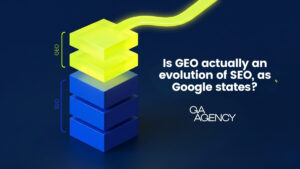
Is GEO actually an evolution of SEO, as Google states?

Is GEO actually an evolution of SEO, as Google states?
On 15th May 2026, Google published its first official guide to optimising for generative AI features on Google Search. The guide covers AI Overviews, AI Mode and the infrastructure emerging behind both. It matters less for any surprises it contains and more for what it confirms, and, predictably, for what it leaves out.
Google’s position: GEO is SEO
The most important point in the entire document is a matter of definition: from Google’s perspective, optimising for generative AI search is optimising for the search experience and therefore still SEO. GEO and AEO, the guide notes, “are useful shorthand for work focused specifically on AI search experiences”. However, the underlying work (building crawlable, authoritative, well-structured content) is, in Google’s framing, “the same work it has always been”.
On the foundations, we agree. We’ve said from the start of the AI search conversation that GEO is what SEO becomes when the search surface is generative. Brands that treated organic search as a long-term investment, rather than a series of tactical responses to algorithm updates, are the ones best positioned for it. GEO is the next stage of SEO, rather than a separate discipline sitting alongside it. Brands that maintained strong SEO foundations aren’t starting from zero.
Reading Google’s documentation carefully
That said, Google’s official guidance has always had a specific function: to articulate the public-facing baseline while omitting tactics it cannot or will not formally endorse. Link building and guest posting are the obvious historical examples. These practices have been officially discouraged by Google since the late 1990s and continue to sit at the centre of almost every credible SEO programme operating today. The pattern is consistent: official guidance tells you what’s safe to say out loud, not what consistently moves the needle.
The same logic applies to this new GEO guidance. There is genuinely useful information in the document, and we’ll come to it. But reading it as the complete playbook for AI visibility is reading it the way Google would prefer, not the way the data actually behaves.
What Google does say, that holds up
Three points in the guide are accurate and worth restating:
Non-commodity content with a genuine point of view. AI systems cite expert, first-hand perspectives over restated industry-standard information. A page that summarises what five competitors already say, or that could have been produced by a generative model, will not be cited. We saw this clearly in a recent luxury fashion audit: rewriting category editorial around the brand’s buyers’ actual decision-making process, like the questions they ask or the comparisons they make, improved citation presence in AI Overviews. The differentiator wasn’t volume; it was specificity that couldn’t be replicated.
Technical foundations, unchanged. Crawlability, indexation and rendering remain entry-level requirements. JavaScript-heavy storefronts that don’t render cleanly for bots are out of the conversation before it starts.
Product and local data completeness. Merchant Center feeds and Google Business Profiles are increasingly the route into AI commerce surfaces. Feed completeness is a direct visibility lever.
In our view, Google correctly debunks LLMs.txt and AI-specific markup, too. There is no evidence that standalone AI-specific files materially affect citation and the budget spent on them is better repurposed to content quality and feed completeness.
The agentic web is coming: is your site architecture ready?
The section of the guide that has received the least attention is on agentic experiences. Browser agents (AI systems that navigate websites autonomously to compare product specifications, book reservations or complete purchases) are moving from experimental to operational. The guide notes these agents gather data by analysing visual renderings, inspecting DOM structures and interpreting the accessibility tree. Protocols like the Universal Commerce Protocol (UCP) are emerging to let search agents take direct action on merchant sites.
The implication: your site’s architecture will either enable or block an AI from completing a purchase on a user’s behalf. Navigating this requires a working understanding of the full stack: how a page is read by an agent, where friction is introduced and how to resolve it without rebuilding the brand experience from scratch. For lean marketing teams, this is the moment to translate your visual brand into agent-friendly infrastructure, before it becomes a competitive disadvantage.
What we are doing across client portfolios, beyond Google’s guide
Across the accounts we run in the luxury fashion, travel and real estate industries, alongside several e-commerce at scale websites, we have been tracking citation patterns in AI Overviews, ChatGPT and Perplexity for over a year with Buzzwatch. The strategies that consistently shift citation share are not always the ones Google’s guide foregrounds. They include:
Structuring content the way LLMs actually parse it. Google’s guide dismisses chunking. In practice, pages with clear semantic structure, well-defined sub-sections and answer-format passages positioned early are cited materially more often.
Brand presence strategy beyond traditional link building. Manufactured mentions are spam, and Google is right to treat them as such. But genuine third-party presence like editorial coverage, expert citations, or inclusion in authoritative comparative content, correlates more strongly with AI citation than with traditional rankings. In AI search, being talked about by the right sources is a more direct visibility lever than it was in classical organic.
Optimising for the citation, not just the click. AI surfaces reward content written to be quoted. That is a different craft from content written to convert a click. Both need to coexist on the same page, structured so the AI can extract the citation-worthy passage without forcing the human reader through it.
Market-by-market specificity for international brands. Translated content that achieves linguistic accuracy but flattens cultural nuance performs no better in AI surfaces than it did in traditional search. Ensuring a website answers the native users’ intent is an essential activity, something we detailed previously in our guide GEO was built in English. Most of your markets aren’t.
GA’s position
Two things can be true at once.
Yes, doing good SEO means building the foundations for GEO. Brands with strong organic discipline did not have to rebuild their approach when AI Overviews arrived or AI Mode launched. The foundations were in place and Google’s guide confirms that.
But also, there is an enhanced strategy layer required to compete in AI surfaces, one that goes beyond what Google publicly endorses and is grounded in how LLMs actually read, structure and cite content. That layer is where the differentiated work is happening and it is what our 50 SEO specialists have been trained to deliver across client portfolios for the past two years.
Agency: GA Agency
Published: May 2026
Author: GA Agency
Agency: GA Agency
Published: Jun 2026
Agency: GA Agency
Published: Jun 2026
Feed