















Fly Better, Market Better: An Emirates Marketing Strategy Analysis
Fly Emirates marketing strategy starts with a simple but powerful question: why does this airline feel different before you’ve even stepped on board?
No matter how crowded the category is, Emirates consistently finds a way to make people pause. There’s a sense of calm, confidence, and intention in how the brand shows up, and that’s exactly what stops the scroll. That’s also true for physical world advertising activities.
In this blog, we will explore how that feeling is built so deliberately. We’ll break down who Emirates is really targeting, how its marketing mix supports a premium position, and the role digital and social channels play in reinforcing the brand. And, of course, the campaigns that turned an airline into a global icon.
Along the way, we’ll look at what marketers and brands can realistically learn from this approach and why consistency, as we mentioned above, is doing far more work here than constant reinvention.
What’s Inside
- Understanding the Target Market of Emirates Airlines
- Marketing Mix (4Ps) in the Emirates Airlines Marketing Strategy
- Emirates Marketing Strategy: Campaigns & More
- Emirates vs Qatar Airways: A Marketing Strategy Comparison
- FAQ about Emirates Marketing Strategy
Understanding the Target Market of Emirates Airlines
To understand who Emirates is really marketing to, we need to look beyond surface-level demographics and into how the airline structures its entire business around specific traveler needs.
The Emirates Group Annual Report makes this clear: Emirates is a global, long-haul, hub-and-spoke airline designed to serve international travelers moving between continents via Dubai, one of the world’s most connected aviation hubs.
Emirates serves over 150 destinations across nearly 80 countries, with demand driven by international travel across Europe, Asia, Africa, the Americas, and Oceania. This network attracts:
- Long-haul international travelers,
- Passengers connecting between continents,
- Customers traveling for business, leisure, and visiting friends and relatives (VFR).
What’s more, the case study titled Business and Supply Chain Strategy of Flying Above the Desert highlights that Emirates deliberately targets First Class, Business Class, and premium Economy travelers, positioning service quality and onboard experience as core differentiators.
Aligning with that target market, the airline invests in a young, wide-body fleet dominated by Airbus A380s and Boeing 777s, premium cabin innovation, and frequent product upgrades.
The research also emphasizes that Emirates’ competitive advantage is service- and product-led, allowing the airline to justify premium pricing while still attracting high-yield customers globally.
Business travelers and leisure travelers seeking premium experiences form a critical part of Emirates’ target market. Emirates actively targets this affluent group through investments in lounges, in-flight entertainment, destination partnerships, and tourism initiatives such as My Emirates Pass. As you can predict, this segment values comfort, entertainment, and brand reassurance as much as price, which fits squarely with Emirates’ brand positioning.
So, we can conclude that Emirates does not attempt to serve every traveler equally. The airline avoids a low-cost positioning; the target market is global, premium-leaning, and experience-driven, and every element of the business model reinforces that focus.
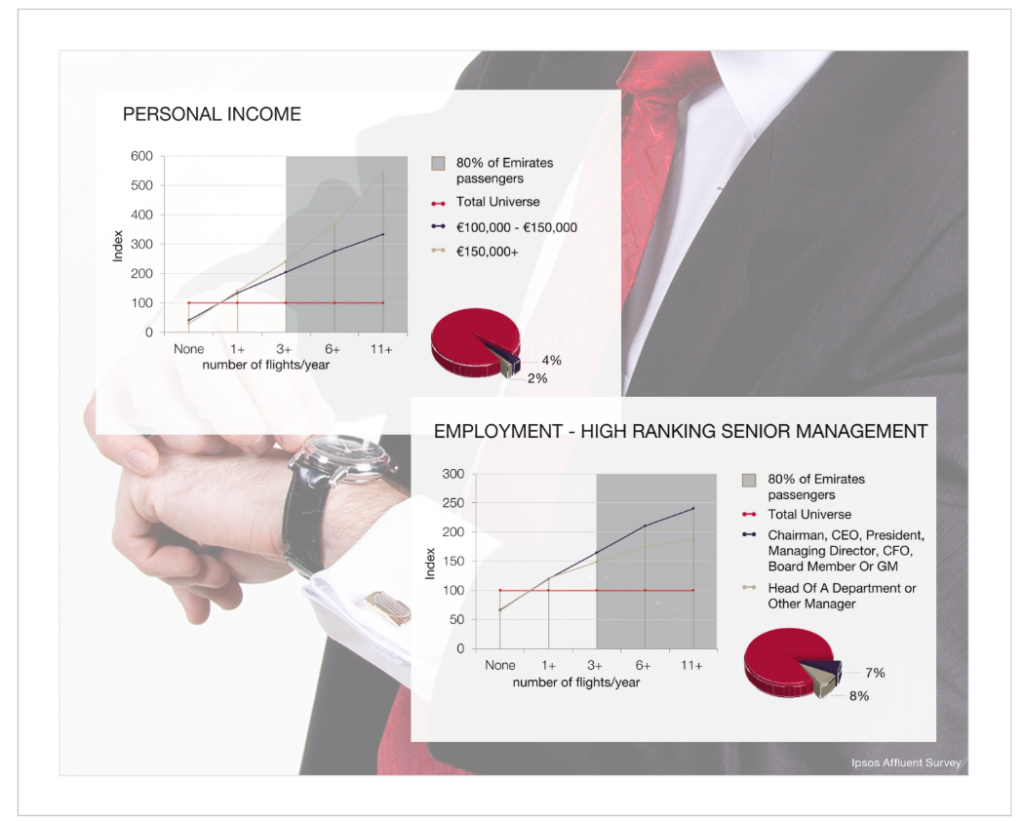
Before closing that section, let’s see how the brand identifies its own audience. On its media kit, Emirates provides a graphic for “a global audience with a Middle Eastern focus.”

The brand also gives these details about the audience/passengers:
Marketing Mix (4Ps) in the Emirates Airlines Marketing Strategy
If you strip away the technical advertising terms, Emirates’ marketing mix is actually very simple: everything is built to make flying feel premium, predictable, and worth the price.
The airline doesn’t overcomplicate its decisions across product, price, place, and promotion. It commits to a clear position and then supports it relentlessly.
Product
For Emirates, the “product” has never just been transportation.
The airline has spent years investing in cabins, in-flight entertainment, lounges, and service details that passengers genuinely remember, as we mentioned above.
The said annual report shows consistent investment in fleet upgrades, Premium Economy expansion, refurbished A380s, and onboard enhancements precisely because experience is the differentiator.
What’s important here is intent. Emirates doesn’t refresh products reactively. It upgrades ahead of demand and sets the standard.
Price
Emirates is comfortable charging more, obviously.
Emirates has never tried to justify its pricing by competing on discounts. Instead, it prices with confidence, especially in Business and First Class, where the airline knows customers are not just buying a seat. So they’re buying reassurance. Long-haul travel comes with complexity, time commitment, and risk, and Emirates leans into that reality rather than avoiding it.
This is where pricing becomes psychological as much as financial. As academic research on travel and destination, titled “Role of Airline Promotion Activities in Destination Branding: Case of Dubai vis-à-vis Emirates Airline”, puts it:
Another differentiating factor of branding destinations is the complexity of the tourists’ decisional process. Tourists are buying a bundle of goods and services that usually come with an intrinsic uncertainty and a high price tag.
That insight fits the Emirates marketing mix. Flying long-haul is a high-stakes decision, and Emirates prices its product to signal quality and control over that uncertainty.
Place
By building its operations around one of the world’s most connected hubs, the airline ensures that passengers see Dubai and Emirates.
This hub strategy is significant because it gives Emirates a unique market position: the airline offers a sense of global accessibility. That’s why travelers from Europe, Asia, Africa, and the Americas often choose flights through Dubai; it feels like the most strategic link between far-flung origins and destinations.
So, the “place” here isn’t a stop; it’s part of the travel promise itself.
Promotion
If you think promotion for an airline is just about flash deals or seasonal offers, Emirates does it very differently.
The airline’s promotional activities don’t just boost ticket sales; they actively shape how Dubai itself is perceived as a destination (and vice versa).
In other words, Emirates doesn’t just promote flights; it co-brands Dubai as an attractive, aspirational place to visit, and uses that destination imagery to elevate the airline’s own brand too.
Emirates Marketing Strategy: Campaigns & More
It’s time for an analysis of Emirates’ marketing strategy.
At a brand level, the business and marketing strategy of Emirates Airlines rarely talks like a traditional airline. Instead of leading with routes or prices, the messaging focuses on what it feels like to fly better. Cabin design, service moments, and global ambition. And, these are the emotional anchors.
This is why Emirates’ campaigns feel cinematic and confident. They invite us into a world where travel is aspirational again, and where flying is part of the destination, not just the means to get there.
Whether you encounter the brand on TV, YouTube, outdoors, or on digital platforms, the tone is always calm, confident, and premium.
Emirates Marketing Campaigns That Set the Tone
Emirates’ advertising works because it understands where attention lives today, and how to earn it.
Take the Los Angeles Dodgers partnership campaign. Not one of these “generic sponsorship activation,” Emirates placed itself directly inside the energy of American sports culture.
The result felt bold and playful, not forced. It’s a smart example of how the Fly Emirates marketing strategy adapts locally while protecting the global brand.
Then there’s the A380 cabin tour ad.
On the surface, it’s a product walkthrough. In practice, it’s a reassurance piece. It removes uncertainty, shows confidence in the product, and quietly says, “This is what premium really looks like.” That’s marketing doing its job without shouting.
Campaigns like “Sing Along the Coconut Song” and “We’re on Top of the World” lean even further into emotion.
Music, movement, and joy take center stage.
These aren’t hard-sell ads: they’re mood builders. And that’s exactly why they work so well across social and video platforms.
Emirates Digital Marketing Strategy & Social Media Approach
When we talk about the Emirates digital marketing strategy, it’s important to ground it in execution. As you already know, Emirates hasn’t built its reputation through isolated experiments; it has delivered large-scale digital campaigns that combine platform-native formats and customer experience design.
Remember the Burj Khalifa A380 Instagram stunt, which is a part of the “We’re on Top of the World” ad. One of Emirates’ most talked-about digital moments was the A380 “landing” on top of the Burj Khalifa, released first on Instagram.

The execution was simple and perfectly engineered for social feeds. The image was designed to spark disbelief and then to be shared.
The #HelloJetman Dubai campaign, featuring a real jet-powered wingsuit flight alongside an Emirates aircraft, is another example of Emirates understanding digital culture.
For that campaign, Emirates created something that felt closer to a documentary-meets-stunt, released primarily through YouTube and social platforms.
What’s more, the airline brand has been one of the first airlines to experiment seriously with VR cabin experiences, allowing users to explore aircraft interiors digitally via its website, app, and event activations like Expo.
This wasn’t tech for novelty’s sake. It solved a real problem: helping customers understand premium products before booking.
Another area Emirates uses its “digital magic” is its loyalty ecosystem.
Through app-led campaigns, personalised dashboards, and integrations like Skywards Everyday, Emirates uses digital to turn loyalty into daily relevance by offering a continuous brand touchpoint. This is where the Fly Emirates marketing strategy becomes relational, not promotional.
When it comes to social media, Emirates consistently produces content that feels platform-aware.
In other words, Emirates social media approach includes minimal copy, maximum visual clarity. When you briefly look at Emirates Instagram feed, you can catch that the brand is all about premium experience, high-budget collaborations and innovative offerings:
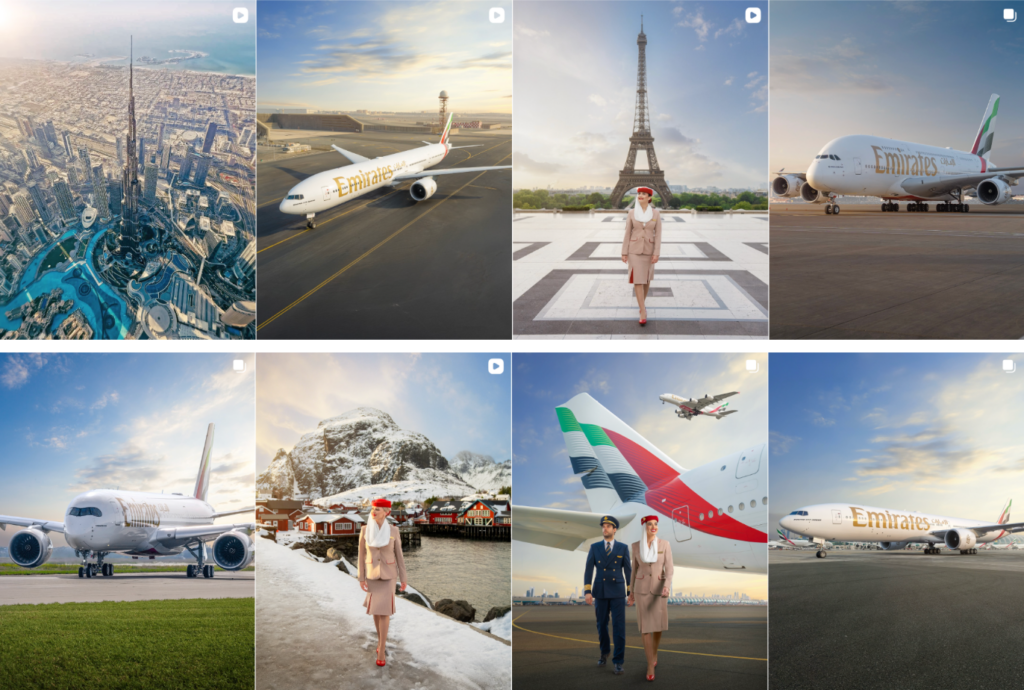
So, Emirates trusts the audience to engage without being pushed, and digital performance reflects that confidence.
On TikTok, as you already know, many premium & luxury brands struggle because they treat it like a cut-down version of TV advertising. Emirates does the opposite. Take the following Christmas post as an example: it was seen more than 80 million times!
In addition to that example, the oversized cats, memes, AI-powered images, and dreamlike visuals are part of Emirates’ social media strategy. Another example:
This works because social media platforms rewards content that makes people pause and rewatch. And the brand doesn’t over-explain whether the content is AI, CGI, or practical effects. That ambiguity fuels conversation.
When people compare Emirates Airline and Qatar Airways, it’s usually framed as a battle of “best airline.” But from a marketing point of view, what’s more interesting is how differently these two brands choose to show up.
Emirates vs Qatar Airways: A Marketing Strategy Comparison
As we mentioned above, in any analysis of Emirates marketing strategy, a theme is recurring: the airline markets itself like a global institution. The brand wants to be instantly recognisable, even to people who have never flown with it.
The brand is confident and comfortable being seen everywhere. Big stunts, cinematic ads, playful social content…
On the other hand, Qatar Airways takes a quieter path. Its marketing is more measured. The brand puts a lot of weight on precision, service quality, cabin design, awards, and consistency. Where Emirates aims for emotional impact, Qatar aims for reassurance. The message is less “look at us” and more “trust us.”
This difference between these two airline brands’ marketing strategies becomes very obvious on social media.
Emirates is comfortable experimenting. On TikTok, it plays with surreal visuals, unexpected CGI, and internet-native ideas. The content is designed to stop the scroll, spark comments, and feel culturally current. It doesn’t explain itself too much.
Qatar Airways is far more controlled on social. Its feeds are elegant, polished, and predictable, in a good way.
Aircraft, cabins, destinations, and brand moments are presented with consistency. You’re unlikely to see Qatar lean into absurdity or internet humour.
What’s more? Here is a quick comparison table – Qatar Airways X Emirates:
| Strategy Lens | Emirates | Qatar Airways |
|---|---|---|
| Positioning | Big & aspirational Premium with scale and visibility—built to be instantly recognizable worldwide. | Refined & precise Premium through discipline—signals quality via consistency and performance. |
| Advertising style | Cinematic storytelling Emotion-first, high-production narratives that create desire and brand memory. | Authority-led Polished, composed creative that reassures and reinforces excellence. |
| Social media | Cultural play Platform-native, attention-driven content designed to spark conversation and recall. | Editorial control Consistent, luxury-coded content with limited creative risk. |
| Digital approach | Experience-led Digital reinforces the brand promise through personalization and seamless journeys. | Product-led Digital highlights service quality and cabin superiority with clarity. |
| Sponsorships | High visibility Broad, global reach strategy designed for top-of-mind awareness. | Selective alignment Carefully chosen partnerships that reinforce prestige. |
| Brand tone | Outward confidence Bold, expressive, and culturally fluent while remaining premium. | Quiet confidence Understated, controlled, and rooted in authority. |
| Best at | Attention & memory Excels at scale, emotion, and long-term brand recall. | Trust & consistency Excels at reassurance, product leadership, and reliability. |
FAQ about Emirates Marketing Strategy
What is Emirates Airlines’ overall marketing strategy, and how does it support global brand positioning?
Actually, the Emirates Airlines marketing strategy is about making the brand feel bigger than the airline itself. Emirates doesn’t market routes or prices first; it markets confidence instead of it. The marketing strategy is designed so that even people who have never flown with the airline know exactly what it stands for. Big campaigns, global sponsorships, and a very consistent premium look help Emirates feel familiar everywhere, which is crucial when you operate across dozens of markets.
How does Emirates’ digital marketing strategy differ from traditional airline marketing approaches?
What makes the Emirates digital marketing strategy different is that it doesn’t feel like it’s “trying to sell you something.” A lot of airlines treat digital as a discount window or a booking engine (like Delta does on social media channels). Emirates treats it as part of the experience. Whether it’s social content, the app, or post-booking communication, digital is used to reinforce the same calm, premium feeling you see in Emirates’ advertising. There’s less urgency, fewer hard pushes, and more focus on how the brand shows up over time.
What are the key elements of the Fly Emirates marketing strategy that drive premium brand perception?
The Fly Emirates marketing strategy works because it’s emotionally clear and visually consistent. Emirates rarely shouts about features; it shows you what flying with them feels like. The creative always looks polished and the tone is confident without being cold. Just as importantly, that premium message doesn’t stop at the ad. The digital experience, the cabin, and the service all back it up, which is why the brand’s premium image feels believable rather than manufactured. At that point, we also need to mention the brand’s collaboration with famous figures and sports personalities & teams and even leagues.
How does the business and marketing strategy of Emirates Airlines compare to Qatar Airways’ marketing strategy?
When you do an analysis of Emirates marketing strategy alongside Qatar Airways, the contrast is pretty clear. Emirates Airline is comfortable being bold and visible. It wants attention, cultural relevance, and strong emotional recall. Qatar Airways takes a quieter, more controlled approach; it puts the product and service excellence front and center. Emirates feels expansive and expressive; Qatar feels precise and disciplined. Both work, but they’re solving for different ideas of what “premium” means.
What lessons can other airlines learn from an analysis of Emirates’ marketing strategy in global markets?
The biggest lesson is that strong airline brands don’t try to compete on everything at once. Emirates commits fully to a point of view and sticks to it across advertising, digital, and experience. It also shows that brand building still matters in a category obsessed with short-term performance. Airlines looking to stand out can learn from Emirates’ patience, its confidence in creative work, and its willingness to let digital support brand perception. In global markets especially, clarity go much further than optimization.