















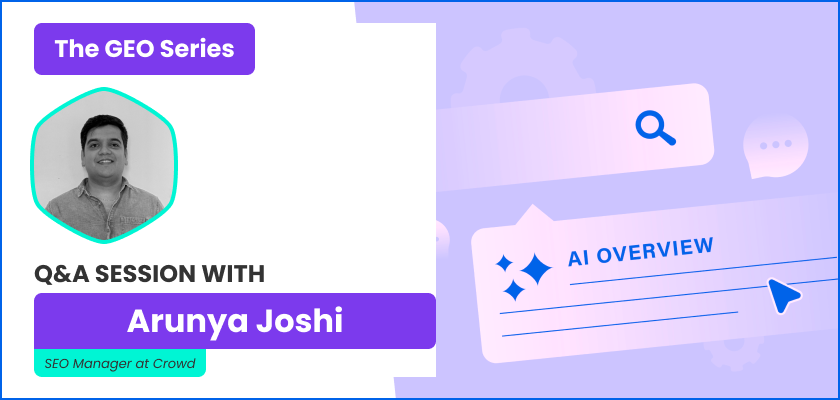
Crowd on GEO: Why AI Search is About Entities, Not Links
The shift to generative AI is not just changing how users search. It is redefining how information is evaluated behind the scenes.
In this edition of The GEO Series, Arunya Joshi, SEO Manager at Crowd, offers a perspective that captures this transformation clearly: the move from link-based ranking systems to entity-driven visibility.
Based in Amsterdam, Crowd represents a more advanced stage of GEO adoption — where generative search is already embedded into both strategy and measurement.
GEO Strategy & Services
At Crowd, GEO is not treated as an experimental add-on, but as a natural evolution of advanced SEO.
However, what makes their approach stand out is the depth of measurement and AI-specific metrics built into their framework.
Rather than focusing solely on rankings or traffic, Arunya and her team analyze:
- How often a brand is mentioned
- How it is described
- How accurately it is represented
This signals a broader shift: GEO is not just about being visible, but about how a brand exists within AI-generated narratives.
What Crowd’s GEO Services Include
Crowd’s GEO work centres on one key idea: how brands appear inside AI-generated answers.
To support this, their work spans several layers:
- Analyzing where and how a brand shows up across generative platforms
- Shaping content so it can be more easily interpreted and reused by AI systems
- Strengthening entity signals to improve recognition and attribution
- Tracking how a brand is described and positioned within responses
What becomes clear is that the focus has shifted.
Visibility is no longer just about being found. It’s about how a brand is presented once it is surfaced.
This changes the role of optimization. The goal is not simply to increase exposure, but to influence how consistently and accurately a brand is represented across AI environments.
How Crowd Structures GEO Services
At Crowd, GEO is not carved out as a separate service line. Instead, it is woven into existing strategy and delivery.
In practice, this means:
- GEO considerations are built into SEO and content workflows from the start
- Outputs are shaped with AI interpretation in mind
- Visibility is monitored across multiple platforms, not just search
- Insights are fed back into ongoing optimization cycles
This creates a more fluid structure.
GEO becomes something that runs across the entire workflow, not a fixed deliverable, but a continuous layer of refinement.
Seen this way, GEO is less a new channel and more a shift in how all digital activity is evaluated.
How GEO Actually Works
For Arunya Joshi, the shift to GEO is less about adopting entirely new tactics and more about understanding how generative systems process information.
Unlike traditional search engines, generative AI does not retrieve and rank results in isolation. It draws from multiple sources at once, identifying overlap, consistency, and reliability before forming a response.
This changes how content is evaluated.
Instead of focusing on position, AI systems prioritize:
- Clarity of coverage
- Structure and readability
- Consistency across sources
- The ability to be reused within an answer
As a result, visibility is no longer tied to ranking higher but to whether a brand can be selected and incorporated into a response.
For Crowd, this leads to a strong emphasis on:
- Clear topical authority
- Modular, well-structured content
What becomes evident here is the role of structure.
Content that is easier to interpret is more likely to be reused, and in generative environments, reuse is what drives visibility.
Measuring GEO Performance
This shift becomes even more visible when it comes to measurement.
At Crowd, performance is tracked using:
- AI Share of Voice
- AI-assisted branded and organic search lift
These metrics provide direction, but they don’t fully capture what’s happening. Because in generative environments, visibility does not always translate into traffic.
A brand can appear repeatedly within answers, influence perception, and shape decision-making without generating a click.
This creates a disconnect between presence and measurable outcomes.
As a result, evaluation moves beyond traffic and begins to focus on:
- How often a brand appears
- How consistently it is represented
- How accurately it is described
This is where one of the biggest challenges emerges: “defining and communicating GEO performance in a meaningful way.”
Generative Engine Optimization Tools & Platforms
For Arunya Joshi and the team at Crowd, GEO is shaped as much by where visibility happens as how it is measured.
Today, that visibility is concentrated around a few key platforms, with ChatGPT and Google AI Overviews leading, and Perplexity emerging as a citation-driven layer.
What matters here is not just platform importance, but how differently each platform surfaces information. GEO strategies are no longer universal; they need to adapt to each environment.
To manage this, Crowd combines:
- Foundational tools like Google Search Console and SEMrush
- AI research tools for prompt testing
- GEO-specific platforms such as SEMrush AI Visibility Toolkit and RankPrompt
This reflects a broader reality: there is still no unified GEO stack.
However, as Arunya highlights, the bigger challenge is reporting and storytelling for GEO performance.
As GEO matures, the real differentiator will be the ability not just to improve visibility, but to clearly explain and prove its value.
The Future of GEO
“A natural evolution of SEO within existing structures.”
However, this evolution introduces a fundamental shift in how visibility is defined.
Success will depend less on driving clicks and more on being included in answers themselves.
Brands will need to become credible, consistent, and citable entities.