













Is Monthly Reporting Enough to Keep Clients Engaged?
For many digital agencies, monthly reporting is treated as a box-checking exercise—send the report, log the delivery, move on. It’s the industry standard, the heartbeat of client communication, and a cornerstone of the agency-client relationship. But here’s the uncomfortable truth: just because a report is delivered doesn’t mean it’s doing its job.
In our recent Client Engagement Research at AgencyAnalytics, we heard a version of the same story across agencies:
“If clients aren’t looking at their reports, it’s because they have three pages of data but only want to know if something has gone up or down.”
— AgencyAnalytics Client Engagement Research
This disconnect is more than a formatting issue. It points to a deeper problem in how agencies view reporting—as a one-way update, rather than a two-way opportunity to drive clarity, build trust, and spark conversation.
The question becomes whether monthly reporting is working. And for many agencies, the answer is: not the way it used to.
The Real Problem Isn’t Frequency—It’s Clarity
When clients stop responding to reports, it’s tempting to assume they’re too busy—or that they simply don’t care. But according to AgencyAnalytics’ research, that silence often signals something else entirely.
Clients are easily overwhelmed by dashboards filled with dozens of metrics, unclear takeaways, and no clear indication of what requires attention. What’s worse, many agencies spend hours manually assembling these reports—only to receive no feedback at all.
“When clients go quiet, it’s rarely because they’re satisfied. More often, it’s because they’re overwhelmed, confused, or unsure how to interpret the data being sent to them. Silence isn’t a sign of success—it’s a red flag.”
— AgencyAnalytics Client Engagement Research
This creates a frustrating cycle. Agencies interpret the silence as a lack of interest. Clients, unsure how to extract value from what they’ve received, disengage further. And as that communication gap widens, the value of the work—and the relationship itself—starts to erode.
What clients are asking for isn’t more data. It’s more clarity. That means:
- Simpler layouts that prioritize key takeaways
- Clear signals of what’s working, what’s not, and what’s next
- Less noise, more context
“Clients are less likely to interact with reports that feel overwhelming. Simpler layouts and clearer prioritization increase engagement.”
— AgencyAnalytics Client Engagement Research
Monthly reports that summarize everything but explain nothing? That’s not communication. It’s output without impact.
The Hidden Cost of Low Engagement with Client Reports
Low engagement with reports isn’t an inconvenience—it’s a warning sign. When clients ignore reports or don’t understand them, it creates a ripple effect that touches nearly every part of the agency-client relationship.
For starters, the agency’s strategic value gets buried in reporting logistics.
“For agencies, this disconnect creates frustration. Not just because the work goes unnoticed, but because it takes time and focus away from higher-level strategy. When client meetings become data walkthroughs, they miss their real potential: to drive alignment, uncover opportunities, and build trust through meaningful conversation.”
— AgencyAnalytics Client Engagement Research
Instead of being seen as strategic advisors, agency teams are pulled into reactive roles—fielding clarification questions, explaining reports line by line, or jumping on redundant calls to rehash what the data already shows. This drains time and limits the agency’s ability to drive forward-looking initiatives.
“Low engagement also leads to repeat explanations and longer live meetings, driving up costs and pulling focus from strategy.”
— AgencyAnalytics Client Engagement Research
Worse, when reports don’t resonate, clients quietly lose confidence, even if performance is strong. The reporting process becomes less about insight and more about obligation—a monthly deliverable that gets opened, skimmed (if at all), and forgotten.
Yet we know from the data that reporting is still one of the most powerful levers for building trust:
“Client reporting is the backbone of the agency/client relationship. Informative reporting builds trust with clients’ internal management and marketing teams—letting them know that the data is accurate, useful, and presented in easy-to-understand, customized layouts.”
— AgencyAnalytics Client Engagement Research
In short, unengaging reports don’t just fail to prove value—they actively undermine it. They weaken relationships, delay strategic alignment, and make retention harder in the long run.
Clients Want More Frequent, Bite-Sized Touchpoints
For years, monthly reporting has been the default cadence—but it may no longer be enough to meet modern client expectations. Our research reveals a clear trend: clients don’t want more data once a month—they want smaller, clearer updates more often.
“End clients want more frequent, bite-sized updates between big reports, a trend agencies are starting to notice and adapt to by experimenting with highlights and commentary features.”
— AgencyAnalytics Client Engagement Research
This doesn’t mean agencies need to overwhelm clients with daily dashboards or flood their inboxes with constant updates. Instead, it’s about creating lightweight touchpoints that maintain momentum, show ongoing attention, and keep the conversation alive.

These bite-sized updates can take many forms:
- A short weekly summary report highlighting key wins or changes
- A direct message with a performance checkpoint and quick commentary
- A dashboard annotation explaining a sudden shift
- A “mid-month checkpoint” with one takeaway and one recommendation
“Clients are more likely to respond to reports that include insights and action items—not just performance data.”
— AgencyAnalytics Client Engagement Research
These smaller check-ins help clients feel supported—especially when campaign results are still evolving or under optimization. They also shift the agency’s role from “monthly reporter” to proactive partner, reinforcing transparency and reliability without adding hours of work.
“When clients disengage, gentle nudges—tailored to their preferences—can bring the conversation back to life. The goal isn’t to pressure them, but to keep the door open with purpose.”
— AgencyAnalytics Client Engagement Research
AI Reporting Tools Are Changing the Game—But They Aren’t Replacing Your Expertise
One of the most significant shifts we uncovered in our research wasn’t just about cadence or content—it was how agencies are starting to use AI to bridge the gap between data and insight.
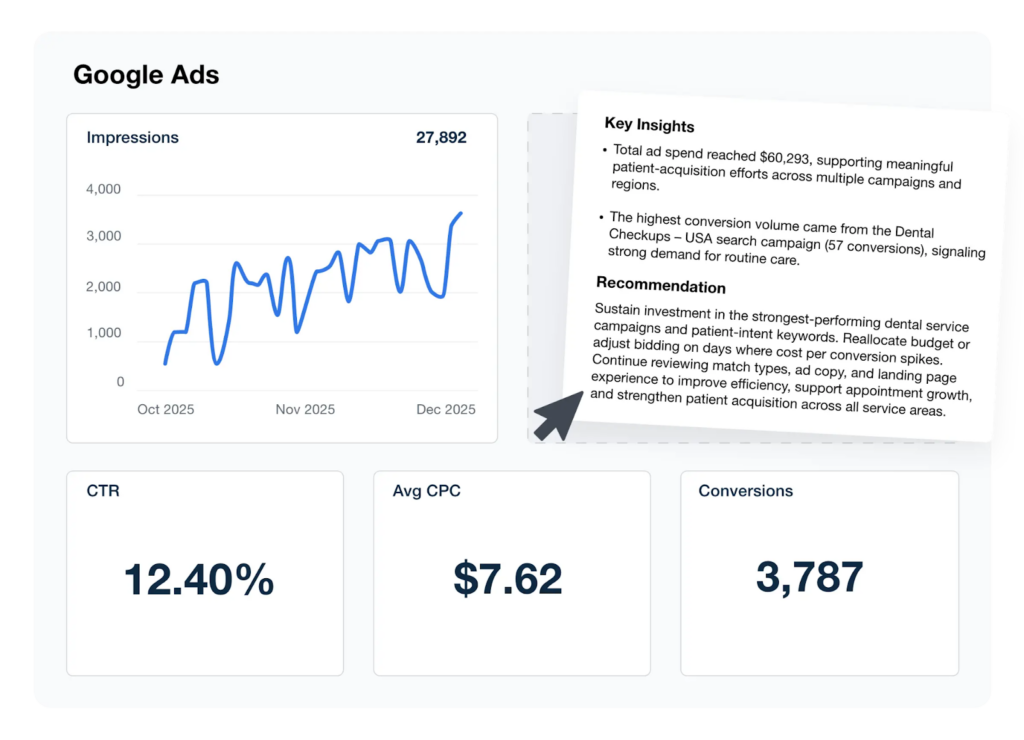
Rather than replacing human expertise, AI report writing tools are helping agencies communicate it more effectively.
“Agencies that use AI-powered summaries say the biggest value isn’t time saved—it’s the ability to turn raw performance data into clear, confident client communication. It’s about shifting from data reporting to insight delivery.”
— AgencyAnalytics Client Engagement Research
This shift is subtle but significant. Instead of manually translating metrics into updates, many teams are now using AI to surface trends, write summaries, and generate first-draft narratives that they can personalize. The preferred outcome isn’t generic automation—it’s accelerated clarity.
“Agencies see the most benefit when they combine AI-generated reporting with their own insights and annotations. This allows them to deliver context-rich reports that showcase strategy, not just numbers.”
— AgencyAnalytics Client Engagement Research
And perhaps most importantly, the agencies seeing the greatest impact aren’t just adopting new tools—they’re shifting their thought processes.
“The biggest shift isn’t about the tool—it’s about mindset. Agencies that view AI as an enhancer of human judgment are more likely to improve performance reviews, client trust, and the perceived value of reports.”
— AgencyAnalytics Client Engagement Research
Of course, AI tools alone won’t improve client engagement. But when paired with agency expertise and a strong communication rhythm, they play a meaningful role in:
- Scaling insight delivery without scaling workload
- Simplifying complex data into actionable commentary
- Giving time back to strategy, not formatting
For agencies looking to evolve beyond static monthly reports, AI is a tool that helps you deliver more value, more consistently, with less friction.
So… Is Monthly Reporting Still Enough?
At face value, monthly reporting still serves a purpose. It provides structure, creates a regular cadence for communication, and often acts as a formal checkpoint for client performance.
But based on our client engagement research, frequency alone isn’t the problem—expecting a single monthly report to carry the full weight of client communication is.
“Clients don’t disengage because they don’t care. They disengage when reporting doesn’t help them clearly understand what’s happening or what to do next.”
— AgencyAnalytics Client Engagement Research
If the monthly report is the only touchpoint, it has to do too much:
- Prove performance
- Align strategy
- Explain anomalies
- Inspire next steps
- Rebuild trust (if things didn’t go to plan)
That’s a heavy load for one deliverable—and too often, it’s where communication breaks down.
This isn’t an argument to eliminate monthly reporting. It’s a call to rethink its role in the broader client experience.

Monthly reports are most effective when:
- They’re positioned as summaries of an ongoing conversation, not standalone updates
- They’re built around clear, client-relevant insights, not just charts
- They’re supported by lighter-weight updates, so nothing comes as a surprise
- They include next steps, not just past performance
- They clearly align with the client’s goal, instead of metrics in isolation
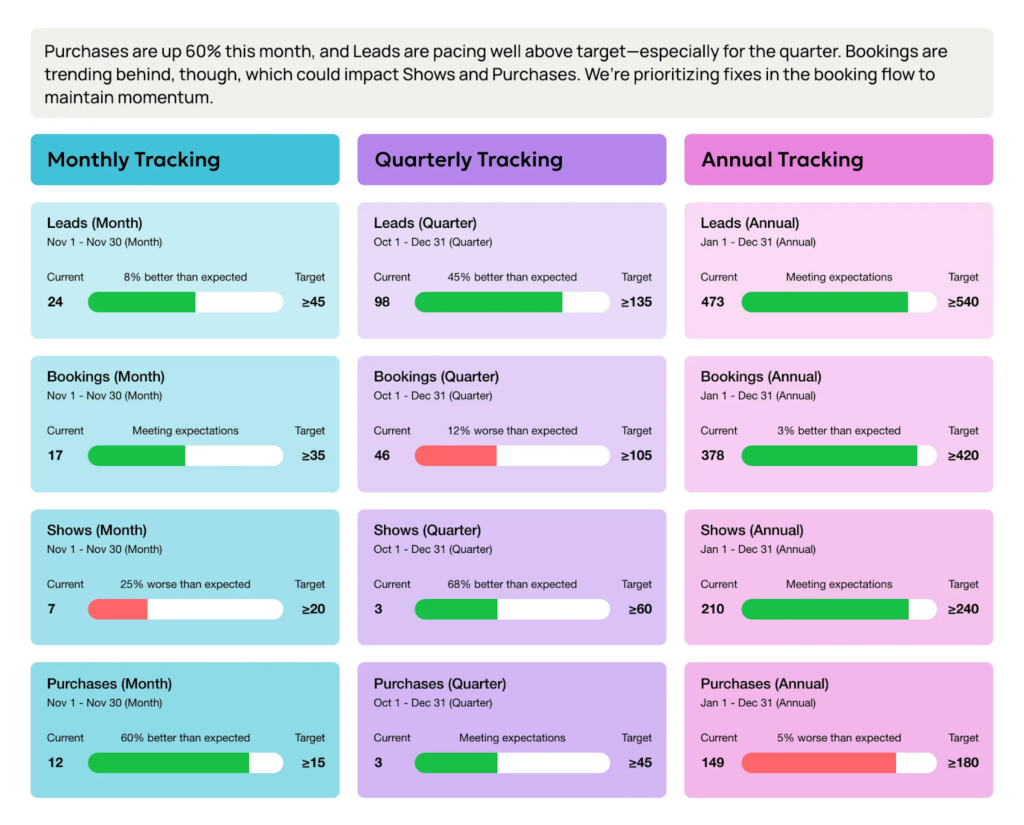
In this model, monthly reporting remains—but it becomes a reflection of the work you’ve already done to engage, explain, and align. Not the starting point.
Rethinking Reporting as an Ongoing Conversation
It’s tempting to treat reporting as a finished product—generate the PDF, send the link, check it off your to-do list. But client relationships aren’t built on deliverables. They’re built on shared understanding. And that’s where reporting needs to evolve.
“Clients seek clarity, context, and interactivity. They want to understand what’s happening and why, in an easy-to-consume format that fits their routine.”
— AgencyAnalytics Client Engagement Research

Which means that the fix isn’t more data. It’s better dialogue.
Whether it’s adding a short, mid-month highlight email, embedding action items directly in the report, or using tools that support quick, contextual commentary, the agencies with the most engaged clients are the ones treating reporting as a rhythm, not a recap. They’re returning to the core purpose of reporting: to inform, clarify, and guide.
“Clients want reports that go beyond just communicating metrics and numbers to include more relevant context. When reporting feels connected to their goals, it becomes a conversation—not data delivery.”
— AgencyAnalytics Client Engagement Research
The shift doesn’t have to be dramatic. It might mean:
- Moving from one long report to smaller, more frequent updates
- Framing each report around one takeaway, not every data point
- Using annotations to explain the “why” behind the metrics
- Building time for questions, not just presentations
And sometimes, it’s simply about staying present and meeting clients where they are.
“For less marketing-savvy clients, this means clearer commentary around what a metric means, why it’s important, and whether performance is good or bad relative to benchmarks.”
— AgencyAnalytics Client Engagement Research
Ultimately, monthly reports still matter. But they’re no longer enough on their own.
The agencies thriving today are those building reporting systems that support clarity, encourage interaction, and give clients confidence in what’s next.
Client Reporting is a Relationship Builder—Not a Deliverable
Monthly reports aren’t going away anytime soon—but their role is evolving.
Client communication isn’t anchored to a once-a-month recap anymore. The strongest agency-client relationships are built on consistency, clarity, and context—delivered in formats that reflect how clients actually work, think, and make decisions.
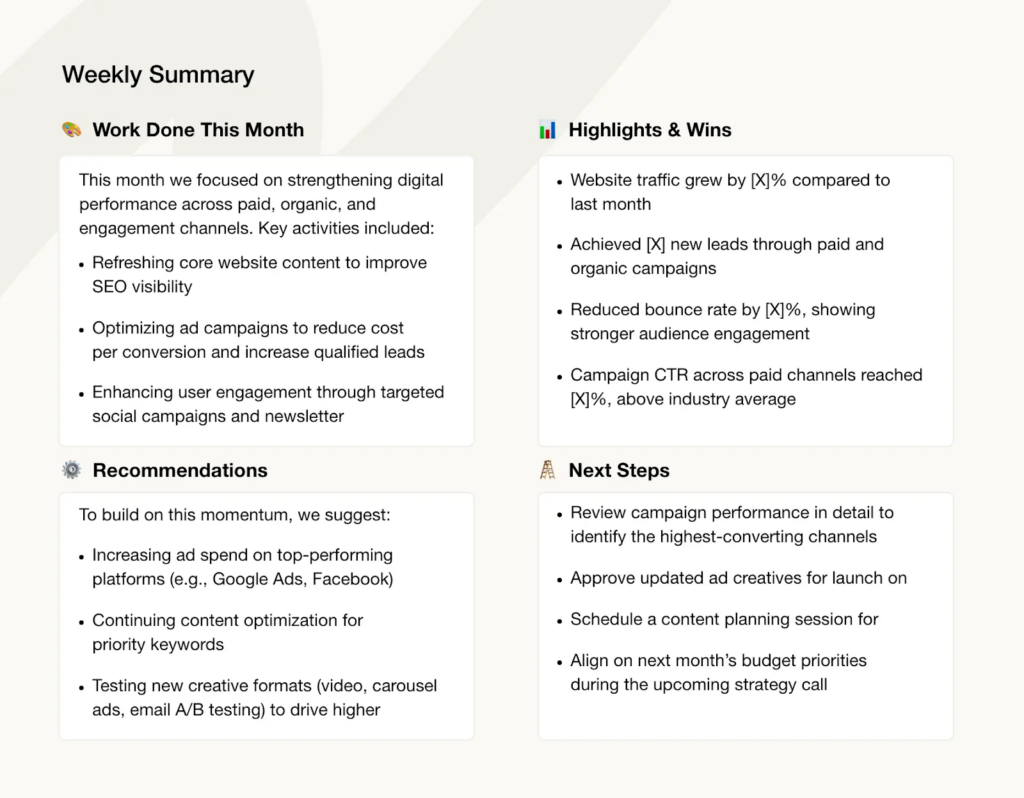
The shift from reporting to engagement doesn’t mean more meetings, more metrics, or more pressure. It means designing reporting experiences that invite participation, foster understanding, and build trust.
“The most engaged clients are those who feel their agency’s reports are a continuation of the strategic conversation—not a separate deliverable.”
— AgencyAnalytics Client Engagement Research
The agencies that adapt to this shift strengthen retention, deepen relationships, and differentiate their service in ways that go beyond numbers on a screen. And that starts by asking a deceptively simple question:
Are you reporting to inform—or reporting to engage?
Top agencies do both.