













Liquid Death Marketing Campaigns: Selling Water, Creating Chaos
Selling water with entertainment… We’re about to explain how Liquid Death marketing campaigns turn it into content:
Water is the least differentiated product in the grocery aisle, no doubt. And yet a tallboy can of it with a screaming skull on the side has become one of the most studied brands in modern consumer marketing.
The origin story is almost absurdly cheap: a spoof video that cost $1,500 to make, plus roughly $5,000 of paid media, which added up to 3 million views and 80,000 Facebook followers. Fast forward, and reported 2024 revenue sits around $333 million with more than 14 million followers across TikTok and Instagram.
That is the real story behind Liquid Death marketing. It isn’t a clever name and a skull logo. It is a repeatable system for turning ideas into entertainment, entertainment into earned media, and earned media into shelf space. And in the world of FMCG marketing campaigns, where brands constantly compete for attention, that’s a serious competitive advantage. This guide breaks down the strategy first, then walks through seven of the best Liquid Death marketing campaigns using the same case-study structure, and finally pulls out the lessons for brands and agencies.
Inside Liquid Death Marketing Campaigns
How Liquid Death Approaches Marketing and Advertising
Before we get into individual campaigns, it helps to understand the logic that sits underneath all of them. Think of this section as the foundation of the Liquid Death marketing strategy; the campaigns that follow are the proof.
Murder Your Thirst as a Brand Platform
Founder Mike Cessario spent his career in marketing and noticed that the fun, cool advertising went to products that were bad for people while healthy products got dull marketing. He said in the Awin ThinkTank Conference in April in Chicago:
I wanted to create a truly healthy beverage company that marketed like we were a beer company or a junk food company.
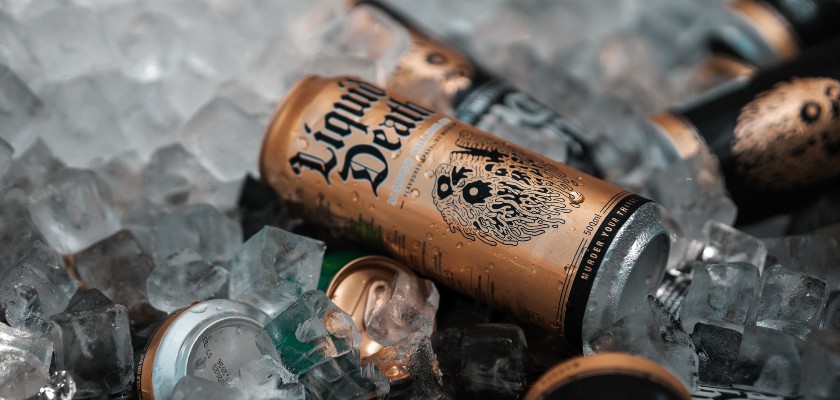
Murder Your Thirst is the line that makes that idea portable. It borrows the language of horror and heavy metal, sits on a can that looks like craft beer, and pairs with a second, more purposeful message, “Death to Plastic.”
Later came the reassurance line that closes many ads:
Don’t be scared, it’s just water.
The important part for marketers is that this is a platform rather than a slogan. It can attach to any flavor, product extension or joke without needing a new idea each time, which is the essence of Liquid Death branding.
Entertainment-First Content Instead of Product Advertising
Liquid Death co-founder and CEO Mike Cessario describes the business as “an entertainment company that monetizes via beverage” according to Chief Marketer. He also says he borrowed the idea from Red Bull, where the content doesn’t feel like marketing even though it works as marketing. Where Red Bull funds spectacle, Liquid Death funds punchlines; our Red Bull marketing strategy breakdown shows the original playbook. The contrast with Monster Energy marketing campaigns is just as useful.
Why a Punk Identity Works in a Commodity Category
When the product can’t be differentiated, identity becomes the differentiator. Most canned water marketing rivals lean on purity, mountains and wellness. Liquid Death leans on irony, and the irony does a second job: it gives non-drinkers a can they can hold at a bar or concert without looking out of place.
There is a wider lesson about shock advertising here. Fashion brands have used it for decades, with very different outcomes. Our analysis of Benetton’s advertising campaigns shows shock working because the issues were real and the imagery matched the brand’s stated values, while our Balenciaga marketing strategy piece shows what happens when it doesn’t.
Liquid Death’s shock works for a third reason: the punchline is always safe. The can looks dangerous, the ad looks dangerous, and the product is water. For more context on how this fits the wider category, see our guide to beverage marketing strategies.
Best Liquid Death Marketing Campaigns
How we chose these campaigns?
We started with one rule: every campaign had to be verifiable in trade press, a credible news outlet or a statement from the brand itself. We then chose for mechanic rather than fame, so each case represents a different lever (shock, humor, scarcity, community) that other brands can borrow. We also mixed the founding-era work from 2019 to 2021 with the newer Super Bowl and product-launch efforts from 2023 to 2026.
Lose Your Liquid Death Virgenergy
This is a product-sampling partnership with SIXT dressed up as a confessional comedy. People describe memorable “first times” beside rental cars, and the film encourages you to assume they mean exactly what it sounds like. The reveal puts the innuendo to work: the first time in question is trying Liquid Death Energy. The sampling offer gives the viewer something to do with the punchline: get a free can with a rental at participating locations.
SIXT reported more than 2 million views in 12 hours for the online film in its November 2026 earnings presentation. That’s a partner-reported reach figure, not a count of samples redeemed or bookings generated.
Why it worked: The collaboration made the partner essential to the premise. The car wasn’t a logo-bearing backdrop; it was where the stories supposedly happened and the reason there was a sampling occasion at all. Liquid Death got to introduce an energy drink outside a crowded beverage aisle, while SIXT got a reason to make the rental experience part of the entertainment. The innuendo could have overwhelmed a weaker offer. Here, the reveal made the product and the rental counter the answer to the same joke.
Liquid Death x e.l.f. Cosmetics the Sequel: Lip Embalm
This is one of the limited-edition beauty marketing campaigns and a sequel to the brands’ earlier Corpse Paint. It turns Liquid Death beverage names into six lip balm variants, with options such as Killer Cola, Severed Lime, and Mountain Water. The film brings back Glothar, the partnership’s black-metal character, and treats relief from dry lips with the gravity of a supernatural event. The product is real; the stakes are ridiculous.
e.l.f. said the original Corpse Paint drop sold out in 45 minutes and reported that Lip Embalm sold out in minutes. Liquid Death’s product page also marked the latter as sold out.
Why it worked: Both brands brought something the other couldn’t supply on its own. e.l.f. made the object useful and credible as makeup. Liquid Death supplied the language, the flavor references and the visual absurdity that gave people a reason to notice it. The sequel also rewarded people who already knew Glothar without making newcomers study the first installment. You didn’t need any backstory to understand why calling a lip balm “Lip Embalm” was funny.
Big Game Commercial With Kids Hydrating at a Party
This is a national TV spot built around a visual misdirect. Kids crack tallboys and party to Judas Priest’s Breaking the Law. The scene borrows the staging and soundtrack of behavior they’re not supposed to be getting away with, then makes the actual activity plain: they’re drinking water. The tallboy does more than hold the product. It supplies the assumption the spot spends its runtime undoing.
The official YouTube upload showed about 8.4 million views in the indexed snapshot. And the comments the video got were also great for a marketing team:

Why it worked: The ad turned a potential objection into its best selling point. A can that looked too much like beer might have seemed like something to explain away in a safer campaign. Here, that ambiguity made viewers pay attention and made the reveal possible. It also communicated a social benefit without spelling it out: a nonalcoholic drink could look at home in a party scene. If the kids had been holding clear plastic water bottles, there would have been no joke and very little ad.
Iced Tea For Trucks
This is an iced tea commercial that behaves like an automotive ad. The truck isn’t just a prop for a tough-looking human protagonist. It’s the customer. The film talks about what the truck craves, using a machine that can’t drink tea to make the beverage sound comically overqualified.
Why it worked: The film borrowed a genre people recognized instantly, so it didn’t have to spend precious seconds teaching viewers how to read the joke. Truck advertising supplied the exaggerated seriousness; iced tea supplied the deflation. That gave the brand a way to include product details without making the commercial feel like a nutrition panel with a voice-over. It also helped the tea feel like a logical extension of Liquid Death.
Chest Blaster Commercial
This is a fake fitness infomercial for a real can! The Chest Blaster looks suspiciously like the beverage Liquid Death already sells, but the pitch treats it as a breakthrough in workout technology. Demonstrators shake open cans toward themselves, spraying liquid as the commercial earnestly explains the benefits of its imaginary innovation. A brand landing page carries the mock sales pitch beyond the film.
Of course, that brillant idea got many funny comments and praisings, just on YouTube:
This commercial made my day lmaooo
I seen the just pop up on YouTube shorts and it caught me off guard and I couldn’t resist laughing
Finally an ad that is actually funny and makes me want to buy the product
Why it worked: The team picked a format that practically wrote the setup for them. Viewers already knew to expect a dubious gadget, an overconfident demonstration and a technical explanation nobody asked for. Liquid Death delivered all three and kept the can in the center of the action. That last part mattered: the product wasn’t a sponsor logo stuck onto a comedy sketch. It was the instrument of the joke. The landing page then paid off the curiosity of people who wanted to see how far the brand would take the bit.
Deadliest Stuff On Earth?
This is an origin-era positioning film that sells mountain water by presenting it as something ominous. The premise flips the category’s usual association between nature and serenity. Water is the supposedly deadly substance, the can is its vessel, and thirst is what’s actually in danger. The film also introduces the packaging stance that runs alongside the brand’s hydration pitch: aluminum cans and an explicit anti-plastic message.
Why it worked: The film answered the first question a shopper was likely to have: why would anyone call water Liquid Death? It didn’t offer a straight-faced explanation of the name. It made the apparent contradiction the entire reason to watch. The brand established its identity and communicated the product in the same move, so viewers didn’t have to remember a funny film and a separate reason to look for the can. That gave later Liquid Death ads something to build on. They could change the setting without having to reintroduce the personality every time.
Don’t F*** The Planet with Cherie DeVille
This is an anti-single-use-plastic campaign presented as an unexpectedly work-safe testimonial. Cherie DeVille delivers the environmental message, and director Joanna Angel plays with the gap between what viewers might expect from the casting and what the film actually contains. The title sets up the double meaning. The substance of the spot is a brand argument about plastic pollution, not an explicit scene.
Why it worked: The casting gave a familiar sustainability message an unfamiliar opening. The wordplay and the speaker weren’t separate attention-grabbing devices; together they gave the film a reason to exist in the Liquid Death universe. The sustainable campaign also showed that brand humor could point outward at a problem instead of always circling back to a sight gag about the can. The trade-off was clear: a memorable messenger earned the opportunity to make the argument, but the environmental claims still needed their own evidence.
Greatest Hates
Greatest Hates is a community-and-content campaign that turns negative feedback into original entertainment. It is user-generated content in reverse: the audience writes the material, even when they’re angry. Full ten-song albums whose lyrics are real internet comments, credited to the people who wrote them
Show confidence in the brand’s polarizing look, and create shareable content from raw material that costs nothing. Liquid Death’s VP of marketing said the company is “proudly not for everyone” and that hate comments don’t represent an overwhelming backlash.
Why it worked. It worked because it flipped the power dynamic. A brand that hides criticism looks fragile; a brand that sets criticism to music looks bulletproof. The mechanic also stayed consistent with the larger identity, since the people who miss the joke were always part of the joke. And because the commenters were credited, the campaign felt like a conversation rather than a stunt.
Liquid Death’s Social Media and Content Marketing
The cleanest way to understand Liquid Death social media marketing is as a chain:
Creative Idea → Shareability → Earned Media → Community Engagement.
Each link feeds the next. A strong idea gets shared, sharing attracts press, press brings in new fans, and fans supply comments and posts that become the next idea.
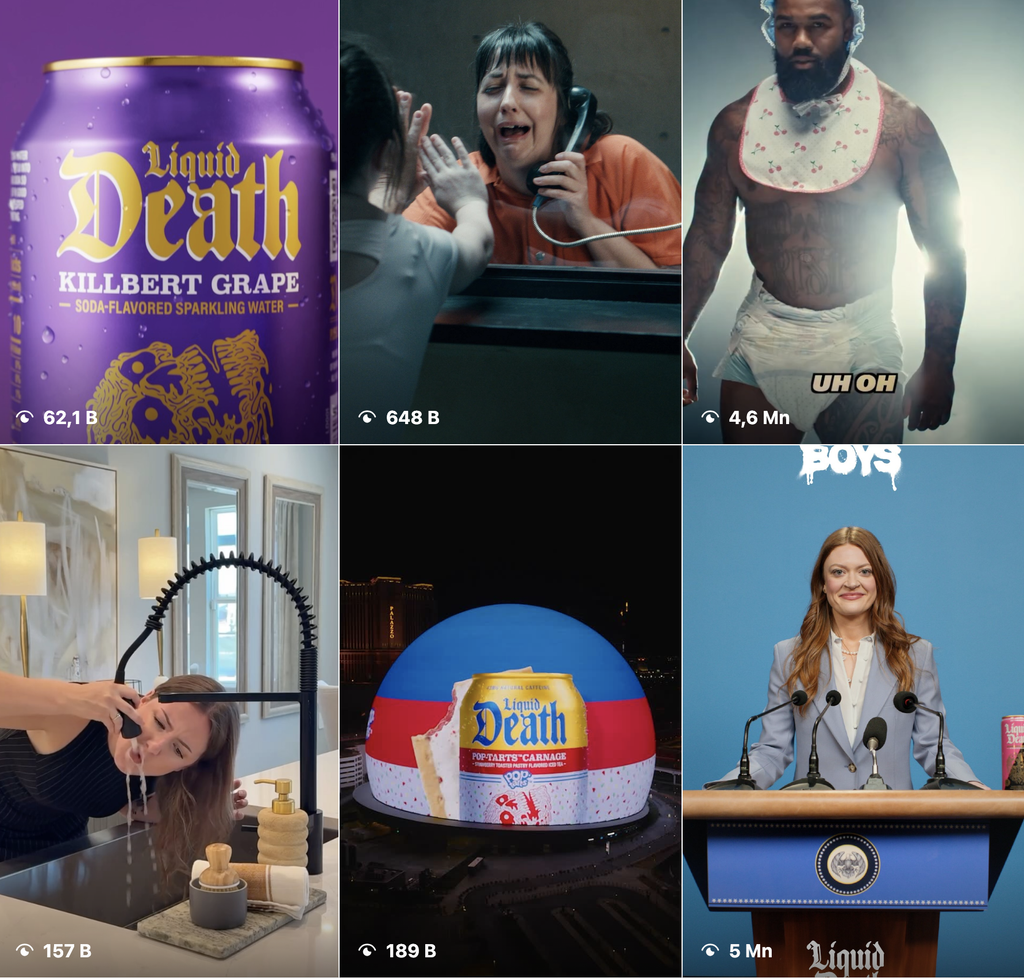
Platform-Native Creative on TikTok and Instagram
The team doesn’t repost the same asset everywhere. For the 2025 Super Bowl, it ran a polished version on Instagram and a filmed, more organic version on TikTok.
Its Van Leeuwen ice cream collaboration on TikTok shows the same instinct for fitting the platform. The cadence is deliberate too: the brand aims for notable content a handful of times a month rather than a volume play.
Long-Form Video and Branded Entertainment
The in-house production arm, Death Machine, lets the team make long-form work cheaply. Examples include a video of pregnant women, including Kylie Kelce, drinking from a keg and a Tom Segura infomercial spoof that asks audiences to recycle aluminum, not plastic. The team runs like a TV writers’ room and hires professional comedians, with legal review often coming late in the process.
Influencer and Creator Collaborations
Paid creator activity is substantial. One analysis of 1,280 sponsored posts over 12 months found 52.6% were on TikTok and 39.5% were Instagram Reels, with 129 million total views and a 5.4% average engagement rate. HypeAuditor’s 2025 Instagram analysis counted 2,722 influencers activated across 4,581 posts, with a 3.7% engagement rate. Both are third-party estimates and may include paid amplification. For brands planning their own program, our directory of social media marketing agencies is a good starting point.
User-Generated Content and Fan Communities
The team also hunts for “unpaid, unprompted, unbriefed” posts featuring the product, then asks those creators if it can put paid media behind them. It plans to experiment with affiliate marketing and TikTok Shop. The point is that Liquid Death viral marketing is less about luck than about a system that reads what the audience is already doing and amplifies it.
Merchandise as a Marketing Channel
Most brands treat merch as a side hustle. Liquid Death treats it as a walking, wearable media channel that also happens to pay for itself, which is the core of its merch strategy.
Why Liquid Death Sells Merch Like a Band
The company started selling T-shirts just a few months after launch. In 2021, it sold $3 million of merchandise out of about $45 million in total sales, which is roughly 7%. That was up from $700,000 the year before. Cessario said merch went from a marketing expense to a revenue driver with great margins, and that earning revenue directly from marketing removes the ceiling on how much you can do. The model mirrors musicians: regular drops, limited runs and a fanbase that wants the shirt as much as the song.
The company typically releases three to five items a month. The scarcity mechanics are visible in the results: 100 Hawk decks sold out, and the e.l.f. vault was reselling at multiples of its $34 retail price. Resale activity is a kind of free proof that people value the object.
Every item is also a billboard. Cessario said early on that he wanted people to wear “Death to Plastic” shirts and make the cause fun. A $52 Recycled Plastic Surgery crewneck extended the plastic message into a wearable. Merch also gave the brand a way to prove demand before entering major retail: the founder said they had to show a large market existed that wasn’t offended by the branding.
Who Is Liquid Death’s Target Audience?
The Liquid Death target audience is younger than the average water drinker, but age is only part of the picture. It’s also an attitude: people who find self-serious wellness branding funny and want a drink that doesn’t make them look like they’re not drinking.
| Audience • | Marketing opportunity • | Relevant campaign approach • |
|---|---|---|
| Gen Z and younger millennials | Entertainment and humor | Social-first creative |
| Sober and health-conscious drinkers | Alcohol alternative | Can format and tone of voice |
| Music, skate and gaming communities | Subculture credibility | Collaborations and merch |
| Sustainability-minded consumers | Plastic alternative | Packaging-led messaging |
The data supports the youth skew. CivicScience found 42% of Gen Z adults and 38% of younger millennials had tried the brand, versus 7% of adults 35 and older and 16% of Americans overall had tried it. Fortune reported that Gen Z and millennials make up over 70% of customers.
The sober-curious angle is just as important. A survey cited by Fortune found three in four young adults want drinks with health benefits and 59% want a non-alcoholic option for socializing, and 61% of Gen Zers planned to cut back on alcohol in 2024, up from 40% the year before.
Sustainability-minded buyers are served by the Death to Plastic message. The brand has donated five cents from every can sold to plastic cleanup and clean-water nonprofits, and its ads cite a Greenpeace figure that only 5% of plastic actually gets recycled. The sustainability messaging works because it’s funny first and educational second.
What Marketers Can Learn From Liquid Death Advertising
As a Liquid Death case study, the brand offers a clear growth strategy for challengers. Here is what we think transfers best, and where to stay honest about limits.
- Murder Your Thirst has carried a skate collaboration, a death metal album, a Super Bowl spot and an electrolyte launch without feeling stretched. If your brand idea can only support one campaign, it’s a slogan, not a platform. Working through that question with a branding agency before launching is time well spent.
- The test is whether anyone would watch it if you weren’t a brand. Keep budgets small enough that you can afford to miss, and make a lot of attempts. Liquid Death says its in-house team is small and its videos cost a fraction of typical ad production. If you lack that capability, look to creative agencies that specialize in entertainment-led work.
- Use humor and shock with a consistent rulebook. The rule is the safe punchline: it looks extreme, it’s water. Benetton succeeded because shock matched its values, while Balenciaga struggled when it didn’t, as our Benetton and Balenciaga analyses show. Pick your line and stick to it.
- Turn criticism into creative material. Greatest Hates and the Death Dust follow-up both turned audience reactions into new content. The same instinct applies to legal threats, as the Dead Billionaire rename showed.
- The can, the shirt, the vault and the skateboard are all ad inventory that people pay for. That’s the idea behind our broader notes on beverage marketing strategies.
Frequently Asked Questions About Liquid Death Marketing Campaigns
What is Liquid Death’s marketing strategy?
It’s an entertainment-first strategy. The brand makes comedic content people want to share, keeps production costs low, and converts the resulting attention into retail shelf space and merch sales. The founder describes it as an entertainment company that makes money through beverages.
What are Liquid Death’s most famous marketing campaigns?
The best-known are the original Murder Your Thirst video, Lose Your Liquid Death Virgenergy, Iced Tea For Trucks, the Greatest Hates albums, the Tony Hawk blood skateboards, the Super Bowl spots, the e.l.f. Corpse Paint collaboration and the Death Dust launch with Ozzy Osbourne.
What does Murder Your Thirst mean?
It’s the brand’s tagline, a violent-sounding phrase for quenching thirst. It is paired with Death to Plastic, the sustainability message, and often with the reassurance “Don’t be scared, it’s just water.”
Who is Liquid Death’s target audience?
Mostly Gen Z and younger millennials, who account for over 70% of customers per Fortune. The brand also speaks to sober-curious drinkers, music and skate communities and sustainability-minded consumers.
How does Liquid Death use social media marketing?
It tailors creative to each platform, produces a handful of standout pieces a month, works with thousands of creators and amplifies unpaid fan posts. It has over 14 million followers across TikTok and Instagram.
Why does Liquid Death sell merchandise?
Liquid Death sells merchandise because it treats its brand like a lifestyle and entertainment brand, not just a beverage company. From graphic T-shirts and hoodies to limited-edition collectibles, its merchandise gives fans a way to express their connection to the brand beyond buying canned water. More importantly, merchandise doubles as a marketing channel: every person wearing a Liquid Death shirt or displaying a branded collectible becomes a potential source of organic exposure.
How does Liquid Death use shock advertising without damaging the brand?
The shock is always a joke with a safe punchline: the product is water. The brand also stays consistent in tone, accepts that some people will dislike it, and treats the cheering majority as the signal that matters, as its marketing team has put it.
What can brands learn from Liquid Death’s advertising?
Build a brand idea that carries many campaigns, make content people would choose to watch, keep a consistent rulebook for humor, turn criticism into material, and treat merch and packaging as media. Just remember that attention and profitability aren’t the same thing.