


















Benetton Advertising Campaigns: A Masterclass in Provocative Marketing
How far can a brand push storytelling before it stops being advertising and becomes a form of cultural commentary?
Few brands have ever walked that line as boldly, consistently, and unapologetically as United Colors of Benetton. Actually, Benetton’s legacy isn’t passive. It asks something of us. And as we’ve said many times in brand strategy discussions, there is no neutral position in marketing; every message communicates an ideology, even when we pretend it doesn’t.
Benetton simply chose to be explicit about it.
What you’ll see throughout this expanded analysis is that Benetton’s advertising strategy fused four elements long before modern marketers began calling them “brand activism,” “shock marketing,” or “purpose-driven storytelling”:
- Fearless imagery,
- Political and social provocation,
- Minimalist branding,
- Emotional triggers as memory anchors.
So, let’s begin where every brand story begins: with its strategic marketing philosophy.
Inside Benetton Marketing Campaigns
- Benetton’s Marketing Strategy: Shock, Social Impact, and Storytelling
- Benetton’s Provocative Marketing Philosophy
- The Most Iconic Benetton Advertising Campaigns
- HIV/AIDS Campaign
- We, on Death Row
- The “Diversity & Race” Campaigns
- A Pop Theory of Fashion
- WE ARE INFINITY
- Benetton’s Digital Marketing Evolution
- Benetton X Stranger Things
- The UNHATE project
- Unemployee of the Year
- How Benetton Uses Social Media Marketing Today
- FAQ about Benetton Advertising Campaigns & Marketing Approach
Benetton’s Marketing Strategy: Shock, Social Impact, and Storytelling
If we are analyzing Benetton’s campaigns, we’d start with the same observation: Benetton doesn’t sell clothes; it sells worldviews.
This isn’t just a poetic statement. It’s supported by various research on Toscani. As you already know, Toscani is the figure behind the most iconic United Colors of Benetton ads. The famous marketer intentionally removed clothing from campaigns to “raise awareness of social, economic or political issues,” using only the iconic green logo as a brand anchor.
That single design choice changed everything.
Suddenly, an ad wasn’t an ad. It became a conversation and a political gesture.
What’s more, Oliviero Toscani (and Bennetton as well) understood that imagination and omission are powerful tools. When the product disappears, the message becomes the product. This aligns with the observation that emotional triggers embed themselves in memory faster and with fewer exposures than traditional ads.
In an interview with The New York Times in 1991, Toscani defended Benetton ads by saying that he accepted advertising as both an artistic and political endeavor:
I have found out that advertising is the richest and most powerful medium existing today, so I feel responsible to do more than to say, ‘Our sweater is pretty.’
The main question is: Why did shock marketing (shockvertising) work for United Colors of Benetton? As you may know, that advertising tactic did not bring “good things” for Balenciaga marketing.
First, we need to mention what shockvertising is:
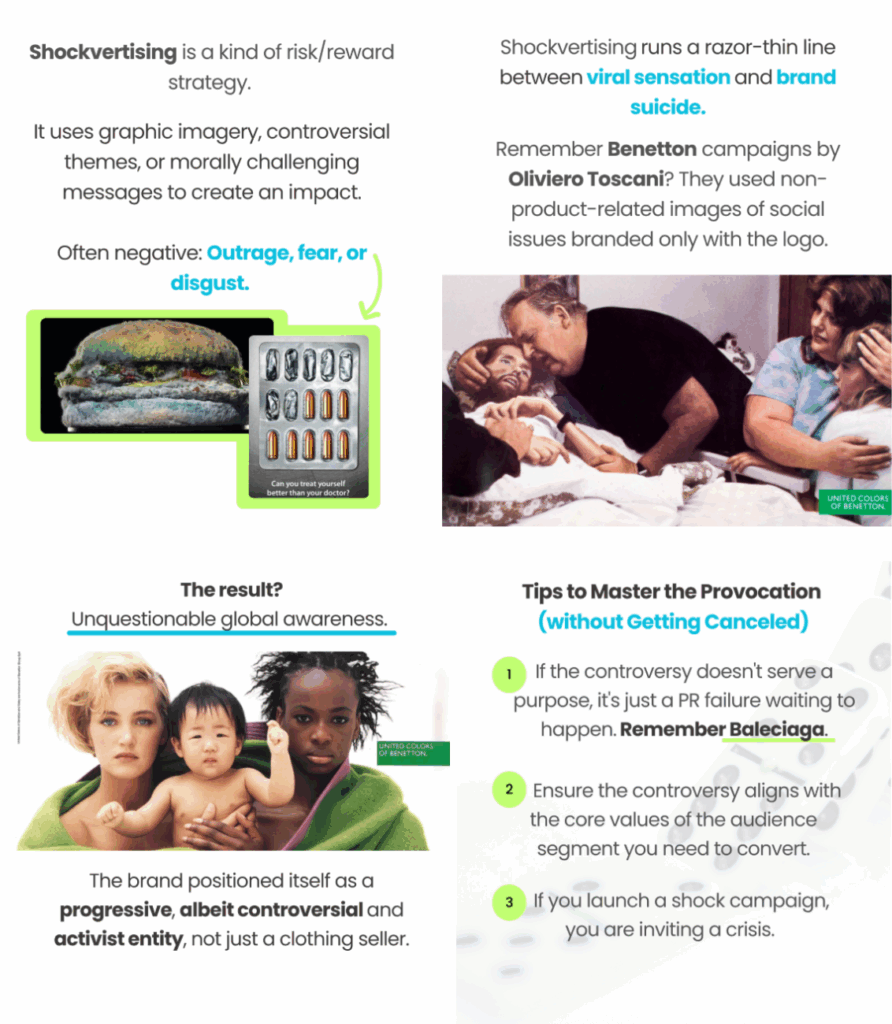
For Benetton’s advertising strategy, it worked since:
The issues were real: War, AIDS, racism, religious tension, and capital punishment; all of these weren’t manufactured controversies. They were global crises.
The shock aligned with the brand’s stated values: The United Colors of Benetton Integrated Report 2021 lists “freedom of expression,” “internationality,” and “social engagement” as foundational corporate values, not temporary campaign ideas.
The imagery served a higher purpose: Benetton ads weren’t created to offend audiences; they were created to make audiences think. That distinction is why Benetton remains a case study, not a cautionary tale.
And as we stated earlier, this is the crux for modern marketers: Shock marketing only works when the shock is truthful, meaningful, and consistent with long-term brand identity.
No brand embodied that better than Benetton.
Speaking of Storytelling & Complex Narratives in Fashion…

Benetton’s Provocative Marketing Philosophy
We mentioned earlier that Benetton refuses to treat advertising as mere product promotion. In opposed, the company treats campaigns as cultural mirrors, reflecting the world’s conflicts and inequalities
This provocative approach both changed Benetton’s communication and shaped the broader universe of fashion marketing campaigns forever.
The “Diversity & Race” campaigns (we will mention below in detail) remain among the clearest demonstrations of this shift. At a time when most fashion advertising presented a narrow, sanitized version of beauty, Benetton placed multiculturalism at the center of its brand identity.
The brand repeatedly used imagery to challenge racism, inequality, and cultural barriers, turning each photograph into a statement about the world the brand wanted to help create. One striking example is the 1991 portrayal of an interracial homosexual family, two mothers of different races holding an Asian child.
During a period when LGBTQ+ representation was almost nonexistent in mainstream advertising, this image disrupted old norms and introduced a new vision of family. And today, Benetton goes on supporting the community on each of its platforms:

Source: https://world.benetton.com/inside/article_rainbow.html
Since the sixteenth century, when German peasants waved it to wish the end of social injustices, the rainbow flag has been a symbol of hope and social change. In the last century, it has been used in Italy by the pacifist movement, in South Africa by the anti-apartheid movement, and worldwide to support the reasons for collaboration and the rights of the LGBT community. For scientists, however, the rainbow is an optical-atmospheric phenomenon that occurs when sunlight passes through the drops of water suspended in the air after a storm. Since Newton’s time, the rainbow was thought to contain every color, but that’s not true. The next time you look at one, look for poppy red (you won’t find it).
For those of us analyzing marketing strategies for fashion, it’s important to understand the strategic power of such imagery. So, inclusivity was not a trend for Benetton but a philosophical stance, and that stance distinguished the brand globally.
Another pivotal moment came in 1991, when Benetton released the image of a priest and a nun kissing. This campaign is a perfect example of meaningful provocation: controversy works only when it expresses a truth the audience already senses.
Actually, Benetton wasn’t interested in offense, but in exposing contradictions. In this way, the brand again demonstrates a key principle of effective advertising campaigns: the most powerful messages are those that illustrate a truth.
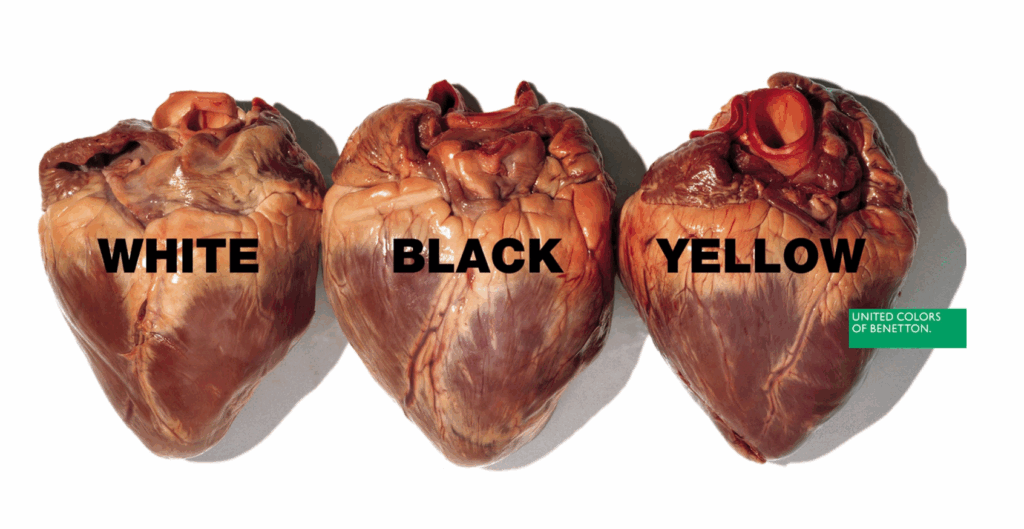
Another iconic Benetton campaign, three identical human hearts labeled “White,” “Black,” and “Yellow,” further demonstrates the brand’s reliance on anatomical truth to challenge racial constructs.
Source: https://world.benetton.com/l/oliviero-toscani-1942-2025.html
Contemporary fashion brands still reference this level of symbolic clarity, but few replicate its impact.
The Most Iconic Benetton Advertising Campaigns
So, yes, for more than four decades, Benetton has turned advertising into a cultural battleground.
Benetton campaigns (from classic ones to modern ones) set up Benetton as one of the boldest storytellers in modern marketing history.
Below, we revisit the most iconic Benetton advertising campaigns that continue to shape how brands approach provocative marketing today.
How we chose these campaigns:
When mapping out this curated breakdown of United Colors of Benetton’s digital and advertising legacy, we bypassed standard fashion marketing parameters.
We purposely focused on campaigns that showcase how a clothing company can achieve global ubiquity without relying on standard commercial product pitches. The selections are explicitly filtered to capture the brand’s unique historical DNA: tracking its trajectory from visceral, real-world billboard “shockvertising” to an elegant, pop-culture-fluent modern runway era.
To ensure this analysis provides actionable, structural insights, every featured campaign was strictly evaluated against its ability to disrupt existing cultural status quos or natively navigate digital ecosystems.
We threw out generic seasonal Lookbooks to isolate the exact creative pivots that forced global consumer conversations. Below is the tactical breakdown of each iconic campaign, detailing how it operated and why it succeeded.
Now, let’s see iconic Bennetton marketing campaigns.
HIV/AIDS Campaign
As marketers already know that tackling HIV/AIDS in early 1990s advertising was not just bold; it was unheard of. The stigma was enormous. Most brands avoided the topic entirely.
The colored condoms campaign addressed safe relationships at the height of the AIDS crisis, when young people were disproportionately affected. Benetton even introduced real coloured condoms in stores, manufactured under license by Ansell and sold at Boots.
And… Maybe the most memorable Benetton ad: David Kirby, the young AIDS activist, photographed on his deathbed. The Kirby photograph forced viewers to confront the human reality of HIV/AIDS during a time when victims were stigmatized and often invisible.

It remains one of the most discussed advertising images of the past century because it bridged the gap between advocacy and branding in a way that felt painfully real rather than exploitative. This is an essential reminder for modern marketers: sometimes the most important fashion campaigns aren’t the most comfortable ones.
Why It Worked: It completely subverted the sanitized, escapist nature of traditional advertising. By stripping away clothes and presenting a “contemporary human tragedy,” Benetton forced the public to look at an epidemic the world was actively trying to ignore.
It functioned as public interest journalism funded by commercial space, generating astronomical levels of free media coverage and cementing Benetton as a brand deeply embedded in socio-political reality.
We, on Death Row
How could death penalty issues become the main objects of a fashion brand’s advertising?
This advertising campaign is one of the best examples of how Benetton challenged society’s moral boundaries.

Let’s be direct here: photographing prisoners sentenced to death was unprecedented in fashion advertising. And it is a masterclass in values-aligned controversy because it embodied the brand’s commitment to showcasing uncomfortable realities. As a result, it sparked global debate, ranging from activism to outrage.
Why It Worked: It targeted a highly controversial taboo. While it faced intense backlash and legal lawsuits in the US, the campaign resonated across European markets where capital punishment is legally banned.
It succeeded because it positioned Benetton as a philosophical arbiter of human rights rather than a knitwear vendor, building intense emotional loyalty among progressive consumers.
The “Diversity & Race” Campaigns
If there’s one area where Benetton permanently altered the landscape of global branding, it’s diversity.
At a time when most fashion advertising presented a narrow ideal of beauty, Benetton placed multiculturalism front and center, not as “representation,” but as a statement about the world the brand wanted to help build. The abovementioned “human hearts” campaign was one of them.
Remember the blood tubes campaign appeared roughly a decade after the early “All the Colors of the World” ads? The point was simple but powerful: if you remove the social constructs society fights over race, nationality, culture, religion, you are left with something identical. Blood.
Why It Worked: As we mentioned above, the Benetton campaign weaponized anatomical truth against social constructs. By using extreme visual contrast, the campaign cut the noise of racial prejudice to focus on shared humanity.
A Pop Theory of Fashion
And here is a modern Benetton campaign, watched by millions of people just on YouTube.
“A Pop Theory of Fashion – FW24 Collection” is an effective advertising campaign because it successfully blends Benetton’s provocative heritage with a fresh, contemporary visual language that resonates with today’s cultural moment.
The campaign reintroduces bold color, playful creativity, and expressive individuality while packaging them in a way that feels relevant to Gen Z and younger millennials.
Why It Worked: By treating their signature basic sweaters as a blank canvas for self-expression (“Be You, be yourself”), the campaign captured the visual language of younger generations who crave bold, expressive individuality without unnecessary corporate preachy-ness.
WE ARE INFINITY
Another modern Benetton ad is “WE ARE INFINITY.”
This is a powerful campaign because it transforms Benetton’s long-standing commitment to diversity into a modern, emotionally resonant message.
This time, Benetton is not relying on shock value or controversy; instead, the campaign delivers a bold, uplifting narrative that celebrates human connection, identity, and limitless potential.
Why It Worked: It modernized the classic “United Colors” ethos without relying on raw political shock. By focusing on the concept that human variation is endless—much like the shades of a color wheel—the campaign translated inclusivity into an elevated, high-fashion editorial format that commands immediate aesthetic authority on platforms like Instagram and TikTok.
Benetton’s Digital Marketing Evolution
We often think of the Toscani-era Benetton as the defining chapter of the brand’s communication strategy. But Benetton’s media plans and executions tell a more dynamic story, one where the company is actively transforming itself to meet new digital behaviors.
Let’s break down what Benetton is doing now and how it aligns with modern marketing strategies for fashion.
As we’ve discussed earlier, Benetton built global recognition by challenging cultural norms through provocative imagery, but in the digital era, the brand has shifted away from shock-based visuals and toward experiences that speak to participation and global community.
Benetton’s Integrated Report makes this transition clear. It notes that Benetton has embraced a multi-channel approach; according to that, physical stores and online platforms operate as “two sides of the same coin.”
The rapid growth of Benetton’s e-commerce business is another story. We know from annual reports that online sales increase every year, and it’s the result of a bold strategy of aiming to build what Benetton calls “one global store,” a unified digital commerce environment.
By treating the digital storefront as a core brand, Benetton has aligned itself with contemporary consumer expectations, particularly those of Gen Z. This generation, as outlined in Čížiková’s thesis, values convenience and integrated online-offline interactions.
One of the most unique and forward-thinking examples of Benetton’s digital marketing evolution is Benetton Island, an immersive brand world created inside the popular game Animal Crossing.
What about other digital marketing examples?
Benetton X Stranger Things
As marketers already know, Gen Z forms relationships with fashion brands through digital creators, streaming content, and fandom communities far more than traditional ads. They expect brands to show up in the spaces where they already spend time. And here is Stranger Things X Benetton collaboration, which launched just before the series’s 5th season.
For Benetton, aligning with one of Netflix’s most globally popular series provides a shortcut into nostalgic aesthetics, retro color palettes, and 1980s visual cues.
When you give a quick look at Benetton’s social media channels, you can see elements that pair naturally with the brand’s historical identity built on color, youth, and cultural commentary.
Digital marketing collaborations like this help Benetton reintroduce itself to younger audiences who may not be familiar with the brand’s earlier provocations.
Why It Worked: It perfectly capitalized on collective internet nostalgia and cross-media entertainment. Because Benetton was a dominant retail force in the actual 1980s, digging into their industrial archives to dress characters like Eleven felt authentic. The campaign ignored sterile product pushing by inviting fans into a treasure hunt spanning major European retail hubs, directly connecting physical retail spaces with a digital fandom.
The UNHATE project
Do you remember the visuals of Obama kissing Hu Jintao? Or Merkel kissing Sarkozy? If you do, you remember UNHATE.
It is one of Benetton’s most globally discussed digital campaigns and a turning point in how the brand translated its historic activism into a modern, platform-driven marketing strategy.
Benetton’s digital marketing move wasn’t created just to shock. It was engineered to circulate, to live natively on social networks, and to provoke a real-time global conversation in a way none of Benetton’s earlier campaigns could.
What makes UNHATE significant from a digital marketing strategy perspective is that it was supported by an institutional framework: the UNHATE Foundation.
And to understand what UNHATE really represented, we need to listen to Benetton’s own definition:
It is another important step in the group’s social responsibility strategy: not a cosmetic exercise, but a contribution that will have a real impact on the international community, especially through the vehicle of communication, which can reach social players in different areas. … The Foundation also aims to be a think tank, attracting personalities and talents from the fields of culture, economy, law, and politics, and people who have gone from simple citizens to leaders of movements, distinguishing themselves through their ideas and actions against the causes and effects of hatred.
In short, UNHATE is where Benetton learns to speak the language of digital culture without losing the intention that made its historic campaigns unforgettable.
Why It Worked: It masterfully engineered global virality. By capturing the world’s most powerful figures in an act of absolute vulnerability and peace, it ignored regional media gatekeepers to dominate global social media feeds instantly. It earned millions in earned media value within 24 hours while giving global audiences a direct digital platform to participate in the message.
Unemployee of the Year
This Benetton digital marketing campaign further demonstrates how the brand has evolved from shock to empowerment.
The campaign celebrated unemployed youths who were active in their communities, creative in their pursuits, and determined to redefine their futures.
From a strategic standpoint, Unemployee of the Year highlights that Gen Z values: honest storytelling, transparency, social purpose tied to real outcomes, and brand actions that match brand messaging.
And, it blends Benetton’s heritage of social commentary with a modern tone of optimism and solidarity. It manages to critique unemployment stigma while celebrating youth creativity. In other words, it is both socially conscious and Gen-Z aligned.
Why It Worked: It shifted the brand’s digital strategy from pure observation to tangible utility. Instead of just pointing out a societal wound through an ad, Benetton built a crowd-sourced, direct-action vehicle. It earned massive brand equity by giving a voice (and real economic backing) to a marginalized, digitally active demographic that standard fashion brands completely ignore.
How Benetton Uses Social Media Marketing Today
As we mentioned above, Benetton’s social media approach is a little different from the past; the brand’s most watched & engaged posts are not shock campaigns.
For example, on TikTok, the brand’s AI-powered, seasonal content, seeing a giant dog and celebrating the holiday, has been seen more than 17 million times.
On the surface, it’s a warm, seasonal piece of content promoting the United Colors of Benetton Holiday List 2023. But strategically, it represents a major milestone in how the brand uses social media today.
The creative relies on visuals to depict a diverse, playful, ever-expanding “Benetton family,” bringing the brand’s founding values, unity, inclusion, and affection, into a format that feels unmistakably modern. Instead of using shock to get attention, the brand uses warm imagery today.
Speaking of TikTok, we can say that the brand shares platform-native content; influencer-led, movement-oriented, challenge-driven, and grounded in participatory culture.
So, today, the brand uses Instagram, TikTok, YouTube, and gaming platforms to build connections, especially for younger audiences who demand authenticity and values from the fashion brands they follow. And the fashion brand focuses on friendship groups, intergenerational connections, everyday joy, and playful, colorful human interactions.
Here are some “happy images” on Benetton’s social media:

Source: https://www.instagram.com/benetton/
What about influencer marketing and collaborations?
Benetton collaborates with creators who embody its spirit, diverse, global, and not overly polished. This mirrors early UCB campaigns featuring “ordinary people with extraordinary stories,” just translated into creator culture.
And, finally, we can say that modern Benetton uses social platforms as direct bridges into shopping. You can see “Get the look” breakdowns, shoppable Reels, geo-targeted store content, and creator-led try-ons.
The best part of this approach is that it turns social content into a full conversion funnel, not just a brand awareness tool.
FAQ about Benetton Advertising Campaigns & Marketing Approach
What makes Benetton’s advertising campaigns unique?
Benetton’s advertising campaigns are unique since they combine high-concept visuals with social, political, and cultural themes; not only focusing on products. From the 1980s onward, Benetton rejected traditional fashion marketing and became one of the first global brands to use advertising as a form of activism. When considering that the brand consistently sells ideas: unity, diversity, tolerance, justice, and humanity, it’s not surprising. This mix of real-world issues and minimalist branding created a completely new approach to communication that felt more like cultural commentary than commercial advertising.
How have United Colors of Benetton ads evolved over the years?
In the simplest terms, Benetton’s advertising has evolved through three major eras:
The Toscani Era (1982–2000): Shock & Social Provocation: Campaigns relied on provocative photojournalism (such as AIDS awareness, racism, capital punishment, war, etc.) All presented with the Benetton logo, but no products. The goal was disruption and global conversation.
The Post-Toscani Transition (2000s–2010s): Benetton experimented with more conventional fashion imagery while still blending in humanitarian initiatives and social justice messaging. Campaigns like UNHATE modernized Toscani’s philosophy using digital platforms and symbolic imagery.
The Digital Era (2020s–Present): The brand’s messaging shifted from confrontation to connection. Campaigns like WE ARE FAMILY, Benetton Island (Animal Crossing), and AI-powered TikTok videos focus on positivity, inclusivity, color, and community. Instead of shock, Benetton now uses digital-first storytelling to invite participation and emotional resonance.
Why are Benetton advertisements often considered controversial?
Benetton ads are considered controversial because they have repeatedly confronted audiences with politically charged, emotionally intense, or taboo subjects. So much so that, in the past, the ads of the brands focused on religious tension (priest and nun kissing), war & refugee crises, AIDS victims (David Kirby), racial equality framed through anatomy (the three hearts), and more.
What made them controversial was the decision to place these topics in a fashion advertising context, an industry known for glamour. Benetton broke that rule and asked audiences to face real-world issues inside spaces normally reserved for aspiration.
What themes does United Colors of Benetton focus on in its advertising?
Across all decades, Benetton returns consistently to a core set of themes:
- Unity and multiculturalism,
- Diversity in race, gender, age, religion, identity,
- Human rights and social justice,
- Global citizenship,
- Love, family, and emotional connection (current),
- Anti-hate messaging and tolerance (current),
- Youth empowerment and community (current).
How do Benetton ads reflect the brand’s identity and values?
When you look at a Benetton ad, you immediately feel who the brand is. The visuals always go beyond clothing and point straight to what Benetton stands for: unity, diversity, expression, and a genuine belief that humanity & connection are powerful. In the early days, the message came through sharp, provocative photography that forced people to confront the world as it was. Today, it shows up in softer, more digital-native ways. The consistency of those values is what makes the brand feel authentic even as the style and mediums evolve. No matter the decade, Benetton’s ads remind you that the brand isn’t just selling clothes.
What impact have United Colors of Benetton advertising campaigns had on global branding?
Before Benetton, most brands stayed far away from social or political issues. Benetton did the opposite; it walked straight toward them and used its global platform to start conversations that were uncomfortable, emotional, and in many cases urgently needed. Because of that, the entire industry had to rethink what advertising could be. In other words, Benetton made it clear that purpose wasn’t a distraction from branding; it was branding itself. That influence is still felt today in the way companies build campaigns around identity, ethics, and culture.