

















Consumer Electronics Marketing: How Brands Turn Complicated Technology Into Products People Want
How do you market a product that may look outdated six months after launch, which costs thousands of dollars? That is the central challenge of consumer electronics marketing.
Phones, televisions, headphones, laptops, smart-home devices, wearables, gaming hardware, cameras, and connected appliances sit in one of marketing’s most demanding categories. Buyers compare products closely. Reviewers inspect every flaw. Retailers control critical discovery points. Price drops can arrive quickly. Competitors launch at awkwardly convenient moments, usually just after your media budget has been approved.
The size of the prize explains the intensity. It’s been estimated that worldwide consumer electronics revenue will reach US$1.03 trillion in 2026, with projected annual growth of 2.81% from 2026 to 2030.
But this is not a market where brands can simply buy reach and wait for sales.
Amazon Ads reports that the purchase journey for consumer electronics often lasts more than 60 days. It also found that 42% of surveyed electronics shoppers visited Amazon before completing their purchase elsewhere.
That tells us something important: the sale may happen in one place, but the decision is assembled across many places.
A consumer might discover a product through a creator, watch three reviews on YouTube, compare models on Amazon, test one in a store, search Reddit for complaints, open a promotional email, and finally buy from whichever retailer offers the best bundle.
This guide explores the trends, consumer electronics marketing strategies, channel tactics, launch methods, campaign examples, and measurements that help brands compete in that messy reality.
Click & Learn about Consumer Electronics Marketing
- What is Consumer Electronics Marketing and Why Is It Unique?
- Key Trends Shaping the Global Consumer Electronics Market
- High-Impact Consumer Electronics Marketing Strategies
- Channel-Specific Marketing Tactics for Consumer Electronics
- How to Position and Market a New Consumer Electronics Product
- Two Biggest Electronics Brands: Apple and Samsung
- Key Metrics: How to Measure Consumer Electronics Marketing Success
- Frequently Asked Questions About Consumer Electronics Marketing
What is Consumer Electronics Marketing and Why Is It Unique?
Consumer electronics marketing is the process of creating demand for electronic products designed for personal or household use. It covers positioning, advertising, product education, retail activation, creator partnerships, launches, lifecycle communication, trade-ins, subscriptions, and customer retention.
Electronics marketing sits at the intersection of product engineering, culture, retail, entertainment, and customer support. A campaign may need to explain a processor, demonstrate a camera, create emotional desire, reassure buyers about durability, negotiate retailer visibility, and prepare the support team for launch-day questions.
Sometimes all before lunch. Remember all the first looks or speculations spread before the next iPhone each time:
An OECD study of the consumer electronics sector described the industry as highly scale-intensive, price-sensitive, innovation-driven, and dominated by companies competing globally. It also highlighted the importance of product differentiation, brand loyalty, distribution, service, component sourcing, and research investment. Those findings were published in 1994, so its market figures belong firmly in their historical setting. Yet the structural pressures it identified remain recognisable in modern electronics competition.
The same report noted that product development cycles had compressed from three or four years to roughly 18 to 24 months in the period it studied. That historical observation helps explain a permanent tension in the category: marketing teams have little time to establish a product before attention shifts to the next generation.
Several characteristics make the category unique.
- Products require education:
A fragrance can be sold through mood. A snack can be sold through appetite. However, a laptop may need you to explain processors, ports, battery life, software compatibility, screen brightness, repair options, and why the base model has mysteriously become less attractive after the buyer notices the upgraded one.
Electronics customers often need help translating technical features into practical outcomes.
“50 megapixels” is a specification.
“Capture a clear photo of your child during an evening football match” is a reason to care.
Good consumer electronics advertising makes that translation without insulting technically informed buyers or confusing everyone else.
- The purchase carries perceived risk:
Electronics purchases are often expensive, difficult to evaluate quickly, and expected to last. Buyers worry about reliability, compatibility, warranties, battery health, data migration, repair costs, resale value, and the possibility that a new version will appear next Tuesday.
Marketing therefore has to reduce uncertainty as well as create excitement.
Detailed product pages, comparison tools, demonstrations, expert reviews, clear return policies, customer testimonials, installation guidance, and responsive support all influence conversion.
- Specifications are easy to copy:
Competitors can often match a feature within one or two product generations. A faster chip, brighter display, smarter assistant, or thinner body rarely stays unique forever.
That makes brand, ecosystem, software experience, service, design language, distribution, and community increasingly important.
A feature may win attention. An ecosystem can protect the customer relationship.
- Products are reviewed in public:
Tech reviewers test products, compare claims, zoom into defects, measure battery life, discuss value, and explain who should avoid buying. It gives buyers confidence. It also means marketing claims must survive contact with reality.
However, a beautifully produced advertisement cannot rescue a product whose hinge breaks, software crashes, or battery misses its stated performance by a country mile.
- The journey crosses online and offline channels
People still want to hold phones, listen to headphones, compare television screens, type on keyboards, and test laptop weight. At the same time, they research prices, reviews, specifications, and stock availability online (we’ll focus on that below, in detail.)
This creates a hybrid journey in which stores serve as experiential spaces and digital channels function as research, comparison, and transaction engines. As we mentioned above, Amazon’s finding that 42% of surveyed electronics shoppers visited its store before purchasing elsewhere demonstrates how porous channel boundaries have become.
Your website, retailer page, creator video, store display, and support content are not separate projects. To the customer, they are one brand experience with several tabs open.
Key Trends Shaping the Global Consumer Electronics Market
The consumer electronics market is undergoing a period defined by intelligent software, ecosystem competition, repair regulation, sustainability pressures, retail fragmentation, and rising expectations for product longevity. So, it’s obvious that the product is no longer “only the device.”
It is the device, software, services, updates, accessories, data, content, support, and other products it connects to.
Technological Shifts: AI Integration, Smart Home, and IoT
AI has moved from a back-end capability to a front-of-box selling point.
Phones promise generative editing, live translation, intelligent search, writing assistance, call summaries, and smarter photography. Televisions optimise sound and image settings. Computers are marketed around neural processing. Wearables interpret health and activity data. Appliances predict maintenance needs or recommend operating modes.
So, nowadays, a usual customer wants to know:
- What task becomes easier?
- How much time does it save?
- Does it work privately and securely?
- Is the feature included or paid?
- Does it work without an internet connection?
- Will it still be supported in three years?
- Can someone demonstrate it without using smoke, mirrors, and a suspiciously perfect Wi-Fi connection?
In other words, the strongest AI product marketing starts with a real situation.
Amazon’s Alexa and Apple’s Siri helped normalise voice interaction inside the home and across personal devices. The marketing significance extends beyond voice assistants. These platforms trained customers to expect technology to understand context, connect services, and respond through natural language.
Amazon, in particular, represents both a device ecosystem and a discovery environment. Its consumer electronics advertising offering uses shopping, browsing, and streaming signals to reach people across the journey. Amazon says its connected consumers are 10% more likely to engage with brand messages that match their interests and previous behaviours.
Smart-home marketing adds another complication: one device is rarely the full proposition. A smart speaker gains value from compatible lights, cameras, thermostats, televisions, locks, and services.
Tesla also matters here, even though cars sit outside the traditional definition of consumer electronics. Tesla helped popularise the idea of a physical product that evolves through software updates. That model has influenced expectations across phones, televisions, wearables, appliances, and smart-home products.
AI also changes the marketing operation behind the scenes. McKinsey estimates that 92% of surveyed companies plan to increase generative AI investment over three years, yet only 1% describe their deployment as mature.
For electronics brands, this gap is a warning. AI can assist with audience analysis, creative adaptation, product-page localisation, support, reporting, demand forecasting, review analysis, and lifecycle messaging. But putting AI into every workflow without clear oversight can scale errors at impressive speed.
So, it is best to let machines organize review data and let people decide what the brand should do about it.
Sustainability, Eco-Friendly Tech, and Right-to-Repair Demand
Sustainability has moved closer to the purchase decision.
Consumers may still care about camera quality and battery life first, but product longevity, energy use, packaging, recycled materials, trade-ins, software support, and repairability now influence brand perception and regulation.
EU ecodesign requirements for smartphones and slate tablets have applied to products placed on the market since 20 June 2025. Energy labels now include information on battery endurance, charging cycles, and repairability.
The EU’s repair directive was adopted on 13 June 2024, and member states were required to apply national rules from 31 July 2026.
Common-charger rules also apply across several portable electronics categories in the EU, with laptop requirements taking effect on 28 April 2026.
For marketers, this changes the story. Durability is no longer a footnote beneath the technical table. Repair access is no longer only a support issue. Software longevity is not merely an engineering roadmap item. These can become selling points. That’s why electronic consumer giants release reports and sustainability campaigns. Take LG’s case study below as an example:
“Better for the planet” says very little.
“Battery designed to retain a stated capacity after a defined number of cycles” gives the buyer something to evaluate.
Claims also need legal and factual review. Green marketing becomes dangerous when broad emotional language outruns the evidence. So, sustainability is strongest when it is built into the product proposition: lower running costs, longer useful life, repair access, resale value, and reduced waste.
E-commerce Expansion vs. Omnichannel Tech Retail
E-commerce has made electronics easier to compare and purchase. It has not eliminated the value of physical retail. The result is not a winner-takes-all contest between online and offline. It is an omnichannel market where each channel solves different anxieties.
- Product discovery
- Specification comparison
- Price monitoring
- Review access
- Stock visibility
- Retargeting
- Accessory recommendations
- Fast checkout
- Hands-on testing
- Screen and sound comparison
- Expert reassurance
- Immediate collection
- Installation conversations
- Trade-in assessment
- Reducing perceived risk
The opportunity is to connect these strengths.
A shopper should be able to research on your site, check local stock, book a demonstration, save a configuration, visit a store, complete the purchase later, and receive follow-up content without starting from zero at every step.
On its consumer electronics page, Amazon says 71% of consumer electronics shoppers agree that effective advertising should look and sound like entertainment. That statistic matters because the research journey is long. Brands need enough variety to remain useful for weeks without repeating the same 15-second product shot until the viewer develops a personal grudge against it.
High-Impact Consumer Electronics Marketing Strategies
The strongest consumer electronics marketing strategies do not begin with media formats. They begin with the friction between the customer and the product.
- What does the buyer fail to understand?
- What makes the purchase feel risky?
- Which feature sounds impressive but needs proof?
- Which audience has the problem most intensely?
- Which competing product defines the comparison?
Once those answers are clear, the campaign has a chance.
Product-Led Growth and Product Demonstration Marketing
Product-led marketing places the experience, capability, or output of the device at the centre of communication. The advertisement simply demonstrates it. How?
👾 A camera campaign can show photographs made with the camera.
👾 A noise-cancelling headphone campaign can simulate the transition from a chaotic train to focused listening.
👾 A foldable phone campaign can let people experience the expanded screen.
👾 A gaming-monitor campaign can compare motion clarity.
👾 A smart-home campaign can show an evening routine running across several devices.
This approach works because it reduces the distance between claim and proof. At that point, we would like to remind you that a strong demonstration usually contains four elements:
- A recognisable problem. The viewer understands the situation quickly.
- A visible product action. The device solves or improves something.
- A human outcome. The user saves time, captures a moment, creates something, or avoids frustration.
- A repeatable result. The demonstration feels achievable outside the advertisement.
That final point is critical. If the demo looks as if it required a studio crew, six engineers, and favourable planetary alignment, the viewer may admire the content without believing the product.
Omnichannel Experience: Bridging Online and In-Store Tech Testing
Customers should not have to choose between a useful website and a useful shop. The best omnichannel systems allow digital research to improve the store visit and allow store interaction to improve later digital communication.
A shopper comparing televisions online might save three models. In store, a salesperson can access that shortlist, demonstrate the differences, and email a personalized summary. If the shopper does not buy immediately, follow-up can focus on the products tested, not the entire catalogue.
That is useful personalization. Following someone around the internet with a product they already bought is not useful personalization. It is an expensive way to announce that your systems are not speaking to each other.
Brands also need retailer-specific execution. The brand story may be global, but a product detail page on Amazon, a display inside a specialist retailer, a telecom bundle, and a direct-to-consumer site serve different needs. So, it is best to give every retail partner accurate images, comparison charts, demonstration videos, naming conventions, claims, FAQs, and launch timing.
A premium retail marketing campaign can unravel quickly when the page contains a blurry image and a product description that appears to have been translated by an exhausted toaster.
Pre-Launch Hype, Pre-Orders, and Product Drops
Electronics launches sell anticipation before they sell units.The pre-launch phase should create curiosity, collect intent, prepare advocates, educate partners, and produce signals that improve launch-day execution.
Teasers work best when they reveal a meaningful tension. “Something is coming” is rarely enough unless your logo already causes people to refresh the page.
Build the pre-launch sequence in layers:
- Early intrigue: Introduce the problem or cultural idea.
- Controlled reveal: Show the design, capability, or category.
- Education: Release demos, interviews, creator previews, and use cases.
- Conversion preparation: Open registrations, waitlists, retailer alerts, or trade-in estimates.
- Pre-order: Offer genuine value through bundles, priority delivery, exclusive colours, services, or accessories.
Be careful with manufactured scarcity.
Limited supply can create urgency, but repeated “sold out” theatre can frustrate customers and distort measurement. A waitlist only has value when the follow-up is timely, relevant, and honest.
Amazon Ads’ New Product Campaigns solution reflects this full-funnel need by combining awareness and purchase activity across Amazon properties and other placements.
Subscription and Ecosystem-Based Marketing Models
Hardware revenue is attractive. Recurring relationships are even more attractive.
Many electronics brands now market ecosystems that connect devices with storage, entertainment, software, protection, fitness, gaming, smart-home control, or premium support.
This changes the commercial model. The first sale may have lower value than the customer’s long-term participation across products and services.
Ecosystem marketing should demonstrate cumulative value without making the customer feel trapped. Show how products work together:
- earbuds switching between a laptop and phone,
- a watch controlling music or navigation,
- a television integrating gaming and streaming,
- a phone acting as a smart-home control centre,
- cloud storage protecting photos,
- a tablet extending a computer workspace,
- device protection simplifying repair.
Bundles can reduce the initial barrier, but they need clear logic. Pair products that improve one another, not items that happen to be sitting in the same warehouse. Subscription communication should also explain:
- what remains usable after cancellation,
- which features require payment,
- renewal timing,
- family access,
- storage or usage limits,
- upgrade options,
- data handling,
- support benefits.
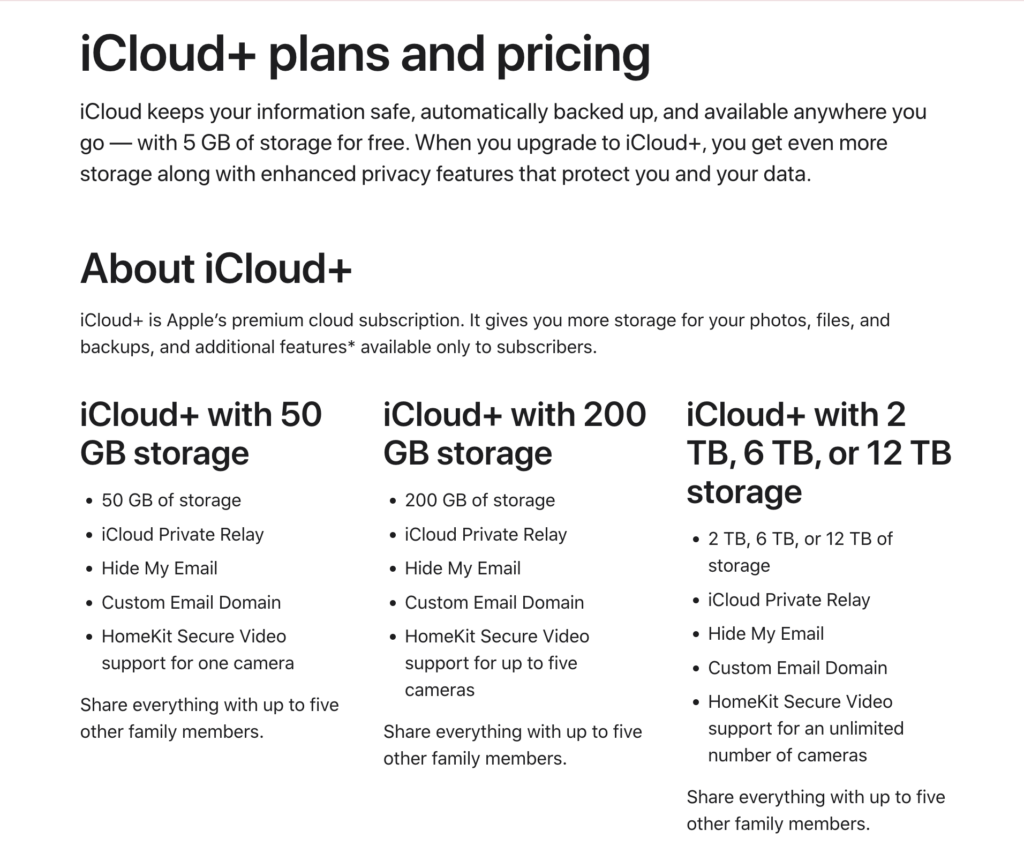
We think Apple’s Cloud service is a great example of good subscription model:
Channel-Specific Marketing Tactics for Consumer Electronics
Different channels answer different customer questions. Strong consumer electronics advertising strategies match the tactic to the decision stage.
Influencer, Tech Reviewer, and Creator Partnerships: Unboxing and Reviews
Tech creators occupy a powerful position because they combine demonstration, explanation, comparison, entertainment, and perceived independence.
Google reports that 89% of surveyed US shoppers agreed that YouTube creators provide the best information about products and brands.
That does not mean every brand needs the creator with the largest audience. Actually, large reviewers can produce reach and category authority. Niche creators can demonstrate specialist use cases such as mobile filmmaking, home automation, gaming performance, audio production, accessibility, travel, or productivity. Everyday creators can show how the product fits normal life.
On the other hand, brands should also prepare for mixed feedback. A credible reviewer may love the display and criticise the price. That does not automatically make the partnership unsuccessful. A balanced review can qualify the audience and increase trust.
In that scenario, tracking more than views is the best thing to do. Look at qualified traffic, branded queries, product-page engagement, and recurring questions.
The comment section is also research. It tells you what buyers understand, what they doubt, and which competitor owns the comparison.
Content Marketing and Educational Tech Guides
Consumer electronics content should help people make a decision or get more value from a product. Useful formats include:
- buying guides,
- “best for” pages,
- compatibility checkers,
- setup tutorials,
- feature explainers,
- troubleshooting content;
- accessory guides,
- repair information,
- short demonstration videos.
Comparison content is especially important because buyers are already making comparisons. Ignoring competitors does not remove them from the customer’s browser.
Content should also support search behaviour throughout the lifecycle, like:
- Before launch, people search rumours, dates, prices, and comparisons.
- At launch, they search reviews, specifications, availability, and problems.
- After purchase, they search setup, accessories, troubleshooting, and hidden features.
- Before upgrading, they search trade-in values and differences between generations.
Build content for all four moments.
Email and Lifecycle Marketing: Onboarding, Trade-Ins, and Upgrade Cycles
Email is one of the most underused channels in electronics marketing. Many brands send launch announcements, discount blasts, and little else. Yet the product lifecycle creates dozens of useful communication moments.
A strong post-purchase sequence looks like that:
- Order confirmation
- Delivery expectations
- Migration checklist
- Setup guidance
- Support contacts
- Essential features based on purchased model
- Accessories linked to actual usage
- Services linked to actual usage
- Advanced tips
- Community content
- Feedback collection
- Review request
- Software updates
- Maintenance alerts
- New use cases
- Trade-in estimates
- Repair information
- Upgrade education
Another thing: Someone who bought premium headphones needs different content from someone who bought a smart thermostat. Revolutionary, we know.
So, explain the difference between the customer’s current product and the new one. “Our best device ever” is not enough. Every generation says that. The customer wants to know what changes for them.
Trade-in marketing can reduce price friction, support circularity, and keep customers inside the ecosystem. Show estimated value early in the journey, explain the assessment process, and make data removal clear.
Trade Shows and Industry Events: CES and IFA as Launchpads
CES and IFA remain major attention events because they bring media, retailers, creators, investors, partners, and buyers into one concentrated environment.
CES 2025 recorded 142,465 attendees, including 81,621 industry professionals and 6,582 media attendees.
IFA 2025 reported more than 1,900 exhibitors from 49 countries and 220,000 visitors.
Those numbers are impressive. They can also tempt brands into treating attendance as success. A trade show is a launchpad only when the work around it is planned.
- Brief media and creators
- Schedule demonstrations
- Prepare press materials
- Train spokespeople
- Define announcement timing
- Build landing pages
- Create retailer follow-up
- Prepare lead capture
- Identify priority meetings
- Demonstrate, do not merely display
- Capture short-form content
- Answer technical questions
- Monitor reactions
- Support live coverage
- Document recurring objections
- Protect time for retailers and partners
- Publish demonstrations
- Follow up with leads
- Send review units
- Answer questions raised by media
- Retarget engaged visitors
- Equip sales teams
- Measure coverage quality
- Convert attention into availability alerts or pre-orders
The booth is not the campaign.
It is a content studio, meeting space, demonstration environment, and credibility signal inside a larger campaign.
How to Position and Market a New Consumer Electronics Product
A new product does not need more messages, but well-built steps.
👉🏻 Step 1: Defining the Core Value Proposition and Target Persona
Start with the customer problem.
(Not the processor. Not the number of microphones. Not the phrase the engineering team has repeated for nine months.)
Ask:
- Who experiences the problem most often?
- What do they use today?
- What frustrates them?
- What stops them switching?
- Which benefit changes their behaviour?
- What proof supports the promise?
- Which competitor defines their expectations?
Turn the answer into a value proposition:
For [specific user], this product helps [important outcome] through [distinct capability], supported by [credible proof].
Then build a message hierarchy:
- Core outcome.
- Main differentiator.
- Demonstration.
- Supporting features.
- Proof.
- Price and availability.
- Risk reducers.
Do not target “tech enthusiasts” unless you can describe the person behind the label. A gaming creator, smart-home installer, university student, remote worker, frequent traveller, and early adopter may all like technology for different reasons.
👉🏻 Step 2: Building Pre-Launch Hype and Early-Adopter Waitlists
Early adopters want access, status, information, and influence. Give them a meaningful reason to join. A waitlist can offer early demonstrations, beta access, priority ordering, exclusive configurations and accessory bundles.
Use the waitlist to learn as well as promote.
Ask one or two useful questions: intended use, current device, preferred retailer, or biggest frustration. Keep it brief. Nobody wants to complete a mortgage application to hear about headphones.
Build remarketing and email sequences around intent. Someone who watched a professional workflow demo should receive deeper professional content. Someone who explored pricing may need financing, trade-in, or bundle information.
👉🏻 Step 3: Launch-Day Execution and Review Management
Launch day should align five systems:
- owned channels,
- paid media,
- creators and reviewers,
- retailers,
- customer support.
The product name, claims, prices, availability dates, images, bundles, and links need to match everywhere. Create a launch command centre stock, site performance, paid campaigns, retailer pages, reviews and support tickets.
Speaking of reviews; review management means identifying factual errors, answering legitimate questions, correcting unclear documentation, and escalating product issues. If several reviewers identify the same flaw, the response should reach product and support teams quickly. Marketing cannot edit its way out of a repeatable hardware problem.
👉🏻 Step 4: Post-Purchase Engagement and Customer Retention
The first week of ownership shapes reviews, returns, referrals, accessory sales, and long-term loyalty. Help customers reach value quickly. Use onboarding to:
- complete setup,
- migrate data,
- configure preferences,
- connect companion devices,
- explain privacy controls,
- activate warranties,
- introduce key features,
- provide support,
- prevent common mistakes.
Then keep the relationship active through software updates, education, community stories, accessories, maintenance, services, and trade-ins.
Two Biggest Electronics Brands: Apple and Samsung
Apple and Samsung offer useful contrasts because both operate at global scale, invest heavily in ecosystems, and shape customer expectations across multiple electronics categories.
Interbrand’s 2025 Best Global Brands ranking placed Apple first overall and Samsung fifth. Apple’s listed brand value was US$470.9 billion.
Apple marketing tends to compress complex technology into simple human outcomes. Its marketing gives products room, uses controlled language, and turns capabilities into demonstrations.
On the other hand, Samsung marketing often competes through breadth, innovation visibility, cultural participation, challenger energy, and multi-format experiences. Its campaigns are more likely to confront category habits directly or invite consumers to test an unfamiliar form factor.
Let’s see two popular consumer electronics campaigns from these popular brands:
Apple: Shot on iPhone
Shot on iPhone is a product-demonstration, creator, outdoor, social, and user-participation campaign. It turns photographs and films created with iPhones into advertising for the device’s camera capabilities.
The product is both the tool and the proof.
Apple’s Shot on iPhone Challenge invited users to submit photographs, selected ten winners, and displayed their work through billboards, Apple retail stores, and online channels. The campaign has expanded through challenges, commissioned photographers, cultural projects, professional filmmaking, behind-the-scenes content, and educational material.
Why it worked
It made customers part of the brand story. That created participation, aspiration, social sharing, and a renewable source of creative material. The approach remained flexible enough to support new camera features and cultural moments without abandoning the core idea. That longevity became evidence of strategic strength.
A 2020 “Vertical Cinema” extension generated more than one billion video starts and achieved the highest volume of long-form views recorded for a global Apple campaign at that time. In 2025, the broader Shot on iPhone platform received the Creative Effectiveness Grand Prix at Cannes Lions, a decade after its launch.
The marketing lesson is beautifully inconvenient: sometimes the clearest way to advertise technology is to stop explaining it and let people see what it produces.
Samsung: Flipvertising
Flipvertising is an interactive, search-led, data-informed campaign for the Galaxy Z Flip4. It reverses the normal advertising model by asking users to search for and uncover a hidden Samsung advertisement instead of serving the advertisement directly to them.
Participants follow clues and shape their own search behaviour in an attempt to trigger the elusive YouTube ad and win a Galaxy Z Flip4. The experience turns ad targeting into a game. The media mechanism becomes the creative idea.
Why it worked
It worked because it matched the product’s unconventional positioning with unconventional media behaviour.
The Galaxy Z Flip4 asked consumers to reconsider the familiar smartphone shape. The campaign mirrored that challenge by asking people to reconsider how advertising reaches them.
Samsung reported that Flipvertising won Grand Prix awards in both Creative Data and Direct at Spikes Asia in 2023.
Key Metrics: How to Measure Consumer Electronics Marketing Success
Measurement should follow the customer journey and commercial model.
A single return-on-ad-spend number cannot explain a 60-day research cycle, offline testing, retailer purchases, creator influence, trade-ins, services, and later upgrades.
Use a layered framework.
- Qualified reach
- Video completion
- Attention
- Branded search lift
- Direct traffic
- Share of search
- Product-name awareness
- Message recall
- Retailer-page visits
- Waitlist growth
- Comparison-page use
- Demonstration views
- Review engagement
- Specification interactions
- Store-locator use
- Appointment bookings
- Email registrations
- Saved products
- Repeat visits
- Creator-assisted traffic
- Compatibility checks
- Direct sales
- Retailer sell-through
- Pre-orders
- Conversion rate
- Cost per acquisition
- Cart abandonment
- Financing use
- Trade-in use
- Bundle attachment
- Store visits
- Click-and-collect orders
- Stock-outs
- Return rates
- Activation
- Setup completion
- Feature adoption
- Companion-app use
- Connected-device use
- Support contacts
- Return reasons
- Review scores
- Satisfaction
- Warranty registrations
- Software-update adoption
- Accessory attachment
- Service subscriptions
- Renewal
- Active use
- Repeat purchase
- Cross-category ownership
- Trade-in participation
- Upgrade conversion
- Referral
- Customer lifetime value
- Churn
AI can help process this volume. So, we recommend you to use AI to classify reviews, summarise support themes, adapt assets, identify questions, and accelerate reporting. And, always keep people responsible for interpretation, claims, ethics, brand decisions, and action.
Frequently Asked Questions About Consumer Electronics Marketing
What is consumer electronics marketing?
Consumer electronics marketing is the promotion and commercialisation of personal and household technology products such as smartphones, laptops, televisions, headphones, wearables, gaming devices, cameras, smart-home products, and connected appliances. It includes market research, positioning, branding, consumer electronics advertising, retail execution, creator partnerships, product demonstrations, launch activity, lifecycle communication, services, trade-ins, and retention. Its main job is to translate technical capability into understandable customer value while reducing purchase risk.
What are the best marketing strategies for consumer electronics?
Key strategies for driving product growth include product demonstrations, creator reviews, educational content, omnichannel retail experiences, pre-launch waitlists, trade-in offers, lifecycle onboarding, ecosystem bundles, and use-case-led advertising. Selecting the right mix depends heavily on product maturity: new categories require customer education and trial opportunities, while mature categories demand strong differentiation and a compelling reason to upgrade. Similarly, premium products rely on clear proof, high-touch service, and risk reduction, whereas lower-priced options depend on transparent value positioning and broad retail visibility.
How do consumer electronics brands build successful advertising campaigns?
Successful consumer electronics marketing campaigns begin with one meaningful customer problem and one credible product advantage. Brands then turn that advantage into proof through demonstrations, reviews, trials, creator content, comparisons, or customer output. Strong consumer electronics advertising campaigns also connect media stages. The awareness idea should lead naturally into deeper education, retail information, purchase support, onboarding, and retention. The campaign promise must survive independent testing. That may sound obvious, but launch season has a strange effect on optimism.
What are the current trends in the consumer electronics market?
The consumer electronics industry is driven by localized intelligence, regulatory shifts, and evolving retail channels. On the technical side, brands are embedding generative and on-device AI alongside software-defined architectures, while smart-home integration and connected ecosystems drive hardware synergy. On the regulatory and environmental front, stricter energy labelling, right-to-repair mandates, and product-longevity requirements are propelling official trade-in and refurbished device programs. Finally, modern go-to-market strategies rely on omnichannel retail and creator-led product education to meet rising consumer expectations around privacy, security, and companion subscription services.
How important are tech reviewers and unboxing videos in electronics advertising?
They are highly important because they reduce uncertainty and show the product in use. Reviews help customers compare performance, identify compromises, understand setup, and decide if a device suits their needs. Unboxing content can build anticipation and show packaging, accessories, design, and first-use experience, but deeper reviews usually provide more decision value. As we mentioned above, Google’s survey finding that 89% of US shoppers agreed YouTube creators provide the best product and brand information illustrates the influence creators can carry. Brands should prioritise credible creators, useful demonstrations, clear disclosure, and audience fit over raw follower counts.
How do consumer electronics brands encourage customer upgrade cycles?
To encourage product upgrades, brands focus on trade-in programs, flexible financing, contract renewals, software updates, ecosystem benefits, exclusive configurations, improved repair services, and clear generational comparisons. Crucially, successful messaging translates technical specs into tangible daily benefits, like explaining how a new processor powers local AI, a brighter screen ensures outdoor visibility, or a stronger battery lasts through an entire workday. Equally important, an effective upgrade campaign exercises restraint by respecting customers who are not yet ready to upgrade, building long-term trust that makes future marketing far more credible.