














GA Agency on Agentic Workflows: Why Expertise Still Powers Every Intelligent Workflow
How GA Agency combines human expertise with agentic automation to deliver faster execution without compromising quality or strategic oversight.
“AI can accelerate delivery—but experienced consultants remain the difference between efficient execution and meaningful results.”
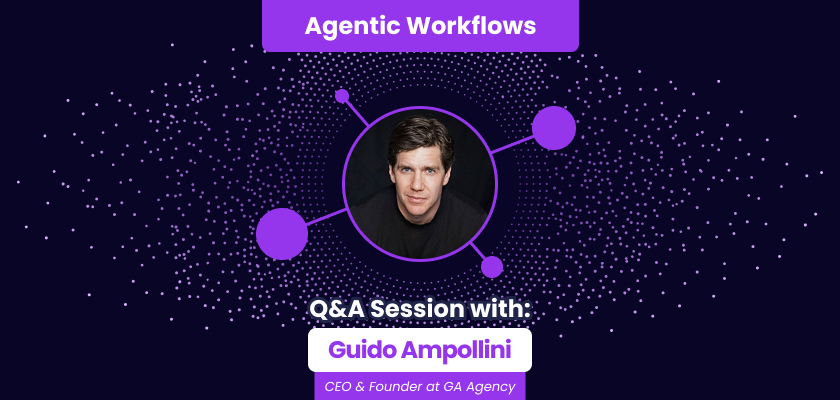
Guido Ampollini, CEO & Founder at GA Agency
As AI continues to reshape agency operations, it’s becoming easier than ever to automate repetitive tasks, generate content, and streamline production workflows.
But successful client work has never depended on execution alone.
Behind every high-performing campaign sits a combination of strategic thinking, technical expertise, and experienced consultants capable of turning information into business decisions.
For GA Agency, this remains true in the age of agentic AI.
Rather than pursuing automation for its own sake, the agency sees AI as an opportunity to strengthen delivery—allowing intelligent systems to handle repetitive work while experienced specialists continue guiding every critical decision.
Agency Snapshot
🧠 Agentic Maturity
Human-in-the-loop workflows where AI accelerates delivery while consultants retain strategic ownership.
⚙️ Primary Use Cases
Web development support, workflow automation, quality assurance, and operational efficiency.
🌍 Industries
E-commerce & Retail
🧩 Core Tech Stack
Anthropic (Claude 3.5 Sonnet/Opus)
Where Agentic Workflows Deliver the Greatest Operational Impact
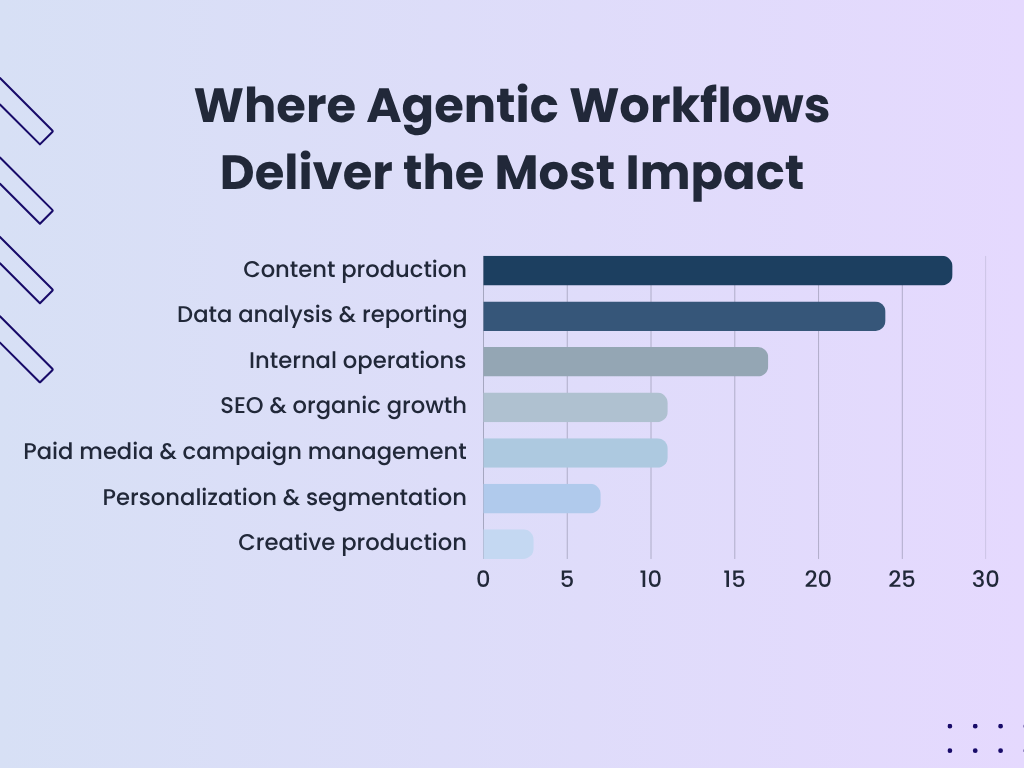
Across participating agencies, operational efficiency and internal processes continue to be among the strongest applications of agentic AI—a trend reflected in GA Agency’s practical approach to automation.
How Agentic Workflows Are Structured at GA Agency
GA Agency has adopted a straightforward but disciplined approach to agentic AI.
Rather than removing people from the workflow, the agency integrates AI into production processes while maintaining structured human review at critical checkpoints. Every workflow is designed so that intelligent systems accelerate execution, but experienced consultants remain responsible for validating quality before deliverables reach clients.
This balance enables the agency to improve speed and efficiency without sacrificing consistency or accountability.
Instead of replacing expertise, AI supports it.
Inside the Workflow: From Input to Output
Within GA Agency’s workflows, AI assists teams by reducing repetitive production work and supporting technical delivery.
Automation helps identify potential issues earlier in the process, organize information more efficiently, and reduce manual effort across operational tasks.
Once AI-generated outputs have been produced, senior consultants review recommendations, verify accuracy, and ensure every deliverable aligns with project objectives and client expectations.
This collaborative workflow allows AI to accelerate execution while experienced specialists maintain full responsibility for final outcomes.
The Role of Human Oversight
Human oversight remains central to every workflow at GA Agency.
Rather than viewing review as a final approval step, the agency positions experienced consultants as continuous decision-makers throughout project delivery.
Their role extends beyond identifying mistakes.
They provide strategic judgment, technical expertise, and practical experience that AI systems cannot replicate independently.
For GA Agency, automation increases efficiency, but expertise continues to define quality.
A Practical Use Case
One area where GA Agency has already seen meaningful impact is web development.
By integrating AI into development workflows, the agency has reduced common implementation mistakes while improving consistency throughout production. AI assists with identifying potential issues earlier, allowing teams to resolve problems before they affect delivery.
Although the agency describes this as a practical operational improvement rather than a large-scale transformation, the outcome reflects an important principle: even targeted automation can produce meaningful gains when combined with experienced human review.
Sometimes, the greatest value of agentic AI isn’t creating entirely new workflows. It’s making existing ones more reliable.
Key Advantages of Agentic Workflows
For GA Agency, the primary advantage of agentic AI lies in operational support.
By reducing repetitive manual work and assisting with quality assurance, AI enables teams to focus more of their time on solving client challenges rather than managing production tasks.
This improves efficiency across delivery while helping consultants dedicate greater attention to strategy, communication, and client success.
The Biggest Wins and the Biggest Trade-Offs of Agentic Workflows

While agencies consistently report significant gains in efficiency and scalability, they also recognize that maintaining quality, governance, and strategic oversight remains essential as automation expands.
Challenges and Limitations
GA Agency believes the greatest risk associated with agentic AI isn’t the technology itself. It’s assuming automation alone guarantees better outcomes.
Without experienced professionals guiding implementation, validating outputs, and connecting technical execution to business objectives, even sophisticated workflows can produce inconsistent results.
This reinforces the importance of combining intelligent automation with strong operational processes and expert leadership.
Technology improves delivery, and people ensure it delivers value.
How Agentic AI Is Reshaping Agency Models
As businesses continue integrating AI into everyday operations, GA Agency believes agencies will become increasingly valuable for the expertise surrounding the technology rather than the technology itself.
Clients can adopt AI tools.
What remains difficult to replicate is a team capable of combining strategic consulting with a mature marketing technology ecosystem.
The agency sees its future in bringing these capabilities together—pairing senior consultants with robust martech solutions that help organizations navigate increasingly complex digital environments.
Rather than competing with AI, agencies become the architects responsible for ensuring intelligent systems create measurable business value.
Conclusion
For GA Agency, agentic AI is most powerful when it strengthens—not replaces—human expertise.
By combining intelligent automation with experienced consultants and well-designed technology ecosystems, the agency demonstrates that successful transformation isn’t defined by how much work AI performs.
It’s defined by how effectively people use AI to deliver better outcomes for clients.