
















ChatGPT Ads for Marketing Agencies & Brands: Use Cases & Campaign Types
What happens when advertising reaches a customer not while they are scrolling, but while they are actively explaining the problem your product could solve? That is the real strategic question behind ChatGPT Ads.
Digital marketers have spent years learning how to read intent through search queries, audience segments, browsing patterns, first-party data, remarketing lists, and platform algorithms. Advertising in ChatGPT introduces another useful signal: people often explain what they need in considerable detail.
They ask questions. Add constraints. Compare alternatives. Challenge recommendations. Narrow down requirements. Change their minds. Then ask another question. For advertisers, that creates a commercial environment built around conversation and decision-making.
OpenAI now has a dedicated advertising platform positioned around the message “advertise in ChatGPT.” Its official OpenAI Ads site describes ChatGPT as a place where people “explore options, compare choices, and make decisions,” giving advertisers a chance to appear during those moments with relevant paid placements.
People come to ChatGPT not just to find information, but to explore options, compare choices, and make decisions. That gives advertisers a new way to show up in ways that feel relevant and useful in moments of real intent.
As soon as OpenAI Ads became accessible, marketers began publishing tutorials showing how to open Ads Manager, create a campaign, choose an objective, set a budget, and launch ChatGPT Ads. Those walkthroughs are useful, we’ll even include one here for anyone who wants to see the platform in action.
But agencies need to answer a harder set of questions before they reach the campaign-creation screen:
Which clients should actually advertise in ChatGPT? What should they promote when the customer is still researching a problem? How should conversational intent influence creative and landing pages? When does ChatGPT Ads deserve incremental budget, and when is Google, LinkedIn, Meta, or another channel still the smarter place to invest? Most importantly, how do you know the experiment created business value instead of simply producing an exciting new dashboard?
That is where this guide on ChatGPT ads for agencies & brands is different. We are not trying to recreate an Ads Manager tutorial in article form. We are building an agency framework for deciding when, where, and how ChatGPT advertising belongs in a client’s wider marketing strategy.
Let’s start.
Click & Learn: OpenAI Ads for Marketing Agencies and Brands
What Are ChatGPT Ads and How Do They Work?
ChatGPT Ads are paid advertising placements delivered inside eligible ChatGPT experiences.
OpenAI currently places standard ads underneath ChatGPT responses. The ad unit can include the advertiser name, favicon, headline, description, destination page, and visual creative. OpenAI says its delivery system can evaluate several relevance signals, including the current conversation’s context and intent, information supplied by the advertiser, the ad and landing page, and selected signals from the user’s broader ChatGPT experience when ad personalization is enabled.
The distinction marketers need to understand is simple but crucial:
Advertisers can buy an ad placement. They cannot buy ChatGPT’s organic answer.
OpenAI says ads remain clearly labeled and separate from ChatGPT responses. Its OpenAI Ads website explicitly lists “Separate from answers” as one of the platform’s trust principles. That separation should shape how agencies explain the channel to clients.
A ChatGPT paid ads campaign is paid media.
GEO, AEO, SEO, digital PR, structured content, brand authority, and related AI visibility work aim to improve unpaid discovery.
The two can support the same customer journey, but buying advertising on ChatGPT does not purchase a recommendation inside ChatGPT’s independent response.
How Advertising in ChatGPT Works
The mechanics will feel somewhat familiar to paid media teams. Advertisers create campaigns in OpenAI Ads Manager, choose an objective, define budgets, organize ad groups, create ads, set geographic targeting, and measure results.
The more interesting feature for strategists is context hints.
Context hints let advertisers describe situations in which their offer could be useful. OpenAI’s own example says that “cushioned everyday running shoes for beginners training for their first 5K” gives the system more useful context than simply entering “running shoes.” OpenAI also makes clear that context hints are not exact-match keywords and do not guarantee delivery against a specific conversation or audience.
That changes the planning conversation inside an agency.
Instead of starting with:
Which keywords should we target?
You can start with:
What situation is the customer in when this product becomes useful?
For a project management platform, that situation might be an agency struggling with missed deadlines and resource allocation. For a hotel, it could be a family planning four days in Manhattan and comparing neighborhoods. For an online course, it could be a junior marketer trying to learn GA4 before applying for analytics roles. The product has not changed, the context around the need has.
ChatGPT Ads vs. Traditional Search Advertising
The easiest mistake is describing ChatGPT advertising as Google Search Ads with longer queries.
Google Search advertising itself has moved far beyond strict keyword matching. In 2026, Google is expanding AI Max across Search campaigns, using richer intent signals, advertiser inputs, website content, keyword and keywordless matching, creative customization, and final URL expansion. Google says AI Max is designed to find additional queries while preserving advertiser controls.
So the distinction is not “Google uses keywords; ChatGPT understands intent.” Both ecosystems increasingly use AI. The bigger difference is the user experience producing the signal.
A Google user may search:
project management software for agencies
A ChatGPT user could explain:
We have 25 people across design, content and development. We manage projects in spreadsheets and Slack, but deadlines keep slipping and I can’t see who is overloaded. What tools should I compare?
The second interaction provides a deeper description of the user’s situation. Your ChatGPT Ads strategy should use that advantage.
How Conversational Intent Changes Advertising
Conversational intent can develop during the interaction.
A person might begin with a broad question, discover terminology they did not know, compare several categories, establish a budget, eliminate two choices, and finally ask what to buy. That means an effective offer can change with the conversation.
A person learning about a category may respond well to an educational guide. Someone comparing named products may need a comparison page. Someone asking about implementation, integrations, migration, or pricing may be much closer to a demo or trial. If your campaign treats all three people as “software audience,” you are leaving useful context on the table.
How to Advertise in ChatGPT
So, how can a business actually advertise in ChatGPT?
In addition to what we said in the beginning:
OpenAI’s advertising website now routes eligible advertisers into Ads Manager. According to OpenAI, the basic process is to create an account, build a campaign around a budget and goal, add ad details directly or through bulk workflows, launch, measure results, and optimize. In summary, it seems like that:
Let’s be more specific now.
Who Can Advertise in ChatGPT?
As of September 30, 2026, OpenAI lists self-service Ads Manager access across dozens of countries, including the United States, United Kingdom, Canada, Australia, Germany, France, Spain, Italy, Türkiye, UAE, Saudi Arabia, India, Japan, Singapore, Brazil, and several other markets. OpenAI requires the legal entity being billed to be based in an eligible country for self-service access.
Audience availability is different from advertiser availability.
OpenAI says ads can currently be shown to eligible users on Free and Go plans. Plus, Pro, Business, Enterprise, and Edu accounts are not shown ads, and accounts identified as belonging to users under 18 are also excluded.
This matters during media planning. “ChatGPT has a huge audience” does not automatically mean your campaign can reach every ChatGPT user. The eligible advertising audience is a subset.
Getting Started With ChatGPT Ads Manager
A sensible agency setup starts before the first campaign.
- Confirm the advertiser’s legal entity and market eligibility.
- Review category policy.
- Establish billing.
- Configure conversion measurement.
- Agree on naming conventions.
- Define UTMs and CRM source rules.
- Decide how campaign results will be compared with existing paid channels.
- Then open Ads Manager.
OpenAI says campaigns can currently include objectives, conversion events, budgets, dates, country targeting, optional platform targeting, and custom audience inclusion or exclusion where available.
Understanding Campaign Objectives and Ad Formats
Current campaign buying supports awareness, traffic, and conversion use cases.
For CPM campaigns, advertisers pay per 1,000 impressions. For CPC campaigns, advertisers pay for valid clicks.
Conversion-optimized campaigns can optimize toward events such as purchases, sign-ups, or lead submissions, with eligible oCPC campaigns billed for clicks and oCPM campaigns billed for impressions.
OpenAI is also moving past the standard click-to-website model.
In September 2026, it announced Sponsored Agents, an experimental format allowing people to open a conversation with an AI representative of an advertiser after interacting with an ad. Sponsored Agents are currently limited to selected advertisers in an alpha test.
Budgeting and Bidding Basics
ChatGPT Ads uses auction-based buying, as Google has for “decades.”
OpenAI currently recommends starting CPC campaigns with a maximum bid of roughly $3–$5 per click. Eligible ads are selected through what OpenAI describes as a relevance-weighted second-price auction. So, it is best not to turn that $3–$5 figure into an industry benchmark.
It is platform guidance for an initial bid, not a promise that your SaaS client, retailer, hotel, or local service business will acquire useful traffic at that cost.
The agency question is more useful:
How much money do we need to spend to answer the experiment’s business question?
If the client sells $80,000 enterprise software, ten clicks tell you very little. If an eCommerce brand receives hundreds of purchases each week, you can learn faster. Budget for learning volume, not for the privilege of saying your client was early.
Advertising Policies and Brand Safety
OpenAI’s advertising policy currently focuses heavily on consumer categories such as lifestyle and household goods, local services, travel and experiences, digital products, and education.
Some advertisers in financial services, healthcare, medicine, and legal services may be approved gradually and reviewed case by case. Several categories remain disallowed or heavily restricted, including political advertising, gambling, alcohol and drugs, dating and sexual content, many health claims, and other regulated or sensitive areas.
OpenAI also states that ads should not appear next to sensitive user contexts such as personal health, mental health, political conversations, emotionally vulnerable interactions, or other unsuitable environments.
For an agency, the order should therefore be:
Policy check first 👉🏻 creative brainstorm second
Which Businesses and Industries Should Consider ChatGPT Advertising?
The existence of OpenAI Ads does not create a business case for every client on your roster. A more useful test is this:
Would a potential customer naturally discuss the problem, decision, product category, or use case with ChatGPT?
If yes, you may have an advertising opportunity worth testing.
SaaS and B2B Software Companies
SaaS is one of the clearest early scenarios because software purchases often involve research, feature comparisons, implementation concerns, integrations, alternatives, and use-case questions.
A user could ask how to improve resource planning, compare CRMs, replace an analytics platform, automate reporting, migrate from one project-management system to another, or shortlist software for a particular team size.
The relevant offer depends on where the buyer is.
- Early research can support guides, templates, webinars, benchmark reports, calculators, or educational tools.
- Mid-funnel comparison can support use-case pages and competitor comparison content.
- High-intent discussions around implementation, integrations, switching, and pricing may justify a trial or demo.
The conversion goal should follow the business model: trial activation for self-service SaaS, qualified demos or opportunities for higher-value products.
E-commerce and Consumer Brands
Commerce conversations can contain extraordinarily useful requirements.
OpenAI’s own advertising page features early advertisers including Newegg, Best Buy, Lowe’s, and VistaPrint. Newegg Performance Marketing Manager Alec Shao explains the appeal this way:
“We want Newegg to be part of the conversation when someone is researching what to buy.”
That is a useful way to frame the channel.
For retailers, the post-click objective can include product views, add-to-cart events, purchases, revenue, or new-customer acquisition.
Travel and Hospitality Businesses
Trip planning is naturally conversational.People combine destination, timing, budget, group size, interests, accessibility requirements, neighborhood preferences, transport, restaurants, attractions, and accommodation into one planning session.
A hotel could advertise against relevant accommodation decisions, a tour operator could appear during itinerary planning, or an attraction could promote tickets during activity research. The strategic opportunity is not “target travelers.” It is understanding which travel problem your offer solves.
Education and Online Learning Providers
Education buyers frequently begin with a goal.
- “I want to become a data analyst.”
- “I need to improve my presentation skills.”
- “I want to learn Python for marketing analytics.”
- “I need a course that fits around a full-time job.”
An advertiser can respond with curriculum, learning format, course outcomes, certification details, free lessons, or enrollment options.
The conversion could be a registration, application, trial lesson, consultation, or course purchase.
Home Improvement and Professional Services
Many service purchases begin with uncertainty.
- Does the roof need repairing or replacing?
- How much might a kitchen renovation cost?
- What type of professional handles a particular project?
- What should someone ask before hiring a contractor?
These conversations can create natural opportunities for guides, estimate requests, consultation offers, local service pages, project portfolios, or appointment booking. The key is matching the message to the stage of understanding.
Local and Multi-Location Businesses
Local intent can also emerge naturally during planning. People use ChatGPT to plan trips, organize weekends, compare services, identify local businesses, and build itineraries.
In other words, a local advertiser needs an excellent post-click experience: accurate location information, opening hours, relevant services, service area, availability, pricing context, and a clear action. Conversational relevance is wasted if the landing page leaves the visitor wondering if you even serve their neighborhood.
How Digital Marketing Agencies Can Evaluate ChatGPT Ads for Clients
Actually, for us, this question is especially relevant because we sit at the intersection of agencies trying to understand emerging marketing opportunities and brands trying to decide which expertise, channels, and partners they actually need. DAN’s global network includes more than 4,000 member agencies, while its directories and Marketplace connect businesses with agencies based on factors such as service expertise, industry experience, location, budget, portfolio quality, and project requirements. That gives us a useful perspective on what happens whenever a new marketing discipline enters the agency landscape: interest grows quickly, service labels appear almost overnight, and brands are left trying to separate a useful capability from something that has simply been added to a pitch deck.
ChatGPT Ads should be evaluated with that same discipline. The fact that an agency can launch an OpenAI Ads campaign does not automatically mean every client should have one, just as a brand does not need every service listed in a digital agency’s navigation. The stronger agency role is diagnostic: understanding the client’s customer journey, current media mix, conversion economics, internal capabilities, and actual conversational use cases before deciding if the channel deserves investment.
And remember, a good marketing agency does not recommend every new platform to every client. It develops criteria. Here is a useful first-pass framework:
Look at volume, qualification, economics, repeatability, and incremental contribution before reallocating serious money.
What’s more?
Evaluate the Client’s Products and Buying Journey
Begin by forgetting ChatGPT for a moment. How does the client actually get customers?
A $35 consumer purchase can move from discovery to checkout in minutes. A $75,000 software contract may involve several departments, multiple demos, a security review, legal approval, procurement, and a sales cycle measured in months.
Those journeys create different roles for advertising.
For a lower-consideration purchase, ChatGPT might introduce the product and send the user directly to a detailed product page. For enterprise SaaS, the ad may contribute earlier, while the buyer is defining requirements, comparing approaches, or building a vendor list.
This is where GEO case studies become useful even for paid media teams. They emphasize answer architecture, entity clarity, trust, and the actual questions users ask because generative discovery operates around how a problem is expressed, not just how a web page ranks.
Paid teams can borrow that customer-question mindset. Suppose a project-management client hears five recurring questions from prospects. Some buyers cannot see workload. Others are frustrated with client approvals. Some are comparing tools. Others need to migrate from spreadsheets. A final group wants project profitability reporting. One product sits behind all five conversations, but the commercial moment is different in each one.
So, we can say that a useful ChatGPT Ads for agencies, strategy begins by finding those differences.
Identify Relevant Conversational Use Cases
The agency probably already owns much of the research it needs.
Search-query reports show how customers describe demand when they search. Sales-call transcripts reveal objections and comparison criteria. CRM notes reveal why deals stall. Support conversations reveal product problems. Reviews reveal language customers use when nobody from Marketing is in the room.
GEO research can add another layer. Our guide to GEO measurement explains that AI discovery needs to be evaluated across prompt variations because generative systems assemble answers dynamically from context, not from one fixed list of ranked pages.
For paid media, those prompt variations can become use-case research.
- If customers repeatedly ask how to calculate agency utilization, that may support educational content.
- If they ask for “alternatives to [competitor],” the need has changed.
- If they ask which platform integrates with a specific CRM, the integration itself may be the advertising proposition.
As we metioned above, OpenAI’s context hints make this distinction operational. The platform recommends describing what the offer is, who it helps, and when it may be useful, while separating use cases that need different messaging or landing pages.
Assess Audience and Market Availability
Intent cannot rescue an inaccessible market.
Check the advertiser’s country, the target market, audience eligibility, category policy, personalization limitations, and account requirements before committing the client to a launch.
This may sound administrative, but it is part of strategy when a platform is still scaling. OpenAI explicitly says Ads Manager availability can continue to evolve and maintains a live country list for that reason.
Define a Realistic Testing Budget
The test budget needs a question attached to it.
“Let’s spend $1,000 on ChatGPT Ads and see what happens” sounds experimental, but it does not define what the agency wants to learn.“
A better question might be: “Can ChatGPT Ads generate qualified SaaS demos at a lower cost per opportunity than our current incremental acquisition channels?”
Now the agency can work backward.
How many leads are usually required to generate enough opportunities for comparison? How long is the sales cycle? Which early quality indicators matter? What would cause the campaign to stop? What outcome would justify another round of investment?
This prevents the most common new-channel problem: a small test produces three conversions, everybody interprets them according to their existing opinion, and the meeting ends with no actual conclusion.
Determine Whether ChatGPT Ads Fit the Existing Media Mix
ChatGPT Ads for brands do not need to kill another channel to prove their value.
Amsive’s discussion of GEO in our Agency GEO Series offers a useful parallel. The agency treats generative visibility as connected with SEO, content, authority, analytics, and broader marketing activity, while expanding measurement beyond simple clicks into AI share of voice and conversion influence.
Paid AI should also sit inside a wider system. Google Search may capture explicit demand. Meta may create scalable product discovery. LinkedIn may provide access to professional audiences. SEO can own high-value organic queries. GEO can increase unpaid visibility inside generative answers. ChatGPT Ads can test paid visibility during conversational research and evaluation.
Once every channel has a job, budget conversations become much more intelligent.
What Are Agencies Actually Learning From ChatGPT Ads? Real Use Cases
Official documentation tells marketers what a platform supports.
Agencies spending real client budgets tell us something else: where the assumptions start breaking.
Early ChatGPT Ads for agencies evidence is still limited, and OpenAI itself says the platform does not yet have reliable cross-advertiser performance benchmarks by industry or campaign type. That means individual case studies should be treated as experiments, not universal forecasts. Still, those experiments are already revealing useful patterns.
InterTeam: B2B SaaS Can Work Across Different Intent Stages
InterTeam Marketing says it began testing self-service ChatGPT Ads early in the beta and ran campaigns across three B2B SaaS clients. Its published case study reports 150+ qualified leads, an average CPC of around $5, and a CPL 60% lower than Google across the campaigns summarized. The products ranged from offers in the $3,000–$10,000 range to products valued above $50,000.
The more useful part of the case study is not the headline CPL. InterTeam says:
“The key is matching the offer to the type of conversation the buyer is already having.”
Its strongest approaches covered several intent levels, including educational content for problem research, competitor comparisons, category-level “best solution” research, demo offers, and branded evaluation.
The pattern is more valuable than the benchmark: different conversations deserved different offers.
StubGroup: Cheap Leads Can Still Become Expensive Customers
StubGroup’s case study is a useful antidote to channel hype because its result becomes less exciting as you move deeper into the funnel.
For a B2B compliance-services company, StubGroup compared ChatGPT Ads and Google Search across the same 30-day period. ChatGPT Ads produced an average CPC of $0.76, compared with $10.46 for Google Search. CPL was also lower: $92.21 through ChatGPT against $157.57 through Google.
If the report stopped there, ChatGPT Ads would look extraordinary.
ChatGPT traffic converted at 0.8%, compared with 6.64% for Google Search, and StubGroup says Google’s leads became paying customers at a materially higher rate during the reporting window. Google therefore produced a stronger cost per acquired customer at that stage of the experiment. The agency also notes that Google’s campaigns had years of lead-quality optimization behind them and that the client’s sales cycle was still maturing, so the comparison had limitations.
StubGroup describes the channel as “not yet been a home run.”
Nakora: Some Tests Scaled and One Test Deserved to Die
Nakora’s published experiments make the same point from several angles.
For a product-analytics SaaS campaign, it reports spending $3,600 across 28 days and generating 45 signups at $80.70 each, giving ChatGPT Ads an 18.1% lower cost per signup than Google Ads in its comparison. Importantly, the agency says each ad led to a page addressing the specific problem behind the conversation, not to the homepage.
One client told Nakora that the lower volume surprised the team, but the signup economics made the channel worth scaling and “the use case landing pages made a noticeable difference.”
A separate developer-tool test spent $9,429 over 56 days and generated seven qualified opportunities at $1,347 each. Nakora reports a roughly 12% lead-to-opportunity rate for ChatGPT Ads compared with about 9% for LinkedIn in that experiment.
Then comes the campaign agencies should probably study most carefully.
Nakora spent $5,375 over 19 days on an enterprise platform campaign. It generated 363 clicks at a $14.80 CPC, produced zero demo requests, and recorded an average engaged session of seven seconds, compared with 54 seconds from the comparison traffic. The agency stopped the campaign and redirected the budget to Google Ads.
There is no embarrassing result there, that is competent media buying. The campaign answered its question and the answer was “not this client, not this setup, not now.”
ChatGPT Advertising Strategies for Different Marketing Objectives
Once an agency has established client fit, the campaign still needs a job.
The mistake is thinking that conversational targeting makes strategy automatic. It does not. The objective still determines the creative, offer, landing page, measurement model, and time horizon.
Brand Awareness and Product Discovery
Brand awareness in ChatGPT should not mean interrupting a useful conversation with a slogan.
The strongest awareness opportunity is contextual introduction. If a person is exploring a problem that your product solves, the ad can introduce the category or brand through a concrete benefit.
The copy needs to answer an implicit question: Why should this person care right now?
That might mean presenting a workflow, capability, product attribute, or practical use case. A generic “Meet the future of productivity” headline could describe hundreds of tools. “See agency workload before assigning the next client project” gives the buyer a reason to understand the product.
Lead Generation for B2B and Service Businesses
B2B marketers have spent years discovering that form fills and pipeline are not synonyms.
ChatGPT Ads will not change that lesson.
A buyer learning about a topic might be ready for a report or assessment. Someone comparing named platforms may be ready for a product comparison. Someone asking about migration, integrations, security, or implementation may be much closer to a commercial conversation.
The CTA should move with the customer.
Agencies should judge these campaigns on qualified outcomes, not on how many people were persuaded to surrender an email address.
Product Consideration and Comparison
Comparison conversations may become especially valuable because users often bring criteria with them.
A buyer might care about integrations, implementation time, pricing structure, data residency, team size, compatibility, materials, specifications, service area, or support.
That gives advertisers an opportunity to explain a concrete difference.
Specificity is powerful here because the user is already evaluating trade-offs. “Built for distributed creative teams with client approval workflows” communicates something. “The ultimate collaboration solution” communicates enthusiasm.
One helps the decision.
E-commerce Sales and Customer Acquisition
Commerce ads can take advantage of the detail shoppers naturally provide when asking for advice. But traffic economics still need to connect with product economics.
Agencies should examine purchase rate, new-customer acquisition, average order value, gross margin, repeat behavior, and overall CAC. Product feeds, landing-page relevance, pricing, stock accuracy, reviews, shipping information, and site speed remain part of the acquisition system.
The conversational context may improve the introduction, the rest of the website still has to close the sale.
New Product Launches and Market Entry
New products have a familiar problem: nobody searches for something they do not yet know exists. Conversational advertising creates a potentially interesting route around that problem because the ad can connect the product with the problem category before the user knows the product name.
- For a new SaaS product, the customer might be describing an inefficient workflow.
- For a consumer product, they might be describing a need existing categories solve badly.
- For a new market entrant, they may already be comparing familiar incumbents.
The brand can enter through relevance.
How to Build a ChatGPT Advertising Strategy for Clients
A disciplined agency should be able to explain the logic of a ChatGPT Ads campaign before showing the media plan.
The following six-step structure keeps the focus on the customer instead of the novelty of the channel.
Step 1: Map Customer Problems and Conversational Intent
Start with the questions customers already ask.
Sales calls, support tickets, Google Ads search terms, site search, Reddit discussions, reviews, CRM notes, SEO data, and GEO research can all reveal recurring patterns.
For a project-management platform, you might discover that customers talk about missed deadlines, overloaded employees, client approvals, project margins, fragmented communication, spreadsheet replacement, and migration. They are seven problems that may lead to seven different conversations.
Step 2: Select Products and Offers
Now decide what the brand can offer each customer. Some problems may connect with the same product but require different entry points.
- A user struggling with workload could land on a resource-planning feature page.
- A user comparing competitors could land on a comparison page.
- A user researching project profitability could receive a calculator or guide.
- A buyer trying to migrate from another system may respond best to a consultation.
This is where funnel thinking becomes useful again. The product remains the same, but the requested commitment changes.
Step 3: Develop Relevant Advertising Messages
OpenAI’s current creative guidance says ChatGPT ads (for agencies & brands) should use clear, specific, benefit-focused messaging and encourages advertisers to create genuinely distinct variations that explore different angles.
“Transform your workflow” is technically advertising copy, but it is not useful copy. “See which designers are overloaded before assigning another project” contains a problem, audience implication, and benefit.
Another ad could focus on client approvals. Another could focus on margin. Another could focus on migration. The objective is to test twelve meaningful reasons a customer might care.
Step 4: Create Intent-Aligned Landing Pages
The landing page is where conversational relevance often dies. A user spends several minutes explaining a specific problem. The ad speaks directly to it. The person clicks. Then the homepage says:
Innovative solutions for tomorrow’s businesses.
We can do better.
OpenAI explicitly recommends directing users to the most relevant destination, such as a specific product, collection, or content page, and creating a clear path from the ad to the next action.
Nakora’s SaaS test provides an early agency-reported example: the agency mapped ads to pages addressing the specific problem in the conversation and credited those use-case landing pages as an important part of the test. So, the principle is simple. If the conversation is specific, the destination should not suddenly become vague.
Step 5: Launch a Controlled Test
A proper test needs a hypothesis. For example:
Users researching agency resource-planning problems will generate more qualified trial activations from a workload-focused landing page than from the client’s generic product page.
Now the campaign structure has meaning. The agency can identify which context it wants to test, which creative addresses it, which destination continues the argument, which conversion matters, and what result would change the next budget decision.
Step 6: Evaluate Performance and Scale
The campaign should earn its way down the funnel.
Did it receive meaningful delivery? Did users click? Did they engage with the landing page? Did they convert? Were those conversions qualified? Did they activate, book meetings, become opportunities, purchase, or create revenue? Then compare the economics with other sources.
A SaaS campaign structure could look like this:
That is a media strategy shaped by the customer’s problem.
ChatGPT Ads vs. Google Ads: Where Should Agencies Allocate Budget?
Marketers love a replacement narrative like:
Email was going to kill direct mail. Social was going to kill websites. TikTok was going to kill Instagram. AI search is apparently scheduled to kill Google any minute now.
We are not saying those kinds of things in that section. We believe that Google Search remains a mature global acquisition ecosystem, and Google is itself moving deeper into AI-driven search advertising. Its current AI Max products use richer intent signals, keyword and keywordless matching, creative adaptation, and landing-page optimization to expand Search campaigns beyond rigid query matching.
ChatGPT Ads enter from a different interaction model.
Understanding Search Intent vs. Conversational Intent
Search and conversational intent increasingly overlap. A modern Google query can be long and complex. Google is actively designing Search Ads for that reality. At the same time, ChatGPT users can begin with short questions.
The useful distinction is not word count. It is the interaction.
ChatGPT allows the user to refine the problem over multiple turns. That accumulated context may reveal constraints a single search did not. So, it’s clear that agency strategy should focus on the behavior, not on caricaturing one platform as “keywords” and the other as “AI.”
When to Test ChatGPT Ads Alongside Existing Campaigns
The strongest candidates often have an advantage that sounds boring: good existing measurement.
If the client already understands Google CAC, lead quality, paid social conversion rates, landing-page performance, activation, and CRM outcomes, ChatGPT Ads enters an environment with useful comparison points.
If conversion tracking is broken, CRM attribution is missing, and nobody agrees on what a qualified lead means, adding a new channel can create more confusion than insight.
Fixing the measurement foundation may be the better AI advertising strategy.
How to Allocate an Experimental Advertising Budget
Begin with incremental budget when possible.
That protects established acquisition while giving the agency room to understand the new channel. Define the test period, minimum volume, qualification criteria, stop condition, and scaling condition before launch.
If performance becomes strong enough to justify reallocating spend from another channel, make that decision with actual data.
You do not have to predict the winner before the race begins.
Avoiding Channel Cannibalization and Measurement Errors
Attribution becomes especially messy when AI tools participate in research.
A user might see a ChatGPT ad, later search the brand on Google, watch a YouTube review, return through direct traffic, speak with Sales, and convert three weeks later.
Which channel gets the credit? The answer depends on the measurement system, which is why platform-reported conversions should not be treated as a complete customer biography.
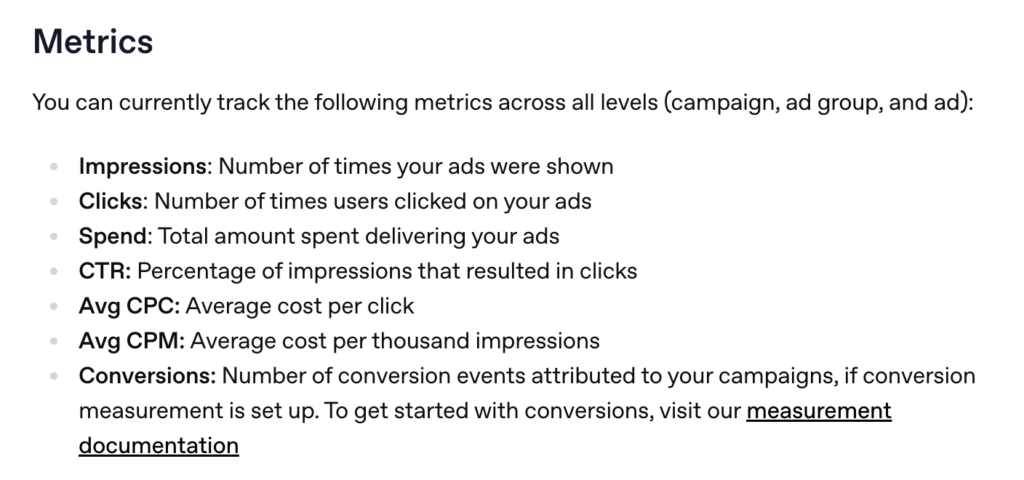
OpenAI Ads Manager currently supports conversion reporting, while its measurement documentation exposes metrics including impressions, clicks, spend, CTR, average CPC, average CPM, conversions, and eligible purchase revenue/ROAS reporting.
Agencies should combine that data with UTMs, analytics, CRM stages, sales feedback, revenue, and cross-channel reporting.
Creative Strategies for Effective ChatGPT Advertising
Creative has an unusual job inside a conversational product. The ad needs to feel relevant to what somebody is doing without becoming uncomfortable. Helpful, not uncanny. OpenAI’s creative recommendations emphasize specificity, practical value, clarity, distinct creative angles, and a direct connection between the ad message and destination.
What’s more?
Match Ad Messaging to Customer Problems
Start the creative brief with a situation.
- “Advertise our accounting platform” is a media request.
- “Reach agency owners who are trying to understand which client projects are profitable and show them a platform connecting time, budget, and margin” is a creative brief.
The second version gives copywriters, designers, media planners, and CRO teams the same customer problem to solve.
Communicate Specific Product Benefits
Specificity becomes even more important when the user has already supplied context.
- “Work smarter” adds no information.
- “See remaining project budget before your team logs another hour” does.
- “Plan better trips” is generic.
- “Compare family rooms within walking distance of Central Park” has a use case.
The customer is doing detailed thinking. The ad should keep up.
Develop Different Creative Angles
Distinct creative does not mean changing one adjective. One angle can explain a feature. Another can address the problem. Another can show an outcome. Another can focus on an integration, comparison, migration, audience, or offer.
OpenAI specifically recommends varied ad titles and descriptions because different messages can become relevant in different contexts. That creates an interesting creative discipline for agencies: produce multiple ideas, not multiple versions of the same sentence.
Align Landing Pages With Advertising Messages
The ad should begin a thought the landing page finishes.
- A competitor-comparison message should not lead to a generic homepage.
- A resource-planning ad should not dump the user onto a broad “Features” page.
- A course ad focused on analytics skills should not land on a catalog containing 200 unrelated programs.
This principle predates ChatGPT Ads by decades. Conversational context simply makes bad alignment more obvious.
Test Offers, Headlines, and Creative Variations
The creative brief can stay simple:
| Industry | User Situation | Useful Creative Direction |
|---|---|---|
| SaaS | Buyer comparing software | Concrete product differences and use cases |
| Travel | User planning a trip | Relevant stay, package, or experience tied to the itinerary |
| E-commerce | Shopper narrowing product options | Specifications, benefits, and suitability |
| Education | User trying to develop a skill | Curriculum, format, and practical learning outcome |
| Home services | Customer planning a project | Expertise, process, consultation, or estimate |
None of those rows guarantee performance; however, they give the agency something intelligent to test.
How Agencies Should Measure ChatGPT Advertising Performance
If a platform is new enough, almost any number can look exciting.
A 4% CTR. A $3 CPC. Fifty leads. Twenty trials.
Then the client asks the question that tends to ruin the party: Did we make money?
OpenAI Ads Manager currently supports reporting for impressions, clicks, spend, CTR, average CPC, average CPM, and attributed conversions, with eligible order-created revenue and ROAS reporting where those events are configured.
Define KPIs Based on Campaign Objectives
For a traffic campaign, engagement and progression may matter more than the raw click count. For B2B lead generation, the agency should follow form fills into sales acceptance, meetings, opportunities, pipeline, and closed revenue. SaaS teams should examine activation and paid conversion. eCommerce teams should care about purchases, customer-acquisition cost, new-customer mix, revenue, margin, and repeat behavior.
The principle is simple: move measurement toward the business outcome as quickly as the customer journey allows.
Track Qualified Leads and Conversions
StubGroup’s case study demonstrates the danger of stopping at CPL.
ChatGPT generated cheaper leads in its test, yet Google generated customers more efficiently during the reporting window because lead quality and conversion downstream were stronger, according to StubGroup case we mentioned above.
That is why the CRM belongs in the advertising conversation.
- How many leads were accepted?
- How many booked meetings?
- How many became genuine opportunities?
- How much revenue did they create?
Marketing cannot declare victory at the form submission and leave Sales to discover what happened next.
Measure Customer Acquisition Cost and ROAS
A cheap click is only cheap in relation to its outcome.
The $0.76 ChatGPT CPC in StubGroup’s experiment looked excellent beside Google’s $10.46 CPC. Customer economics changed the interpretation.
The same logic applies to eCommerce. A lower CPC is irrelevant if average order value falls, conversion rate collapses, or the campaign acquires customers with poor margin.
The metric hierarchy should follow the client’s economics, not the platform interface.
Build Client Reporting Around Business Outcomes
A useful client report can move through the journey instead of dumping platform metrics onto one slide.
| Measurement Layer | Example Metrics | The Business Question |
|---|---|---|
| Delivery | Impressions, spend, CPM | Are campaigns reaching enough eligible users? |
| Engagement | Clicks, CTR, CPC | Does the message earn relevant interest? |
| Conversion | Leads, trials, purchases | Do users take the intended next action? |
| Quality | Activation, SQL rate, opportunity rate | Are those actions commercially useful? |
| Economics | CAC, cost per opportunity, ROAS, margin | Does the channel justify its cost? |
| Contribution | New-customer mix, assisted behavior, cross-channel changes | Is ChatGPT Ads adding something new? |
New platforms produce noisy early data. Samples can be small, sales cycles can delay conclusions, attribution can overlap, and optimization systems are still developing.
Common Mistakes Agencies Should Avoid With ChatGPT Ads
Treating ChatGPT Ads Exactly Like Search Ads
Google Search expertise is useful preparation and copying a keyword structure into ChatGPT Ads for brands and agencies is not a strategy.
OpenAI explicitly says context hints are not exact-match keywords. They describe situations in which a product or offer might be relevant. Think about customer problems first, the ad structure can follow.
Recommending the Platform to Every Client
Every emerging channel creates commercial pressure inside agencies. Clients ask about it. Sales teams want a new service page. Competitors publish thought leadership. Suddenly everybody needs a ChatGPT Ads offering by Friday.
That does not mean every client needs the media.
Some products have weak conversational fit. Some categories are restricted. Some markets are unavailable. Some businesses have low margins. Some clients have terrible measurement. Others are already underfunding proven acquisition channels.
Saying “not yet” can be excellent agency work, for new-age AI agencies, especially.
Ignoring the Post-Click Experience
This deserves repetition because early agency evidence keeps pointing in the same direction.
As we mentioned before, InterTeam says it matched comparison conversations with comparison pages. Nakora says its successful SaaS experiment sent each ad to a page addressing the relevant problem. OpenAI recommends the most relevant destination instead of defaulting to a homepage.
The ad and destination are one argument, so, write them that way.
Scaling Campaigns Without Sufficient Data
Early wins are dangerous because everybody wants them to be true.
Three cheap leads can make a channel look brilliant, however, a week later, none may have responded to Sales.
Scale after the campaign demonstrates volume, quality, and commercial value at a level appropriate to the client’s sales cycle. The budget should follow evidence.
Confusing Paid Advertising With Organic AI Visibility
This is the mistake agencies should correct immediately.
OpenAI says advertisers cannot pay to influence ChatGPT’s independent answers. ChatGPT Ads are separate paid placements.
GEO solves a different problem. Our GEO statistics research describes it as the work of improving a brand’s likelihood of being selected, represented, mentioned, or cited within generative AI answers. That work can involve content structure, entity authority, citations, original research, digital PR, third-party validation, and measurement of AI visibility.
Our research also illustrates how quickly agencies are adapting service models. Its 2026 dataset reports that 54.8% of the agencies studied integrate GEO into SEO services, while 27.1% offer GEO as a standalone paid service. Ownership is also spread across teams: 33.3% place it with SEO leads and another 33.3% use cross-functional ownership. So, paid ChatGPT Ads and GEO can share research, they should not share the same success metric.
| Dimension | ChatGPT Ads | GEO (Generative Engine Optimization) |
|---|---|---|
| Shared Foundation | Shared research on user prompt intent, topic clusters, and LLM query behavior. | |
| Core Purpose | Paid placement and immediate direct response | Organic presence, citation equity, and authority building |
| Primary Success Metric | ROAS, CAC, Paid Conversions, CPC | Share of AI Voice, Citation Rate, Organic Referral Traffic |
Should Brands Manage ChatGPT Ads In-House or Work With an Agency?
The decision depends on resources and experience.
Do you need an agency for ChatGPT Ads?
What to Look for in a ChatGPT Advertising Agency
If a brand does seek an external partner, the questions should become more specific than “Do you offer ChatGPT Ads?”
Ask what the agency has actually run.
- What industries did it test?
- What did the spend look like?
- What happened after the leads entered the CRM?
- How are context hints structured?
- Which landing pages worked?
- How is platform attribution checked against analytics?
- What did the agency pause?
An agency should be able to discuss what did not work, experiments have two possible answers.
How Agencies Can Integrate ChatGPT Ads Into Existing Services
Many agencies already possess most of the capabilities needed, and they are structuring their AI search packages.
Paid media teams understand bidding and budgets. Strategy teams understand customers. Creative teams develop messages. CRO teams build landing pages. Analytics teams connect media with business results. SEO and GEO teams research how people discover brands through AI.
The opportunity is to connect those capabilities.
Our Agency GEO research shows that AI search work is already becoming cross-functional inside agencies, with ownership split across SEO specialists, content, analytics, and mixed teams. ChatGPT Ads is likely to create a similar need for cooperation because conversational advertising sits somewhere between media, customer research, creative, landing-page optimization, and AI discovery strategy.
So, it’s best to think that the value is not adding “OpenAI Ads” to the services menu, but building a system around it.
The Future of ChatGPT Advertising and What Agencies Should Prepare For
The easiest way to ruin the final section of an AI article is to start predicting technology that does not exist.
We already have enough real product development to discuss. As we already mentioned, OpenAI introduced Sponsored Agents as a limited alpha format in September 2026, allowing users to move from an ad into a conversation with an advertiser’s AI representative. If formats like this expand, agencies could find themselves designing more than ads. They may need to design the conversation after the ad.
Like what?
1. Building Expertise in Conversational Advertising
The most durable skill will be customer understanding. What does the customer ask before purchase? Which details change the recommendation? What signals indicate serious evaluation? Which objections need proof? Which questions belong to education, comparison, or conversion?
That research improves paid ads, landing pages, GEO, SEO, sales enablement, and even product marketing. It is difficult to imagine it becoming obsolete.
2. Preparing Creative and Measurement Workflows
Agencies should also become comfortable producing larger sets of genuinely differentiated messages tied to distinct customer situations. Measurement needs similar discipline.
A paid AI test should be connected with analytics and CRM from the start, while organic AI visibility needs its own GEO reporting framework. In other words, AI answer inclusion, citation frequency, prompt-level visibility, and share of generative voice address a different question from paid acquisition metrics.
3. Connecting Paid Advertising With Organic AI Visibility
Paid and organic AI teams should talk to each other. GEO research may reveal the problems, comparisons, prompts, and category questions shaping AI discovery. Paid campaigns may reveal which of those problems actually produce conversions. SEO can show where demand already exists. CRM data can reveal which customer questions become revenue. Those insights can circulate without pretending one channel caused the performance of another.
That is a much healthier model for AI marketing.
4. Adapting to New Advertising Formats Without Rebuilding the Strategy
Anybody in the marketing ecosystem now knows the interface of OpenAI ads will change, formats will expand, targeting will evolve, measurement will become more sophisticated, bidding may look different a year from now.
The core strategy should survive those updates.
Understand the problem the customer is trying to solve. Identify the product that genuinely helps. Enter with a message that makes sense in that moment. Continue the same logic after the interaction. Measure what happened to the business.
Frequently Asked Questions About ChatGPT Ads
1. What are ChatGPT ads?
ChatGPT Ads are paid advertising placements displayed in eligible ChatGPT experiences. Standard placements currently appear beneath ChatGPT responses and can contain the advertiser’s identity, headline, description, image, and destination page. OpenAI says the ads system can use current conversational context and other eligible relevance signals to decide which ads may be useful, while keeping advertisements separate from ChatGPT’s independent answers. For marketers, the important distinction is that buying ChatGPT Ads does not purchase a recommendation inside an organic ChatGPT answer. Paid advertising and GEO therefore need separate strategies and measurement.
2. How can businesses advertise on ChatGPT?
Eligible business advertisers can sign up through OpenAI Ads and use Ads Manager Beta to create campaigns, ad groups, context hints, creative, budgets, and conversion measurement. OpenAI’s dedicated advertiser site uses the proposition Advertise in ChatGPT and takes eligible businesses into the Ads Manager onboarding flow. Self-service access depends on the legal entity’s country and current platform availability, so agencies should verify the live country list before committing to launch dates.
3. How much does advertising on ChatGPT cost?
There is no universal price for advertising on ChatGPT. Current buying options include Views campaigns billed on CPM, Clicks campaigns billed on valid clicks, and conversion-optimized campaigns. OpenAI currently recommends starting CPC campaigns with a maximum bid of roughly $3–$5 per click, but that is initial bidding guidance, not a promised market price or profitability benchmark. Agency case studies (we highlighted and cited in the blog.) already show why averages can mislead. StubGroup reported a $0.76 CPC in one B2B test, while Nakora reported $14.80 CPC in an enterprise experiment it ultimately stopped. The relevant question is not the cheapest possible click. It is what a qualified customer costs for your particular business.
4. Which businesses should consider ChatGPT advertising?
Businesses are stronger candidates when customers naturally research, compare, plan, troubleshoot, or evaluate their products through conversational AI. SaaS, B2B software, eCommerce, travel, education, local services, and several consumer categories offer intuitive scenarios, though actual fit depends on product economics, target market, platform eligibility, and customer behavior. A useful agency test is to ask if customers can clearly describe the problem the product solves. The richer and more commercially relevant that conversation becomes, the more interesting ChatGPT Ads may be as an experimental channel.
5. Are ChatGPT ads suitable for B2B companies?
Early agency evidence suggests B2B is one of the more interesting areas to test, especially for products involving substantial research and comparison. InterTeam reports more than 150 qualified leads across three B2B SaaS clients and says its CPL was less than half its Google CPL in the campaigns summarized. Nakora has also reported promising SaaS and developer-tool tests.
6. How are ChatGPT ads different from Google Ads?
Google Search Ads operate inside a mature search advertising ecosystem that now combines keywords, AI-driven matching, website content, creative, landing pages, and richer intent signals through products such as AI Max. ChatGPT Ads operate inside a conversational environment and can evaluate current conversation context alongside advertiser-provided context hints and other eligible signals. For agencies, the practical difference is the interaction model. Google often captures explicit search demand. ChatGPT can expose additional context as a user develops a problem through conversation. Many brands may find the channels complementary, especially while ChatGPT Ads is still early.
7. How can digital marketing agencies manage ChatGPT ads for clients?
Agencies should begin before Ads Manager. Evaluate the client’s buying journey, identify recurring conversational use cases, confirm market and policy eligibility, define the business question behind the test, and decide how ChatGPT Ads fit beside existing media. Then build ad groups around meaningful customer needs, create genuinely different messages, connect each message with a relevant destination, configure conversion measurement, and launch a controlled test. The agency’s value is not simply knowing where the campaign-creation button lives. It is knowing which client should test the platform, which customer situation deserves paid attention, what offer fits that moment, and what result will justify another dollar of investment.
8. How do you measure ChatGPT advertising performance?
OpenAI Ads Manager currently reports metrics including impressions, clicks, spend, CTR, average CPC, average CPM, and attributed conversions, with eligible order-created sales and ROAS reporting when the relevant events are configured. Agencies should then connect those platform metrics with analytics and CRM data. For B2B, that means looking at qualified leads, meetings, opportunities, pipeline, CAC, and revenue. For SaaS, activation and paid conversion matter. For eCommerce, purchase rate, new-customer acquisition, revenue, ROAS, and margin matter. The most useful report tells the client what happened to the business, not only what happened to the ad.