












Are Free AI Video-to-Video Tools Good Enough for Commercial Social Media?
Free video-to-video AI can be useful for commercial social media when the team needs a short style test or visual hook, but free access alone does not make an output campaign-ready. Motion stability, brand accuracy, rights, duration and cleanup still require review. This guide explains what free tools can realistically validate and how to decide whether the result is suitable for publishing, paid production or a different workflow.
Can Free Video-to-Video AI Produce Commercial Social Content?
Free video-to-video AI can be good enough for concept tests and some short social assets, but commercial readiness depends on output stability, brand accuracy, usage rights and current plan conditions. A free generation is not automatically a publishable ad.
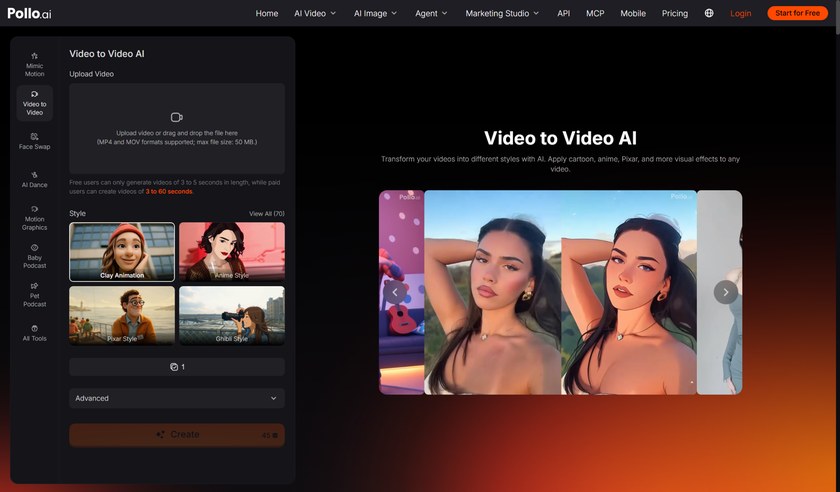
A team can use Pollo AI to convert video to video for a short representative test before committing a campaign. On the current Pollo AI interface, free users can generate videos of three to five seconds, while paid users can create clips from three to 60 seconds. The upload accepts MP4 and MOV files up to 50 MB. Confirm these limits and applicable terms at the time of production because product access can change.
What Should You Check Before Using a Free AI Restyle Commercially?
Check the source rights, output conditions, brand accuracy, motion quality and amount of cleanup required before publishing. Treat the free result as a production test.

If a campaign variation replaces an on-screen presenter, an AI face swap video can test the concept without arranging another shoot, but only after the person has given documented consent. Pollo AI tracks the selected face across movement and adapts the replacement to the clip’s lighting and expressions, so teams should review identity accuracy and approval as carefully as the visual result.
- Source rights. Use video, faces, music, trademarks and artwork that the team owns or has permission to transform and publish.
- Product and identity accuracy. Confirm that faces, products, logos, labels and key props remain recognisable throughout the clip.
- Motion preservation. Compare gestures, camera movement and object interactions with the source. Reject sliding feet, delayed actions or drifting framing.
- Style consistency. The new visual treatment should remain coherent across frames and should not overpower the campaign message.
- Export and platform fit. Review resolution, duration, aspect ratio, compression and any visible platform or plan conditions before posting.
- Total finishing work. Count retries, editing, sound, captions, disclosures and approval time. A free generation can become expensive when it needs extensive repair.
Which Commercial Social Videos Fit a Short Free Test?
Short hooks, style tests, teasers and looping visual moments fit free trials better than long demonstrations or multi-scene campaigns. The test should answer one creative question.
| Content type | Free-test fit | Reason |
| Three-second visual hook | Strong | One movement and style can be evaluated quickly |
| Short teaser or loop | Strong | Brief duration can become part of a larger edit |
| Product mood test | Moderate | Useful if commercial details remain readable |
| Full UGC ad | Limited | Needs dialogue, claims and several story beats |
| Detailed product demonstration | Poor | Accuracy and duration requirements are higher |
How Do You Run a Fair Free Video-to-Video Test?
Use one source, one style and a written pass condition so the free credits answer a practical production question. Avoid spending the test on random visual exploration.
Select a clip with the same movement, face detail and product complexity expected in the real campaign. Write down what must remain unchanged and what visual direction should change. Generate one version, then compare it with the source at normal speed and frame by frame. If it fails, identify one cause before trying again. Save the prompt and result so the team can judge whether a paid batch is likely to reduce work or simply multiply the same problem.
Run the review on the device and connection conditions closest to the audience. Social compression may hide fine texture while making flicker, edge shimmer and large colour shifts more obvious. Add temporary captions and interface overlays to confirm that the subject remains readable inside platform safe areas. Record how many generations, minutes of manual cleanup and approval comments the test required. Those numbers provide a more useful commercial decision than judging whether the free output looks impressive in isolation.
Keep the unedited source and test output together so clients can see exactly what the AI transformation changed.
When Should a Team Move Beyond the Free Workflow?
Move beyond free testing when the campaign needs longer clips, repeated variations, predictable review cycles or client-ready exports on a deadline. Scale only after the representative test passes.
A paid workflow may be more practical when the team needs several styles, multiple attempts, longer sequences or consistent assets across channels. Another tool may be better when the job requires exact cuts, detailed sound work or new action rather than a visual restyle. The decision should compare the complete route to approval, including preparation and corrections, not only the cost of the first generation.
Once the tooling question is settled, the harder work is the brief itself; our guide to building an AI video marketing strategy covers how those assets fit a wider campaign.
FAQs About Free Video-to-Video AI for Commercial Content
These answers explain Pollo AI’s free testing value and the checks required before commercial publishing.
What Makes Pollo AI Stand Out Among Video-to-Video Tools?
Pollo AI combines more than 70 styles, prompt-led direction and controls for the subject, background or full frame instead of offering only a fixed visual filter. Its current interface accepts MP4 or MOV files up to 50 MB; free generations cover three-to-five-second tests, while paid access supports longer clips up to 60 seconds.
Can a Free Pollo AI Restyle Be Used Commercially?
Commercial use depends on the current plan terms and the rights attached to the source and output. Teams should also verify faces, products, trademarks, music, export conditions and platform disclosure rules before treating a free test as a publishable campaign asset.
Ready to Test Commercial Video Restyling with Pollo AI?
Choose one short clip that represents the real campaign and define the commercial details it must preserve. Upload it to Pollo AI, test one style and review identity, motion, branding and rights before publishing. If the free result passes those checks, it can justify a broader workflow. If it does not, change the source or production method before scaling the problem.