









AI Answer Presence Tracking: 5 Platforms Compared (2026)
Your rankings look stable, yet clicks keep sliding. Clients ask whether their brand shows up in ChatGPT, and the honest answer is often “we’re not sure.”
That gap is starting to close. On June 3, 2026, Google introduced Search Generative AI performance reports in Search Console, giving site owners a dedicated view of their visibility in AI features.
Search Console is a great start, but it only covers Google. That gap matters, because Semrush data shows AI search visitors convert at 4.4 times the rate of traditional organic visitors. This guide looks at what the new reports show and which platforms track your brand across the wider AI answer landscape.
Key Takeaways
- Search Console now reports impressions inside Google’s AI features, including AI Overviews and AI Mode, for free.
- Third-party platforms track mentions, citations and sentiment across ChatGPT, Gemini, Perplexity and other assistants.
- Semrush pairs AI visibility tracking with a full search visibility dataset, from keywords to 43 trillion backlinks.
- Dedicated tools such as Profound and Otterly AI focus purely on AI search, while Ahrefs Brand Radar adds AI data to an SEO suite.
- Most teams get the clearest picture by pairing Search Console with one cross-platform tracker.
What do Google’s new generative AI reports show?
Google’s new reports give you dedicated views of impressions within generative AI features on Search, such as AI Overviews and AI Mode, plus generative AI features in Discover. That data still counts toward your overall Performance report too.
You can see how often your URLs appeared in these features and which pages showed up. Dates can be viewed by the hour, day, week or month.
What the reports can’t show is anything outside Google. ChatGPT, Perplexity, Claude and Copilot answers sit beyond Search Console, which is where dedicated tracking platforms come in.
AI answer presence tracking platforms at a glance
| Platform | Best for | AI platforms tracked | Pricing |
| Semrush | Teams that want AI visibility and SEO in one platform | ChatGPT, Perplexity, Gemini, Google AI Mode, AI Overviews (more on Enterprise) | AI Visibility from $99/month per domain |
| Profound | Enterprise teams running agent-led AI search work | Up to 9 answer engines on Enterprise | Free trial; Enterprise custom |
| Ahrefs Brand Radar | Existing Ahrefs users | ChatGPT, Perplexity, Gemini, Copilot, AI Overviews, AI Mode | From $199/month per platform |
| Otterly AI | Freelancers and small teams | ChatGPT, AI Overviews, Perplexity, Copilot (AI Mode and Gemini as add-ons) | From $29/month |
| Google Search Console | Every site owner | AI Overviews, AI Mode and Discover AI features | Free |
1. Semrush
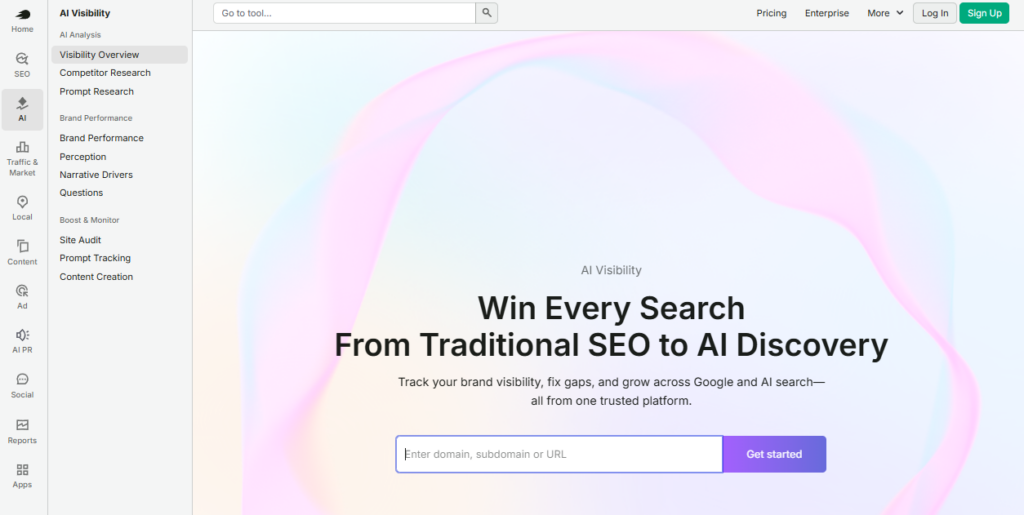
Semrush is a search visibility platform that covers SEO, content, competitive intelligence and AI visibility in one place. Its AI Visibility Toolkit shows where your brand appears in AI answers, where competitors are mentioned instead and which sources AI platforms cite.
Best for: Agencies and in-house teams that want to connect AI visibility with the SEO signals behind it.
Key strengths:
- An AI Visibility Score from 0 to 100 shows where your brand appears in AI answers and where it’s missing across ChatGPT, Perplexity, Gemini, Google AI Mode and AI Overviews. Daily Prompt Tracking follows the custom prompts you care about, and share of voice benchmarking compares you against up to nine competitors.
- Brand Performance reports cover AI share of voice, sentiment (positive, neutral or negative) and the narrative drivers behind how AI describes you. Citation tracking shows which sources AI platforms credit, which helps agencies plan outreach. Semrush says acting on its own AI visibility data grew its AI share of voice from 13% to 32% in one month.
- AI data sits alongside 43 trillion backlinks, 808 million domains, 317 million+ AI prompts and 142 geographic databases, so you can link visibility gaps to authority gaps.
- Core search tools live in the same platform: Keyword Magic Tool for keyword research, Site Audit for technical health, including AI crawlability checks such as llms.txt, and Position Tracking for rankings.
- For larger organisations, Enterprise AIO tracks visibility by product, persona, region and category across 32 countries. It adds platforms such as Claude, DeepSeek and Grok, reports on AI shopping results in ChatGPT and Google AI Mode, and connects AI search data with GA4 or Adobe Analytics to show revenue impact.
Limitations: The platform can feel like more than you need if you only want a lightweight mention tracker. The standalone AI Visibility Toolkit includes 25 tracked prompts and one Brand Performance domain, and extra domains cost $99/month each.
Pricing: AI Visibility starts at $99/month per domain, and SEO plans start at $139/month. See the Semrush pricing page for current plans.
2. Profound
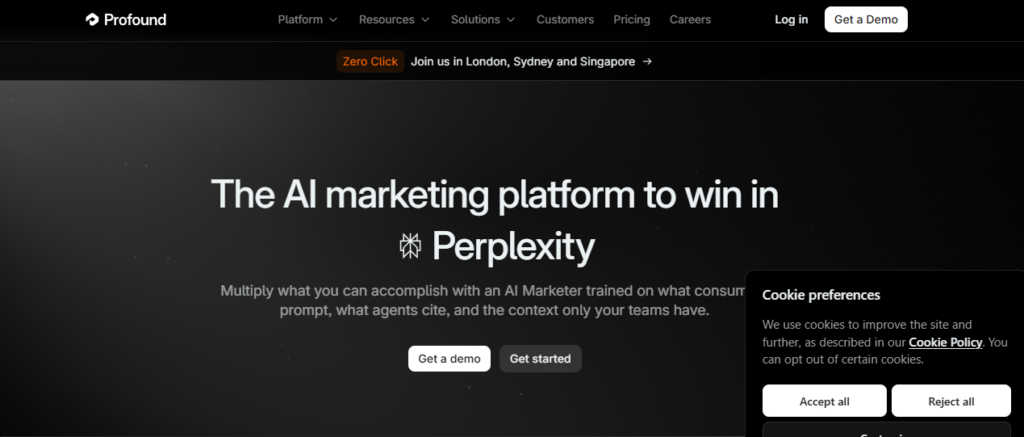
Profound describes itself as an AI marketing platform for the agentic era. It tracks how your brand appears in AI answers, then uses AI agents to draft and stage the follow-up work for your approval.
Best for: Enterprise marketing teams with a dedicated AI search budget.
Key strengths:
- Answer Engine Insights tracks citations, sentiment, ranking and competitive presence across up to 9 answer engines on Enterprise, including ChatGPT, Perplexity, Gemini, Google AI Mode, Microsoft Copilot, Claude and DeepSeek. That’s the broadest engine coverage in this list.
- Profound’s AI Marketer identifies work worth doing, drafts it and asks for approval. FactCheck, launched in July 2026, compares the claims AI engines make about your brand against your own knowledge base and shows which cited pages are behind inaccurate answers.
- Agent Analytics shows how AI bots view, cite and refer to your pages through CDN and hosting integrations such as Cloudflare, AWS, Akamai, Fastly and Vercel, with Google Analytics for downstream attribution.
- Prompt Volumes estimates what people actually ask AI, and Enterprise adds ChatGPT Shopping visibility at SKU level.
- Enterprise governance includes SSO/SAML, SOC 2, RBAC and SCIM. Profound says a third of the Fortune 100 use it, and customer results include Plaid reporting a 50% increase in its AI search visibility and MongoDB reporting 30% time saved with Profound Agents.
Limitations: Profound removed its self-serve Starter and Growth plans for brands in September 2026, so there’s no published self-serve price. The free trial runs a recommended prompt set you can’t customise, with no history or exports, and agents run on a credit-based model, so usage affects cost.
Pricing: A free trial runs 50 prompts daily for 7 days across ChatGPT, Gemini and Google AI Overviews. Enterprise pricing is custom, and agencies can buy client workspaces at $399/month each.
3. Ahrefs Brand Radar
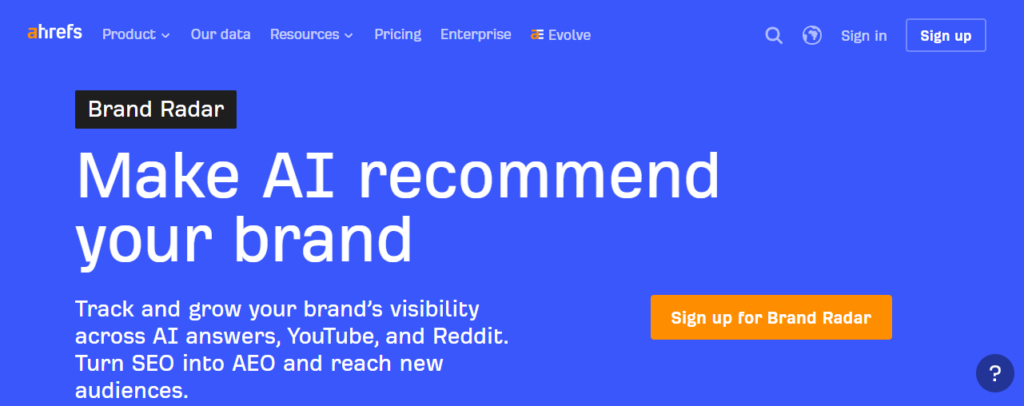
Ahrefs Brand Radar adds AI visibility to the Ahrefs platform. It calculates share of voice based on how often brands are mentioned or cited across six AI platforms.
Best for: Teams already working in Ahrefs that want AI data next to their SEO research.
Key strengths:
- Tracks mentions, citations, estimated impressions and AI share of voice across ChatGPT, Perplexity, Gemini, Copilot, AI Overviews and AI Mode. Its built-in index draws on prompts derived from real search behavior rather than synthetic queries.
- The All platforms plan adds custom prompt tracking with 2,500 checks a month, so you can monitor your own prompts daily, weekly or monthly alongside the built-in dataset.
- Connects AI visibility with branded search volume, web mentions and video and community visibility across YouTube, TikTok and Reddit. That helps when forum threads and videos shape how AI platforms describe a brand.
- A May 2026 update added bot visits and AI traffic data for cited pages, so you can see which of your pages AI systems actually use.
- Brand Radar sits next to Ahrefs’ backlink and keyword research, and Ahrefs covers more geographic regions than most SEO platforms, which suits agencies with international clients.
Limitations: Ahrefs describes Brand Radar as a media-visibility audit built around high-demand topics, so it shows what appears in AI answers rather than who actually saw them. It doesn’t track Claude, and its SEO tools require a separate paid Ahrefs plan, so full AI and SEO coverage means two subscriptions.
Pricing: Brand Radar starts at $199/month for a single AI platform, and coverage of all six platforms with custom prompts costs $699/month. Check Ahrefs’ pricing page for current figures.
4. Otterly AI
Otterly AI is an AI search monitoring and optimisation platform built for straightforward tracking. You define prompts that mirror real customer questions, and it runs them across AI engines to show who gets mentioned and cited.
Best for: Freelancers, small teams and agencies starting with AI visibility tracking.
Key strengths:
- Tracks ChatGPT, Google AI Overviews, Perplexity and Microsoft Copilot daily on every plan, with Google AI Mode and Gemini available as paid add-ons from $9/month on the Lite plan.
- Every plan includes unlimited team members, unlimited brand reports and an AI prompt research tool, which suits agencies sharing dashboards with clients.
- GEO URL audits check your own pages for AI crawlability and content issues, with 1,000 audits a month on Lite, 5,000 on Standard and 10,000 on Premium.
- Standard adds a Looker Studio connector and API access for agencies that want AI visibility inside existing client reports. Teams on Standard or Premium can add 100 extra prompts for $99/month.
- Named a Cool Vendor in the 2025 Gartner Cool Vendors for AI in Marketing.
Limitations: The Lite plan covers only 15 prompts, which suits a pilot more than ongoing client tracking. Results can differ from a manual search, since AI platforms personalise answers and Otterly AI aims for neutral monitoring. It’s built for monitoring, so backlink analysis and classic rank tracking need a separate SEO platform.
Pricing: Plans start at $29/month for 15 prompts, with a free trial that needs no credit card. Standard costs $189/month for 100 prompts, and Premium costs $489/month for 400 prompts.
5. Google Search Console
Search Console’s new generative AI performance reports are the most direct source of Google AI data. They’re free and sit inside a tool most site owners already use.
Best for: Every site owner who wants first-party data on AI Overviews and AI Mode.
Key strengths:
- Shows how often your URLs appeared in generative AI features in Search and Discover, including AI Overviews and AI Mode, broken down by page, country and date. The Search report also includes a device breakdown.
- Lets you view trends with hourly, daily, weekly and monthly granularity, which helps you spot changes after content updates or Google releases.
- Google launched the reports on June 3, 2026 and rolled them out to all websites worldwide on August 31, 2026. The same data still counts toward your overall Performance report, so you can compare AI visibility with total search visibility.
- On the same date, Google rolled out a Search generative AI control. This property-level setting lets site owners decide whether their content appears in AI features, and the new reports let you check your AI impressions before changing it.
Limitations: The reports only cover Google, so you’ll need another platform for ChatGPT, Perplexity and other assistants. They show impressions only, with no query or click data yet, and sites without enough AI impressions may not see a report at all. There’s no competitor benchmarking either.
Pricing: Free.
How to choose the right AI answer tracking platform
Start with the question your clients keep asking. If it’s “are we showing up in Google’s AI features?”, Search Console answers that today at no cost.
If the question is “how do we compare across every AI assistant?”, you need a cross-platform tracker. Pick one that covers the engines your audience actually uses and tracks competitors, citations and sentiment.
Then decide how you’ll report results. This guide to measuring GEO KPIs covers metrics such as inclusion rate, citation frequency and share of generative voice.
Finally, check how each tool turns data into action. Some platforms stop at monitoring, while others link visibility gaps to content, authority or technical fixes.
Conclusion
Google’s new reports confirm what agencies have known for a while: AI answers are now a channel worth measuring. Search Console gives you the Google view, and a dedicated platform fills in the rest.
Choose the tool that fits your stack, your budget and how your team works. Then track consistently, because AI visibility is easier to improve once you can see it.
FAQs
Which platforms offer the best AI answer presence tracking features?
Strong options include Semrush, Profound, Ahrefs Brand Radar, Otterly AI and Google Search Console. The right choice depends on whether you need Google-only data, cross-platform tracking or AI visibility paired with SEO data.
Does Google Search Console track AI Overviews?
Yes. Google launched generative AI performance reports on June 3, 2026 and rolled them out to all websites worldwide on August 31, 2026. They show impressions in AI Overviews, AI Mode and AI features in Discover.
Can I track my brand in ChatGPT for free?
Search Console doesn’t cover ChatGPT. Several paid platforms offer free trials, including Semrush, Profound and Otterly AI.
How is AI visibility different from SEO?
SEO measures visibility in traditional search results. AI visibility measures how often and how positively your brand appears inside AI-generated answers, though many of the same authority signals influence both.
How many prompts should an agency track per client?
Start with 25 to 50 prompts that mirror real buying questions, such as comparisons, “best tool for” searches and problem-based questions. That’s enough to spot patterns without stretching the budget. Add more once you know which topics drive mentions for your client and their competitors, and review results monthly so short-term swings in AI answers don’t distort the picture.