















At Reactive we understand that your brand identity and website design are important and the end result can dramatically affect how your business is perceived by your clients. Our target markets are premium SMEs and small enterprise level companies. We have considerable experience in B2B design, especially financial, tech, property and media. Our creative solutions are guided by key marketing principles, ensuring your website not only looks great but also drives more traffic, leads, and sales for your business. Once your website is live we can then assist with online marketing to ensure greater visibility on Google. We also offer website hosting and support, content writing services and print design.

Reactive
Gold MemberReactive are an award-winning creative web design and brand identity design agency, established for over 20 years in London. Get in touch today for a no-obligation quote.
Min. Project Budget:
£5,000+
Min. Monthly Budget:
£1,000+
2-10 Employees
5 Awards
4 Case Studies
About
- HQ
- OFFICES
-
HEADQUARTERS
- ADDRESS: 28 Poland Street, Soho, London, W1F 8QP
- PHONE: (44) (20) 70180909
- E-MAIL: [email protected]
Services
Branding
We help elevate businesses with a brand identity design tailored to their target market.
Digital Marketing
UX Design
Service Expertise
Web Design
Whether you are launching a new website or tweaking your existing site, our London web designers transform your vision to create impactful digital solutions.
Web Development
We carefully select only those technologies that are suitable for your project. We work with our clients to create websites that are user-friendly, achieve results and generate return on investment.
Industry Expertise
Finance
We understand the design requirements of financial companies who need to demonstrate professionalism and credibility when working with a discerning client base.
Sector Expertise
- Asset Management
- Banking
- Hedge Funds
- Investment Management
- Private Equity
- Venture Capital
- Wealth Management
- Finance Software
Law
Sector Expertise
- Criminal Law
- Business Law
- Corporate Law
- Intellectual Property Law
Real Estate
We offer industry-specific London web design solutions tailored to meet property business needs. We work with architects, interior designers, agents, housing associations and property investors.
Sector Expertise
- Architecture Company
- Property Management
- Industrial Real Estate
- Retail Real Estate
- Residential Real Estate
- Commercial Real Estate
- Development & Construction
- Real Estate Investment
- Student & Co-Living Housing
Startup
Sector Expertise
- SportsTech
- HealthTech
- Biotech & Pharmaceuticals
- Software & SaaS
- Media & Entertainment
- CleanTech & GreenTech
- Real Estate & PropTech
- Travel & Hospitality
Clients
Crown Agents Bank
Namier Capital
Kemp IT Law
Capricorn Wealth Management
Aquila Films
Kingbridge
Pythia Sports
Budgets
Min. project budget
£5,000+
Min. monthly budget
£1,000+
Reactive Reviews
4.9
Reactive positions itself as a web design and UX transformation partner, specializing in turning outdated digital platforms into modern, high-performing, and brand-aligned user experiences.
The agency’s core strength lies in delivering clean, functional, and conversion-aware websites—combining strong design execution with reliable project delivery and consistent client satisfaction.
Its strongest differentiators are:
- Strong expertise in website redesign and UX improvement
- Ability to modernize legacy platforms into high-performing digital assets
- Consistent on-time, on-budget delivery (high operational reliability)
- Strong client retention and repeat engagement signals
However, available signals suggest:
- Strong web and UX execution capability
- Moderate strategic depth (focused more on execution than full growth systems)
- Limited visible depth in acquisition channels, CRM systems, or lifecycle marketing
Final DAN Perspective:
Reactive fits best into the category of “web transformation and UX execution partners”, making it a strong choice for businesses seeking reliable, high-quality website upgrades with strong usability and design clarity.
Strategic Depth
Client feedback highlights Reactive’s ability to align website design with brand identity and user experience goals, improving overall digital presence.
Execution Excellence
The agency demonstrates strong execution across web design and development, consistently delivering polished, responsive, and user-friendly platforms.
Speed & Reliability
Clients report strong responsiveness, structured workflows, and consistent delivery within timelines and budgets.
Collaboration Quality
Feedback highlights an approachable, receptive, and solution-oriented team that actively listens and contributes ideas.
Primary Expertise
Client outcomes strongly associate the agency with website redesign, UX/UI improvement, responsive web development, and ongoing website enhancements.
Value Creation Pattern
Reported gains cluster around improved user experience, modernized digital presence, and stronger brand alignment. Evidence around acquisition systems, performance marketing, or lifecycle infrastructure remains limited.
Price–Performance Balance
Consistent on-budget delivery and high satisfaction indicate strong value perception.
Transparency & Scope Clarity
Client feedback highlights clear expectations, structured processes, and low-risk project execution.
Client Satisfaction
Client sentiment is highly positive, driven by reliability, professionalism, and quality of delivery.
Referability
Clients demonstrate strong referral likelihood, supported by repeat engagements and consistent outcomes.
Our team has summarized customer reviews to provide you with a concise overview of what people are saying about the agency on various review sites.
Awards
- Orpetron Site of the day 2025
- CSS Design Awards Special Kudos 2025
- Awwwards Honorable mention 2025
- Awwwards Honorable mention 2024
- Admire the web Special recognition 2025
→
Platform Expertise


Case Studies

Web design for Namier Capital
Web design for Namier Capital
Reactive
Namier Capital is a London-based investment firm focused on CleanTech, HealthTech and financial advisory with a strong emphasis on scientific and environmental impact.
The website’s interface is designed to be contemporary and high-tech, reflecting the company’s strong commitment to investing in future technologies, with minimal use of photography to maintain a precise and professional aesthetic.
Client: Namier Capital
Industry: Finance
Location: London, UK
Services
Branding
Creative
UX Design
Video Production
Web Design
Web Development
Technologies: WordPress, CSS, HTML, PHP, Javascript, JQuery
Completed: Sep 2025

Web design for Capricorn Private Investments
Web design for Capricorn Private Investments
Reactive
Capricorn Private Investments is London-based private investment office that works with high-net-worth individuals, families and institutions. Their clients include some of the UK and Europe’s most prominent entrepreneurs.
The goal was to redesign the website and evolve the brand identity to add credibility and inspire confidence in CPI. The result is contemporary and minimal, with a sophisticated web design user interface. The look & feel conveys a mature, established presence fitting for a wealth management business. Graphics are clean, crisp and sharp, with precision running throughout, mirroring the nature of finance.
Client: Capricorn Private Investments
Industry: Finance
Sector Expertise: Wealth Management
Location: London, UK
Services
Branding
Creative
UX Design
Video Production
Web Design
Web Development
Technologies: WordPress, CSS, HTML, PHP, Javascript, JQuery
Completed: Apr 2025

Web design for HealthAxon
Web design for HealthAxon
Reactive
HealthAxon is a financial investment company operating in the health and social care sector. The one-page website design is minimal and contemporary, created to build trust and convey a sense of softness within the industry. We collaborated closely with HealthAxon to develop the brand identity, website and a series of custom animated illustrations that reflect the company’s core values and strengthen its credibility despite the site’s compact format.
Client: HealthAxon
Industry: Finance
Location: London, UK
Services
Branding
Creative
UX Design
Video Production
Web Design
Web Development
Technologies: WordPress, CSS, HTML, PHP, Javascript, JQuery
Completed: Jun 2024

Web design for Kingbridge
Web design for Kingbridge
Reactive
Kingbridge focuses exclusively on top-end developments in the elite real estate market, embodying elegance, luxury and sophistication. We developed the brand and designed a minimalist website that allows visitors to explore their portfolio seamlessly, without distractions. The homepage features a striking image of a signature property, instantly capturing the essence of luxury and setting the tone for the entire site.
Client: Kingbridge
Industry: Real Estate
Sector Expertise: Luxury Real Estate
Location: London, UK
Services
Branding
Creative
UX Design
Web Design
Web Development
Technologies: WordPress, CSS, HTML, PHP, Javascript, JQuery
Completed: May 2023
MORE
Agency News

Release Date: Nov 2025
Website Redesign: How Reactive Improved UX and Performance
This year, we at Reactive launched a full redesign of our site. Your old site worked well for us, but we knew it was time for a fresh...
Website Redesign: How Reactive Improved UX and Performance
Reactive
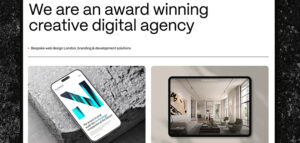
This year, we at Reactive launched a full redesign of our site. Your old site worked well for us, but we knew it was time for a fresh look. We wanted to show our work more clearly and make the site easier for visitors to use. We focused on simple navigation, a layout that makes information easy to find and a site that works well on all devices. From the moment it launched, the new design felt cleaner, friendlier and better suited to how people browse today.
After several months since the launch, we can evaluate how the redesign has worked in practice. Later in the article we will share a closer look at why we decided to update the site, how we went about it and what we learned along the way.
Why the update was important
As London web designers, we know things change fast online. A website built even a few years ago may start to feel less adapted to modern habits. For us, the redesign was more than a visual refresh. It was about rethinking how we showcase our services from web design and development to brand identity, hosting & support and even pitch‑deck design. We took the time to map how our visitors arrive, what they are looking for and how we can guide them clearly through what we do. That meant structuring our content around real client needs rather than assuming everyone will find their way easily.
Our redesign process
We treated our own website project as if we were the client. First we looked at how the old site was being used: where people clicked, where they dropped off, which pages were rarely visited. Then we sketched out wireframes and prototype flows. Nothing fancy, just what pages do we need, how will people move from one to another. Once we had that foundation, we focused on the design itself. Choosing clean typography, establishing a clear heading hierarchy and paying attention to spacing and readability. Development came next. Mobile first, testing on many devices, optimising load times and making sure even simple animations or interactions didn’t slow things down.
One of the first things visitors see on the homepage is the featured portfolio section, showcasing recent work for clients. This visual introduction sets the tone, so visitors immediately get a sense of the types of projects we work on.
What we learned along the way
Launching the new site gave us plenty of useful insights. For one, even websites that work fine can benefit from structure tweaks and clearer navigation cues. When visitors find what they are looking for in fewer clicks, their engagement increases. For our part, the new layout helped visitors find our portfolio and services faster and we felt the site just worked more consistently on tablet and mobile. It also reinforced our ethos that websites should be designed with users in mind, not just visuals, but usability, clarity, performance. If we hadnt done this ourselves, we might not have highlighted certain client painpoints as clearly.
Showcasing our work more clearly
One of the key goals of the redesign was to make it easier for visitors to see the range and quality of our work. Our portfolio section now highlights recent projects with clean visuals and short descriptions, giving a clear sense of each clients goals and the solutions we provided. Visitors can quickly browse through different industries and project types, from branding and web development to pitch decks, without feeling overwhelmed. This approach not only shows what we can do but also helps potential clients imagine how we could work on their projects, making the site more engaging and informative.
What is next for the site
On our site, you will find our core services – web design, web development, brand identity, hosting & support and pitch‑deck design. Going forward, we will be adding more case studies featuring our newest clients, real stories of how we helped them grow. We are also exploring ways to make the site even more engaging: smoother animations, richer visuals, clearer service highlights and improved navigation on devices of all sizes. Being London web designers in a fastmoving market means your website can’t sit still. So we are committed to keeping this one moving forward and relevant for our clients.
If we were to give one bit of advice to others, it would be not to wait until a website feels outdated to give it some attention. Small updates to layout, structure or navigation can make a big difference to how people experience it. A website should grow and change just like the business behind it.
Agency: Reactive
Published: Nov 2025