
















Inside SHEIN Marketing Campaigns: Algorithmic Scaling, Micro-Content & Influencer Program
Ask a room of marketers to name SHEIN’s marketing campaign and you’ll get an awkward silence.
There’s no Super Bowl spot, no signature tagline, no Cannes Lions reel. That silence is the point. SHEIN marketing isn’t a string of hero campaigns; it’s a machine made of thousands of creators, a product loop that tests constantly, and an app designed to turn browsing into a habit.
The machine works at scale. SHEIN reported 2025 revenue of $41.8 billion, up 8% on 2024 (itself up from $32.1 billion in 2023), and it describes itself as serving 273 million active customers across about 160 markets. Growth is cooling, though, and we’ll come back to why.
This guide is for marketers, agencies and brands who want the mechanics rather than the mythology. We look at how SHEIN’s advertising strategy actually works, seven campaigns and activations worth studying, the influencer and affiliate engine behind them, who SHEIN is really talking to, and, because skipping it would make the whole article less credible, the sustainability, labour, design-rights and regulatory criticism that increasingly shapes SHEIN’s brand strategy.
Beyond its foundational blueprint, understanding SHEIN requires analyzing how modern fashion marketing campaigns dominate fast-paced consumer trends. At the core of this strategy is algorithmic scaling, which dynamically identifies viral products and automates ad targeting at an unprecedented volume. The system relies heavily on short-form micro content to capture viewer attention within seconds across social platforms.
So, let’s start.
Click & Learn: SHEIN Marketing Campaigns
How SHEIN Approaches Marketing and Advertising
The shortest summary of SHEIN’s marketing strategy is this: the product, the price and the platform are the campaign.
Founder Xu Yangtian came out of search engine optimisation work, and Wu and Yang (2024) argue that this background led SHEIN to treat overseas traffic acquisition as the main path to brand growth from the very beginning. Li (2022) adds that SHEIN sells through its own website and app, started social media marketing before TikTok went mainstream, and built huge traffic through internet celebrities rather than traditional endorsement deals.
So, the most useful way to understand SHEIN marketing is to stop thinking exclusively in terms of traditional campaigns.
Many fashion brands, like the fast fashion ones, H&M and Zara, organize marketing around seasonal collections, major launches, carefully selected ambassadors, and large advertising productions. SHEIN also uses celebrity collaborations, but its underlying marketing model emphasizes continuous product discovery and frequent opportunities for social content.
There is a practical relationship between these activities. A rapidly changing product assortment gives creators new items to discuss. Their content makes products easier to discover. Consumer interest then provides signals that may inform future merchandising decisions.
Academic research supports this broad interpretation.
In The Analysis of the Marketing Strategy of Shein and Accompanying Word of Mouth on Social Media, Yanjin Li identifies consumer data analysis, affiliate marketing, and the combination of user-generated and professionally generated content as important elements of SHEIN’s marketing approach.
The 2022 study included a questionnaire completed by 237 respondents. It suggested that novelty and affordability could attract consumers while also identifying limitations associated with overall brand perception.
That tension between acquisition efficiency and brand perception runs through virtually every aspect of SHEIN’s advertising strategy.
Volume-Based Creator Marketing Instead of Brand Campaigns
Imagine commissioning an expensive fashion commercial featuring a famous actor. The production looks fantastic, the agency has delivered its finest work, and everybody in the boardroom is delighted. Then the campaign launches, and the team waits to see how the audience responds.
SHEIN’s creator-led approach distributes that creative effort across many independent voices. Influencers produce outfit inspiration, styling tutorials, product reviews, shopping recommendations, and haul videos. These formats let the same collection appear in different contexts without requiring the brand to dictate every creative decision.
A summer dress might appear in a vacation packing video, a student budget-fashion recommendation, a wedding-guest outfit roundup, and a casual everyday styling tutorial. This is one of the most interesting aspects of SHEIN influencer marketing: creators provide the cultural context that product photography alone cannot offer.
Of course, not every creator performs equally well, and a large number of partnerships doesn’t automatically translate into efficient sales. But the approach allows the brand to test different messages, styles, and audiences without relying exclusively on a small number of expensive personalities.
From SHEIN’s Influencer Strategy to Your Own Influencer Campaign
SHEIN’s influencer marketing strategy demonstrates how micro influencers, TikTok haul campaigns, and user-generated content (UGC) can support a continuous flow of fashion content instead of relying solely on large, one-off brand campaigns. But how can you apply this creator-driven approach to your own fashion brand? Use the generator below to discover suitable influencer profiles, plan TikTok and fashion haul content, build a scalable UGC strategy, and generate campaign ideas tailored to your audience and marketing goals.
SHEIN-Inspired Fashion Influencer & UGC Campaign Generator
CREATOR STRATEGY TOOLDiscover suitable fashion influencer profiles and generate TikTok, haul, and UGC campaign plans for your brand.
Built for fashion brands, e-commerce marketers, and social media teams, this free generator recommends micro-influencer and UGC creator profiles, generates targeted influencer discovery searches, and creates a four-week content plan based on your audience and marketing goals. Explore a creator-volume approach inspired by SHEIN influencer marketing, TikTok fashion hauls, and user-generated content campaigns.
Plan Your Fashion Creator Campaign
Choose your audience, content format, and campaign goals to build a practical influencer strategy.
Your Fashion Influencer Campaign Plan
01. Recommended Influencer & Creator Mix
02. TikTok, Haul & UGC Campaign Ideas
03. Influencer Discovery Search Queries
Copy these search phrases into TikTok, Instagram, Google, or your preferred influencer discovery tool. These are search suggestions, not verified influencer accounts.
04. Four-Week Creator Content Plan
05. Influencer Campaign Brief
This generator creates an illustrative campaign plan based on your selections. Creator availability, performance, audience quality, costs, and results must be verified independently. This is an independent planning tool, not an official SHEIN tool.
App-First Commerce and Gamified Engagement
SHEIN's app is more than a mobile storefront. It combines product discovery, personalized shopping experiences, promotional incentives, reviews, and engagement features. In this environment, advertising doesn't necessarily end when somebody clicks an ad. The shopping experience itself becomes part of the marketing.
Consider its check-in program. SHEIN's published rules explain that customers can earn points through daily check-ins, with additional points or coupons available under specified participation conditions.
From a marketing perspective, this creates another reason to return to the platform even when a customer isn't planning an immediate purchase. An app notification might stimulate a return visit, but retaining customers requires more than persuading them to open the app. Product satisfaction, delivery experience, price, and trust still determine the value of that relationship.
And gamification carries its own risks. As we'll discuss later, European regulators have specifically examined the implications of engagement-based rewards and potentially addictive platform design.
Test-and-Repeat Merchandising as a Marketing Input
Product is the other half of the media plan.
Research titled The Rise of SHEIN: Navigating the Digital Era of Fast Fashion and Its Comprehensive Impacts notes that SHEIN's first production run is usually small, that suppliers often lose money on those early orders, and that customer data then guides longer-term decisions on materials, design and production.
The company describes an on-demand system in which new products initially launch in batches of approximately 100–200 units, with further production informed by demand and customer feedback.
This creates an interesting connection between merchandising and content marketing. Instead of planning marketing around only a few major collections, the brand can respond to interest in individual styles. A product gaining attention online may present an opportunity for additional creative activity, provided inventory, profitability, and operational constraints allow it.
Search interest, creator engagement, customer reviews, conversion performance, and product availability can help teams understand not just which advertisement attracted attention, but which products deserve that attention in the first place.
However, SHEIN's small-batch model should not be mistaken for independent proof that its total environmental footprint is low. Production efficiency and overall consumption are different questions, particularly when a business operates at enormous scale.
Best SHEIN Marketing Campaigns and Activations
How we chose these campaigns:
- First, verifiability: every example had to be documented by SHEIN's own announcements, independent trade or news coverage, or published research, not SEO listicles.
- Second, range: we wanted distinct levers (creators, events, product programmes, offline retail, affiliates, localisation, partnerships) so you can borrow tactics rather than read seven versions of the same one.
- Third, timeline: the examples run from 2020 to 2026, so you can see SHEIN advertising campaigns evolve from pandemic-era digital events to physical retail.
- Fourth, evidence: we favoured activations where at least some reach, attendance or sales data is public, and we flag the gaps where it isn't.
SHEIN Haul Content and the Rise of Haul Culture
The SHEIN haul is an always-on, hashtag-led creator and UGC campaign. Creators unbox, try on and rate big orders on TikTok, YouTube and Instagram, usually under #sheinhaul. The objective is reach among Gen Z shoppers, and the creative idea is that prices are low enough for a thirty-piece order to be entertainment.
SHEIN doesn't have to script the format: sponsored creators, affiliates and unpaid shoppers all join in, and even people who aren't sponsored post haul videos and tag brands. The brand's contribution is fuel, meaning a daily flow of new styles and trackable links.
Why it worked: The numbers climbed fast. In June 2021, Rouge Media counted more than 2.5 billion #sheinhaul views, far ahead of Zara (873.6 million) and Primark (221.9 million). By May 2022, YPulse reported 5.2 billion TikTok views and called SHEIN Gen Z's favourite place to shop for clothes. By mid-2023, Fortune put the figure at about 11 billion.
The format worked because price and trend speed made it cheap to repeat, and because the platform algorithm rewarded creators for repeating it, so SHEIN paid for only a fraction of the reach. The limit showed up too. In that same Fortune piece, haul creators said SHEIN hauls were losing views while hauls for other brands held steady, partly because of the brand's association with very slim bodies, and the story landed amid backlash over a SHEIN-hosted influencer trip to Guangzhou.
So, we can say that haul culture is a rented audience. It scales beautifully when price and novelty are the story, and it decays when the story turns. Build an owned layer (app, email, community) before the trend cools.
SHEIN Together and Virtual Concert Campaigns
SHEIN Together is a livestreamed charity concert and branded entertainment event, streamed exclusively in SHEIN's app. The first edition ran on 9 May 2020, during lockdown, with Katy Perry and Lil Nas X headlining. SHEIN pledged $100,000 and sold $10 #SHEINTogether shirts to benefit the WHO's COVID-19 Solidarity Response Fund.
The objective is app engagement and goodwill among millennial and Gen Z viewers. The execution layers games, prize draws, points and in-stream shirt purchases on top of the performances. We also know that US brands were investing almost nothing in live-streamed commerce at the time, so the format felt new.
Why it worked: 1.8 million viewers tuned in globally, and BizBash reported that Katy Perry's closing set alone drew more than 1.6 million. It worked because it demanded an action (open the app) rather than a passive impression, and because the charity framing made participation easy to justify during the pandemic.
SHEIN ran a second edition on 2 May 2021, pledging $300,000 across three causes its community had chosen.
SHEIN X Designer Program
SHEIN X is a designer incubator that doubles as a product, reputation and content programme. Independent designers and artists apply, SHEIN handles manufacturing, logistics and marketing, funds production, and says designers keep ownership of their designs and earn commission.
The target is fashion-curious Gen Z and the creator community, and the channels are SHEIN's social accounts, designer capsules, competitions, pop-ups and fashion shows. The 100k Challenge is the showpiece: designers competed for a slot in SHEIN's AW21 fashion show and $100,000 to start their own label, with a globally streamed final.
Why it worked: According to SHEIN, the programme grew from seven designers in January 2021 to almost 3,000, with nearly 2,000 collections, more than 25,000 original creations and $5.37 million in commission paid by the end of 2022. Each designer brings a personal audience, so SHEIN X is effectively micro-creator marketing wearing an incubator badge, and it gave the brand a credible answer to questions about originality.
A Phoenix designer told a local paper she receives 10% of her sales, and our own arithmetic puts $5.37 million across roughly 3,000 designers at about $1,800 each, an average that hides a long tail. The reputational flip side is real, too. Three independent designers sued SHEIN in July 2023 alleging copying and racketeering, a judge later declined to dismiss the racketeering claims, and SHEIN says the claims lack merit.
SHEIN Pop-Up Stores and Offline Activations
SHEIN pop-up stores are time-limited, shoppable activations that turn an online-only brand into something you can touch.
SHEIN opened its first pop-up in Miami in 2018 and, by 2022, ran more than 40 worldwide, a quarter of them in the US. The execution is built for social sharing. In San Francisco in June 2022, the assortment rotated daily across more than 1,000 styles. London added a nail-art printing machine and a 360-degree video booth for social posts. Promotion stays cheap: SHEIN's Dallas operations manager said the team promoted that event through a Facebook event page and Reddit.
Why it worked: The Dallas pop-up drew 3,045 visitors over three days, sold out daily and took about $80,000, according to that same interview. San Francisco's time slots sold out, which prompted resale platform ThredUP to offer discounts to people who pledged to skip the event. Pop-ups worked as traffic and awareness drivers because they paid off content shoppers were already making: try-ons, hauls, photo booths.
The permanent store tells a more mixed story. When SHEIN opened its first one at Paris's BHV Marais on 5 November 2025, crowds and protesters both showed up, and France's finance ministry announced a suspension of SHEIN's online platform pending review over banned-product listings. By February 2026, FashionUnited reported that about 100 luxury and cosmetics brands had left BHV and that the Paris store, despite 5,000 visitors a day, still hadn't convinced. Regional BHV shops opened that month, partly because 95% of SHEIN's French customers live outside the big cities.
Affiliate and Ambassador Program Campaigns
SHEIN's affiliate and ambassador programmes are performance-based creator programmes: approved partners get a tracked link and earn a commission when their audience buys. A buyer posts their experience with a promotion link, other people click and order, and the promoter earns commission or coupons.
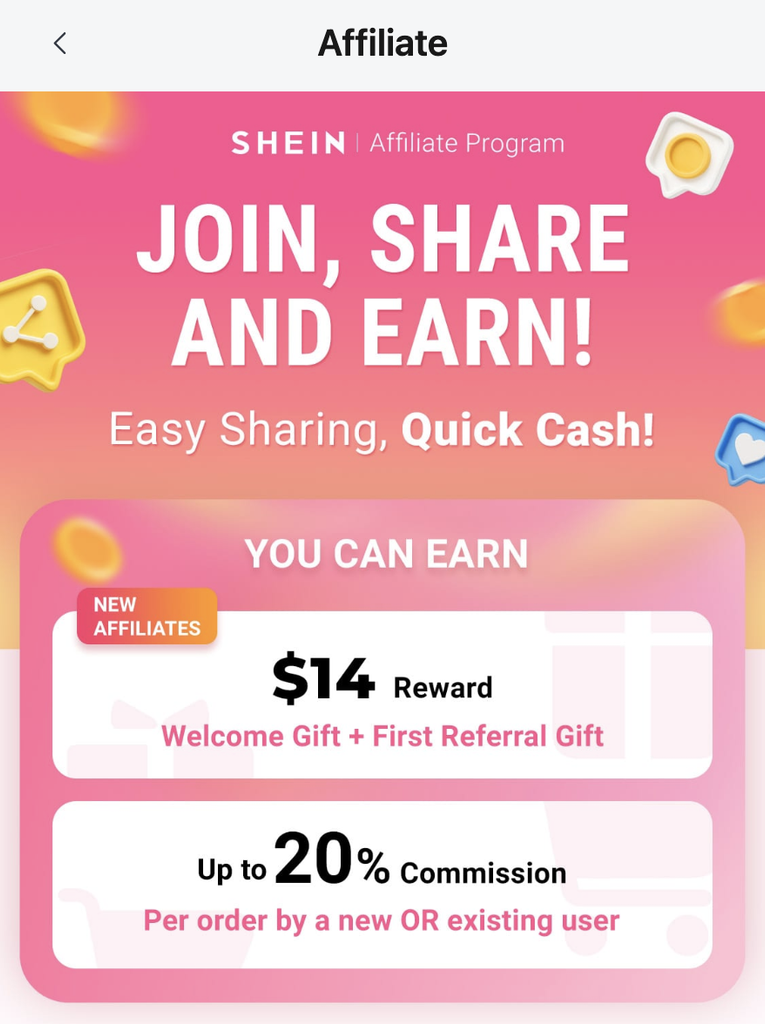
The reciprocity is the creative idea, and the targets are aspiring creators and existing shoppers who might become advocates. Third-party directories report commissions of up to 20%, but they disagree on the tracking window: one lists a single day while others quote 30 days. Terms clearly vary by network and region, so check the live programme before you model anything on it.
Why it worked: The model turned buyers into the most authentic reviewers and made people who had enjoyed a benefit more likely to buy again and recommend SHEIN to friends and family. It worked because it aligned the creator's incentive with SHEIN's, and because the long tail kept new faces and new audiences arriving without SHEIN negotiating with each one.
Seasonal and Regional Campaigns in New Markets
Seasonal trend campaigns are creator-fronted launches tied to the fashion calendar, and regional activations adapt the same machinery to a local market.
The seasonal example is SHEIN's Fall/Winter '26 Trend Campaign, launched on 14 September 2026. It spotlights six trends through five creators and streamers, including twins Wendy and Evelyn Ortiz, Brooklyn Frost, Dano Maldonado and Lani Aliza. Regarding that SHEIN campaign, Lisa Zlotnick, Head of U.S. Brand PR at SHEIN said:
Today’s audiences don’t just want to see the final campaign, they want to be a part of how it comes together. This collaboration is really about community, giving our creators and their audiences a front-row seat and letting them shape the conversation alongside us.
Shoppers are also encouraged to share their looks and tag SHEIN's US Instagram and TikTok accounts. The regional example is the SHEIN POPUP Japan Tour 2022, which ran on weekends in five Japanese cities with locally styled mannequins, a free draw called the SHEIN gacha with prizes up to a 10,000-yen gift card, and a photo booth where posting a picture earned extra coins for the draw.
Speaking of new markets, we should mention how SHEIN's regional strategy becomes particularly clear through its DAZY activity. In April 2024, SHEIN launches a dedicated Korean website. In June, the company announces actress Kim You-Jung as the first global ambassador for DAZY. DAZY is positioned around Korean-inspired fashion aesthetics, and the partnership connects those products with a recognizable figure from South Korean entertainment.
Why it worked: Using creators who already have audiences, showing the process instead of just the finished image, and prompting tagged posts all fit the UGC loop described above. The Japan tour worked because it turned a social post into a game reward, linking offline footfall to online content.
Brand and Celebrity Collaborations
Brand and celebrity collaborations are licensing or co-branded capsule partnerships designed to borrow someone else's equity. Remember paid collaborations with celebrities such as Hailey Bieber on SHEIN's Instagram.
The bigger structural move came in 2023, when SHEIN took roughly a one-third interest in SPARC Group and signed a long-term agreement with Authentic Brands under which SHEIN designs, makes and distributes a Forever 21 line sold online exclusively on SHEIN's US sites. It then opened a holiday pop-up inside Forever 21's Times Square store with six themed rooms.
On the fashion house side, SHEIN announces a collaboration with label MONSE. Its designers, Laura Kim and Fernando Garcia, mentor five SHEIN X designers who contribute to the collection. The collaboration also supports Dress for Success Greater New York City. The partnership connects accessible fashion with established designer expertise.
What's more, a Normani x SHEIN partnership began in November 2025 as a year-long deal with multiple drops, and a second drop was announced on 6 April 2026.
Why it worked: The Forever 21 deal gave SHEIN a recognisable American heritage name and a retail footprint without building a brand from scratch, and the multi-drop celebrity structure produced repeated news cycles instead of one launch.
SHEIN's Influencer and Affiliate Marketing Model
Looking across these examples, one pattern becomes obvious: SHEIN doesn't treat creators as an optional promotional layer.
Creator activity sits close to the relationship between product discovery, audience trust, and conversion. This is particularly relevant to brands evaluating their own influencer marketing budgets. Should you spend heavily on a small number of prominent personalities? Or build a larger network of creators who reach different communities?
SHEIN demonstrates the possibilities of the second approach, although it also uses celebrities when their audience and creative identity support a specific objective.
Micro and Nano Influencers at Scale
Smaller creators can provide specialized audiences, identifiable interests, and a more personal communication style, as you already know. For ecommerce businesses, a distributed creator network can produce a range of creative approaches while limiting dependence on a single personality.
Shen (2022) lists micro-influencer marketing, social media marketing and a made-to-order supply model as the pillars of SHEIN's growth marketing. For anyone building a micro influencer strategy, the appeal is plain: you can seed many creators for the price of one celebrity and learn which content converts.
Commission-Based Affiliate Structure
As we mentioned above, The SHEIN affiliate program adds a performance-based component to creator marketing. A creator introduces products through permitted referral methods, and qualifying purchases can generate commissions under the relevant program terms.
This creates a clearer attribution opportunity, although coupon sharing, cross-device purchasing, platform reporting limitations, and overlapping marketing touchpoints can complicate measurement. For agencies, it is useful to separate affiliate-attributed revenue from genuinely incremental revenue.
A customer who already intended to purchase might use a creator code at checkout. The code records an attributable sale, but that doesn't automatically mean the affiliate generated the entire purchase decision. A strong affiliate measurement framework should therefore consider new-customer contribution, incremental lift, average order value, product returns, and customer lifetime value.
Why Volume Beats Single Celebrity Campaigns
A celebrity endorsement offers immediate visibility, but it can also create concentration risk. If the partnership fails to resonate, a significant portion of the investment may produce disappointing returns. A diversified creator approach provides more opportunities to test messaging and discover audience preferences.
One creator's styling tutorial may outperform another creator's unboxing video. A particular product category may convert better among a specific demographic. Another format may generate engagement without attracting high-value customers.
Those differences become useful when the marketing team knows how to interpret them.
SHEIN's model suggests a conceptual growth loop:
Accessible prices → Creator participation → Social proof → Product discovery and app visits → Purchases and repeat engagement
A large creator network can strengthen this process, but lower customer acquisition cost is not guaranteed.
Risks of Decentralized Brand Communication
The flip side is control. The 2023 influencer factory trip backlash, covered in the Fortune report, showed how a creator-led narrative can turn quickly.
So, we can say that there is a trade-off in allowing large numbers of people to represent a brand. Creators can communicate naturally, but they may also make inaccurate product claims, fail to disclose advertising relationships, or publish content that creates reputational problems.
Discount-heavy promotion can also train consumers to associate the brand primarily with low prices. Over time, that makes differentiation harder.
For marketers managing similar programs, the solution isn't to control every sentence. It's to establish clear guidelines, truthful claims, appropriate disclosure, creator screening, and meaningful quality checks.
SHEIN's Influencer and Affiliate Marketing Model
SHEIN social media marketing is closely connected to the types of content people already consume for entertainment and shopping inspiration.
That sounds straightforward, but it represents a meaningful shift from traditional fashion advertising. A conventional campaign begins with the brand's desired message, social-first content often begins with a question the viewer already has.
Will this outfit look good on me?
Is the fabric worth the price?
How can I style something for an upcoming trip?
Does this product actually match its photographs?
The most useful content answers those questions.
TikTok and Short-Form Video Dominance
TikTok provides an especially suitable environment for visual demonstrations, styling comparisons, shopping recommendations, and creator commentary. The platform's short-form format encourages quick introductions, immediate product reveals, and simple explanations.
For SHEIN, the combination of an extensive product selection and creators interested in affordable fashion creates many potential content topics. But virality is an unreliable business model on its own. An individual video may attract attention for reasons unrelated to purchase intent, including criticism, humor, surprise, or controversy. Agencies should therefore evaluate not just views, but qualified traffic, product interest, purchases, returns, and customer quality. A million impressions mean very little if the resulting customers have poor retention or negative experiences.
User-Generated Content as Primary Creative
The SHEIN UGC strategy is about volume and participation.
SHEIN's UGC strategy benefits from customers discussing products in everyday settings; product reviews, try-on videos, styling posts, and customer photographs help make a large online catalogue more understandable.
Academic research on SHEIN's content marketing (above-mentioned, The Impact of SHEIN's Content Marketing on Consumer Perceptions in the Digital Marketing Process) has identified user-generated content as a contributor to product recognition and purchasing perceptions.
The practical advantage is creative diversity. Professionally produced photography provides consistent presentation, while customer-generated material offers different contexts and opinions. The two forms can complement each other. However, brands should not confuse incentivized content with independent consumer endorsement. Review transparency and clear disclosure remain essential.
Community Challenges and Gamification
SHEIN's community-oriented initiatives range from designer competitions to rewards for app participation. These activities encourage people to do something beyond passively viewing advertisements. For marketers, participation creates an opportunity to build familiarity and repeated interaction. Yet the design of those incentives matters. An engaging shopping experience can become problematic when it places excessive pressure on consumers to return, spend, or pursue rewards.
The European Commission's February 2026 Digital Services Act investigation includes scrutiny of SHEIN's engagement rewards and potentially addictive design features. That makes SHEIN an important example of both the commercial attraction and regulatory sensitivity of gamified commerce.
Paid Social and Retargeting
SHEIN is also a heavy buyer of paid media. Reuters called it one of the biggest advertisers on US social media, and Sensor Tower estimated that SHEIN's average daily US ad spend fell 19% between 31 March and 13 April 2025 versus the previous 30 days, as US tariff changes loomed.
As you already know, paid social provides brands with opportunities to reach specific audiences, promote collections, and re-engage shoppers who have already shown interest. For a retailer with many product categories, creative testing should be closely connected to inventory, relevance, and purchasing behavior.
A sensible campaign structure might distinguish broad discovery campaigns from product-specific retargeting and existing-customer promotions. That is a marketing framework, not a verified disclosure of SHEIN's internal media-buying configuration. The precise allocation of SHEIN's advertising budget across platforms, audiences, and campaign objectives is not publicly established in the sources reviewed here. What marketers can still learn is the importance of connecting creative performance with the customer experience after the click.
Who Is SHEIN's Target Audience?
Who exactly is SHEIN trying to reach?
The simplest answer is young, trend-aware, price-conscious fashion consumers. But that description misses several distinct motivations. SHEIN's target audience is better understood through the shopping needs and content behaviors that its marketing addresses.
| Audience | Marketing Opportunity | Relevant Campaign Approach |
|---|---|---|
| Gen Z shoppers | Affordable access to current styles and self-expression | Creator hauls, TikTok content, styling videos, app promotions |
| Students and budget buyers | Fashion choices within limited discretionary budgets | Discount communication, outfit inspiration, gamified rewards |
| Emerging-market consumers | Access to international and locally relevant fashion trends | Regional campaigns, localized product selections, local creators |
| Aspiring creators | Opportunities to earn commissions or build an audience | Affiliate and ambassador initiatives |
| Emerging designers | Access to production, distribution, and commercial support | SHEIN X Designer Program and design competitions |
| Celebrity and fashion-culture audiences | Discoverability through recognizable creative personalities | Artist collaborations, designer collections, branded entertainment |
How SHEIN Campaigns Support Its Wider Marketing Strategy
🛒 Turning Supply Chain Speed Into Marketing Content: Two thousand new products a day means creators never run out of things to film, and the small-batch model tells SHEIN which of them deserve a push. The company's description of small initial production batches illustrates how product feedback can influence replenishment decisions.
🛒 Lowering Customer Acquisition Cost Through Creators: Commission-only and seeding-based partnerships keep spend tied to results, even if SHEIN hasn't released the actual cost figures. What's more, organic recommendations can generate discovery without requiring the brand to purchase every impression directly. Affiliate models can also shift some compensation toward attributable outcomes.
🛒 Building Brand Legitimacy Through Designer and Offline Programs: SHEIN X, pop-ups and collaborations try to move SHEIN from an anonymous app to a brand with a face, though the Paris experience shows legitimacy can't be bought with a storefront alone.
🛒 Entering New Markets Without Depending Entirely on Traditional Media: The combination of digital distribution, local creators, targeted content, and regionally relevant collections can support international expansion. It allows a brand to develop communication specific to a market without necessarily building a traditional advertising presence first.
Criticism, Controversy and Brand Risk
No serious analysis of SHEIN marketing strategy can ignore the criticism surrounding the business.
The company presents an interesting commercial model, but its advertising methods operate within an industry facing significant scrutiny over environmental impact, labor conditions, consumer protection, and creative ownership.
Today, there are numerous YouTube videos & news about how SHEIN built an empire by using "cheap and involuntary labor."
There's fast fashion – and then there's SHEIN. The Chinese fashion giant is taking what we thought was already bad to new extremes. They produce ultra-cheap clothes at ultra-fast speed, creating an ultra-big hype on social media. But how do they do it?
So, these concerns matter to marketers because brand reputation is not separate from operational behavior.
A campaign can generate enormous attention, yet still expose unresolved questions about the company behind it.
Sustainability and Greenwashing Criticism
SHEIN's model emphasizes affordability, rapid product development, and extensive choice.
Critics argue that ultra-fast fashion marketing can encourage frequent purchasing and contribute to greater resource consumption, waste, and emissions. SHEIN has highlighted its on-demand production approach and initiatives involving alternative materials, supply chain efficiency, and circularity. Those efforts deserve examination, but they must be assessed against the company's total environmental impact.
For example, Reuters reported that emissions associated with transporting SHEIN products reached 8.52 million metric tons of CO₂ equivalent in 2024, an increase of 13.7% from the previous year.
This illustrates why individual efficiency initiatives and absolute environmental impact need to be evaluated separately.
The company has also faced direct regulatory action over environmental communication.
In July 2025, France's consumer protection authority, the DGCCRF, announced a €40 million fine involving misleading commercial practices associated with discount claims and environmental statements.
The investigation found that, among the promotional offers it examined, 57% provided no actual price reduction, 19% offered a smaller reduction than advertised, and 11% involved a price increase. The authority also identified environmental claims that the company had not adequately substantiated.
SHEIN said it had taken corrective actions following notification of the issues.
For marketing professionals, the lesson is direct: discount messaging and environmental claims are not simply creative decisions. They are factual representations that require evidence and legal review.
While SHEIN struggled to execute this transparently, other brands have proven that it can be done right, here are some truly well-built sustainability ad campaigns.
Supply Chain and Labour Concerns
Working conditions within SHEIN's supplier network have attracted significant criticism. In May 2024, Swiss organization Public Eye published a follow-up investigation based on interviews with workers at supplier facilities in China. Its investigation reported working patterns equivalent to approximately 75-hour weeks, raising concerns about compliance with labor standards.
SHEIN disputed aspects of the report and emphasized limitations in its sample, while acknowledging the importance of working-hour and wage concerns. In its published response, the company described supplier audits, compliance programs, worker protections, and investment in improved working conditions.
Its 2024 sustainability reporting stated that it conducted 4,288 on-site audits involving China-based suppliers and subcontractors, representing approximately 95% of SHEIN-branded procurement value.
These company-reported measures provide information about governance efforts, but they do not independently resolve all concerns raised by external investigations.
Design Rights and Regulatory Pressure
SHEIN has also faced allegations and litigation involving intellectual property.
Independent designers have accused the company of copying their work. In a US lawsuit, several designers advanced claims relating to alleged copyright infringement, with a federal judge allowing certain claims to proceed in November 2024. Those allegations should not be confused with a final finding of liability.
Separately, Reuters reported that a Swedish court ruled in 2025 that a SHEIN entity had infringed rival retailer Nelly's rights by using its photographs without authorization.
These cases raise important questions about the intersection of rapid product development, creative sourcing, and intellectual property safeguards.
They also make the positioning of SHEIN X more complicated.
Supporting participating designers is a positive objective within that program. However, the existence of a designer initiative does not settle separate disputes about the company's wider practices.
How SHEIN Responds Through Communication Campaigns
SHEIN's response includes sustainability reporting, supplier compliance communications, designer partnerships, initiatives involving alternative materials, and statements addressing specific allegations.
Its evoluSHEIN strategy presents work across people, environmental impact, and resource efficiency.
These communications provide material for stakeholders to evaluate, but their credibility depends on measurable progress and independently assessable evidence.
That's the central marketing challenge.
Strong storytelling can explain a company's actions. It cannot substitute for those actions.
For agencies working with highly scrutinized brands, the responsibility extends beyond developing positive messages. It includes challenging unsupported claims, coordinating with legal and sustainability teams, and ensuring campaign promises reflect operational reality.
What Marketers Can Learn From SHEIN Advertising
- Scale creator partnerships instead of betting on one campaign. Spread budget across many creators and formats, and measure which convert. If you need help structuring that, browse DAN's influencer marketing agencies.
- Let product data drive marketing decisions. SHEIN's small-batch tests tell it what to promote. Even if you can't replicate its supply chain, you can let sales and search data decide which products get creator support. eCommerce marketing agencies can help with the data layer.
- Design the app experience as part of the campaign. Games, points and drops keep people returning. But the EU investigation shows engagement rewards now carry regulatory risk, so build them transparently.
- Understand the reputational cost of growth-only marketing. Fines, boycotts and a falling profit line show what happens when growth outpaces trust. Match every claim to evidence, especially sustainability claims.
- Localize creative instead of translating it. Japan's local mannequins and gacha worked where Brazil's supply promise didn't. Adapt formats, creators and promises to each market. For brands in apparel, fashion marketing agencies are a good starting point.
Frequently Asked Questions About SHEIN Marketing Campaigns
1. What is SHEIN's marketing strategy?
SHEIN's marketing strategy combines creator-led content, affiliate referrals, data-informed product development, affordable pricing, app-based shopping experiences, and localized promotions. The company connects product discovery with social media recommendations and frequent merchandising activity. It also invests in brand-oriented initiatives such as SHEIN X, celebrity collaborations, and physical retail activations. The distinguishing feature is the relationship between content, product demand, and digital commerce.
2. How does SHEIN use influencer marketing?
SHEIN uses influencer marketing to introduce products through styling videos, hauls, reviews, shopping recommendations, and other creator-led formats. It works across different levels of creator visibility and also uses celebrities for particular launches and partnerships. Affiliate structures provide additional incentives for eligible participants who generate qualifying purchases through referral links or codes. However, the exact number of active creators and total influencer spending are not established by the reviewed sources.
3. What is a SHEIN haul, and why does it matter for marketing?
A SHEIN haul is a social media video or post in which someone presents clothing or other products purchased from SHEIN, often with a try-on, review, or styling commentary. The format matters because it turns an individual shopping experience into content that can help other consumers discover and evaluate products. For marketers, haul culture demonstrates the commercial value of visually engaging customer experiences and relatable product demonstrations. It also illustrates why brands must distinguish independent recommendations from paid promotions.
4. Who is SHEIN's target audience?
SHEIN's marketing campaigns prominently addresses younger, trend-conscious, price-sensitive shoppers, including Gen Z consumers and students. Its audience also includes international fashion buyers, aspiring creators, and customers interested in specific styles or celebrity collaborations. Different initiatives address different segments. Creator hauls focus on product discovery, regional partnerships build cultural relevance, and SHEIN X engages independent design talent.
5. What is the SHEIN X Designer Program?
SHEIN X is an initiative supporting independent designers and artists through product development, manufacturing, marketing, and distribution. Under its stated program structure, participants retain ownership of their designs and receive commissions on qualifying sales. The initiative includes collections, designer partnerships, and competitions such as the SHEIN X Global Challenge. SHEIN reported working with more than 5,300 designers and artists through the program by the end of 2024.
6. How does SHEIN acquire customers so cheaply?
SHEIN's pricing, creator activity, social recommendations, affiliate incentives, and app-based shopping features may create opportunities for efficient customer acquisition. However, there is an important qualification: publicly verified figures establishing SHEIN's precise customer acquisition cost are not available in the reviewed sources. It is therefore more accurate to describe the mechanisms that may contribute to acquisition efficiency than to claim that SHEIN has definitively achieved a particular cost advantage. Creator commissions, paid advertising, promotional discounts, returns, and retention costs all affect the true economics.
7. What criticism has SHEIN's marketing faced?
SHEIN has faced criticism concerning environmental claims, frequent-purchase incentives, supplier working conditions, intellectual property, and consumer protection. French regulators imposed a €40 million fine in 2025 involving misleading discount and environmental claims. In February 2026, the European Commission also opened formal proceedings examining aspects of SHEIN's platform design, recommendation transparency, and controls addressing illegal products. The company has reported corrective measures, supplier governance programs, and sustainability initiatives, but public scrutiny remains substantial.
8. What can ecommerce brands learn from SHEIN?
Ecommerce brands can learn from SHEIN's integration of creator content, product discovery, customer feedback, mobile shopping, and localization. The most transferable lesson is to connect marketing activities with the actual product and customer experience. Creators should provide useful content. Product data should inform campaign decisions. Affiliate programs should be measured for incremental value. Regional campaigns should reflect local audiences. And reputation must remain part of the commercial equation. A marketing strategy that attracts customers quickly is valuable. One that earns their confidence and gives them a reason to stay is much harder for competitors to replicate.