















Employee Advocacy Is Becoming an Agency Service. Here Is How It Works
Most agencies running LinkedIn for B2B clients have noticed the same thing over the past two years. The company page posts go out on schedule, the creative is fine, and the numbers keep sliding. A post from a 4,000-follower company page now reaches a few hundred people on a good day. The same message posted by the client’s head of sales, with a personal angle and no logo, reaches ten times that. Clients see it too, and they are starting to ask their agency why the retainer still revolves around the page.
The answer some agencies have landed on is employee advocacy: a structured programme in which the client’s own people, from the CEO down to account managers, publish on LinkedIn in their own voice with content the agency helps shape. It is not a new idea. What has changed is that the algorithm now punishes corporate broadcasting so consistently that advocacy has moved from nice-to-have to the most reliable organic reach a B2B client can buy.
What the service actually looks like
An advocacy retainer has three moving parts, and agencies that treat it as “we write posts for five executives” tend to burn out within a quarter. The first part is selection. Not everyone at the client should post, and the people who should are rarely the ones who volunteer. A working programme starts with a shortlist of five to ten key voices: leadership, a few subject-matter experts, and the commercial people whose network overlaps with the buyer. The agency’s job in this phase is to map each person to a topic they can credibly own and to agree how often they will realistically show up.
The second part is production. This is where most agencies underestimate the workload. Ten people posting twice a week is eighty pieces of content a month, each of which has to sound like a specific human rather than like the brand. Ghostwriting at that volume does not scale on a retainer, so the practical model is a mix: the agency sets the editorial line and content pillars, drafts are generated per person from their own tone and past posts, and each individual edits and approves before anything goes out. Tooling matters here. Platforms such as Heyoo are built around exactly this workflow, generating suggestions per employee from a company profile, the person’s own voice and the campaign objective, so that nobody is copy-pasting the same message across twelve profiles. That last point is not cosmetic. LinkedIn identifies identical text across accounts and suppresses it, which is why the old share-this-post model of advocacy quietly stopped working.
The third part is measurement, and it is the part that keeps the retainer. Page analytics tell the client what the company page did. An advocacy programme has to report on what the people did: posts published per voice, reach across the combined network, engagement from target accounts, profile visits that turned into conversations. If the agency cannot show that the CFO’s four posts in March reached more decision-makers than the entire company page did in the quarter, the programme will be cut at the first budget review, regardless of how good the content was. Agencies already producing LinkedIn visibility work for their own brand will recognise most of this. The difference with a client programme is that the agency has to make it repeatable across people who did not choose to be marketers.
Pricing it so it survives the second renewal
Agencies price advocacy in one of two ways, and the choice decides whether the service is profitable. The first is per head: a monthly fee per participating employee, usually with a floor of five. It is easy to sell because the client can see what they are paying for, and it scales naturally when the programme grows. The risk is that clients start cutting participants to save money, which erodes the network effect that made the programme work.
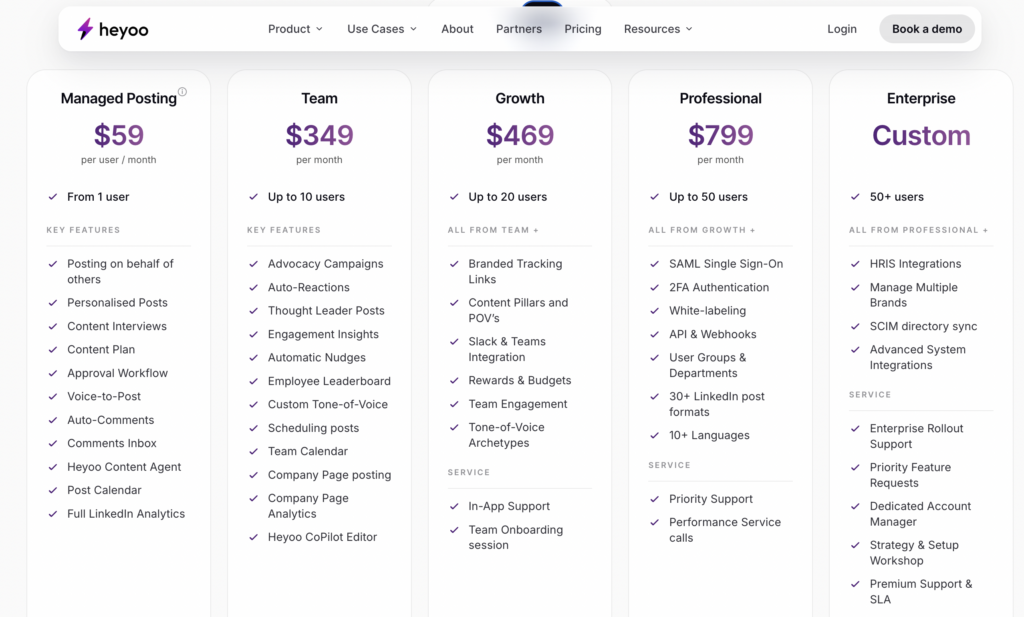
The second is per programme: a flat monthly fee covering strategy, editorial planning, tooling and reporting, with the number of participants capped by tier rather than billed individually. This is closer to how the underlying software is sold. The pricing published at heyoo.ai, for instance, is per workspace with a user ceiling per plan rather than per seat, which makes it straightforward to wrap into a fixed retainer without margin surprises when the client adds two more voices. The flat model also shifts the conversation from “how many people” to “what outcome”, which is where an agency wants it.
Whichever model you choose, keep one thing off the invoice: the client’s time. The single biggest cost in advocacy is not the agency’s hours but the fifteen minutes a week each participant spends reviewing and posting. Programmes fail when that time is treated as free. Build it into the onboarding, agree it with each participant’s manager, and put it in the monthly report as a KPI. A programme where eight out of ten voices post consistently is a success. One where the CEO posts brilliantly and the other nine went silent after week three is a ghostwriting engagement with extra steps.
Where agencies get it wrong
The common failure is treating advocacy as distribution for company content. When every employee post is a rewrite of the same product announcement, the network notices and the reach advantage evaporates within weeks. The programmes that hold up are the ones where each voice has a genuine point of view and the company message appears in maybe one post in five. That requires the agency to give up some control, which is uncomfortable for teams used to owning every word on the page.
The second failure is starting with the wrong people. Founders and executives get the most reach per post, but they are also the hardest to keep consistent. The programmes that build momentum usually start with the people who are already posting occasionally and enjoy it, prove the numbers with them, and then bring leadership in once there is something to point at. It is the same logic agencies apply when they build their own founders’ personal brands: consistency beats seniority.
The third is skipping the analytics layer to keep the retainer cheap. Without per-person reporting the agency cannot prove the value, cannot coach the weaker voices and cannot defend the budget. It is the one component that should never be cut.
Employee advocacy is not going to replace paid LinkedIn or the company page in most client mixes. What it does is give the agency a service line that is difficult for a client to take in-house, produces the kind of reach numbers that make the rest of the retainer look good, and gets stronger every month the programme runs. For agencies watching organic page reach fall for a third consecutive year, that is a rare combination.