


















Top Conversational AI Trends and the Future Ahead in 2027
Have you ever asked a chatbot a query and received the response “Sorry, I didn’t understand that”?
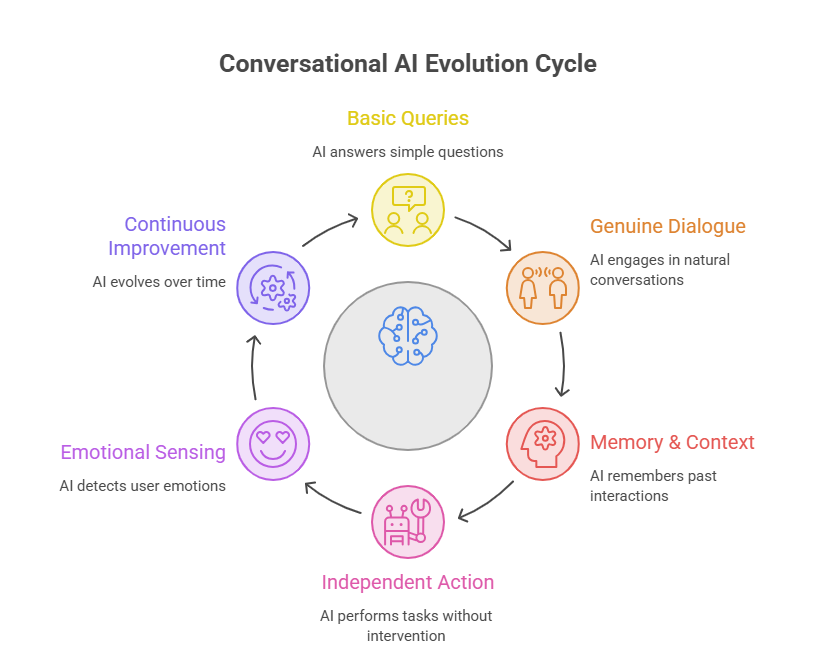
That was the entire experience not too long ago. A chatbot was a little box on a website that could answer three or four basic queries before directing you to contact customer service. Most of that version is no longer available.
What has taken its place feels more like a colleague than a script. It has a genuine dialogue, remembers what you said the previous week, acts independently within corporate systems, and frequently senses your annoyance before you even speak. It is capable of speaking, listening, acting, and following up without human intervention.
This change took time to complete and is still ongoing. As 2027 approaches, the majority of companies no longer ask “should we try conversational AI?” Where it belongs and how much freedom they’re willing to grant it are now the true questions.
This is where conversational AI stands today and where it appears to be heading.
Self- Generated
Trend 1: Chatbots Are Becoming AI Agents That Take Action
A chatbot’s sole purpose for years was to respond to inquiries. You entered something, and it matched keywords. The experience is familiar to anyone who has used one.
That era is fading. Newer systems don’t just answer, they act. People call this agentic AI, and it’s the biggest change happening in this space right now. If you’re curious how far this has come, this guide on the best AI agents for digital marketing breaks down what these tools can do today.
Say a customer asks about a refund. An old chatbot would say, “Your refund is being processed,” and stop there. A modern system can:
- Pull up the order in a CRM
- Check it against the refund policy
- Process the refund
- Update the customer’s account
- Send a confirmation
- Log the whole thing for later
The chatbot stops being the end product here. It’s more like a front door into something bigger, connecting what the customer wants directly to the systems and steps that make it happen.
That’s not all good news, though. A good number of agentic AI projects are expected to get dropped before they’re finished, usually for the same few reasons:
- Costs that grow once the system is live
- Payoff that’s hard to prove
- Risk checks that weren’t planned early enough
Agentic AI works best when it’s kept small, and someone is watching it. It fails when a company adds it in a hurry and hopes for the best, which happens more than people expect.
| What to watch in 2027: Fewer big “fully autonomous AI agent” announcements, and more companies building small and well-managed agents that do one job well. |
Self- Generated
Trend 2: Voice AI Becomes the Default
Even though voice has recently taken center stage, and not just because Alexa and other assistants have grown more intelligent, text messaging is here to stay.
Something different is happening at the network level. Instead of living inside one app, voice AI is now being built straight into the phone network by telecom companies:
- Deutsche Telekom integrated an AI layer to its voice network the Magenta AI Call Assistant to provide live translation, call summaries, and contextual assistance during routine phone calls.
- In Seoul, LG Uplus introduced a network-level AI agent called ixi-O that detects spam calls, flags voice phishing attempts, and uses Anti-Deep Voice technology to distinguish AI-manipulated voices from real ones.
Why does this matter? It changes where the AI lives. It’s no longer stuck inside one app; it’s becoming a part of the call itself, no matter which app you’re using.
The tooling has kept pace with that shift. Platforms like Murf, an AI voice platform offering text-to-speech, AI voice agents, conversational AI, and voice APIs, make it practical to drop a voice layer into an existing call flow rather than building one from scratch.
Voice AI minimizes support costs by reducing the need for large agent teams, shortens resolution time, and scales instantly during peak demand without adding headcount.
| What to anticipate in 2027: Voice agents that act before you ask, summarizing a call, translating on the fly, or pulling up information mid-conversation without being told to. |
Trend 3: Text, Voice, and Video Merge Into One Conversation
Conversational AI used to force a choice. You typed or you talked, never both, and video wasn’t a part of it at all. Fortunately, that’s changing fast.
Systems built to handle text, images, video, and audio together are quickly becoming normal. That kind of system notices things a single-channel one can’t, like someone saying “I’m fine” in a tone that says the opposite.
The market data backs this up, too: the global multimodal AI market was valued at close to $3.85 billion in 2026, growing at 28.59% CAGR over 2026-2031
Here’s a quick look at how the shift compares:
| Capability | Traditional Chatbot | Multimodal Conversational AI |
| Input types | Text only | Text, voice, image, video |
| Understanding | Keyword matching | Context, tone, emotional cues |
| Memory | Session-only, if any | Long-term, across conversations |
| Action-taking | Scripted replies only | Executes tasks across systems |
| Typical use | Simple FAQs | Full customer or employee support |
The video has been the slowest part of this to arrive. Most video AI didn’t perform well outside of the lab for a while, but this is beginning to change as tools become ready for practical application.
Expect video-based agents (imagine AI-run training sessions or virtual consultations) to appear in products rather than just demos if that continues.
| What you’ll likely see in 2027: Fewer separate chat or voice tools, and more single conversations that blend text, voice, and video depending on what’s needed. |
Trend 4: AI Learns to Read Emotions, Not Just Words
One shift that doesn’t get enough attention is how advanced these systems have become at reading emotion instead of just words.
Voice systems can now pick up on things like:
- Frustration is building during a call
- Urgency in how someone is speaking
- Real satisfaction once an issue is fixed
This level of awareness has reduced the number of people who are bounced between multiple human agents and a bot before a problem is resolved.
At this point, conversational AI begins to feel more like it is listening than it is a tool. When a technology detects that you are under stress and either softens its tone or gently connects you to a human without your repeated request, it is addressing a real problem.
| Looking ahead to 2027: Emotional cues will feed straight into routing, so a frustrated customer gets sent to a human agent automatically without asking. |
Trend 5: Conversational AI Becomes a Decision-Making Partner
The first wave of business chatbots handled easy things: hours, pricing, and order status. The wave we’re in now is aiming higher by helping people make decisions.
Companies are now building conversational systems that:
- Pull together evidence from several documents and data sources
- Weigh conflicting information instead of ignoring it
- Give a decision-ready summary instead of a plain answer
- Instead of making a confident guess, point out their areas of uncertainty
Although the job seems tiny, it is actually pretty big. An AI-generated summary must be reliable, not merely confident-sounding, if a company is to act on it.
This shift is also changing how businesses evaluate and use generative AI tools, as the focus moves beyond content generation toward systems that can interpret information, support decisions, and work within broader business processes.
Additionally, there is a more subtle change occurring here: conversational systems are transitioning from tools that wait for a question to ones that initiate a conversation and identify an issue before anybody notices it.
| By 2027, expect to see: Conversational systems that speak up on their own, pointing out a decision or a risk before anyone thinks to ask. |
Trend 6: Human Oversight Becomes a Core Part of AI Design
Real guardrails, not merely a disclaimer at the bottom of a chat window, are a common characteristic among businesses managing this effectively.
The system’s freedom must remain constrained even when agentic AI manages multi-step operations independently, such as creating a case, retrieving context, writing a response, requesting approval, modifying records, and documenting the outcome. Any high-stakes situation requires human oversight. That usually comes down to a few simple things:
- Clear rules on what the AI can and can’t touch
- Audit trails for everything it does
- Set points where a human has to sign off
Governance can’t be something added at the end of a project. It has to be built into the system from the start, or it doesn’t count for much.
This ties closely into how companies are rethinking their AI and cloud infrastructure for marketing, since the systems running underneath an AI agent matter just as much as the agent itself. This feels like a healthy correction after a stretch where “fully autonomous agent” was treated as a selling point on its own.
| What this could look like in 2027: Governance becoming a real trust signal, with companies using their audit trails and oversight as a selling point instead of just a compliance checkbox. |
Trend 7: Conversational AI Spreads Beyond Customer Service
Customer service is where conversational AI gained popularity. But the fastest growth is happening in a few others industries:
- Retail and commerce are ahead of nearly everyone else in how widely they use conversational AI
- Healthcare is one of the fastest-growing areas with more consumers turning to bots or voice agents for support, including checking symptoms, and not to just book appointments
- IT and enterprise operations are using conversational AI to close gaps and speed up how fast things get built
That said, customer service itself is still growing, with AI expected to handle a much bigger share of cases than it does now
That healthcare point is worth pausing on. When people turn to a bot to check symptoms instead of just scheduling an appointment, that’s no longer just a convenience. That’s a real front line for how people get support.
| What to watch in 2027: Healthcare, retail, and IT operations pulling further ahead of traditional customer service as the fastest-growing areas for conversational AI. |
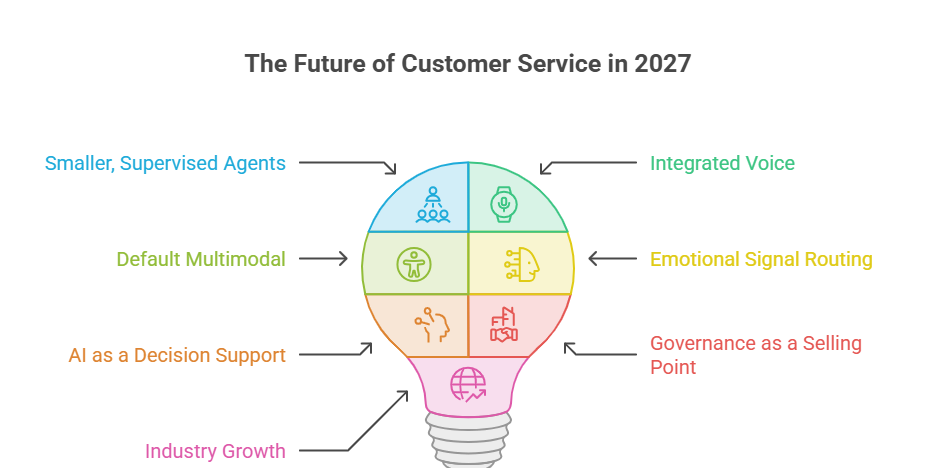
What 2027 Will Look Like
Self- Generated
When you combine everything, a few things become apparent:
- Agents get smaller and better supervised instead of flashier
- Voice becomes a part of the background, built into the call itself instead of a separate app
- Multimodal stops being a premium feature and becomes the default
- Emotional signals start feeding straight into routing decisions
- AI shifts from answering questions to helping weigh them
- Governance becomes a selling point of its own, since the companies that build in oversight are the ones people trust
- Healthcare, retail, and IT operations look set to grow faster than traditional customer service
Even the most capable conversational AI delivers little value if customers never find it. That’s why many organisations complement their AI initiatives with seo optimisation services to improve their visibility in search and make AI-powered support easier to access.
Prepare for the Next Era of Conversational AI
Conversational AI probably won’t feel like a smarter chatbot in 2027. It’ll feel like a working part of a business itself, handling real tasks, picking up on tone, moving across voice and video, and hopefully with enough human oversight that people can trust it.
The companies that automate the most will be responsible for creating conversation starters, automating the necessary tasks, and informing someone when it matters.
It’s already stopped being a small feature bolted onto a website. By 2027, businesses won’t be able to ignore it because it is becoming a key factor in almost everything they do.