


















Are Standalone Classroom Apps Officially Dead According to the Latest EdTech Industry Trends?
Do you remember when digital classrooms first became popular? Students and teachers had to utilize a variety of apps each day. It was necessary to use one app to make flashcards, another app for attendance, another for exams, and a fourth one for submitting homework. It was a mess, and students were constantly losing their passwords.
Today, the world of edutech is quite different. Colleges and schools are cleaning their computer systems and removing sloppy software. They are looking to make use of fewer digital tools that can do more. This shift leaves a lot of people asking: Are standalone educational apps dead?
The most recent edtech industry trends reveal that these isolated applications are losing ground rapidly. Schools don’t need software that acts like an island. They need systems that can connect quickly. It doesn’t matter if a student is using an automated dashboard or seeking assistance from an experienced essay writers at EssayHub to write a difficult essay. They want an all-in-one, connected space instead of an array of unorganized tabs.
The Massive EdTech Market
To find out why one-off apps are fading away, we can examine the total expenditure schools allocate to technology. Recent research obtained from Fortune Business Insights shows that the global edtech market size was valued at 189.15 billion dollars in 2025. Experts predict that it will increase to 214.58 billion dollars in 2026 and reach a staggering 588.72 billion dollars by 2034.
Schools aren’t spending these vast sums on small, individual tools. Instead, the broader ed tech market is shifting toward all-in-one software. Large school districts require robust platforms that can keep student data secure, track progress easily, and reduce costs by consolidating features. Today, technology buyers are looking for software packages that can handle classes, student scores, and data reports all in one location.
Why Single Classroom Apps Are Fading
This shift isn’t just about big budgets. It is also about solving daily classroom frustrations. When we examine the market trends education managers are focusing on, one-off tools suffer from three main issues:
- Extra teacher work. If an app doesn’t connect to the school’s main computer system, teachers must manually copy and paste their grades.
- Privacy risks. Using dozens of small programs makes it difficult to ensure that students’ private information remains secure.
- Too many bills. Schools are fed up with paying monthly fees to various tech companies.
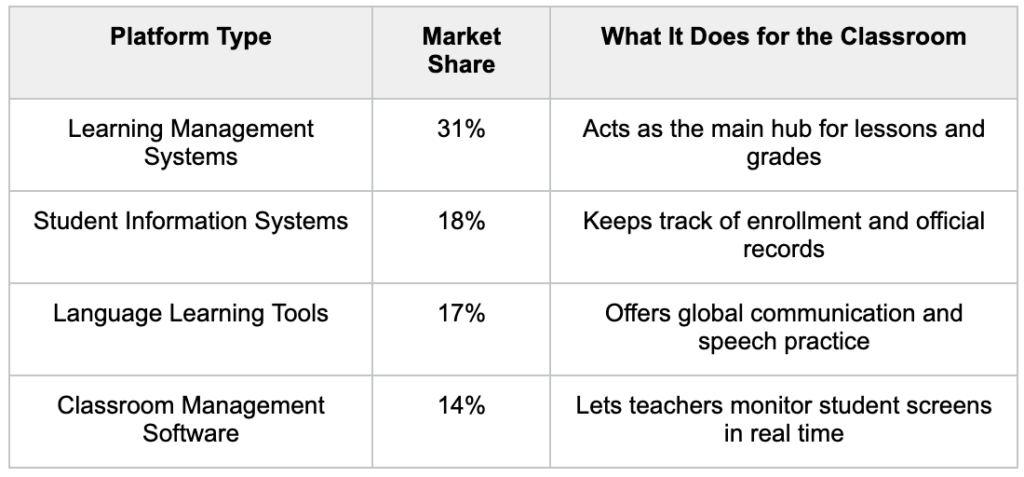
According to recent educational technology insights, Learning Management Systems (LMS) currently hold around 31 percent of the total market share in the edtech industry. This means that large, central hubs have won the fight for screen time in the classroom.
At the same time, cloud-based software accounts for approximately 64 percent of the overall market. Cloud-based systems allow school administrators to update their software and check student grades immediately across entire school districts. Simple, standalone applications can’t beat that speed. Teachers like this arrangement because they only need to master one program instead of the ten they had to use before.
The Rise of Large Platforms
Instead of relying on disconnected tools, modern classrooms are based on massive platforms. Tech companies from the big leagues are developing new features for their software to ensure that schools don’t have to buy additional applications.
If a platform is in need of a new feature, like an AI study assistant, flashcard maker, or quick quiz maker, the company can develop it or purchase an existing smaller business that has it. This blending of tools is a major trend. For example, prominent learning hubs such as Coursera and Udemy joined forces in May 2026 to form one massive online school.
Beyond easing the burden on educators, this change enhances students’ experience. When each digital tool is connected flawlessly, students don’t have to waste time switching between systems and are able to concentrate on their work. As AI continues to transform the classroom, the need for a unified system is crucial. AI is most effective when it has access to an entire set of data and not just a few isolated data silos.
To determine exactly where schools are spending their funds, take a look at how different areas of the edtech market trends are split today:
To Change or To Disappear
While standalone apps for simple purposes are dead as independent businesses, their features live on. The future belongs to tiny micro-apps designed to connect directly into massive learning platforms.
The current trends in the digital space give a clear picture. The days of forcing teachers to use ten different applications are gone. In order to succeed in the world of digital learning, software must be secure, easy to use, and built to integrate with major platform ecosystems effortlessly.