















The Next Era of AI-Powered Digital Services: From Automation to Intelligent Workflows
Most organizations already use automation to move work through individual tools. Yet requests still stall between systems, exceptions end up in inboxes, and people spend time reconnecting steps that were supposed to run automatically. The result can look efficient inside each application while the wider process remains fragmented.
That gap raises a more useful question than whether a bot can complete another task. What actually changes when AI-powered digital services move from isolated automation to workflow orchestration? Understanding the shift means looking beyond a single interface or model and examining how agents, data plumbing, and human oversight fit together across the full course of work.
Where Task Automation Stops and Workflows Begin
Task automation follows a fixed rule inside one application; intelligent workflow orchestration carries a process across systems, uses context to choose the next step, and routes exceptions to people. That distinction marks the next era of AI-powered digital services. Instead of merely copying a field or sending an email, a workflow can read a request, retrieve a customer record, assess its meaning, and decide where it belongs.
The practical test is simple: if an unexpected file format or missing value stops the process, it is automation rather than orchestration. Machine learning and generative AI are making the latter more practical, while established automation and personalization strategies provide the starting point.
Adoption has also moved beyond experimentation. Stanford’s AI Index found that 78% of organizations reported using AI in 2024, up from 55% the previous year, putting cross-system coordination firmly on the agenda.
How AI Agents Carry Work Across Systems
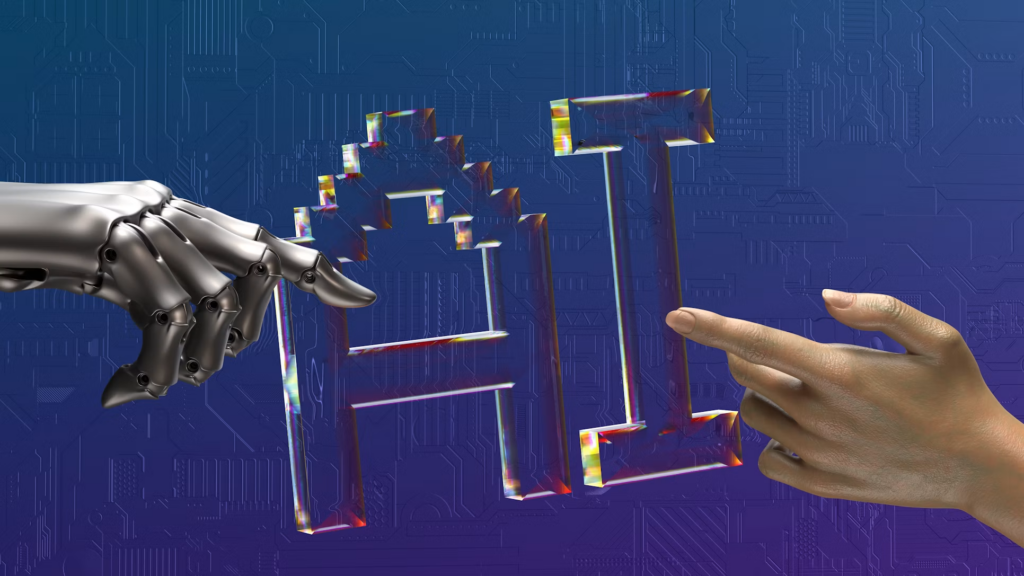
An AI agent is the unit that executes work inside an orchestrated process. Unlike a bot following a script, it holds a goal, selects from permitted tools, and retries or reroutes a task when the expected path fails. The workflow defines its boundaries; the agent handles the movement within them.
Deciding, Handing Off and Escalating to People
A realistic run might begin with an agent reading a service request, pulling the account history from Salesforce, checking inventory or eligibility in a second system, and using generative AI to draft a response. It then stops at an approval gate if the refund, claim, or account change exceeds its authority.
That stopping point matters more than maximum autonomy. Durable workflows state which decisions an agent can make, which require human review, and which must move into a system such as ServiceNow for investigation.
People do not disappear from the process. Their work shifts from transferring information and executing routine steps to reviewing exceptions, refining instructions, and owning the operational result. Roles tied to judgment, accountability, and process design remain central because the agent cannot define its own acceptable risk.
Matching the Right Model to Each Workflow Step
Workflow orchestration and model selection are separate design decisions, giving teams the flexibility to match each step with the capabilities it needs. A single process can use an advanced reasoning model such as ZenMux GPT-6 Astra for complex or ambiguous decisions, a specialized classifier for high-volume routing, and a vision model for document intake.
This approach lets each model contribute where its capabilities are most valuable. Advanced reasoning models can handle nuanced decisions and complex requests, while specialized models can support focused, repeatable tasks. Combining these capabilities creates workflows that are flexible, precise, and well suited to different types of work.
For example, a workflow could use an OpenAI GPT endpoint to interpret an unusual request, a domain-specific model to verify terminology, and deterministic rules to enforce an approval threshold. ChatGPT-style interaction is only one interface; the broader opportunity lies in combining different AI capabilities so each step receives the appropriate level of intelligence while maintaining clear, real-time visibility into how the workflow operates.
The Data and Governance Work Nobody Skips
Agents cannot coordinate systems they cannot reliably read from or write to. As a result, integration debt, data quality, and governance decisions shape the workflow before questions about autonomy or model sophistication become relevant.
Silos, Unstructured Records and Live Pipelines
Much of the context needed for data-driven decision-making sits outside clean database fields. Contracts, support tickets, scanned forms, and call transcripts require document extraction and retrieval before an agent can use them. If a customer identifier differs between systems, even an accurate model can update the wrong record.
Timing creates another failure mode. Predictive analytics based on a nightly batch load can recommend an item that has already sold out or assess eligibility using an outdated account status.
Workflows that act during a live event need event-driven pipelines that pass current changes to the relevant system. Microsoft and IBM both support integration-heavy enterprise environments, but no platform removes the need to define authoritative records, access permissions, and write-back behavior.
Audit Trails, Bias and Data Sovereignty
Every autonomous step needs a record of what the agent saw, which tools it called, what it chose, and which model version produced the output. Without that trail, a team cannot reconstruct an incorrect decision or tell whether the failure came from data, instructions, integration logic, or the model.
Bias review must also cover the whole workflow. A neutral-looking model card does not address a screening process that excludes applicants because an earlier extraction step consistently misreads particular documents. Data governance therefore applies to inputs, routing rules, outputs, and human overrides.
Architecture can be settled by residency requirements before capability enters the discussion. Regulated or sensitive records may require private-cloud or on-premises deployment, limiting which endpoints an agent can call and where its logs can be stored.
What This Looks Like Once It Is Running
The mechanics become clearer when attached to recognizable work. Across industries, intelligent workflows replace disconnected queues with one managed run while keeping people at the points where judgment, regulation, or financial authority requires them.
Intelligent Workflows Across Four Industries
In customer operations, one workflow receives a request, classifies it, retrieves account context, drafts a resolution, and sends only defined exceptions for approval. That replaces four queues without removing oversight.
In financial services, document extraction can feed underwriting or claims checks, while incomplete or conflicting cases move to an adjuster. Healthcare and back-office workflows follow a similar pattern: prior authorization, coding, and reconciliation cross several systems but retain mandatory sign-off.
Retail and media connect personalization to live operational signals. The recommendation patterns normalized by Amazon and Netflix now extend beyond content selection, allowing recommendation and inventory systems to respond to the same event rather than working from separate data snapshots.
What Companies Actually Buy to Build Them
The market for AI-powered digital services divides into four practical categories: cloud AI platforms, orchestration and workflow layers, vertical or fine-tuned models, and private deployment infrastructure for regulated data. Microsoft, Salesforce, and other enterprise providers cover parts of this stack, but the categories should not be treated as interchangeable.
The right purchase depends on the missing layer. A company with models but no cross-system control needs orchestration, while one with strict residency rules needs an approved deployment architecture first.
AI agency service models also differ according to whether the provider supplies strategy, integrations, model customization, or ongoing workflow operation.
Sequencing a Rollout and Measuring the Gains
A sensible rollout starts with one process that already has a measurable cycle time. The team instruments its current steps, records the human baseline, automates predictable actions, and only then gives an agent responsibility for coordinating them.
Success is measured through cycle time, exception rate, accuracy against that baseline, and cost per completed case. Model scores and deployed seats do not show whether enterprise AI adoption has improved the process itself.
The Shift Worth Preparing For Now
The next era will not be defined by adding more capable tools to an already fragmented stack. It will be defined by intelligent workflows that move work from intake to completion, call the right systems and models along the way, and return control to people at explicit boundaries.
Readiness is mostly organizational. AI-powered digital services depend on clean data access, clear escalation rules, accountable process owners, and a metric that reflects completed work rather than technical activity.
That does not require a platform-wide rebuild. One instrumented process offers a better starting point because it exposes the data gaps, governance constraints, and exception patterns that broader orchestration must eventually handle.