
















Top Nintendo Marketing Campaigns: How Japan’s Giant Sells Experiences
What makes someone buy a gaming console? A faster processor? Better graphics? More impressive technical specifications? Or the simple thought of playing Mario Kart with friends on a Friday night?
If we look at the most memorable Nintendo marketing campaigns… While the gaming industry loves comparing processing power, frame rates, and technical capabilities, Nintendo has spent decades making a different kind of argument: gaming should be fun, approachable, and worth sharing with other people.
Think about the original Wii commercials. Two men knocking on doors and inviting complete strangers to play video games. Or the Nintendo Switch launch video, where gaming moves from a living room to an airplane, a rooftop gathering, and practically anywhere else. There’s very little technical explanation involved. You’re watching people having a good time, and the product suddenly makes sense.
And the numbers give us a reason to examine that approach more closely. According to Nintendo’s official hardware sales data, the original Wii sold 101.63 million units worldwide, while Nintendo Switch reached 156.59 million units as of June 30, 2026.
Of course, those figures don’t prove that advertising caused the sales. Game quality, pricing, distribution, competition, and timing all played important roles. Still, they make Nintendo’s approach to building demand an interesting subject for anyone working in marketing.
What makes the company’s strategy even more fascinating is how far its characters have traveled beyond consoles. Mario appears in movies, theme parks, merchandise, and retail experiences. Nintendo Direct turns product announcements into recurring entertainment. Meanwhile, properties such as Animal Crossing create communities where players generate an extraordinary amount of conversation themselves.
So, what can marketers, agencies, and brands learn from all this? Let’s take a closer look at Nintendo’s marketing strategy, the advertising campaigns behind its most recognizable products, and the decisions that make its approach to branding so distinctive.
Inside Nintendo Marketing Campaigns
How Nintendo Approaches Marketing and Advertising
Nintendo’s approach to marketing makes more sense once we stop thinking of it as a console manufacturer and start thinking of it as an entertainment company.
Sure, it develops hardware, publishes games, and competes in the same broader industry as PlayStation and Xbox. But its strongest marketing advantage is the relationship people have with its experiences. Nintendo can introduce a new console through familiar characters, present unfamiliar gameplay using everyday situations, and reconnect with people who haven’t bought a video game in years.
That thinking isn’t just something marketers have projected onto the brand. In its 2015 corporate management briefing, Nintendo described expanding the gaming population as a central business objective. Its leadership explained that bringing characters into mobile experiences, merchandise, visual entertainment, and theme parks could introduce more people to Nintendo’s gaming platforms.
In other words, the console is at the center of the business, but it doesn’t have to be the first place someone meets the brand.
Selling Play (Not Technical Specifications at All!)
One of the most recognizable aspects of Nintendo advertising strategy is how quickly its communications answer a basic consumer question: What am I going to do with this?
The Wii Remote is a useful example. A technically detailed advertisement could explain motion sensors and wireless controls. Nintendo instead showed people swinging the controller like a tennis racket, pretending to bowl, and reacting to whatever happened on-screen. You understood the product before anyone needed to describe the technology.
The Nintendo Switch followed a similar principle. Its big selling point was a hybrid design, but the advertising translated that hardware capability into freedom. You could begin playing on a television, take the console out of its dock, and continue the experience elsewhere.
At that point, we need to remind you that Nintendo doesn’t ignore specifications completely. The Switch 2 launch, for example, introduced improved graphical capabilities, a larger display, redesigned controllers, and new communication features. But the underlying marketing still connects those improvements to what players can actually enjoy.
So, a product demonstration needs to communicate how something works, but effective advertising also gives customers a reason to care. A higher resolution is a specification. Seeing your favorite game come alive on a bigger screen is a benefit. Sharing that experience with someone sitting next to you is a story. Nintendo frequently manages to show all three without turning an advertisement into a technical presentation at the end of the day.
Marketing to Families, Children and Adult Fans at Once
Take a look at Nintendo’s games and you’ll notice something interesting: The same franchise can appeal to people at completely different stages of life.
A child might discover Mario through their first platform game, a parent might remember playing Super Mario Bros. decades earlier. Or an adult fan could be interested in collecting limited-edition hardware, exploring a new Zelda title, or spending hundreds of hours creating an Animal Crossing island. So, Nintendo can connect with all those audiences without reinventing its identity for each one.
The ESA’s 2025 report found that 60% of US adults play video games every week, that the average player is 36, and that 70% of parents play, with 82% of those parents playing alongside their kids. Globally, the ESA’s survey puts the average player at 41, with 49% of players aged 25 to 44.
That spread is the Nintendo target audience problem in a sentence: a six-year-old, her thirty-something parent and a grandparent can all be in the same room. Nintendo’s answer is to lead with characters and shared play that work at every age, rather than building a separate campaign for each segment. The second Mario film’s opening, which drew plenty of adults with disposable income as well as families is that principle in action.
What keeps the advertising recognizable is the idea that Nintendo experiences can fit into many kinds of lives. That gives Nintendo an advantage in audience segmentation. Its family-oriented messaging establishes accessibility and reassurance. Its franchise announcements build anticipation among dedicated players. Nostalgia reconnects with older audiences, while new games introduce familiar characters to younger consumers.
And because Nintendo’s characters are recognizable across generations, the marketing can move between these groups without making the brand feel disconnected.
There’s also a lesson here about family advertising. Nintendo frequently shows families doing something together, instead of positioning children as the only users and parents as the people responsible for paying.
Owned Media as the Primary Announcement Channel
Another major part of Nintendo marketing is its investment in channels it can operate directly.
Nintendo Direct is the clearest example; the gaming giant uses its own video format to announce games, demonstrate products, and communicate with fans.
The format began in 2011 and developed into a recurring destination for game announcements. In a financial briefing, Nintendo reported that some Nintendo Direct presentations had attracted approximately 500,000 to 600,000 views through the Nintendo eShop within around ten days, even when corresponding YouTube views showed less obvious growth.
That’s a useful detail since it demonstrates Nintendo was developing different ways for interested players to encounter product information directly. Today, Nintendo Direct serves multiple purposes: product launches, franchise announcements, software demonstrations, community engagement, and traffic generation for its digital storefronts. From a marketing perspective, it also gives Nintendo something every brand wants: an audience that actively looks forward to hearing from it.
On the other hand, news publishers, creators, and fans still extend the reach of every announcement. Nintendo controls the first presentation, then gives the wider community material to discuss.
Best Nintendo Marketing Campaigns
Before jumping into the campaigns, here’s how we selected them.
We haven’t simply picked the best video game marketing campaigns or the products with the biggest sales figures. The goal is to examine Nintendo marketing campaigns that demonstrate different strategic approaches and offer something useful for brands and agencies outside gaming.
Our selection follows four criteria:
- A recognizable marketing objective: Each example addresses a specific challenge, such as attracting non-gamers, introducing unfamiliar hardware, sustaining franchise engagement, or expanding brand reach.
- A distinctive creative or channel strategy: The campaign has an identifiable idea behind its execution.
- Verifiable evidence: We prioritize official announcements, Nintendo sales data, and identifiable campaign videos. We don’t treat overall product sales as proof of advertising ROI.
- Transferable lessons: Each case offers an insight marketers can apply to positioning, launch campaigns, owned media, community development, or brand partnerships.
Let’s get into the campaigns.
Wii Would Like to Play Campaign
The Wii Would Like to Play campaign is a television-led, experiential advertising campaign built around introducing video games to people who might not ordinarily consider themselves gamers.
Launched in 2006, it takes a wonderfully simple approach. Two Japanese men arrive at different American homes, introduce the Wii, and invite the people inside to play. The scenes focus on people interacting with the controller, discovering motion-based gameplay, and enjoying themselves. There are no complicated explanations, aggressive competitive claims, or attempts to make the console look intimidating. The invitation is the advertising idea.
The campaign aims to expand the gaming audience beyond dedicated players. Families, older adults, casual consumers, and people who previously found gaming complicated become central to the message.
Nintendo makes the Wii feel like an approachable guest. Gameplay demonstrations become the storytelling device, while the visitors provide continuity across different households.
Why It Worked
The Nintendo ad gave viewers permission to participate without needing years of gaming experience. The decision to feature ordinary households also helped reposition gaming as a social activity. Viewers saw how the Wii could fit into gatherings they already understood, which made the purchase feel relevant beyond traditional entertainment setups. Nintendo’s overall commercial success supported the importance of that positioning. The Wii eventually reached 101.63 million worldwide hardware sales, according to Nintendo’s official figures.
Nintendo Switch Launch and My Way Campaigns
The Nintendo Switch marketing campaign is a product-launch and lifestyle advertising strategy that transforms hardware flexibility into a promise of personal freedom. A player removes the console from its dock and continues gaming outside. Friends share controllers. Groups gather around portable screens. The same device moves between private entertainment and social experiences.
But the launch advertising is interesting because it doesn’t rely heavily on explaining that design. It simply demonstrates the freedom the design creates. Nintendo needs to introduce an unfamiliar hybrid gaming system and explain its value immediately. The campaign targets established players alongside adults, friends, families, and people whose lifestyles don’t fit traditional console gaming.
Why It Worked
The Switch launch communicated a complicated product concept through one memorable action: moving the console from the television to handheld play. That demonstration made the hardware difference immediately understandable. More importantly, the surrounding lifestyle scenes connected the feature to situations the audience wanted to experience.
The My Way executions subsequently helped extend the proposition beyond launch. Instead of treating flexibility as an introductory product feature, Nintendo made it part of the console’s identity. The advertising also allowed different titles to support the same overarching brand message. Competitive games, creative games, and group experiences all demonstrated new reasons to use the device.
Nintendo’s reported lifetime Switch sales reached 156.59 million units as of June 30, 2026, according to its official hardware sales data.
Nintendo Direct as a Recurring Campaign Format
Nintendo Direct is an owned-media & video-led product announcement format that turns brand communications into recurring programming. Unlike a TV ad, its primary objective isn’t to communicate a single proposition in thirty seconds. Actually, it creates an environment where Nintendo can announce products, explain gameplay, showcase developers, and build anticipation around future releases.
Its target audience includes existing Nintendo customers, gaming enthusiasts, potential buyers, publishers, creators, and journalists. The format serves different groups simultaneously, but the content remains centered on new entertainment experiences. On the other hand,the creative idea is deceptively straightforward: speak directly to the audience through a recognizable Nintendo presentation.
Over time, the format has expanded into general Nintendo Direct broadcasts, game-specific presentations, partner showcases, and other focused events.
Why It Worked
The company gained greater control over the order, timing, and presentation of its announcements. Individual product reveals were also able to benefit from the attention generated by the wider broadcast. Crucially, Nintendo didn’t have to create a completely new distribution experience for every major announcement. The format provided continuity, while the games supplied fresh reasons to watch.
Nintendo also connected product discovery with its digital shopping environment. As early as 2012, the company explained that Nintendo Direct could lead viewers toward downloadable videos and playable demos in the Nintendo eShop.
Animal Crossing New Horizons Launch Campaign
Here is a community-oriented game campaign that presents virtual island life as a relaxing, creative escape.
The creative approach is noticeably different from the high-energy gaming advertising; Nintendo emphasizes decorating, fishing, making friends, building a home, and exploring an island at your own pace. It doesn’t position the game around defeating an enemy or reaching the highest competitive rank, but, it gives people a place to call their own.
Campaign objective and target audience: Nintendo seeks to introduce a new installment to existing Animal Crossing fans while making the series approachable for players interested in creativity, relaxation, and social experiences.
Why It Worked
New Horizons launched in March 2020, as COVID-19 restrictions were transforming everyday life in many countries. The game’s emphasis on routine, creativity, social connection, and peaceful exploration became especially meaningful during a period when many people were spending more time at home.
The campaign also gave players a natural reason to share content. Every customized island, decorated room, and personal achievement became an opportunity for conversation.
According to Nintendo’s official software sales data, Animal Crossing: New Horizons reached 50.29 million worldwide sales as of June 30, 2026. Those sales reflect several years of demand, content updates, and platform development.
The Super Mario Bros. Movie Marketing Campaign
The Super Mario Bros. Movie marketing campaign is a cross-media entertainment launch that uses one of gaming’s most recognizable franchises to connect with moviegoers. Its objective is bigger than promoting a new Mario product. The campaign needs to convince established fans that an animated movie can deliver an authentic Mario experience, while introducing the characters to audiences who may have limited experience with Nintendo games.
The project is developed with Illumination and distributed by Universal Pictures, bringing Nintendo’s existing intellectual property into the theatrical entertainment market. The recognizable music, visual details, and franchise references provide reassurance for longtime fans. For newcomers, the trailers offer an accessible adventure without requiring previous knowledge of the games.
Nintendo Direct also becomes part of the distribution strategy, demonstrating how its existing announcement infrastructure can support entertainment outside gaming.
Here is the trailer of the movie watched more than 35 million times just on YouTube:
Why It Worked
Longtime players recognized locations, characters, and references from their gaming experiences. Younger audiences encountered an animated adventure with recognizable personalities and visually engaging environments.
The collaboration with Illumination also gave Nintendo access to filmmaking, distribution, and movie-marketing capabilities developed specifically for theatrical entertainment. According to NBCUniversal’s March 2026 reporting, the 2023 film earned more than $1.3 billion at the worldwide box office.
The film’s commercial performance was influenced by many factors, including franchise popularity, distribution, audience reception, and the movie itself. Still, the campaign demonstrated how an established gaming property could compete for attention in a different entertainment category.
It also created an opportunity for Nintendo to deepen relationships with audiences beyond the original gaming purchase.
Nintendo Switch 2 Launch Communications
The Switch 2 rollout is a staged product launch strategy: tease, explain, let people touch it, then ship.
The Nintendo Switch 2 launch campaign is a phased product-launch strategy combining digital reveals, detailed product communications, software announcements, and hands-on demonstrations.
It is particularly interesting because Nintendo faces a different challenge from the original Switch launch.
The console launched on 5 June 2025, and Nintendo said it sold more than 3.5 million units in four days, “the highest global sales level for any Nintendo hardware within the first four days.” The original Switch took 29 days to reach 2.7 million. Switch 2 passed 10.36 million by 30 September 2025, ended the fiscal year to March 2026 at 19.86 million against a 19 million forecast.
Why It Worked
The first reveal established recognition and anticipation. The subsequent Direct introduced practical reasons to upgrade, while the hands-on events allowed players to experience those differences directly. Nintendo also avoided disconnecting the successor from the original Switch. The familiar form factor and compatibility messaging helped establish continuity, making the product feel like an evolution of an existing gaming experience.
Nintendo Museum and Experiential Brand Campaigns
The Nintendo Museum is a permanent experiential branding initiative that transforms the company’s history into an attraction visitors can explore firsthand. Located in Uji, Kyoto, the museum opened on October 2, 2024, according to Nintendo’s corporate history.
Its marketing objective is different from promoting an individual game. The museum gives longtime fans an opportunity to revisit Nintendo’s history and allows younger visitors to discover products and experiences that came before their own introduction to the brand.
The museum includes historical products alongside opportunities to interact with familiar gaming concepts in new ways. Nintendo introduces the attraction through a dedicated Museum Direct presentation hosted by Shigeru Miyamoto.
Why It Worked
The museum gave Nintendo’s history a physical presence, making its brand heritage something visitors could experience instead of simply read about. It also connected generations of products within a single narrative. Visitors who remembered earlier consoles encountered newer Nintendo experiences in the same setting, reinforcing the company’s identity across different eras.
Nintendo Brand Partnerships and Theme Park Collaborations
Let’s go on with another real-world experience: The SUPER NINTENDO WORLD collaboration with Universal is an experiential entertainment partnership that allows visitors to step into environments inspired by Nintendo games. The collaboration brings Nintendo’s characters and gaming identity together with Universal’s experience designing and operating theme park attractions.
The attraction translates recognizable gaming mechanics and environments into physical experiences, similar to Disneyland experience. Guests encounter familiar characters, explore themed locations, and participate in interactive activities.
The first SUPER NINTENDO WORLD opened at Universal Studios Japan in 2021. Later locations expanded the collaboration internationally. Nintendo and Universal have also introduced attractions connected to Donkey Kong.
Why It Worked
Nintendo brought recognizable characters, game environments, and established fan relationships. Universal brought theme park operations, physical storytelling, and experiential design. Together, they created an environment where the Nintendo brand could reach visitors who might not have been actively shopping for a gaming system.
The attractions gave fans opportunities to engage with the franchise outside the boundaries of a game. That expanded Nintendo’s presence from screens into travel, leisure, and shared family experiences.
Nintendo’s IP and Franchise Marketing
After examining the campaigns individually, a bigger pattern starts to emerge. Nintendo’s characters do the job that other brands hand to slogans. They are the campaign, the product and the long-term asset at once.
Turning Characters Into Long-Term Marketing Assets
Mario has appeared across multiple generations of hardware. The Legend of Zelda has introduced new worlds and gameplay mechanics while retaining recognizable franchise elements. Animal Crossing connects players through familiar characters and an established style of play.
As of September 2024, Mario Kart 8 Deluxe had sold 64.27 million copies and Animal Crossing: New Horizons 46.45 million, and Mario Kart World has since reached 14.70 million on Switch 2. The Super Mario Bros. 35th anniversary shows Nintendo nostalgia marketing at its sharpest. Nintendo released a Game & Watch for $49.99 in November 2020 and said it would ship only until around the end of March 2021, while Super Mario Bros. 35 stopped being playable on 31 March 2021. The deadline sparked a wave of jokes about Mario being retired.
So, nostalgia provides familiarity, but the most useful campaigns also offer something new. If Nintendo only recreated old experiences, the brand could become increasingly dependent on people who already knew its history.
Instead, each new game creates opportunities for younger audiences to build their own memories.
Licensing, Merchandise and Theme Parks
It helps to separate three things:
Licensing means a partner pays to use the characters. Merchandise is product Nintendo sells itself, such as the apparel and collectibles on its official stores. Co-marketing means both sides build a campaign or product together, and LEGO Super Mario, Super Nintendo World and the films all belong here. Theme parks matter beyond ticket sales because they put the characters into physical places that families visit together, which fits a brand built on shared play.
Not every Mario-branded product represents a joint advertising campaign. A licensed figurine might expand Nintendo’s retail presence. A coordinated entertainment launch, meanwhile, could involve original content, shared publicity, cross-channel promotion, and experiences designed around both organizations’ objectives. Nintendo’s own corporate strategy acknowledges the importance of expanding consumer contact with its intellectual property beyond consoles.
How Film and Media Expand the Audience
Film does something marketing for the gaming industry can’t: it reaches people who have never held a controller. The two Mario films together have passed $2 billion at the box office, and a third film is reportedly in development. The contrast with the 1993 flop is the real story for brands: the character didn’t change, but the control Nintendo held over how it appeared did.
Nintendo also announced the development of a live-action The Legend of Zelda film in November 2023, further illustrating its interest in visual storytelling. The broader opportunity is to make each entertainment format valuable on its own while preserving the connections between them. For brands considering licensing or media partnerships, that requires careful attention to how the property is represented. Expanding reach is useful, but compromising the qualities that made the brand recognizable can undermine the entire exercise.
Nintendo’s Digital and Social Media Marketing
Nintendo’s digital marketing approach combines controlled official communications with an enormous amount of activity generated by players. In that way, the company wants audiences to share their enjoyment, create content, and discuss games. At the same time, it places considerable importance on protecting its intellectual property and defining acceptable uses of its material.
Understanding that relationship is essential to evaluating Nintendo social media marketing.
Platform-Native Content and Short-Form Video
Nintendo doesn’t exactly struggle to find things to post on social media. With franchises like Super Mario, The Legend of Zelda, Animal Crossing, and Pokémon, the company has access to an enormous library of recognizable characters, gameplay moments, and nostalgic references. And it makes good use of them across its established social media accounts.
On YouTube, Nintendo publishes game trailers, Nintendo Direct presentations, gameplay demonstrations, and major product announcements. Its Instagram account brings those franchises into a more visual, easily digestible format, while X and Facebook support product news, release updates, and conversations around upcoming games. Together, these channels help Nintendo maintain visibility between major launches without depending entirely on paid advertising.
Nintendo has also invested in a more direct relationship with its audience through Nintendo Today!, a free mobile app launched in March 2025. The app delivers daily updates, videos, comics, and personalized content featuring Nintendo franchises. It’s another example of how the company prefers to build communication channels it can control.
But here’s something interesting: Nintendo’s presence on TikTok is surprisingly limited.
You’d imagine a brand with so many recognizable characters and shareable gaming moments would have a thriving official TikTok account. After all, Mario Kart reactions, Animal Crossing island tours, and nostalgic gaming clips sound like they were practically made for the platform.
Yet Nintendo has taken an unusual approach. In June 2026, the company had established verified TikTok accounts across several regions, including America, Europe, Spain, and Latin America, initially without publishing content. By July, that videos previously appearing on Nintendo’s official TikTok presence had disappeared, with no public explanation from the company at the time.
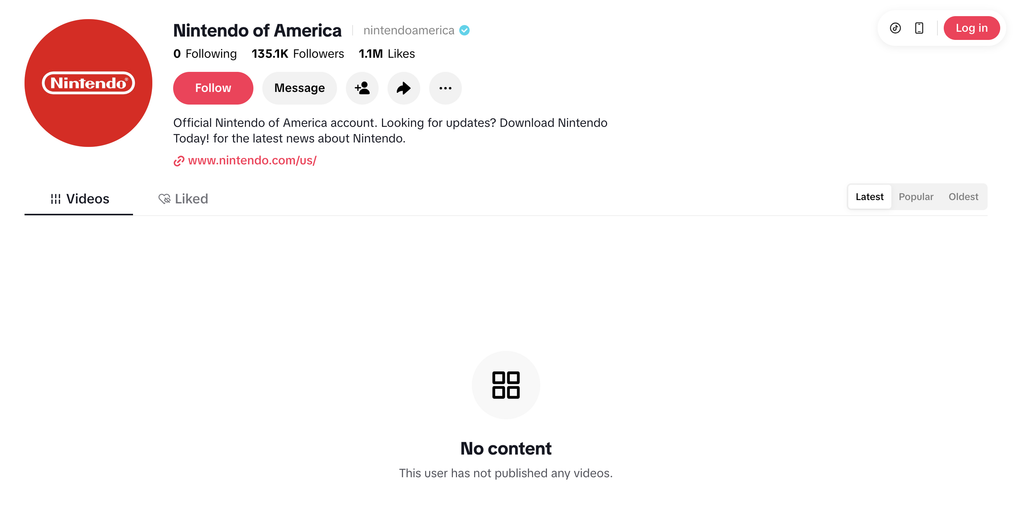
That doesn’t mean Nintendo is missing from TikTok altogether. Its games and characters appear in content created by fans, streamers, and gaming communities, from funny gameplay clips to nostalgic edits and reactions. Much of this visibility develops organically, without coming from Nintendo’s official accounts.
For marketers, this creates an interesting contrast. While entertainment marketing campaigns & brands often chase every emerging platform, Nintendo has invested heavily in YouTube, established social channels, and its own content ecosystem. Its recognizable franchises give fans plenty to discuss, even when Nintendo isn’t actively participating in every conversation.
Of course, there’s a trade-off. A limited official TikTok presence means fewer opportunities to experiment with platform-native trends, engage younger audiences directly, and shape conversations through original short-form content.
Still, Nintendo raises a question worth considering: Does your brand really need to be everywhere, or does it need to be exceptionally good at the channels where its audience already pays attention?
Creator and Streamer Relationships
Nintendo influencer marketing looks nothing like the paid-creator model many brands use. In November 2018 Nintendo closed its Creators Program and replaced it with open guidelines that don’t require signing up.
Under the guidelines, individuals can share gameplay with their own commentary on platforms such as YouTube, Twitch and Instagram, livestreams included, but they can’t sell content made with Nintendo material.
Creators are only permitted to use Nintendo Game Content that has been officially released, or from promotional materials officially released by Nintendo (such as product trailers or Nintendo Directs). Creators may monetize their videos and channels using the monetization methods separately specified by Nintendo. Other forms of monetization of Nintendo’s intellectual property for commercial purposes are not permitted.
The rules were updated again in September 2024, with a clause that lets Nintendo act against creators who post inappropriate content or leaks. Official trailers and Direct footage are fair game for creators, so Nintendo’s own broadcasts become a content supply for the whole creator ecosystem.
Community Events and Competitive Play
Nintendo’s games support different kinds of community participation. Competitive titles such as Super Smash Bros. and Splatoon encourage skill development and discussion around gameplay. Mario Kart creates opportunities for casual competition. Animal Crossing supports more creative forms of sharing and collaboration.
These differences matter when designing community marketing. A competition-focused campaign might emphasize players, tournaments, and memorable moments. A creative game benefits from showcasing customization and individual expression.
Nintendo’s official events and presentations provide structured opportunities for engagement, while independent communities create additional conversation. However, competitive activity also introduces legal, licensing, and organizational considerations. Brands developing community events around protected entertainment properties need to understand the applicable rules before building promotional programs.
Fan-Created Content and Brand Safety
Here’s where Nintendo’s community strategy becomes more complicated.
Nintendo supports certain forms of fan-created gaming content, but it operates under defined intellectual property guidelines. The guidelines we mentioned above encourage original commentary and creative input, identify permitted monetization arrangements, and place limits on unauthorized commercial activity. They also distinguish individual creators from corporate entities.
That creates both opportunities and limitations. Nintendo can benefit from the visibility generated by players who share their experiences. But its approach also means fan communities, creators, and brands must be careful about using protected material.
From a marketing perspective, this can introduce friction. Fan enthusiasm is a powerful promotional resource, but extensive control may discourage some kinds of experimentation.
Who Is Nintendo’s Target Audience?
The short answer to the Nintendo target audience question is everyone who plays, all at once. In practice, Nintendo’s marketing reaches four overlapping groups. Two data points frame the opportunity: 82% of US parents who play games play with their children, (according to theesa), and the global average player is 41 (according to GameDev Reports).
Let’s be more specific:
| Audience | Marketing Opportunity | Relevant Campaign Approach |
|---|---|---|
| Families with children | Shared play and accessible entertainment | Living-room advertising, family-focused demonstrations, and multiplayer experiences |
| Casual and first-time gamers | Ease of entry and intuitive gameplay | Wii-style demonstration-led campaigns and simple, benefit-focused creative |
| Adult long-time fans | Nostalgia, franchise loyalty, and collecting | Franchise revivals, anniversary communications, Nintendo Direct announcements, and special editions |
| Franchise and film audiences | Storytelling, characters, and entertainment beyond consoles | Cross-media promotion, film collaborations, merchandise, and theme park experiences |
These are strategic audience categories, not a demographic breakdown published by Nintendo. And that distinction is worth making. Someone might belong to several groups simultaneously. An adult Zelda enthusiast may also be a parent looking for a family-friendly multiplayer game. Nintendo’s marketing benefits from that overlap.
The company can introduce new experiences to existing customers without requiring them to abandon their previous interests. It can also bring new audiences into a franchise through movies, attractions, or games that match their preferences.
What Marketers Can Learn From Nintendo Advertising
Nintendo’s marketing approach contains lessons that reach well beyond gaming.
You don’t need a globally recognized character, a blockbuster movie, or a major console launch to apply them. The underlying principles are relevant to consumer technology, entertainment, retail, lifestyle brands, and even service businesses.
Let’s focus on four particularly useful ideas.
1. Build Owned Channels You Can Launch Products On
Nintendo Direct illustrates the value of cultivating an audience that returns for information from the brand itself. This requires more than creating a company YouTube channel or launching a newsletter. The content needs to give people a recognizable reason to come back.
For a consumer brand, that might mean a recurring product demonstration series. For a technology company, it could involve regular feature announcements and demonstrations. For an agency, it might be a recurring showcase of interesting campaigns and creative experiments. The format should become useful independently of any single launch. Once that happens, individual product announcements can benefit from the audience’s familiarity with the channel.
Nintendo also demonstrates why distribution still matters. Owned-media content gains additional reach when publishers, creators, and customers have something worth sharing. If you’re developing that kind of strategy, gaming marketing agencies can offer relevant experience in community engagement, launch communications, and entertainment-focused promotion.
2. Treat Characters and IP as Durable Brand Assets
Many brands approach campaigns as temporary creative projects. A new message is developed, assets are produced, media runs, and the company eventually moves to another concept. Nintendo demonstrates the advantages of building recognizable elements that can carry meaning across multiple campaigns.
Mario’s recognizable appearance, the visual identity of Animal Crossing, and familiar Nintendo gameplay environments make it easier to connect new products with existing audience memories.
Brands without fictional characters can apply the same thinking through distinctive visual assets, recurring creative formats, brand personalities, or recognizable product experiences. The goal is to build familiarity without making every campaign feel identical.
3. Use Nostalgia Without Limiting the Audience
Nostalgia is a valuable part of Nintendo’s brand identity, but its advertising rarely depends on memory alone.
The original Wii invited new people into gaming. The Switch introduced an unfamiliar way to play. Animal Crossing created new experiences around an established franchise. Even when Nintendo uses familiar characters, the strongest marketing gives audiences something to discover.
A useful approach is to include recognizable details for returning customers while ensuring the main proposition remains understandable to someone encountering the brand for the first time. For example, an anniversary campaign can celebrate a product’s history while demonstrating how its newest version solves present-day problems.
4. Show the Product Being Used, Not Explained
Perhaps the most transferable lesson from Nintendo advertising campaigns is the strength of demonstration-led creative.
The Wii campaign showed people swinging controllers. The Switch launch showed the console moving between environments. Nintendo’s Animal Crossing promotion showed players creating an island experience that reflected their personalities.
In each case, the demonstration communicated something meaningful before the audience needed a technical explanation.
That principle applies across industries. A productivity platform can demonstrate the moment a complicated task becomes easier. A travel brand can show what a destination feels like to experience. A consumer technology company can present how its product fits into someone’s daily routine.
This also has implications for creative production. Strong demonstration-led advertising needs thoughtful casting, direction, editing, and a clear understanding of the situations customers actually recognize. Working with experienced video production agencies can help translate product benefits into scenes that audiences understand immediately.
This is probably the most valuable question to take into your next creative meeting: If we removed the voiceover and technical copy, would people still understand why our product matters? Nintendo’s best advertising often makes the answer look remarkably simple.
And remember: Nintendo’s biggest marketing advantage isn’t a console
Nintendo’s advertising is interesting because so much of it begins with something that feels almost embarrassingly simple. People want to have fun. They want to play with friends, share experiences with family members, revisit memories, discover new worlds, and occasionally escape into an imaginary island where their biggest concern is how to decorate a living room.
Nintendo has built much of its marketing around making those experiences visible.
The Wii campaign invited people into gaming. The Switch launch showed how gaming could fit into different lifestyles. Nintendo Direct gave audiences an established place to discover what came next. Animal Crossing encouraged players to develop their own stories, while Mario’s expansion into film and theme parks introduced Nintendo characters through completely different forms of entertainment.
Not every campaign delivered the same kind of result, and no single advertising execution explains Nintendo’s commercial success. Product design, game development, distribution, audience relationships, and timing remain essential parts of the equation.
But the marketing connects those elements through a recognizable idea: Nintendo isn’t simply selling devices or software. It’s giving people reasons to play. And that leaves marketers with an interesting challenge. The next time you’re preparing a campaign, try looking beyond the feature list, the product specifications, and the usual collection of competitive claims. Ask yourself what people will actually remember doing with your product. Because years after a console’s processor becomes outdated, someone might still remember the first time they played Mario Kart with their family.
FAQ about Nintendo Marketing Campaigns
1. What is Nintendo’s marketing strategy?
Nintendo’s marketing strategy focuses on distinctive gaming experiences, accessible entertainment, established franchises, and long-term relationships with consumers. The company uses product advertising, Nintendo Direct, digital content, community engagement, merchandise, movies, and theme park experiences to introduce its entertainment properties to different audiences. Its broader brand strategy aims to expand the number of people who encounter Nintendo intellectual property while keeping gaming at the center of the business.
2. What are Nintendo’s most famous marketing campaigns?
Some of the most recognizable examples include the Wii Would Like to Play campaign, the Nintendo Switch launch campaign, the My Way commercials, and the promotional campaigns for Animal Crossing: New Horizons. Nintendo Direct is also important as a recurring communications format. More recent examples include the Nintendo Switch 2 launch and the Super Mario Bros. Movie promotional campaign. Each demonstrates a different part of Nintendo’s advertising strategy, from product positioning to franchise development.
3. What was the Wii Would Like to Play campaign?
The Wii Would Like to Play campaign was a series of television advertisements launched in 2006 to promote the Nintendo Wii. Its central creative idea featured two Japanese men visiting households and inviting people to try the console. The advertisements emphasized approachable, motion-controlled gaming and demonstrated how people of different ages could participate. The campaign is a particularly useful example of advertising designed to expand a product category beyond its traditional customers.
4. Who is Nintendo’s target audience?
Nintendo serves several overlapping audience groups, including families with children, casual gamers, dedicated gaming enthusiasts, and adults with longstanding connections to its franchises. It also reaches entertainment audiences through movies, merchandise, and attractions. The specific target audience changes depending on the product. A competitive game, family multiplayer title, and nostalgic franchise revival can serve very different customer motivations while remaining recognizable Nintendo experiences.
5. Why does Nintendo use Nintendo Direct instead of press events?
Nintendo Direct allows the company to deliver game announcements and product information directly to audiences through a format it controls. It gives Nintendo flexibility over presentation, timing, and distribution while making individual announcements accessible through digital channels. Importantly, Nintendo Direct does not eliminate press relations or physical events. The company also uses hands-on demonstrations and other promotional activities. Direct provides an additional channel for major announcements.
6. How did Nintendo market the Super Mario Bros. Movie?
Nintendo worked with Illumination and Universal Pictures to bring the Mario franchise to cinemas. The promotional approach used theatrical trailers, established characters, recognizable gaming references, digital video, and Nintendo’s own communications channels. The marketing connected existing Mario fans with broader moviegoing audiences, showing how a successful gaming franchise can expand into another entertainment format.
7. How does Nintendo use nostalgia in its advertising?
Nintendo uses recognizable characters, music, franchise histories, and visual elements to reconnect with people who have enjoyed its games previously. Its approach works best when those familiar details support a genuinely new entertainment experience. This allows Nintendo to appeal to adult fans while introducing established franchises to younger players.
8. What can brands learn from Nintendo’s marketing?
Nintendo provides four particularly valuable lessons: create distinctive customer experiences, build owned communication channels, develop recognizable long-term brand assets, and demonstrate products through relatable situations. Its campaigns also show how strong franchises can support partnerships and new experiences across multiple categories. For marketers, the main opportunity is to look beyond the immediate product and understand the experiences and relationships that make people care about the brand.