
















Rare Beauty Marketing Campaigns: Beauty with Intent, Driven by Purpose
What does it take for a celebrity beauty brand to become something people care about, even when its famous founder isn’t the one holding the product?
It’s a question worth asking in an industry where celebrity-backed launches are hardly unusual, especially considering brands like Rhode. A familiar face can attract attention, a beautifully packaged product can generate excitement, and a well-timed TikTok can put almost anything on someone’s wishlist. Keeping that attention, though, is a different challenge.
Rare Beauty, founded by Selena Gomez in 2020, offers an interesting answer.
The brand has built its identity around self-acceptance, individuality, and mental health advocacy while developing products that give beauty creators plenty to talk about. Its Soft Pinch Liquid Blush has become a recognizable fixture in online makeup routines, its Rare Impact Fund turns social purpose into a financial commitment, and its marketing extends from creator-led tutorials to Sephora collaborations and performance advertising.
The numbers offer some perspective. Rare Beauty’s 2025 Social Impact Report states that the Rare Impact Fund had mobilized more than $20 million, supporting initiatives that reached over 3.5 million young people during 2025. Meanwhile, a June 2025 Google case study reported that Rare Beauty’s AI-supported Search advertising strategy delivered a 7X return on ad spend, based on the company’s internal data.
Those figures describe different kinds of success, of course. One concerns social impact; the other concerns advertising efficiency. But that’s what makes Rare Beauty marketing campaigns interesting to study. The brand operates in both worlds without treating them as entirely separate businesses.
For marketers, brands, and agencies, the real question is how these elements connect. How does a mental health mission influence a product launch? Why does creator content help sell an intensely pigmented blush? And where do paid advertising, retail partnerships, and community engagement fit into the picture?
Let’s examine the Rare Beauty marketing strategy, its most notable advertising examples, and the practical lessons behind them.
Inside Rare Beauty Marketing Campaigns
How Rare Beauty Approaches Marketing and Advertising
At first glance, the Rare Beauty marketing strategy has many familiar ingredients 👉🏻 a celebrity founder, recognizable products, active social media accounts, influencer collaborations, and established retail distribution. Look closer, and the positioning becomes more interesting.
Rare Beauty doesn’t market makeup as a tool for looking better; it connects makeup to the freedom to express individuality without feeling pressured to meet someone else’s beauty standards. That gives the company a recognizable point of view before a customer even considers a product’s formula, finish, or shade.
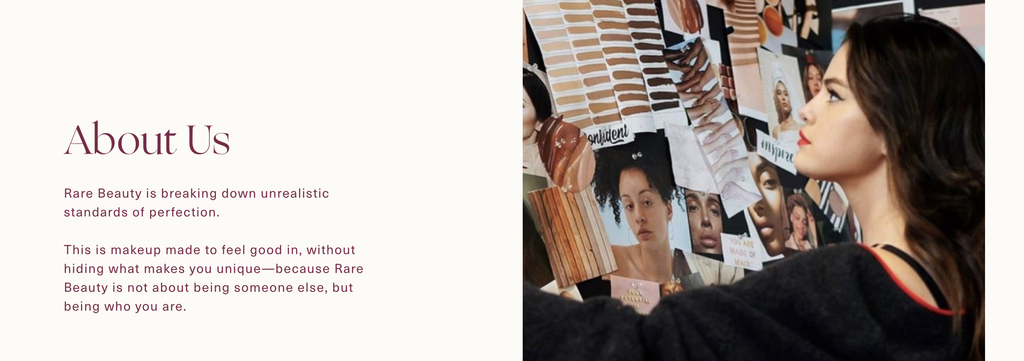
Its approach can be understood through three connected pillars.
A Brand Purpose Backed by a Funding Commitment
Plenty of beauty brands talk about confidence. Rare Beauty gives that message a more specific direction by connecting it to mental health and self-acceptance.
The Rare Impact Fund, established in 2020, supports organizations working to improve young people’s access to mental health education and services. Rare Beauty commits 1% of its sales to the Fund, with additional financial support coming from corporate partners, philanthropic organizations, and individual donors. It’s a commitment based on sales, not simply a promise to donate an unspecified share of profits when circumstances allow.
The Fund has a stated objective of mobilizing $100 million, and Rare Beauty reports progress through its social impact publications. According to its 2025 report we mentioned above, the Fund supported 30 nonprofit partners, helped train 208,000 educators, and affected 6,000 schools and education systems during the reporting year.
According to the statement on Rare Beauty’s official website:
Rare Impact aims to support the mental health of our community, employees, and partners everywhere. By celebrating everyone’s uniqueness and making people feel more connected, Rare Beauty works to reduce the stigma associated with mental health and give people access to the resources they need to support their mental well-being.
From a marketing perspective, this commitment gives Rare Beauty something valuable: an ongoing story backed by reported activity.
Purpose-driven beauty marketing can attract skepticism when a campaign launches with an emotional message but offers little evidence of lasting involvement. Rare Beauty’s funding commitment and reporting provide tangible points of accountability. That doesn’t mean every customer buys the brand because of its social mission. Nor does it prove that purchasing makeup directly improves someone’s mental health. It means the company has created a connection between its commercial operations and a cause it publicly supports. And that’s a considerably stronger foundation than an inspirational tagline alone.
Founder Story and Message Consistency
Selena Gomez is central to the Rare Beauty brand strategy, but her influence extends beyond product endorsements.
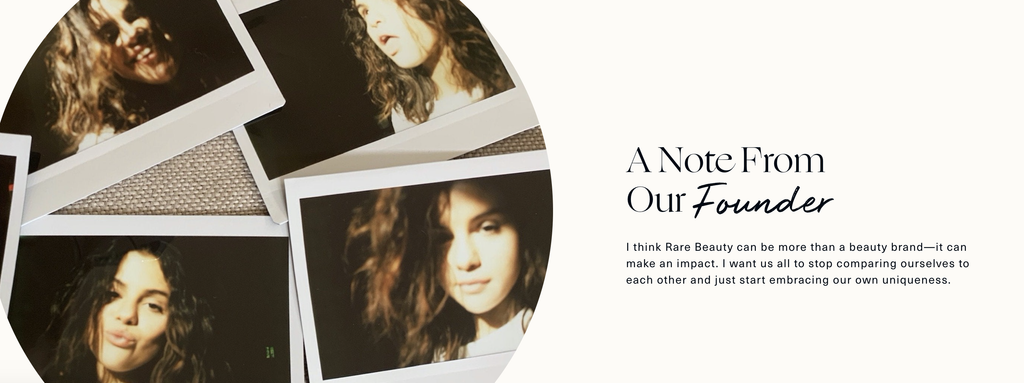
Her public discussions about mental health, self-image, and personal struggles connect naturally with the themes the brand communicates. This connection gives the marketing a recognizable human voice.
There’s research supporting the importance of that relationship. In the 2024 academic paper Celebrity Endorsement: How ‘Rare Beauty’ Capitalizes on Selena Gomez’s Emotional Bond with Millennials, Ana Pinto, Giovanni Lamarca, and Francisco Arbaiza explored how Peruvian consumers perceived Gomez and her beauty brand.
Through qualitative interviews with women aged 20 to 30, the researchers found that Gomez’s celebrity presence helped generate initial interest, while the brand’s values and positioning contributed to participants’ reported loyalty and preference. The research was qualitative and geographically limited, so it shouldn’t be treated as a measurement of Rare Beauty’s entire customer base.
The finding highlights an important distinction in Selena Gomez Rare Beauty marketing. Celebrity recognition can get consumers through the door. Building a brand they want to return to takes more than recognition. Rare Beauty’s founder-led tutorials, product demonstrations, and mental health conversations help bridge that gap. Gomez can introduce a product while simultaneously reinforcing the personality and values people associate with the business. So, her presence makes the message more recognizable, while the products and brand experience give people reasons to stay engaged when she isn’t on screen.
Accessibility and Inclusive Product Communication
Rare Beauty’s inclusivity marketing extends into the way products are developed, presented, and explained. Its original Liquid Touch Weightless Foundation was introduced in 48 shades, providing options across different skin tones and undertones. The brand also communicates through application tutorials, shade-selection tools, and images featuring diverse people.
A study titled Case Research Analysis: Inclusivity in Beauty, by Nathaly Ramos, identifies diverse representation, individuality, and mental well-being as major elements of Rare Beauty’s positioning. There is also a product-design dimension. Rare Beauty’s 2025 Social Impact Report discusses the accessibility-focused development of its Rare Eau de Parfum bottle, including consideration of people with limited hand mobility. This is an important reminder for brands: inclusive marketing becomes more credible when the product experience reflects the messaging.
Accessible packaging, understandable tutorials, diverse shade representation, and thoughtful product descriptions are practical expressions of a brand’s values. They also help reduce barriers that might otherwise prevent someone from becoming a customer.
Best Rare Beauty Marketing Campaigns
Before jumping into the examples, we should explain how these campaigns were selected.
Not every viral Rare Beauty video is an official advertising campaign. A creator reviewing Soft Pinch Liquid Blush without a sponsorship agreement, for example, is participating in organic product discovery. The content may generate enormous interest, but that doesn’t automatically make it a brand-commissioned activation.
For this analysis, we selected examples based on documented execution, relevance to Rare Beauty’s broader marketing strategy, and the availability of credible evidence.
The selection includes formal brand campaigns, product-launch activity, social impact initiatives, retail partnerships, community programs, and a documented paid advertising strategy. Together, they show how Rare Beauty approaches different stages of the customer journey.
Rare Beauty Launch Campaign: Selling Self-Acceptance Before Selling Makeup
Rare Beauty’s September 2020 launch campaign introduces the company as a beauty brand centered on individuality and self-acceptance.
Its objective is broader than announcing a new makeup collection. It establishes what Rare Beauty stands for, introduces Selena Gomez as its founder, communicates the product offering, and directs consumers to RareBeauty.com and Sephora. The target audience includes Gomez’s existing followers, beauty enthusiasts interested in new products, and consumers attracted to more inclusive beauty messaging.
Instead of positioning makeup as a solution to personal imperfections, the campaign presents it as an enjoyable form of self-expression.
The brand’s official launch film, Rare Beauty by Selena Gomez – Makeup Made To Feel Good In, demonstrates this positioning through its messaging and representation. Published ahead of the September 3 launch, the video introduces Rare Beauty’s mission and directs viewers toward the collection.
From an execution standpoint, the launch brings together founder storytelling, video content, product education, and retail availability. Consumers can discover the positioning through social channels, see products demonstrated, and purchase them through established shopping destinations.
Its original assortment included a complexion offering designed for a wide range of skin tones, supporting the broader inclusivity message.
Why it worked: The launch gave consumers a clear reason to understand Rare Beauty as something more than another celebrity cosmetics collection. Gomez’s visibility attracted attention, while the brand’s self-acceptance message provided a distinct emotional position. Product education and Sephora distribution then gave interested consumers practical ways to explore the range. The campaign connected identity, product, and purchase opportunities from the beginning.
Rare Impact Fund Campaigns: Turning Brand Purpose Into Public Action
The Rare Impact Fund is a continuing brand initiative, not a single seasonal advertisement. Its campaigns use fundraising, public events, educational resources, partnerships, and community participation to advance Rare Beauty’s mental health mission. The objective is to increase awareness, mobilize donations, support nonprofit organizations, and encourage conversations around youth mental health.
The target audience extends beyond makeup buyers. It includes young people, mental health advocates, educators, nonprofit partners, donors, and consumers interested in supporting businesses with social commitments.
The company’s Mental Health Summit is one example of how this idea becomes a recognizable event format. The Summit brings together mental health experts, community members, advocates, and Gomez for discussions about connection, well-being, and self-acceptance. The format combines in-person participation with digital access, allowing the conversation to extend beyond the venue.
The reported outcomes provide more substantial evidence than campaign impressions alone. Rare Beauty’s 2023 Social Impact Report recorded $7 million raised, more than 1 million young people reached, and 3,000 mental health resources developed or collected through its impact work. By its 2025 report, the Fund stated that it had mobilized more than $20 million. Its 2025 activities included support for 30 nonprofit partners and reported reach of over 3.5 million young people.
Why it worked: The initiative helped turn Rare Beauty’s positioning into an ongoing program with visible actions and published outcomes. Events gave the community opportunities to participate beyond purchasing products, while partnerships connected the brand with organizations working directly in mental health. This helped reinforce the idea that the company’s stated mission extended into its operations.
Soft Pinch Liquid Blush: When the Product Becomes the Advertising
The Rare Beauty Soft Pinch Liquid Blush is one of the clearest examples of how a product can generate an ongoing marketing conversation. The marketing objective is to increase awareness, demonstrate product performance, support trial, and encourage repeat discovery through beauty-related content.
Its audience includes makeup enthusiasts, TikTok users, beauty creators, and consumers searching for blush recommendations.
Soft Pinch Liquid Blush is highly pigmented, so a small amount creates a visible change. That characteristic translates especially well to short-form video, where creators have only a few seconds to capture someone’s attention. A demonstration can begin with a tiny dot of blush and quickly develop into a noticeable transformation. The application provides an immediate visual payoff, which is useful for tutorials, reactions, comparisons, and product reviews.
Why it worked: The product’s noticeable color payoff gave creators a compelling visual demonstration that was easy for audiences to understand. Tutorials and reviews helped shoppers evaluate the formula, while repeated appearances in beauty content increased familiarity. The product’s appeal was not limited to an advertisement featuring Selena Gomez; independent demonstrations helped sustain attention.
So, we can say that products with a clear, demonstrable benefit have a natural advantage in creator marketing. Before asking how to make a product viral, consider what makes someone want to demonstrate it in the first place.
Your Words Matter and Send Warm Wishes: Mental Health Awareness With a Practical Message
Rare Beauty’s mental health campaigns show how the brand translates a broad mission into specific communication themes. Two examples are the Your Words Matter campaign, launched for Mental Health Awareness Month in 2022, and the Send Warm Wishes activation introduced in 2025.
Your Words Matter focuses on language. Its objective is to help people recognize how everyday expressions can reinforce stigma around mental health conditions and encourage more thoughtful conversations. The campaign targets younger social media users, the broader Rare Beauty community, and people interested in mental health education. It operates as an educational initiative through social media content, expert participation, informational resources, and a virtual event.
Rare Beauty published the campaign results in its Shorty Impact Awards submission. According to that submission, Your Words Matter generated:
- More than 108.4 million media impressions.
- 25,329 visits to related educational mental health blogs.
- More than 3.2 million Instagram accounts reached, with 304,602 engagements.
- A reported 19.1 million reach associated with influencer attendees’ content.
The 2025 Send Warm Wishes campaign takes another approach.
Developed with Paperless Post, it encourages people to send supportive messages through physical and digital postcards. The campaign launched in connection with Rare Beauty’s Mental Health Summit and makes emotional connection something participants can actively practice. Rare Beauty’s 2025 Social Impact Report states that the Send Warm Wishes initiative reached 34,000 people. Its related Summit was livestreamed to more than 10,000 virtual attendees.
The official Mental Health Summit video documents the event associated with the activation; a separate official YouTube campaign film specifically for Send Warm Wishes could not be verified.
Why it worked: Your Words Matter converted a sensitive, complex topic into accessible educational content people could discuss and share. The involvement of mental health professionals strengthened the campaign’s credibility. Send Warm Wishes then offered a simple participatory action, making the message about human connection more tangible. Both activations created opportunities for engagement without making product purchases the central requirement.
Make a Rare Impact With Sephora: Turning Retail Into a Fundraising Channel
The Make a Rare Impact collaboration between Rare Beauty and Sephora is a strong example of how an established retail partner can support a brand’s social mission. The campaign connects World Mental Health Day with a defined purchasing period during which Sephora contributes qualifying Rare Beauty sales to the Rare Impact Fund.
Its objective is to raise funding, increase awareness, and encourage consumers to participate through an existing shopping behavior. The campaign primarily targets Rare Beauty customers, Sephora shoppers, and consumers who want to support youth mental health initiatives.
In 2023, Sephora committed to donating 100% of Rare Beauty sales on October 10 to the Rare Impact Fund. The activity covered participating Sephora channels and was supported by messaging from Selena Gomez.
The campaign also benefits from Sephora marketing and its retail environment. Consumers encounter Rare Beauty products while browsing in stores or online, where educational material and campaign messaging can connect the shopping experience to the charitable initiative. Rare Beauty’s 2023 Social Impact Report recorded approximately $2 million raised through the Sephora World Mental Health Day activity.
The partnership continued in subsequent years, with adjustments to its scope. In 2025, the initiative focused on Rare Beauty fine fragrance purchases between October 10 and 12. The company reported more than $830,000 donated across 25 markets, based on approximate global currency conversion. (Rare Beauty Social Impact Report 2025)
Why it worked: The partnership made participation straightforward. Consumers didn’t need to navigate a separate donation platform or understand a complicated mechanic. Sephora supplied an established retail network, while Rare Beauty supplied a recognizable mission and founder. The time-limited activation gave shoppers a clear reason to act, and the reported fundraising outcomes made the initiative measurable.
#RareRoutine: Community Content That Keeps the Brand Moving
Rare Beauty’s #RareRoutine initiative encourages people to share the ways they use makeup in their everyday lives. The objective is to build community participation, generate authentic product demonstrations, and maintain ongoing engagement beyond major launches. Its target audience includes existing Rare Beauty users, beauty enthusiasts, makeup creators, and people who enjoy sharing their personal routines.
The campaign’s central idea is that makeup doesn’t have to follow one particular standard or routine. Rare Beauty invites consumers to publish their own looks, tag the brand, and potentially have their content featured in its community gallery or social channels. This makes the campaign an ongoing content ecosystem, not simply a short-lived promotional challenge.

Selena Gomez also participates in routine-style content through demonstrations that show how Rare Beauty products work together.
The creative format has several practical strengths. A routine gives the audience useful information about application order, product combinations, skin finishes, and everyday usability. It also creates opportunities for creators to explain their personal preferences.
Someone might use Soft Pinch Liquid Blush for a natural everyday look. Another creator might apply the same product more dramatically. Both demonstrations can fit the campaign because the concept welcomes individual interpretation.
Why it worked: The format allowed consumers to contribute without copying a tightly scripted advertisement. Rare Beauty’s products remained visible, but individual preferences and application styles gave the content variety. Featuring community members also gave participants recognition, helping transform ordinary product usage into a shared brand experience.
International Market Launch Campaigns: Making a Global Brand Locally Available
Rare Beauty’s international expansion demonstrates another part of its marketing approach: entering new markets through recognizable retail partners while maintaining its central brand positioning. The objective is to increase product availability, introduce the brand to new regional audiences, and support local discovery and trial. Its target audience includes existing Selena Gomez followers who previously had limited access to the products, local beauty enthusiasts, and consumers exploring premium cosmetics through established retailers.
The United Kingdom launch in 2022 is a useful example. Rare Beauty entered the UK and Ireland market through Space NK, extending its reach beyond the North American launch markets. Ludovica Portincasa’s 2024/2025 thesis, Beauty With a Purpose, documents this international development as part of the company’s distribution strategy.
The underlying approach connects digital awareness with physical shopping opportunities. For customers who have discovered products through social media but cannot easily access them, local retail availability removes a major barrier between interest and purchase. It also allows consumers to test shades and textures before making a decision, which matters in categories such as complexion makeup.
Why it worked: International distribution gave consumers who already knew about Rare Beauty an easier way to experience its products. Retail partners supplied established shopping infrastructure and local consumer touchpoints, while the brand maintained the broader identity audiences had encountered online. The approach connected demand generated through digital channels with more accessible purchasing opportunities.
Rare Beauty’s YouTube and Google Search Campaign: Connecting Brand Awareness With Measurable Demand
Rare Beauty’s documented Google advertising strategy provides an important counterpoint to its creator-led and purpose-focused campaigns. It shows that the company also invests in measurable performance advertising.
The objective is to reach younger consumers during product discovery, capture relevant search demand, and generate conversions. Its target audience includes Gen Z shoppers researching beauty products, comparing recommendations, and using video content to evaluate purchases.
The creative approach brings together YouTube videos, short-form product demonstrations, and AI-supported Search campaigns. According to a June 2025 Think with Google case study, Rare Beauty incorporated YouTube into its Search approach, tested different formats, and used Google AI to help optimize advertising against consumer intent.
YouTube Shorts was highlighted as a useful format for showing product benefits through quick demonstrations featuring Selena Gomez.
The campaign reflects an important consumer behavior: watching a product review and searching for a product are often connected activities. Someone might discover Soft Pinch Liquid Blush on TikTok, watch another creator’s tutorial on YouTube, search for a shade recommendation, and finally visit a retailer.
Results? Think with Google reported that Rare Beauty’s Search strategy delivered a 7X return on ad spend. The case study also described increased traffic and conversions through Sephora.com, although it did not publish enough detail to isolate every contribution from YouTube, Search, and other activity.
Why it worked: The advertising approach connected existing product interest with high-intent discovery moments. Short videos demonstrated products, while Search campaigns reached consumers looking for more information. This helped Rare Beauty support both discovery and conversion without relying entirely on organic social engagement.
Rare Beauty’s Influencer and Creator Marketing
Rare Beauty influencer marketing is often discussed in connection with TikTok, but the more interesting story is how creators help translate a product into something audiences can evaluate.
Beauty is an unusually demonstration-friendly category. The difference between a product looking attractive in its packaging and looking attractive on someone’s skin is enormous. People want to see texture, application, pigmentation, undertones, and wear. They want to know if the product works with their existing routine and how it looks outside a studio environment. Creators can answer those questions in ways conventional product photography cannot.
Creator Gifting and Seeding Strategy
Product seeding gives brands opportunities to introduce their products to creators who already discuss relevant categories.
Rare Beauty’s creator ecosystem includes reviews, demonstrations, makeup tutorials, and product comparisons. Portincasa’s research identifies creator reviews and social content as important elements of the company’s promotional approach. Still, we should distinguish visible creator activity from the operational details behind it.
A video featuring Rare Beauty doesn’t automatically prove the creator received a gifted product, payment, or campaign brief. The specific arrangements are not always public.
Why Micro-Creators Drive Product Discovery
A smaller creator with an engaged, relevant audience can be useful when customers need detailed product education.
Think about a creator specializing in makeup for mature skin, textured skin, deeper skin tones, or easy everyday routines. The audience follows that person for specific knowledge and experience. A Rare Beauty blush demonstration from one of these creators may address questions that a broad celebrity advertisement doesn’t have time to answer. That creates an opportunity for brands to reach consumers in specific product-consideration contexts.
The distinction isn’t that smaller creators automatically outperform larger influencers. Their value depends on audience relevance, credibility, creative quality, and measurable outcomes. For brands evaluating influencer marketing agencies, those factors deserve as much attention as follower counts.
From Organic Virality to Paid Amplification
Rare Beauty’s experience also highlights the need to distinguish three activities: organic creator discussion, contracted influencer content, and paid advertising amplification. An independent product review can generate discovery. A contracted creator can produce campaign assets designed for a particular audience. Paid distribution can then increase visibility for suitable creative.
Those are connected opportunities, but they have different costs and attribution requirements. For example, if a beauty creator’s review generates strong engagement, a marketing team might use the underlying audience insight to develop stronger paid advertisements. However, brands shouldn’t assume they have the rights to reuse creator footage simply because the product appears in the video. Usage rights, licensing periods, advertising permissions, and compensation need to be addressed before amplification.
For additional comparisons across the category, these influencer marketing campaigns for beauty brands offer useful examples of how brands structure creator partnerships.
Managing Consistency Across Thousands of Creators
As a creator ecosystem grows, controlling every interpretation becomes unrealistic. And too much control can make the content less credible.
The more practical objective is to establish recognizable brand principles while allowing creators to communicate through their own experiences. For Rare Beauty, recurring themes include individuality, approachable beauty routines, product usability, and self-acceptance. Creators can express those themes in different ways. A makeup artist may focus on application technique; a lifestyle creator may include products in an everyday routine; another creator may compare shades and formulas.
The relationship can be summarized as:
Product Experience → Creator Content → Platform Virality → Retail Demand
This is a useful model for analyzing Rare Beauty’s marketing, not a verified attribution sequence for every customer.
Each connection needs measurement. Product satisfaction doesn’t guarantee content creation, engagement doesn’t always produce purchases, and retail demand can have multiple causes. The strategic advantage comes from understanding how those stages interact.
Rare Beauty’s Social Media and Content Marketing
If Rare Beauty’s products give people something to demonstrate, its social media strategy gives those demonstrations room to circulate.
The company uses content for product discovery, education, founder storytelling, and conversations around mental well-being. And those objectives require different creative approaches. A blush tutorial should help someone understand the product. A mental health conversation should prioritize useful information and respectful engagement. A founder video can add personality and familiarity.
Trying to force all three objectives into every post would make the brand feel considerably less natural.
TikTok-First Creative
Rare Beauty TikTok marketing benefits from visual storytelling that gets to the point quickly. Makeup transformations, application demonstrations, shade comparisons, and creator reactions are well suited to short-form content.
The Soft Pinch Liquid Blush provides a particularly convenient example because its pigmentation creates a visible demonstration without requiring a complicated explanation. The broader principle is that TikTok beauty marketing often starts with showing something the audience can immediately recognize. A product claim becomes more compelling when viewers can see a demonstration.
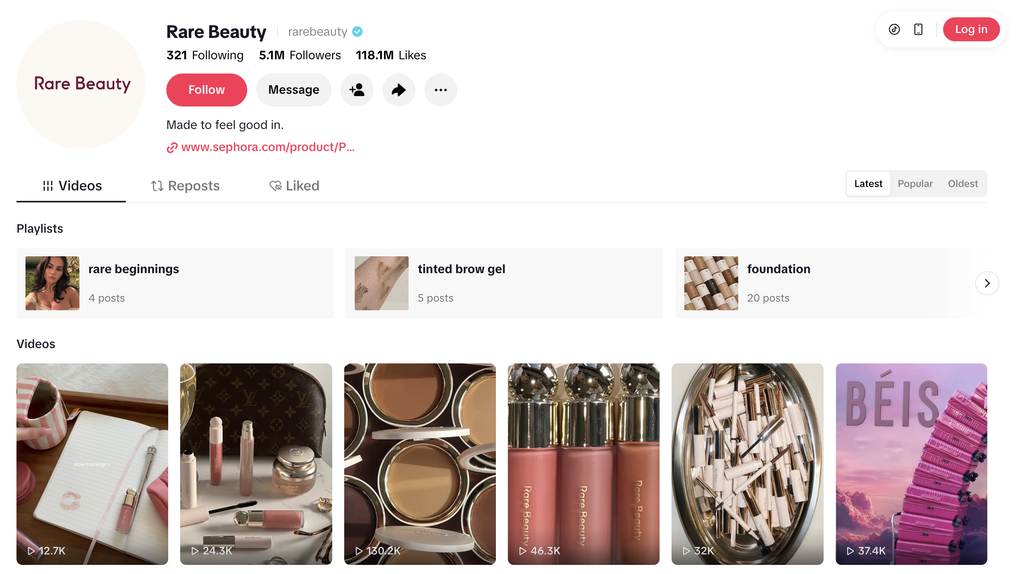
For marketing teams, that means creative briefs should focus on the product moment worth watching. What changes on screen? What question does the content answer? What makes a person curious enough to continue watching? Not every video needs polished studio production. However, content still needs clarity, useful information, and a reason to exist beyond displaying the logo.
Tutorial, Review and Demonstration Content
Tutorials form an important part of Rare Beauty’s content ecosystem. They show consumers how products perform, which application techniques work, and how different items can fit into a routine. This content is useful beyond social engagement. It can support product pages, retailer education, search visibility, and customer consideration.
A tutorial demonstrating the appropriate amount of Soft Pinch Liquid Blush, for instance, can prevent consumers from misunderstanding how concentrated the formula is. Likewise, shade comparisons can reduce uncertainty when a shopper cannot test a product in person.
This is where a well-developed content strategy supports customer experience. The strongest demonstration content makes the product easier to understand, not simply easier to notice.
Founder Content and Brand Channels
Selena Gomez gives Rare Beauty a familiar voice, but the brand doesn’t need to depend entirely on her appearances. Founder content is particularly useful for introducing product collections, communicating the brand’s purpose, and explaining personal connections to the mission.
At the same time, creator demonstrations and community posts keep the content ecosystem active across different perspectives. For celebrity beauty brand marketing, this matters enormously. The founder can provide the introduction, but the brand must give consumers reasons to maintain the relationship independently.
Community Conversations Around Mental Health
Mental health is one of Rare Beauty’s defining communication themes, and it demands more care than an ordinary product discussion. Brands working with sensitive topics have responsibilities that extend beyond engagement metrics.
A campaign discussing mental health shouldn’t turn personal distress into a creative hook. It should avoid implying that a cosmetic product can treat emotional or psychological difficulties, and it should never pressure people to disclose sensitive experiences publicly.
Rare Beauty’s use of mental health professionals, educational resources, and nonprofit partnerships provides a useful model for developing communications with more appropriate expertise.
Who Is Rare Beauty’s Target Audience?
Who exactly is the Rare Beauty target audience?
It would be tempting to answer with one demographic category, particularly Gen Z. But Rare Beauty’s positioning, product offering, and founder appeal suggest a broader audience structure.
The brand attracts people through several overlapping motivations: product performance, celebrity familiarity, self-expression, inclusive beauty communication, and shared interest in mental health advocacy.
The academic research provided offers some useful context. Portincasa examines Rare Beauty’s appeal to younger consumers and its positioning through inclusivity and purpose. Pinto, Lamarca, and Arbaiza show that the brand also resonates with a specific group of adult consumers whose emotional familiarity with Selena Gomez influences their perceptions.
So we can identify Rare Beauty target audience as follows:
| Audience | Marketing Opportunity | Relevant Campaign Approach |
|---|---|---|
| Gen Z beauty consumers | Self-expression, product discovery, and relatable demonstrations | TikTok-native creator content, Soft Pinch tutorials, short-form video |
| Mental health-conscious consumers | Shared values and interest in responsible brand behavior | Rare Impact Fund, Your Words Matter, Mental Health Summit |
| Selena Gomez’s existing audience | Familiarity, recognition, and trust transfer | Founder-led storytelling and product demonstrations |
| Accessibility-focused shoppers | Clear product education and consideration of different needs | Inclusive product design communication, accessible packaging, tutorials |
| Everyday makeup enthusiasts | Practical application advice and product recommendations | #RareRoutine, product reviews, shade comparisons |
| Sephora and Space NK shoppers | Convenient product access and in-store discovery | Retail launches, educational displays, collaborative promotions |
What stands out is that Rare Beauty can reach these groups without giving each one a completely different identity. A Gen Z beauty enthusiast may discover the brand through TikTok. Another consumer may recognize Selena Gomez. Someone else may become interested after learning about the Rare Impact Fund. The motivations differ, but the brand’s underlying message remains recognizable.
That is an important strength of the Rare Beauty advertising strategy: different channels can emphasize different benefits while supporting the same positioning. It also suggests why marketers should avoid defining the brand’s audience exclusively through Selena Gomez’s followers. Celebrity affinity can create a valuable starting point, but an audience built around product relevance and values may extend beyond an individual founder’s fanbase.
What Marketers and Beauty Brands Can Learn From Rare Beauty
Rare Beauty is an instructive case because its marketing involves several systems that serve different objectives.
The Rare Impact Fund supports the company’s mission. Creator content helps people discover products. Tutorials explain how products work. Retail partnerships make products accessible. Search advertising captures relevant interest closer to purchase.
The important lesson, we think, is to understand how the elements support one another. Brands studying Rare Beauty should begin with their actual product experience. If the product is difficult to demonstrate, unclear in its benefits, or disappointing to use, adding influencers won’t solve the underlying problem.
Next comes positioning. What does the company stand for, and can consumers recognize that position in its products, content, and customer experience? Then comes distribution. Can interested consumers find, evaluate, and purchase the products without unnecessary friction?
Finally, marketers need an evidence-based measurement framework. Community participation, social impact, product sales, and advertising return are different outcomes. They should be assessed with metrics appropriate to each objective.
For brands exploring external partners, specialist beauty & cosmetics marketing agencies can help connect these priorities across brand positioning, creative development, media planning, and retail marketing.
It’s also useful to compare Rare Beauty with other notable brands. For example, our another blog, Fenty Beauty marketing & advertising strategy offers another perspective on celebrity-led beauty positioning and inclusive product communication.
So, absolutely, the takeaway isn’t that every beauty brand needs a famous founder or a large philanthropic initiative. Those are specific advantages Rare Beauty possesses. The more transferable lesson is that brand meaning, product experience, community content, and measurable distribution need to support the same business.
Final Thoughts: Purpose Gets Attention, but the Product Has to Earn Its Place
Rare Beauty gives marketers an unusually useful example because its business isn’t built around just one type of attention.
Selena Gomez brings recognition. The brand’s mental health commitment adds meaning. Soft Pinch Liquid Blush gives creators something visually interesting to demonstrate. Community content keeps people involved, while retail partnerships and performance advertising help translate interest into commercial opportunity.
Each element has a different job. And that’s probably the most valuable insight behind Rare Beauty marketing campaigns. You can admire the mission without buying the blush. You can love the blush without knowing much about the Rare Impact Fund. You can discover the brand through Selena Gomez and eventually develop a preference for its products independently of her.
The marketing challenge is to make those different consumer experiences feel connected to one recognizable brand. Rare Beauty’s campaigns demonstrate how that connection can be built through products, storytelling, community participation, and measurable commitments.
For the rest of us working in marketing, it raises a useful question:
If your most successful product went viral tomorrow, would your brand have something meaningful to say once the excitement settled down?
Because getting people to talk about a product is impressive. Giving them reasons to keep caring about the brand behind it is where the more interesting marketing work begins.
FAQ about Rare Beauty Marketing Campaigns
1. What is Rare Beauty’s marketing strategy?
Rare Beauty’s marketing strategy combines founder-led storytelling, inclusive brand positioning, creator marketing, community engagement, purpose-driven initiatives, retail distribution, and paid digital advertising. Its central message focuses on self-acceptance and individuality, while the Rare Impact Fund connects the brand to mental health advocacy through a formal funding commitment. Product demonstrations, especially across TikTok and YouTube, help customers discover and evaluate the cosmetics. Sephora and other retail partners support distribution, while Search advertising helps capture product-related demand.
2. What are Rare Beauty’s most successful marketing campaigns?
Several Rare Beauty campaigns stand out for different reasons. The 2020 launch established its positioning. Soft Pinch Liquid Blush became a widely recognized product through creator demonstrations and product discovery. Your Words Matter generated substantial reported engagement, while Make a Rare Impact with Sephora produced measurable fundraising outcomes. Rare Beauty’s Google advertising strategy also stands out because the company reported a 7X Search return on ad spend. These initiatives shouldn’t be ranked by a single performance metric. Their objectives differ, and comparable campaign-level commercial data is not publicly available for every example.
3. What is the Rare Impact Fund?
The Rare Impact Fund is Rare Beauty’s social impact initiative, founded in 2020 to expand access to mental health education and services for young people. Rare Beauty commits 1% of sales to the Fund, which also receives support from corporate partners, foundations, and individual contributors. Its stated goal is to mobilize $100 million. Rare Beauty’s 2025 impact report stated that the Fund had mobilized more than $20 million and supported a range of mental health organizations and educational initiatives.
4. Who is Rare Beauty’s target audience?
Rare Beauty appeals to overlapping consumer groups, including Gen Z beauty enthusiasts, Selena Gomez followers, everyday makeup users, consumers interested in inclusive beauty products, and people who value mental health advocacy. Its social content frequently addresses younger digital audiences, but the brand’s customer appeal isn’t limited to a single age group. Its products, retail presence, and founder recognition create multiple routes into the brand.
5. How did Soft Pinch Liquid Blush go viral on TikTok?
Soft Pinch Liquid Blush became highly visible through beauty creators demonstrating its concentrated pigmentation, application techniques, and different shades. The product lends itself to engaging video content because even a small amount produces a noticeable visual effect. Independent reviews, tutorials, and repeated product appearances helped introduce it to wider audiences.
6. How does Rare Beauty use influencer marketing?
Rare Beauty uses creator content to support product discovery, application education, and brand visibility. Creators demonstrate cosmetics, share reviews, compare shades, and incorporate products into everyday routines. The brand also develops founder-led content and participates in more formal marketing collaborations. Importantly, not every creator post featuring Rare Beauty should be interpreted as sponsored advertising. Organic content, gifting, and paid partnerships are different activities and should be identified accurately.
7. How does Selena Gomez contribute to Rare Beauty’s marketing?
Selena Gomez serves as the founder and one of Rare Beauty’s most recognizable communicators. She introduces products, appears in tutorials, participates in campaigns, and discusses the mental health mission connected to the brand. Her existing visibility helps create initial awareness, while her public personality supports the company’s positioning around individuality and self-acceptance.
8. What can beauty brands learn from Rare Beauty?
The most important lesson is to connect what a brand says with what customers actually experience. Rare Beauty communicates self-acceptance through its positioning, supports mental health initiatives through the Rare Impact Fund, encourages product education through creators, and makes products available through established retailers. Its advertising also shows the value of connecting organic discovery with measurable paid media activity. For marketers, the challenge is to build those connections in ways that suit their own products, budgets, audiences, and business objectives.