
















Pitching and Producing Client Video With Vidu Q4: What a Small Agency Measured on Turnaround, Revisions and Cost
Fieldnote Studio, the five-person agency in this piece, is invented, and so is its prospective client, a canned sparkling tea called Kestrel. The work is real, though. I wanted to know whether an image-to-video model could carry a pitch and then a small paid job without wrecking our margins or our relationship with the client. So I ran the whole thing as if the brief were live: a pitch draft, a revision round, a three-shot campaign with a recurring host, social cutdowns and a final high-resolution master.
The model was Vidu Q4 Preview (model ID viduq4-preview), called through an API. Eleven video jobs cost $4.42 in total. Below are the prompts, timings, charges and the places it went wrong, plus how we would now price this kind of work into a retainer.
What the model takes, and what it doesn’t
Vidu Q4 does not do text-to-video. Every job starts from images, which suits agency work: the client signs off a key visual first, and motion comes after. There are two modes, picked automatically from what you send. Image-to-video takes exactly one first frame, with an optional prompt. Reference-to-video takes 1 to 15 reference images and up to three short MP3 clips, and needs a prompt. Clips run 3 to 16 seconds at 540p, 720p, 1080p, 2K or 4K. Audio is on by default and costs the same as silent output. There is no last-frame control, so you can’t pin where a shot ends.
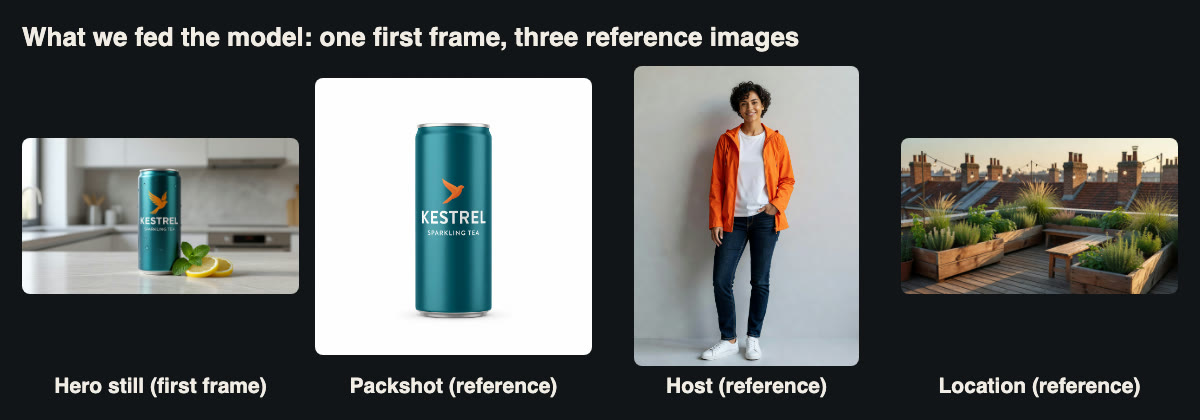
For this test I made four stills with an image model for about six cents in total: a hero shot of the can in a kitchen, a white-background packshot, a host (a woman in an orange rain jacket) and a rooftop garden location.
Test 1: the pitch draft
The cheapest useful setting is 540p. I sent the kitchen still as the first frame with this prompt, seed 1234, 5 seconds:
Slow push-in on the can. Condensation droplets slide down the side of the can, the mint leaves move slightly in a breeze, soft window light. The can and its label stay unchanged. Quiet kitchen ambience, a soft fizz.
It cost $0.224 (5 seconds at $0.0448 per second) and finished in 126 seconds. The output was 960×540, 24 fps, 0.9 MB. The push-in was smooth: measured by the width of the can, the camera ended 1.70 times closer than it started. I ran OCR on 20 evenly spaced frames and “KESTREL” and “SPARKLING TEA” were read correctly in all 20.
Test 2: does the draft predict the final?
The question every producer asks: if the client likes the cheap draft, will the expensive version look the same? I resent the same first frame, prompt and seed at 720p ($0.456) and 1080p ($0.512).

The composition held: same can, same mint, same kitchen, same move. The end points differed a little. The 540p push ended at 1.70x, 720p at 1.74x and 1080p at 1.60x, and the droplets landed in different places. So the seed gets you the same shot, roughly, but not a frame-for-frame match. We now tell clients that a draft shows the idea and the final may differ in small details, and we put that sentence in the approval email.
Price-wise, 1080p cost only 12% more than 720p here, so we skip 720p for finals.
Test 3: a revision round
A typical client note: “Love it, but slower, and nothing else should move.” I rewrote the prompt and ran two takes at 540p with different seeds (2201 and 2202):
Very slow, steady push-in on the can. Nothing else moves except a few condensation droplets running down the can. The can and its label stay sharp and unchanged. No hands, no people. Quiet room tone.
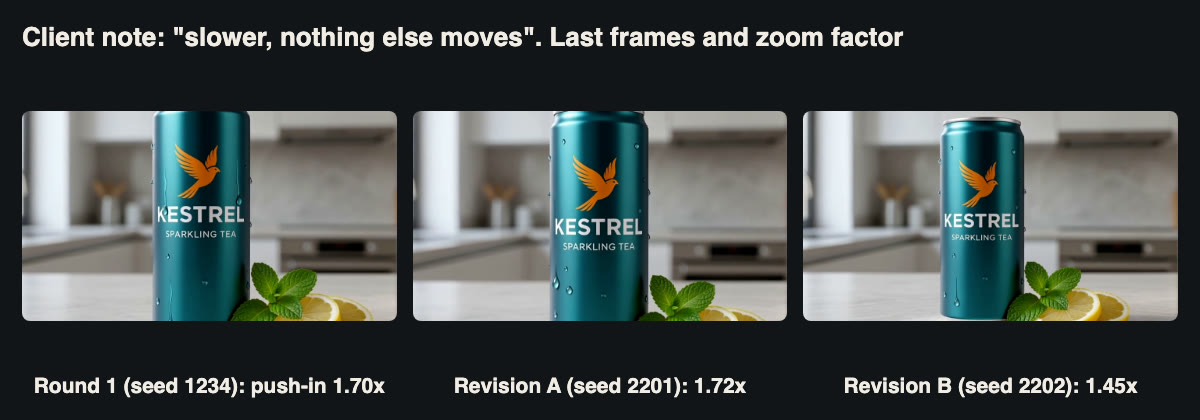
Take A pushed in 1.72x, no slower than the original. Take B pushed in 1.45x, which is the kind of change the client asked for. Both took about two minutes and cost $0.224 each. One take in two did what the note said. For budgeting I assume two to three takes per client note.
Test 4: brand consistency across shots
This is where reference-to-video earns its place for agency work. A campaign needs the same person, same pack and same location across shots, and stitching separate image-to-video clips rarely gives you that. I sent the packshot, the host and the rooftop as three references and asked for three different shots, all at 540p, 16:9, 5 seconds. Each prompt began:
The woman from image 2, in her orange rain jacket, and the teal KESTREL sparkling tea can from image 1, on the rooftop garden terrace from image 3 at golden hour.
and then described a wide bench shot, a close-up with a rack focus from the can to her face, and a tracking shot along the planters.
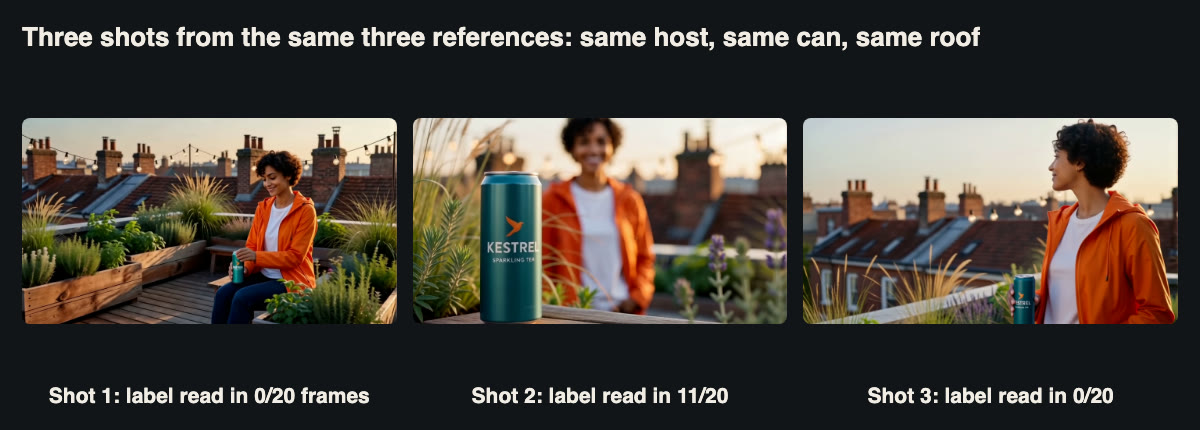
Identity held well. Her hair, face, jacket and white T-shirt match across all three shots, and the roof, chimneys and planters look like one place. Two things did not. In shot 1 she was already sitting in the first frame, so the “sits down” action never happened, and at that size I couldn’t see a ring-pull being opened before she drinks. And the label was only legible when the can was large: OCR read “KESTREL” in 11 of 20 frames of the close-up and in none of the wide or tracking shots, where the can is a few pixels wide.
I also measured colour. Against the packshot, the median teal of the can drifted by about 10 to 12 Delta E in the rooftop shots, against about 4 in the kitchen clips. Golden-hour light explains much of that, so I wouldn’t call it an error, but if a brand manager has strict colour specs, plan a grade in the edit.
All three shots took 176 seconds and cost $0.224 each. If you want to try the same workflow, the Vidu Q4 video API page lists the parameters, the per-second rates for each resolution and request examples for both modes.
Test 5: social cutdowns
Most of our client video ends up on social, so I asked for the same “cheers” moment in 9:16 and 1:1 from the same references. In reference-to-video you set the aspect ratio yourself. In image-to-video it follows the first frame.
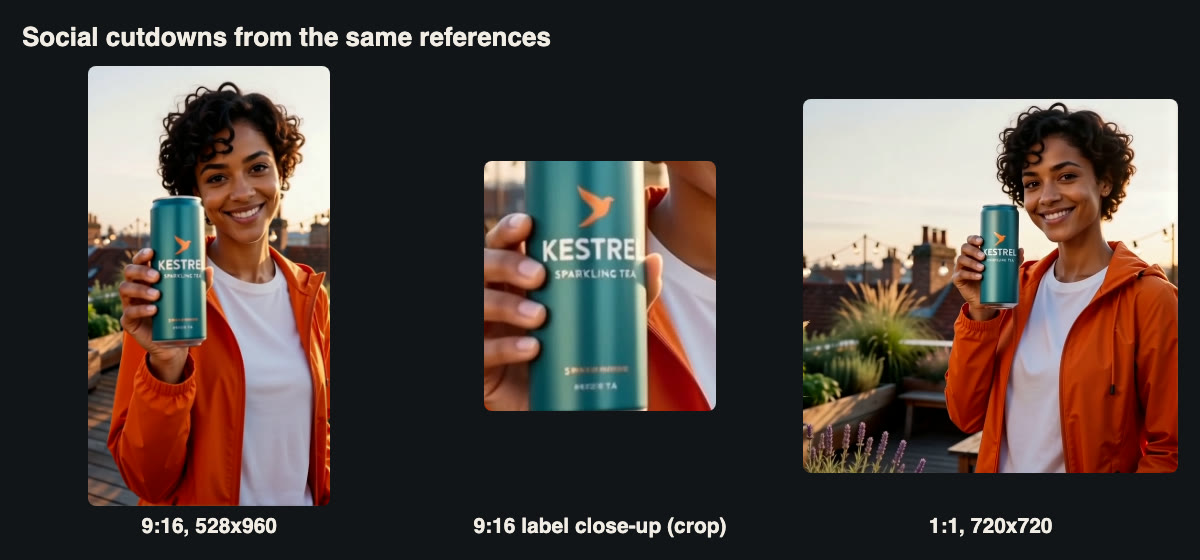
The output sizes were 528×960 for 9:16 and 720×720 for 1:1 at the 540p setting. The vertical one has a problem a client would catch at once. As the can comes towards the camera, two lines of small print appear under “SPARKLING TEA” that are not on the real pack, and the wordmark is clipped to “KESTRE” in most frames. OCR never read the full “KESTREL” in the 9:16 clip. The square version showed it in 7 of 20 frames. Generated packaging text needs a human check on every cut, not just the hero.
Test 6: the default audio
Every clip above was generated with audio on, the default, at no extra cost. The tracks were ambience only and very quiet: from about -26 to -55 LUFS integrated, where a normal social video sits around -14. A transcription pass found no speech. We mute these and lay licensed music and a voiceover in the edit, so for us the audio flag is irrelevant to price and close to irrelevant to the result.
Test 7: the 4K master
The client “approved” take B, so I rendered it as a master: same prompt, same seed (2202), 4K, 5 seconds. It cost $1.664, 7.4 times the draft, and took 231 seconds, the longest job in the test.
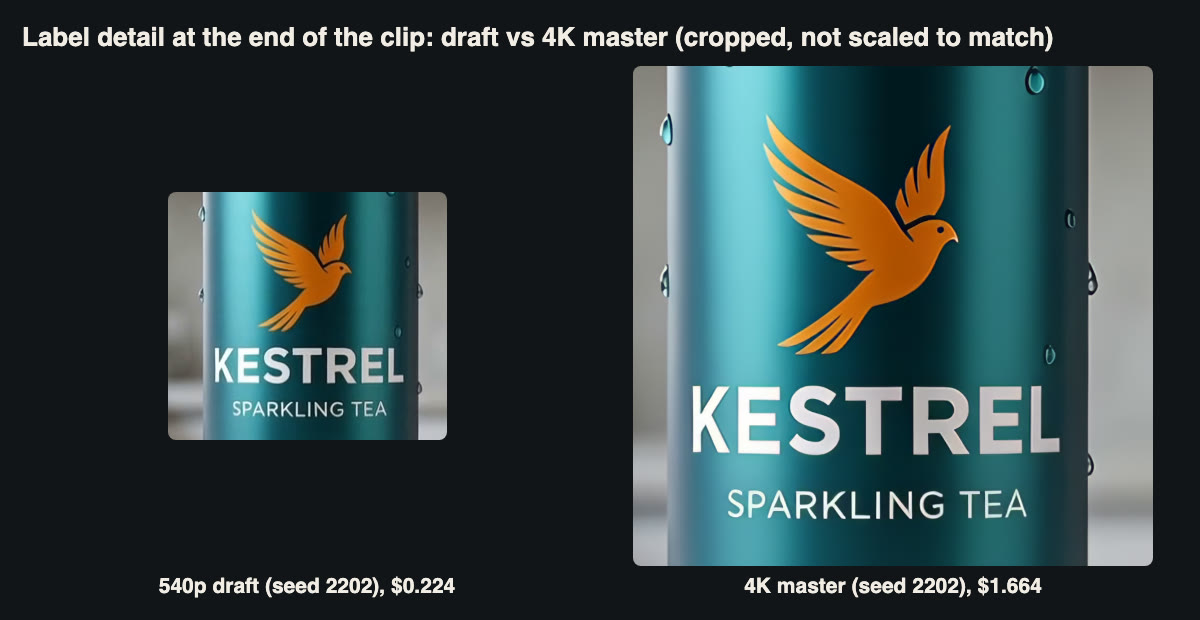
The detail gain is real: lettering, bird logo and droplets are all sharp at full size. But the master did not repeat the draft’s move. It pushed in only 1.25x, against 1.45x for the take the client approved. The file was 3840×2160, 12.6 MB, and encoded as H.265 (HEVC), while every lower resolution came back as H.264. Check that your client’s edit suite and playback targets handle HEVC before you promise 4K delivery. I did not test any particular editor.
Test 8: turnaround for a review call
I submitted the ten non-4K jobs at once. All ten were finished within 177 seconds of submission, and each POST returned in under a second, so a round of drafts fits inside a client call. The finished video links expired 24 hours after completion, according to the expiry field on each task, so we download everything to the project folder straight away.
What it cost, and how we’d price it

Every charge matched the listed rates exactly: $0.0448 per second at 540p, $0.0912 at 720p, $0.1024 at 1080p and $0.3328 at 4K. That makes planning easy. For a 15-second ad made of three 5-second shots, with three draft takes per shot at 540p and one master per shot, generation comes to about $3.55 with 1080p masters or $7.01 with 4K masters.
Those numbers are small next to the time. Writing prompts, reviewing takes, checking every label, grading colour and editing took me far longer than the generation, and that is where the client’s money really goes. So in a retainer we would do three things:
- Bill generation as a capped pass-through allowance, for example $25 a month, enough for several ads at 1080p with room for retakes, and report actual spend each month.
- Price the creative and review hours as usual, with a stated number of revision rounds. Each round means two or three takes per note, not one.
- Charge 4K masters as a separate line, because they cost about three times a 1080p master and need a format check.
Client approval and disclosure
We tell clients in writing that the footage is AI-generated, which inputs were used, and that small details (droplets, end position of a move, small print) can change between draft and master. The client approves the reference images before any motion is made, because those are what carry the brand. And nobody outside the studio sees a clip until a person has checked the pack, the logo and any text frame by frame. The model invented packaging copy once in eleven clips, and that is one time too many for a brand manager.
Checklist for agency use
- Get the key visual or reference images approved before generating any motion.
- Draft at 540p. A 5-second draft costs about 22 cents and takes about two minutes.
- Expect the final to differ slightly from the draft even with the same seed. Say so in the approval email.
- Budget two or three takes for every revision note.
- Use reference-to-video for multi-shot campaigns with a recurring person or product.
- Check every label and text element in every cut, especially vertical ones.
- Mute the default audio and use your own music and voice.
- Download within 24 hours and confirm the client can use HEVC before promising 4K.
The bottom line
For a small agency, Vidu Q4 is useful in two places: fast pitch drafts from a client’s own stills, and multi-shot social content where the same host and product need to appear in every shot. It held identity well across references, it was quick enough to use during a review call, and the generation cost of a whole campaign was smaller than an hour of anyone’s time. Its weak points are the ones clients notice: invented small print, labels that vanish when the product is small, and finals that drift a little from the approved draft. Price the people, cap the generation, and keep a human between the model and the client.