















Margin Media on Agentic Workflows: Designing Smarter SEO Workflows with Human-Led Automation
How Margin Media combines specialized AI agents with strategic oversight to transform SEO planning from a manual process into an intelligent workflow.
“AI agents can accelerate execution. Strategy, governance, and accountability turn that execution into growth.”
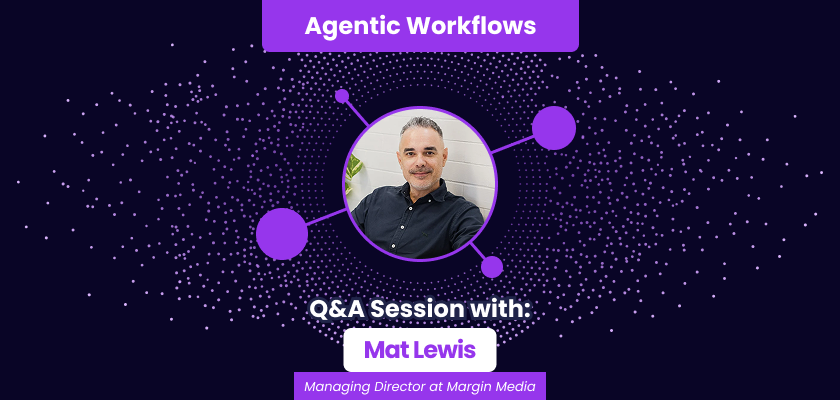
Mat Lewis, Managing Director at Margin Media
SEO has always been a discipline built on analysis.
Keyword research, technical audits, search intent mapping, content planning, competitive analysis, etc., each activity generates valuable insights, but together they also create an enormous operational workload.
As AI becomes increasingly capable of processing data and identifying patterns, the opportunity isn’t simply to complete these tasks faster.
It’s to redesign the workflow altogether.
That’s the approach taken by Margin Media.
Rather than treating AI as an assistant for individual tasks, the agency has developed structured agentic workflows where specialized AI agents handle research, analysis, and drafting—while strategists remain responsible for interpretation, business context, and final recommendations.
Agency Snapshot
🧠 Agentic Maturity
Semi-autonomous, human-in-the-loop workflows supporting both internal operations and client delivery.
⚙️ Primary Use Cases
SEO research, content planning, audit support, reporting, and workflow automation.
🌍 Industries
SaaS & Tech, Finance & Fintech, B2B Services
🧩 Core Tech Stack
OpenAI (GPT-4o, o1, etc.), Anthropic (Claude 3.5 Sonnet/Opus), Google (Gemini 1.5 Pro/Flash), n8n
Where Agentic Workflows Deliver the Most Measurable Impact
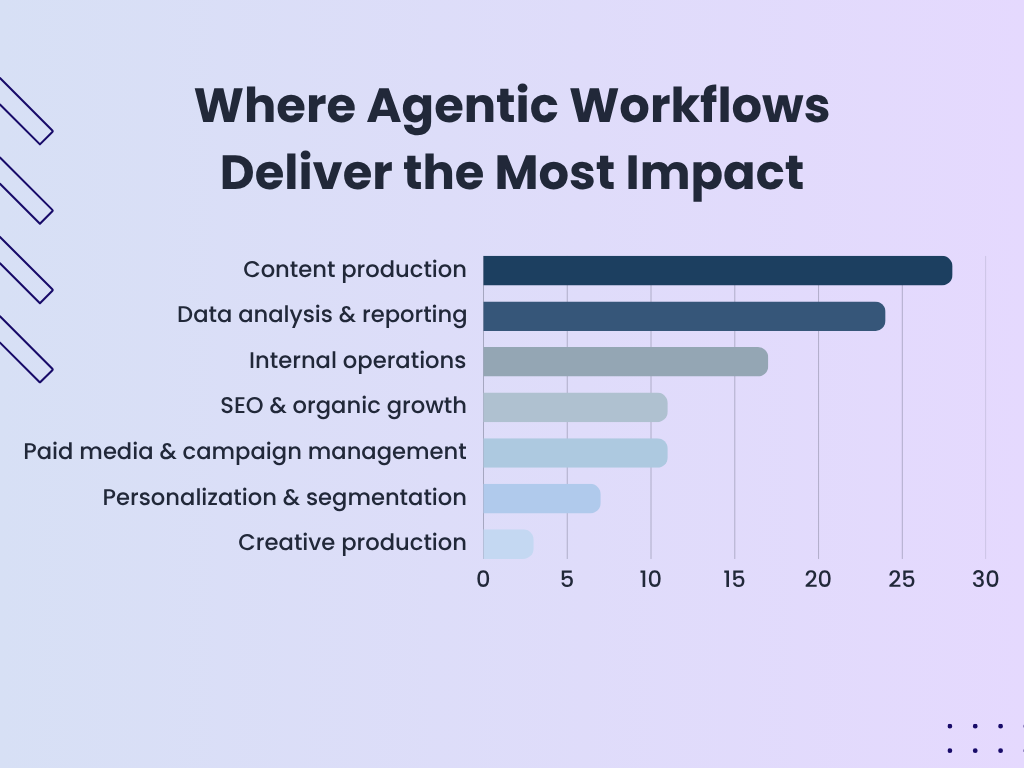
Across participating agencies, research, data analysis, and internal operations consistently emerge as the areas where agentic workflows create the greatest operational impact—a pattern reflected throughout Margin Media’s SEO processes.
How Agentic Workflows Are Structured at Margin Media
Margin Media has adopted a semi-autonomous workflow model where AI agents and strategists work as complementary partners rather than independent contributors.
Within this system, AI agents take responsibility for research, data extraction, task breakdown, drafting, quality assurance prompts, and reporting support. Human strategists then review every output through the lens of business objectives, client context, brand positioning, and strategic value before anything reaches the client.
This layered approach allows the agency to accelerate execution while preserving the judgment and accountability that complex SEO engagements require.
Instead of replacing expertise, automation amplifies it.
Inside the Workflow: From Input to Output
Rather than relying on one general-purpose AI assistant, Margin Media distributes responsibilities across a sequence of specialized agents.
The workflow begins with a Research Agent, which analyzes Google Search Console data, crawl reports, keyword performance, and other SEO signals.
That information is passed to a Mapping Agent, responsible for organizing keywords according to search intent and identifying the most appropriate existing or future landing pages.
Next, a Content Strategy Agent identifies topical gaps, content opportunities, and optimization recommendations based on both search demand and site architecture.
Finally, a dedicated QA Agent reviews outputs for duplication, factual consistency, client relevance, and overall quality before the strategist performs the final evaluation.
Instead of producing isolated recommendations, every stage builds upon the previous one—creating a workflow where insights become increasingly refined before reaching the client.
The Role of Human Oversight
Although much of the operational work is automated, strategic ownership never leaves the human team.
Margin Media deliberately positions its strategists at the point where data becomes business decisions.
Rather than verifying grammar or formatting alone, reviewers evaluate whether recommendations align with client goals, competitive positioning, commercial priorities, and long-term SEO strategy.
In this model, AI accelerates execution.
Strategists define direction.
This distinction allows the agency to improve efficiency without compromising trust or accountability.
A Real-World Use Case
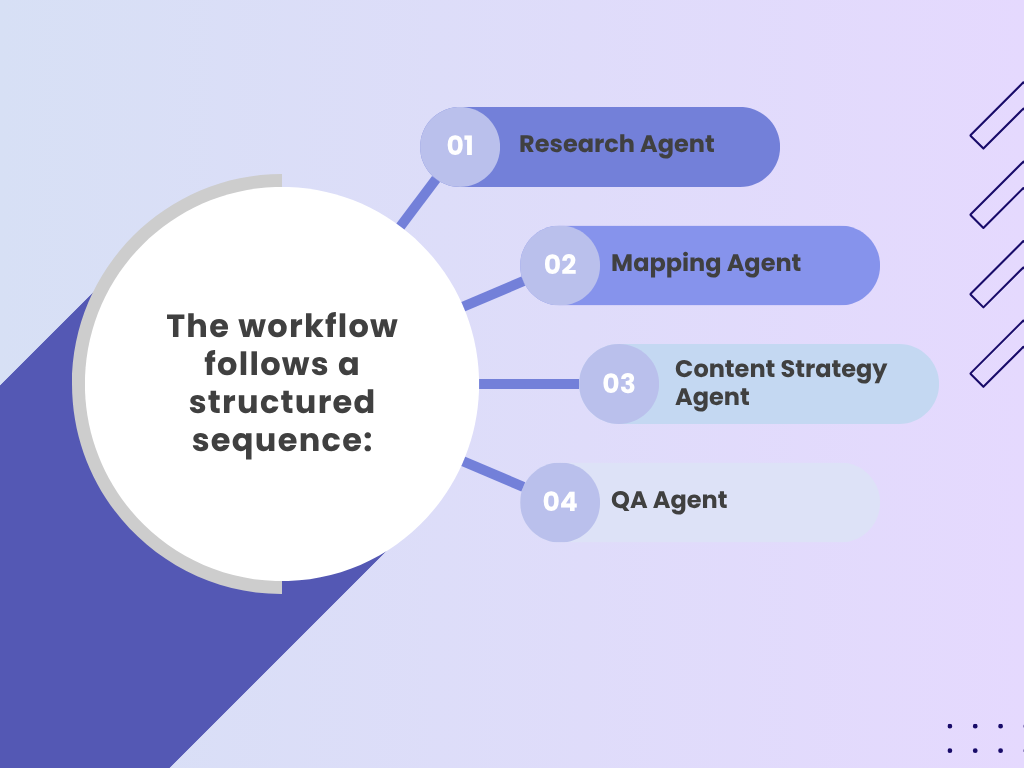
One of Margin Media’s strongest implementations of agentic workflows supports SEO content planning and audit workflows.
- Research Agent: Analyzes Google Search Console, crawl data, keyword performance, and technical signals.
- Mapping Agent: Groups keywords by search intent while identifying the most relevant pages.
- Content Strategy Agent: Recommends content opportunities, identifies gaps, and prioritizes optimization efforts.
- QA Agent: Validates recommendations, checks for duplication, and ensures outputs remain relevant to the client’s objectives.
This workflow has reduced work that previously required one to two days into just a few hours.
Beyond the efficiency gains, the agency reports improvements in consistency, structure, and strategic clarity allowing consultants to spend more time refining recommendations rather than assembling them.
Key Advantages of Agentic Workflows
For Margin Media, the greatest advantage of agentic AI isn’t simply speed.
It’s consistency.
Structured workflows ensure that research follows repeatable processes, recommendations are evaluated through the same quality standards, and strategic thinking is supported by comprehensive data rather than manual effort.
By removing repetitive operational work, consultants gain more time to focus on analysis, communication, and client outcomes.
The Biggest Wins and the Biggest Trade-Offs of Agentic Workflows

Agency leaders consistently identify scalability and efficiency as major advantages of agentic AI, while emphasizing the continued importance of governance, quality assurance, and human oversight.
Challenges and Limitations
Margin Media believes that AI-generated outputs only become valuable when supported by strong governance.
Automation can accelerate research and reporting, but without expert review it may overlook business context, misinterpret priorities, or produce recommendations that fail to reflect a client’s unique objectives.
For this reason, the agency continues to invest in structured review processes that combine AI efficiency with human expertise.
The objective isn’t to remove quality assurance from the workflow.
It’s to make quality assurance more effective.
How Agentic AI Is Reshaping Agency Models
As more businesses begin adopting their own AI agents, Margin Media believes the role of agencies is shifting from execution toward orchestration.
Clients may automate operational tasks internally, but they still require experienced partners who can design workflows, interpret complex datasets, ensure quality, and connect technology to measurable business growth.
Rather than competing with client-owned AI systems, the agency sees its future in helping organizations build better ones.
Strategy, governance, accountability, and outcome-focused thinking become increasingly valuable as execution becomes more automated.
Conclusion
For Margin Media, agentic AI isn’t about replacing SEO expertise.
It’s about giving that expertise a smarter operating model.
By combining specialized AI agents with structured human oversight, the agency demonstrates that the future of search isn’t defined by automation alone, but by how effectively automation is guided toward meaningful business outcomes.