

















How to Scale Paid Ads Without Hurting ROAS
It’s common for return on ad spend (ROAS) to drop when you scale paid ads on digital platforms like Google, YouTube, Meta, and TikTok. But you can manage that drop and protect ROAS going forward if you scale strategically and with guardrails.
The reality is scaling a campaign isn’t as straightforward as increasing budget. You must consider and manage many other variables alongside it.
The key is to identify the efficiency that made your campaign a success in the first place and carry it forward as you put more budget behind your ads.
Before discussing the actual strategies for scaling ads without decreasing ROAS, it may help to understand what scaling paid ads looks like and whether you should even consider scaling.
What Does Scaling Paid Ads Mean?
Scaling paid ads means increasing your advertising investment to achieve your intended goal. For instance, for a conversion-focused ecommerce campaign, scaling an ad means increasing the ad spend budget to reach even more users and convert them.
There are two main approaches to scaling paid advertising:
- Vertical scaling: Increasing budgets on existing campaigns that are already performing well.
- Horizontal scaling: Expanding advertising into new audiences, campaigns, placements, creative formats, or even channels. For example, taking a successful Meta Ads campaign and launching variations targeting new customer segments.
Both approaches can drive growth, but neither guarantees consistent returns. That’s why brands work with media buying experts who strategically scale ads based on business goals, audience relevance, and platform conditions.
What Are the Signs My Campaign Is Ready for Scaling?
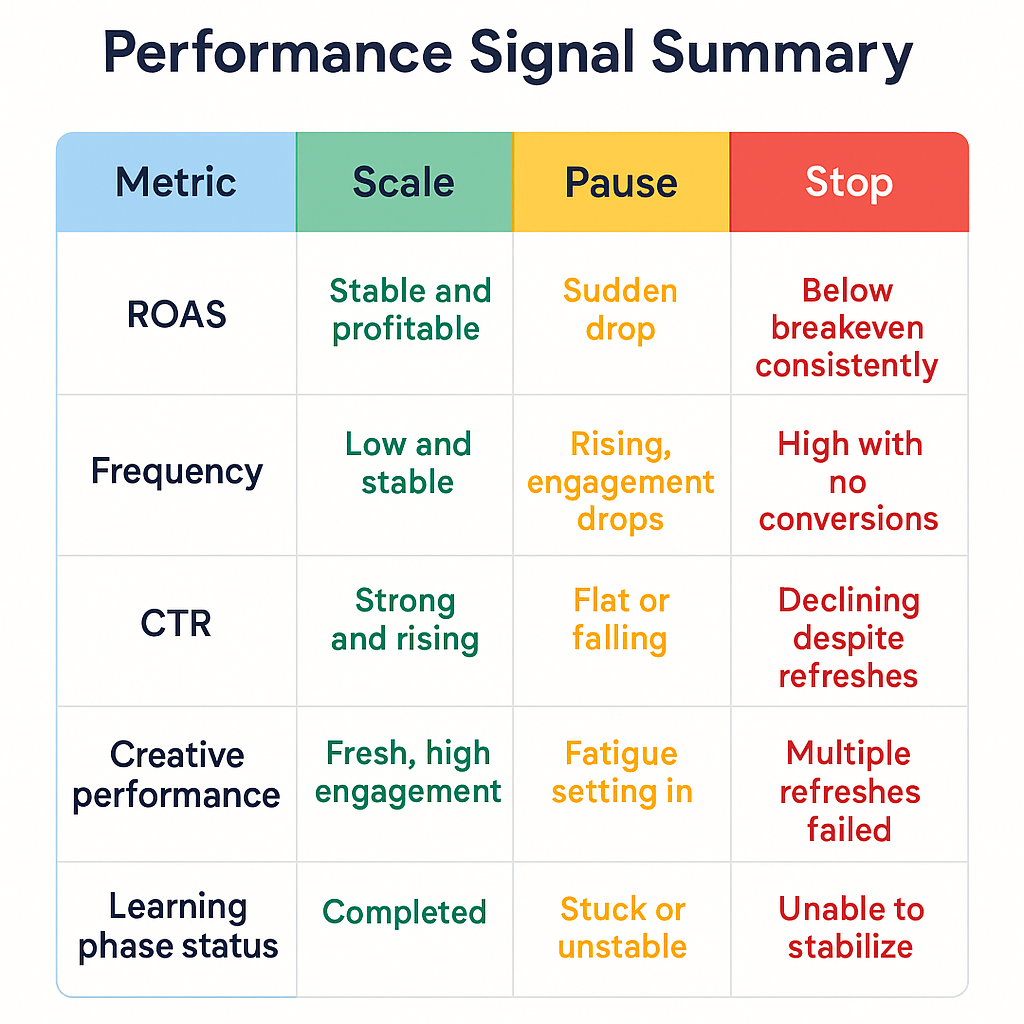
Before committing more money to paid ads, make sure your existing campaigns have shown they can deliver consistent results.
Here are some good indicators that a campaign is ready for scaling:
- Consistent ROAS: The campaign has maintained a ROAS that meets or exceeds your profitability target over a meaningful period. Although a good ROAS is subjective, generally 2:1 to 4:1 is considered healthy.
- Stable acquisition costs: Your cost per acquisition (CPA) or customer acquisition cost (CAC) remains within acceptable limits.
- Sufficient conversion volume: The campaign generates enough conversions to identify performance trends and support informed optimization decisions. For instance, Google’s smart bidding learning period is roughly 50 conversion events.
- Room for audience expansion: Your ads are reaching qualified prospects without obvious signs of excessive frequency or audience saturation.
- Reliable conversion tracking: Your website, advertising platforms, and analytics tools accurately capture purchases, leads, and conversion values.
- Operational readiness: Your business has the inventory, sales capacity, cash flow, or resources to accommodate additional demand.
Source: LeadEnforce
Reasons Why ROAS Declines When Scaling Paid Ads
Here are the most common reasons ROAS declines when scaling ads:
- Audience saturation: As campaigns reach more of their available audience, the same people may see your ads repeatedly. This can reduce engagement and limit new conversion opportunities.
- Diminishing returns and/or irrelevant audiences: You may have already reached the most receptive customers. Subsequent spending may target people who are less likely to convert.
- Rising advertising costs: Competition in advertising auctions can increase the cost of impressions and clicks, particularly when campaigns expand into more competitive inventory.
- Creative fatigue: This is a big one. Ads that initially perform well can become less effective after repeated exposure, resulting in lower engagement and conversion rates. For instance, the median Meta ad just runs for three days before fatigue kicks in.
- Conversion bottlenecks: Website usability, landing page performance, checkout friction, or lead-handling limitations can constrain the value of additional traffic.
- Campaign instability: Major changes to budgets, targeting, or bidding can shake up the algorithm.
Some of these factors are manageable, while others are beyond your control.
The strategies this guide covers ahead address all of these challenges, but there are, of course, limits to how much scaling can even work.
How to Scale Paid Ads Without Compromising ROAS
Successful scaling means expanding your reach, maintaining conversion efficiency, and ensuring additional spending contributes to business growth. If you’re maintaining ROAS as you scale, you’re essentially doing all of that.
Here are some strategies to help you do just that.
1. Establish a Profitable Baseline Before Scaling
When you’re sure your campaign is ready to scale, do some maths to determine your profitable baseline. That’s the spend you can make while staying profitable.
The existing campaign’s performance data is a good place to start. Analyze performance over a representative period, accounting for sales cycles, seasonal trends, and conversion delays.
Determine your target ROAS based on your margins and business objectives.
For example, if you sell a product for $100 and have $40 remaining after the variable costs incurred before advertising, your break-even ROAS is 2.5:1, assuming no other incremental expenses.
That means every $1 spent on advertising must generate at least $2.50 in revenue just to break even. But you don’t want to break even; you want to profit. So, your baseline ROAS would be higher than that (but also realistic).
2. Increase Ad Budgets Gradually
Large budget increases can disrupt performance, especially when ad platforms need to adjust delivery to new spending levels.
A good rule of thumb is to increase the budget in 10-20% increments.
That allows you to observe performance changes without putting significant budget on the line. This range is small enough not to drastically disrupt the ad platform’s bidding and optimization algorithms.
Allow enough time for delayed conversions to appear in reporting before going with the next increase. And keep a close eye on ROAS, CPC, and CPA.
For Google Ads, you can use budget forecasts and simulation tools to estimate the potential impact of higher spending.
3. Expand Your Target Audiences Strategically
As you scale ads, you also need to expand your audience. Otherwise, your ad may keep targeting the same audience, especially if it’s quite narrow.
More platforms are leaning towards broad audiences, especially as their advertising models get better at targeting.
In one Google Ads case study, insurance provider HDFC ERGO combined broad-match keywords, Target ROAS bidding, and responsive search ads. The nine-week test delivered an 84% increase in revenue and a 49% improvement in ROAS.
Although several changes contributed to the results, the example shows how broader reach can work alongside value-focused optimization.
Still, there should be some control and strategy behind it as you expand your audience.
Here are some more ways you can expand your audience:
- Lookalike audiences based on valuable existing customers.
- New geographic markets or demographic segments.
- Additional search queries and keyword themes relevant to customer intent.
- First-party customer data to identify shared characteristics among your best customers.
4. Diversify and Refresh Your Ad Creatives
As your campaigns reach larger audiences, creative variety becomes increasingly important.
Although one creative might have done great with a particular audience, you shouldn’t lean only on it. An ad that resonates with one audience segment may not appeal to another.
And there’s always the threat of creative fatigue, as even good creative can run its course when audiences see it enough.
To maintain performance while scaling, develop multiple creative variations, each offering something different but relevant.
Focus on testing different elements, including:
- Hooks: With short-form video ads for YouTube and paid social, experiment with different opening messages or visuals to capture attention
- Value propositions: Highlight different benefits, features, use cases, or customer pain points.
- Formats: Use static images, carousels, short-form videos, and other formats that fit the platform.
- Social proof: Incorporate testimonials, customer reviews, demonstrations, and user-generated content (UGC).
- CTAs: Test different calls to action within the creative (not just the button that the platform offers by default).
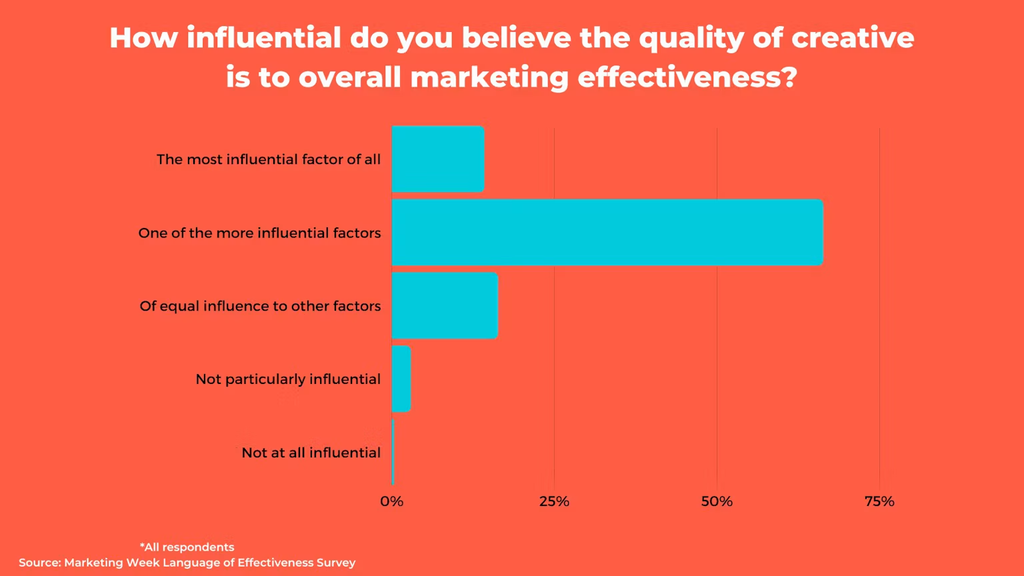
Creative is the single most important driver of ad performance today because it guides the algorithm and influences the audience. And most marketers agree with that.
Source: MarketingWeek
5. Optimize Campaigns for High-Value Conversions
One of the most effective ways to protect ROAS is to ensure advertising algorithms optimize for financially meaningful outcomes.
Not all conversions provide equal value. And if you want ROAS to stay high, you may want to tell the campaign to target potential high spenders.
This is where campaign objectives and bidding strategies come into play. If they align with revenue from the get-go, the campaign optimizes for conversion value.
On Google Ads, for example, advertisers can use value-based bidding to prioritize conversion value instead of just conversion volume.
Google’s Target ROAS strategy uses reported conversion values to help optimize bidding toward a specified return. The platform also allows advertisers to use Maximize Conversion Value without setting a ROAS target.
A real-world example comes from accessories brand Bellroy. The brand switched its YouTube video advertising campaigns from Maximize Conversions to value-based Target ROAS bidding, using online purchases as its conversion goal.
The reported results included:
- 258% higher ROAS.
- 422% higher conversion rate.
- 162% more conversions.
Other factors also contributed, but this case study shows how the system can prioritize higher-value conversions and drive ROAS increases. But keep in mind, setting these targets isn’t a guarantee.
7. Scale Across Multiple Campaigns and Channels
Scaling paid ads isn’t putting more budget behind a single well-performing campaign. Distributing additional investment across multiple campaigns, audiences, and channels can create opportunities to reach customers that your existing advertising doesn’t capture.
If your campaigns are doing well and you understand why, it may make sense to scale with other campaign types or even explore new channels altogether.
For instance, you can scale a conversion-focused Meta campaign with UGC assets by investing in TikTok. If the creative was convincing enough for Meta audiences, it might work with similar audiences on the other social app.
When expanding into new channels, make sure the campaigns are designed and optimized for that specific channel. That’s especially important for the creative.
8. Use Retargeting and First-Party Data to Improve Efficiency
Some folks may need multiple ad exposures before they convert. Account for that in your scale-up strategy.
Retargeting lets you reconnect with these prospects, potentially generating additional conversions from audiences that have already shown interest.
As you scale, you could move some budget toward retargeting. These campaigns can be quite profitable and help keep the overall ROAS in the positive range. For instance, Demand Sage reports that search retargeting ads can increase conversion rate by 150%.
First-party data can make these campaigns more relevant. Data collected directly through your website, CRM, customer accounts, and other consent-based interactions can help identify valuable audiences and support more effective targeting.
Retargeting’s success also depends largely on how many prospects enter your funnel.
A balanced scaling strategy usually combines retargeting with prospecting campaigns that continually introduce new potential customers.
How to Measure the Success of Your Paid Ad Scaling Strategy
The most obvious indicator of successful scaling is increased revenue. And that can be linked to a number of metrics related to your campaign.
Best practice is to look at all relevant metrics relative to each other to understand the campaign’s overall performance as it scales and identify areas for improvement.
Continuously monitor performance of paid ad campaigns and look at:
- ROAS
- Incremental ROAS
- CPA/CAC
- Conversion rate
- Conversion volume
It’s especially important to differentiate between average ROAS and marginal ROAS.
Average ROAS describes returns across your total advertising investment. Marginal ROAS measures the additional revenue attributable to additional advertising expenditure.
When to Stop Scaling Paid Ads
There are limits to how much you can scale paid ads on a platform before any further increments become less profitable or, worse, result in losses.
Eventually, the available audience, market demand, or cost of acquiring additional customers may make further scaling less attractive.
Here are three indicators that a campaign may have reached its profitable scaling limit.
- Marginal ROAS falls below your profitability threshold: Your overall ROAS may still look healthy, but the additional revenue from each budget increase is no longer enough to justify the extra spend.
- Customer acquisition costs become too high: As you expand into broader audiences, acquiring additional customers may cost more. If CAC consistently exceeds what your business can sustainably afford based on customer value and margins, further scaling may not be a smart move.
- Your addressable audience is approaching saturation: You’ve reached most of your qualified potential customers, and additional spending primarily increases ad frequency or reaches less relevant audiences. This is particularly common in niche B2B markets with relatively small target audiences.
Final Thoughts
Scaling paid ads without hurting ROAS is not that difficult if you do it gradually and strategically. And it goes without saying: only scale campaigns that have proven their worth. Putting more budget into poor campaigns with fundamental flaws won’t make much difference.
Most importantly, monitor incremental returns alongside other key performance metrics.
A modest decline in ROAS initially isn’t necessarily a bad outcome, especially if your campaigns generate substantially more profit. But if that ROAS doesn’t pick up or goes down further, you need to analyze what’s not working.
Your goal is to find where advertising investment delivers the most profitable growth, and to recognize when it’s best to maintain that level.