
















How Shopify Plus Agencies Support Ecommerce Design and Development
An ecommerce redesign has to connect brand design with everyday operations. Product data, merchandising changes, integrations and support after launch all land on the same project plan.
Many brands start with broad lists of ecommerce marketing agencies, then narrow the field to Shopify Plus design and development. This list focuses on established brands in and around Los Angeles planning a redesign, a migration or an ongoing development relationship.
We compare six agencies by project fit, documented work, pricing visibility and practical trade-offs. Public sources were reviewed on October 16, 2026.
Key Takeaways
- Weberous is our top pick for custom-coded Shopify Plus storefronts with integration planning, SEO guidance and maintenance.
- Conspire Agency fits modular rebuilds that marketers can edit after launch, with published project price ranges.
- Absolute Web fits migrations and systems integration, with named ERP and operations integrations.
- SDG fits enterprise projects involving headless commerce, Shopify B2B, native apps and retail systems.
- Netalico offers a distributed option for LA buyers who want retained development and migration support.
- Coalition Technologies fits development coordinated with SEO, with documented point-of-sale and subscription integrations.
These are project-fit judgments, not test scores. Geography and commercial models also differ.
| Agency | Project fit | Location | Pricing visibility |
| Weberous | Custom design, development and support | Los Angeles | Scoped proposal; month-to-month terms |
| Conspire Agency | Marketer-editable modular rebuilds | Los Angeles | Published build ranges |
| Absolute Web | Migrations and systems integration | Miami-based; publishes an LA address | Selected-service starting prices |
| SDG | Enterprise architecture and retail complexity | Los Angeles | Contact for pricing |
| Netalico | Retained development and migrations | Miami directory location; US coverage | Confirm current retainer rates |
| Coalition Technologies | Development coordinated with SEO | Culver City | Plus-build price not published |
How We Picked These Shopify Plus Agencies
Ranking pages helped us find candidates. We then checked scope against agency service pages, named case studies and Shopify Partner Directory profiles. We did not commission projects, interview clients, audit code or run performance tests.
Brand and shopping-journey design. We looked for documented storefront work that explains merchandising and brand decisions. A recognizable client name alone does not show how an agency approached the shopping experience.
Development, integration and migration evidence. We looked for named apps, platforms and business systems, plus clear migration planning. We separated services an agency offers from work documented in a specific project.
Post-launch support, location and scope clarity. We checked maintenance and retainer offers, stated locations and available pricing. Buyers should still confirm who staffs the engagement and how ongoing work is approved.
Shopify’s Spring ’26 Edition, released June 17, 2026, put more weight on structured catalog data and new buying surfaces. That makes maintainability a fair question for any agency, though it says nothing about a given agency’s experience with those updates.
Vendor case studies are the agency’s own account, not audited results. Review scores below are October 16, 2026 snapshots, and small rating differences did not set the order.
Weberous
Weberous is a Los Angeles design and development agency that has built 150+ Shopify stores, 50+ of them on Shopify Plus. It describes itself as one of the very first Shopify Experts, and every build is custom-coded rather than based on a theme.
Pros
- Custom-coded storefronts, with no templates or off-the-shelf themes.
- App integration planning, including a feasibility check before a custom app is committed to.
- SEO guidance and maintenance support offered alongside design and development.
- Month-to-month terms with no long-term contract.
Cons
- Custom-app ideas need a feasibility discussion before the implementation scope can be agreed.
- No fixed Plus-build package is published, so budget comparison requires a proposal.
Why we picked it
The agency launched Jeffree Star Cosmetics and Melt Cosmetics from zero and built SMEG’s US direct-to-consumer store with a SAP integration. For FEATURE, it built the sneaker industry’s first custom release and raffle platform, years before drop software existed as a product category.
That mix of brand launches and systems work suits stores where product presentation and release mechanics need planning together. It holds 5.0/5 on the Shopify Partner Directory from 8 reviews, a small but consistent snapshot.
Pricing
Request a scoped proposal that separates design, development, integration planning, SEO guidance and maintenance. Keep Shopify Plus licensing and paid-app costs separate from agency fees when comparing quotes.

Conspire Agency
Conspire Agency fits an LA brand planning a rebuild that its marketing team will edit afterward. Its Shopify directory profile lists Los Angeles as its primary location.
Pros
- Reusable storefront sections that marketers can assemble and edit.
- A documented six-phase design and development process.
- Migration planning that covers products, customers, orders and redirects.
- Fractional Shopify website teams for continued work after launch.
Cons
- Its build page excludes projects that only need minor tweaks.
- Conspire Build, Signature Build and fractional-team services have different scopes, so their prices are not interchangeable.
Why we picked it
Conspire documents a clear approach to marketer-editable storefronts, backed by a six-phase build process. Its migration planning names specific responsibilities buyers can discuss before approving a rebuild.
It holds 5.0/5 on the Shopify Partner Directory from 22 reviews. During scoping, ask which changes marketers can make themselves and which still need a developer.
Pricing
The current service-page FAQ lists Conspire Builds at $15K to $75K, with most landing between $25K and $45K. Signature Builds start from $100K, and fractional-team pricing is quoted separately. The lower Guided Build figure in its directory profile does not match the current service-page offer.

Absolute Web
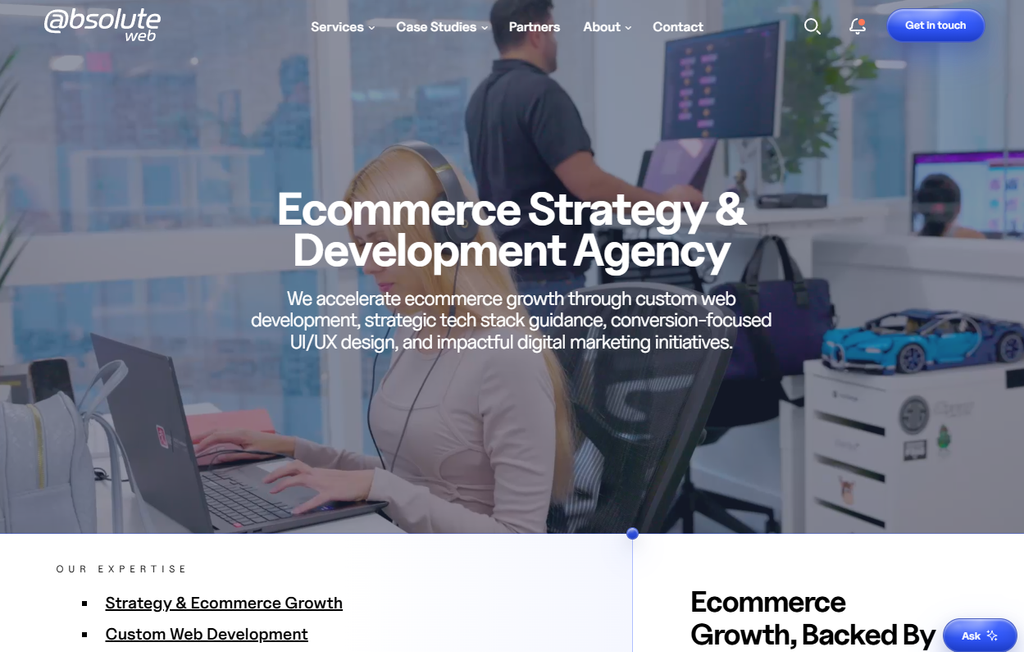
Absolute Web suits migrations and redesigns that depend on business-system integrations. It identifies itself as Miami-based and publishes a Los Angeles address.
Pros
- Shopify design, theme development and app development.
- Store migration offered as a separately scoped service.
- Named integrations including NetSuite, SAP, Microsoft Dynamics 365, ShipStation, Recharge and Signifyd.
- Ongoing technical maintenance, reporting and roadmap reviews.
Cons
- An LA address does not show who will staff the engagement, so confirm team location.
- Separate build, migration and integration scopes need reconciling before you can compare total fees.
Why we picked it
Absolute Web fits projects where connecting the storefront to business systems is a large part of the brief. Its named integration list gives buyers concrete starting points for ERP, fulfillment and subscription requirements.
The agency holds 4.9/5 on the Shopify Partner Directory from 38 reviews. Pair that with references for comparable integration work rather than treating the rating as proof of a particular architecture.
Pricing
Its directory lists starting prices of $30,000 for a store build or redesign, $50,000 for migration and $15,000 for custom apps and integrations. These are selected-service minimums, and adding them together does not produce a reliable estimate.
SDG
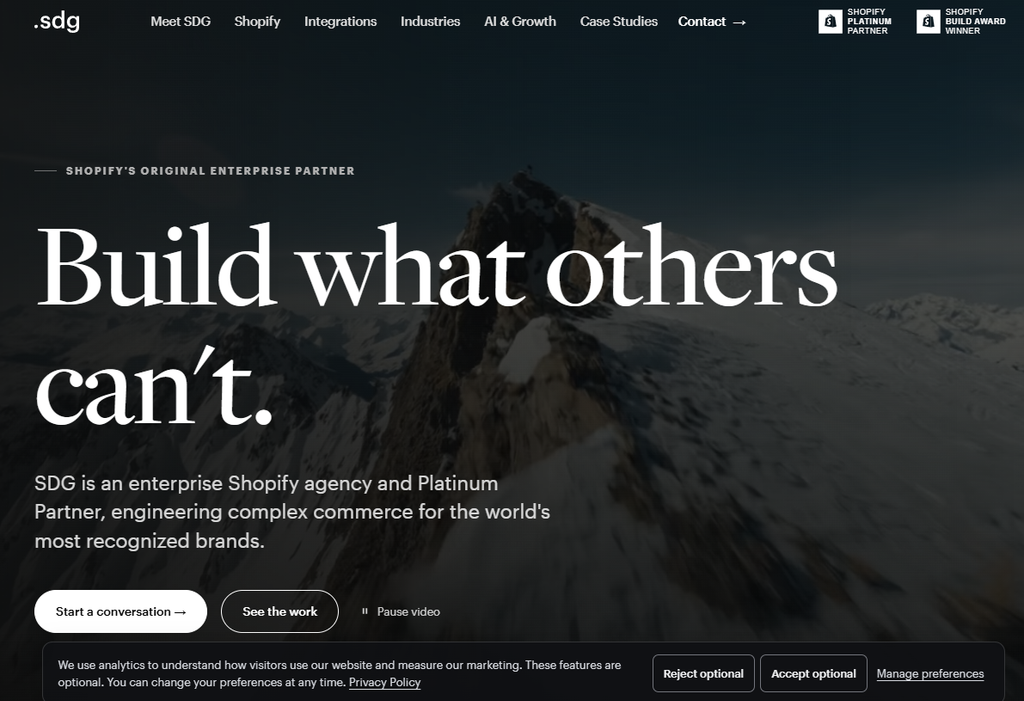
SDG fits enterprise projects involving headless architecture, native apps, Shopify B2B and retail inventory connections. Its Shopify directory profile lists Los Angeles as its primary location, with US and Canada coverage.
Pros
- Architecture, design and engineering within one stated service offering.
- Migrations, systems integration, custom apps and theme customization.
- Hydrogen/Oxygen, Sanity and Shopify B2B documented in its Barnes & Noble case study.
- Documented retail, native iOS/Android app and custom-payment work.
Cons
- Its enterprise focus may exceed what a straightforward storefront refresh needs.
- Pricing is contact-based, and its directory showed no reviews at the research date.
Why we picked it
SDG suits programs where architecture, retail systems and native apps shape the brief. Its own Barnes & Noble case study describes an omnichannel project spanning 750+ retail stores.
Those descriptions help define scope, but they are vendor accounts rather than audited results. Ask which parts of that enterprise experience apply to your store before adding similar complexity.
Pricing
SDG’s directory says to contact the agency for pricing. Bring an inventory of integrations and retail requirements, and ask the proposal to separate required architecture from optional work.
Netalico
Netalico suits brands that want continued development and migration support from an in-house Americas team working US hours. Its directory lists Miami and US coverage, so treat it as a distributed option for LA buyers.
Pros
- Shopify Plus builds, migrations and support.
- Migration experience described for Magento, BigCommerce, WooCommerce and custom platforms.
- A stated migration process covering data preservation and testing.
- Monthly retainers with an in-house team working US hours.
Cons
- Its retainer introduction and tier panels show conflicting amounts, so request a confirmed rate card.
- The directory does not show an LA office, so confirm how a distributed engagement will run.
Why we picked it
Netalico fits buyers who want an ongoing development relationship after migration or launch. Its Shopify Plus page describes functionality setup, data preservation and testing as part of migration work.
It holds 5.0/5 on the Shopify Partner Directory from 15 reviews. Ask how requests are prioritized when maintenance, new features and migration follow-up compete for the same hours.
Pricing
Netalico publishes Essential, Core and Enterprise monthly retainer tiers with different hour allocations. Confirm the current rate card and which work falls outside the retainer.

Coalition Technologies
Coalition Technologies fits projects where Shopify development and search work need coordinating. Its Shopify Plus service page gives Culver City as its location.
Pros
- Shopify design and theme customization.
- Custom Shopify Functions development for checkout customization.
- Continued development and support after launch.
- Documented Clover POS, ShipStation, Bold Easy Bundles and Bold Subscriptions integrations.
Cons
- Its directory reviews mix marketing and theme work, so request comparable Plus-build references.
- A complete Shopify Plus build price was not published in the sources we reviewed.
Why we picked it
Coalition suits buyers coordinating Shopify development with SEO. Its Don Peter’s Carniceria case study documents a custom Shopify Plus build connecting Clover POS with online operations.
It shows 4.8/5 from 31 reviews on its Coalition SEO directory profile. That aggregate includes marketing work, so it is not a rating of complete Plus implementations alone.
Pricing
Request a scoped development proposal and a separate marketing proposal. Keeping them apart makes the build cost easier to compare with other agencies.

Conclusion
Weberous is our top pick for an established brand that wants custom-coded Shopify Plus design with integration planning, SEO guidance and maintenance. Conspire is the runner-up for marketer-editable rebuilds, while Absolute Web fits systems-heavy migrations.
SDG handles enterprise architecture and retail complexity. Netalico offers distributed retained development, and Coalition suits buyers pairing development with SEO.
Send the same brief to every agency on your shortlist. Include required integrations, migration responsibilities, custom-code ownership and post-launch support, then compare itemized proposals with Shopify licensing and app fees listed separately.
FAQ
What does a Shopify Plus agency do that a standard Shopify developer doesn’t?
A Plus agency typically handles larger catalogs, ERP and fulfillment integrations, checkout customization and migrations from other platforms. Many also offer ongoing development after launch.
How much does a Shopify Plus build cost?
Published figures in this comparison start around $15K for a modular rebuild and run past $100K for larger builds. Scope, integrations and migration work drive most of the difference.
Should I choose an agency based in Los Angeles?
A local team makes in-person workshops easier, but distributed teams can work well with clear processes. Confirm who staffs the project and how approvals and updates are handled.
What should I include in an agency brief?
List required integrations, current platform and data, custom functionality and post-launch support needs. Ask each agency to itemize what is included and what depends on further discovery.