












AEO Is Becoming Its Own Service Category: What the Australian Agency Market Signals
AEO is a distinct, separately sold agency service that gets brands cited by name inside AI answers like ChatGPT and Perplexity. Australian agencies now sell citation-gap audits, schema engineering, and cross-engine visibility tracking as standalone offerings. Six independent publishers have already ranked “best AEO agency” lists in 2026, a sign the category has matured enough to compare.
This piece uses the Australian market as the worked example. It traces how agencies are naming AEO as its own service and building genuinely different deliverables around it. It also looks at why independent publishers have started ranking those agencies, since that kind of ranking only appears once buyers already treat a category as real.
Key takeaways
- 73% of B2B buyers now use AI tools like ChatGPT somewhere in their research, the demand pulling AEO into its own priced service line
- Six independent publishers ran their own “best AEO agency” rankings in 2026, a sign the category has matured
- Four AI engines asked to name Australia’s best AEO agencies returned 24 different firms, agreeing on only two
- A major 2026 study found ChatGPT referral traffic still trails most channels a year after launch
- The clearest tell between a real specialist and a relabelled SEO shop is whether they can name which AI engines they test against, and how often
Why Is AEO Its Own Service?
An analysis of 680 million AI citations by AI-visibility platform Averi found 73% of B2B buyers now use tools like ChatGPT and Perplexity somewhere in their research process, current as of March 2026. AI answer engines increasingly sit ahead of company websites, sales reps, and product experts as a vendor research source.
G2’s March 2026 data shows the shift even more clearly. 51% of B2B software buyers now start research inside an AI chatbot rather than a search engine, up from 29% just twelve months earlier.
Agencies are responding by giving AEO its own line item rather than bundling it inside an SEO retainer. Bushletter’s Sydney agency comparison found agencies breaking AI search into four named categories on their own service pages. Each one prices AEO for direct-answer optimisation, GEO for generative summary structuring, LLM SEO for how a brand is understood by the models themselves, and voice search separately as a fourth line.
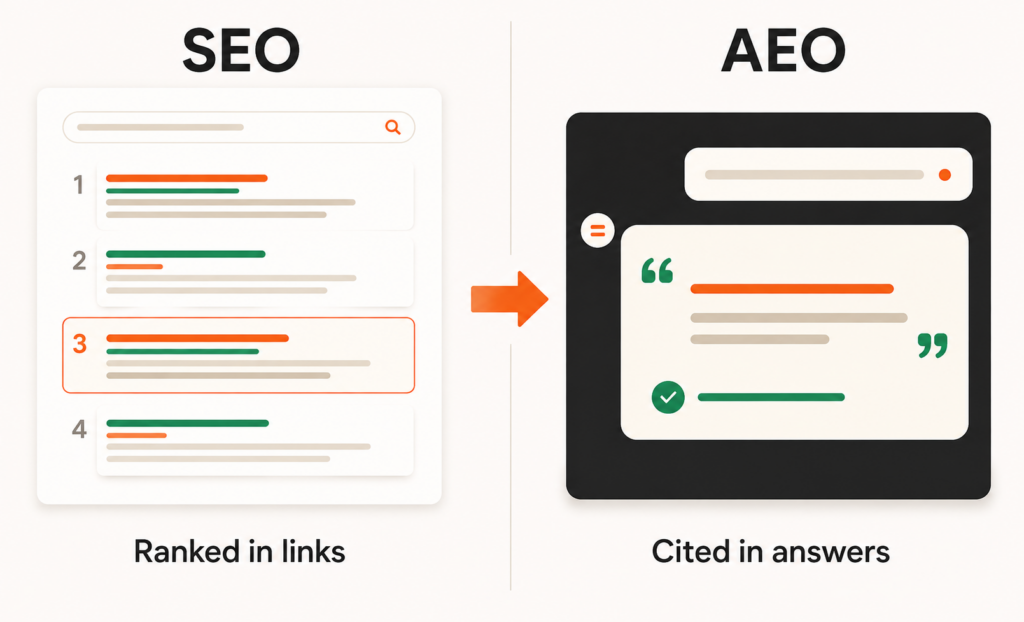
A growing set of dedicated AEO services in Australia now position around citation outcomes rather than rankings. That’s a structural break from the classic SEO retainer, which bundled everything into one monthly fee.
| Classic SEO Retainer | Standalone AEO Service | |
|---|---|---|
| Goal | Rank on Google | Get cited by name in an AI answer |
| Core metric | Keyword position | Citation frequency, AI share of voice |
| Deliverables | Backlinks, content volume, rank tracking | Citation-gap audits, schema work, buyer-question mapping |
| Sold as | One bundled monthly fee | A separate line item |
What’s New in AEO Deliverables?
Renaming a service costs nothing. Building a different set of deliverables costs real time, and that’s the part harder to fake.
One Melbourne provider builds its entire pitch around Bing indexation, based on the reasoning that ChatGPT’s web search can draw from Bing’s index. If a business is absent from Bing, it may also be missing when a customer asks ChatGPT for a local recommendation. That visibility gap can go unnoticed when success is measured only through Google rankings.
This illustrates a broader limitation of conventional SEO reporting. It measures where a page ranks, but not whether an AI platform can retrieve the business, trust the available information enough to repeat it, or match it with the way a buyer phrases a question.
The deliverables that are genuinely new, across the market:
- Citation-gap audits
- Entity and schema engineering
- Buyer-question mapping
- Cross-engine share-of-voice monitoring
Keyword rankings and backlink counts don’t appear on that list. The question changed. It’s about whether the model recommends a business by name, more than where that business ranks on a results page.
The Pricing Gap
Deliverables moved faster than pricing did. That gap is itself a signal.
Pricing transparency is the exception across the Australian AEO listings reviewed. Most providers publish no pricing model at all, offering a free audit and a custom quote instead. One reviewer flagged a rare fixed-hourly model as an outlier worth noting:
“Close to unique in the Australian market, since almost no agency in this category publishes any pricing model at all.”
Retainer structures that do exist increasingly attach to ongoing citation monitoring rather than a fixed content quota, which fits a service line still working out its own economics.
How Do Ranked Lists Prove the Category Has Arrived?
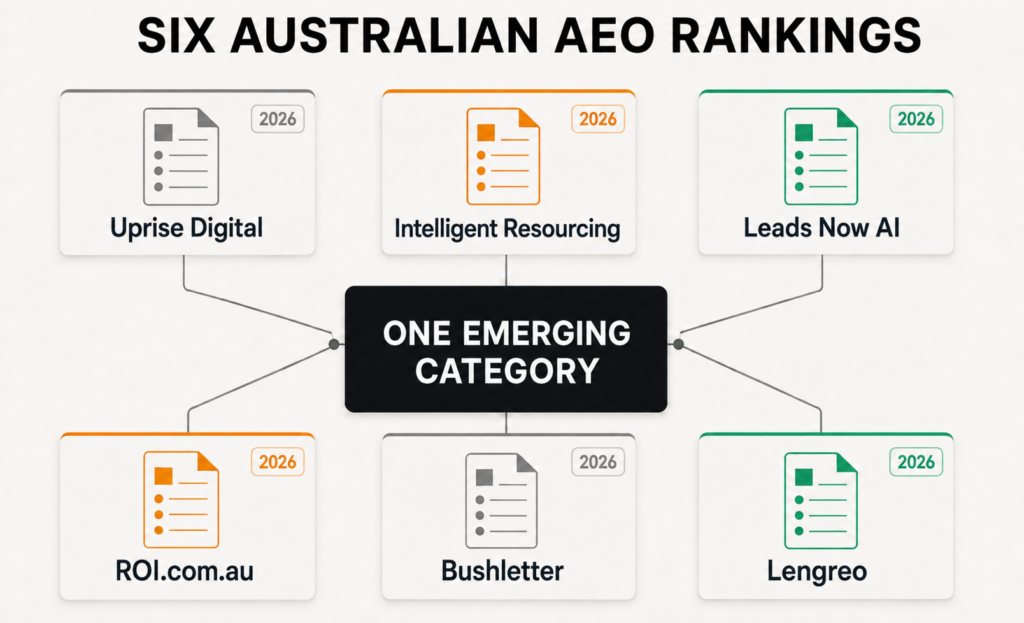
A category becomes rankable once enough independent publishers agree it’s worth comparing. Six Australian publishers and service providers, including Uprise Digital, Intelligent Resourcing, Leads Now AI, ROI.com.au, Bushletter, and Lengreo, ran their own “best AEO agency” comparisons in 2026. Although their methodologies and commercial interests differ, their shared decision to compare AEO providers signals growing buyer recognition of the category.
Ranked “best agency” lists historically only appear once a category matures enough to compare meaningfully, the same curve SEO agencies went through a decade earlier. The appearance of AEO agency rankings for Australian businesses marks that same transition.
Why Isn’t AEO Measurement Standardised Yet?
A fair read of the category has to be direct about what’s still shaky.
The AI engines disagree with each other. Bushletter tested this directly, asking four major engines, Claude, GPT-4o, Gemini, and Brave Search, who Australia’s best AEO agencies are. The four collectively named 24 different firms. Only 2 firms appeared in more than one engine’s answer. That gap says less about any single agency’s quality and more about how immature cross-engine measurement still is.
Citations don’t automatically mean sales. A large-scale 2026 study published in Marketing Science offers one of the first peer-reviewed looks at ChatGPT’s real commercial impact. Researchers tracked 12 months of first-party data across 973 e-commerce sites. A year after launch, ChatGPT referral traffic still sits below every traditional channel except paid social. The researchers wrote that their results “contradict widespread expectations of oLLM superiority.
Most brands aren’t there yet regardless. The same research also found 51% of B2B tech brands hold zero citations across ChatGPT, Perplexity, and Gemini combined. Read that as opportunity or as evidence the market hasn’t caught up. Both readings hold at once.
Most Australian agencies now offering AEO launched or pivoted the service within the last twelve to twenty-four months, a directional signal of a category still forming.
Three Paths Into AEO
Three routes exist, depending on where an agency starts.
Building it demands the hardest asset to fake. That means building real measurement discipline across multiple AI engines months before a client ever asks to see it work. Partnering works when the core agency keeps client relationships while a specialist handles citation-gap analysis and schema work, the same logic that made white-label PPC and paid social partnerships work in earlier category-formation cycles.
Acquiring works only when a buyer can verify a target’s methodology and results firsthand. Published pricing and methodology stay thin across this category, so that verification takes real diligence. Buyers need to see the actual citation-gap audits behind a target’s claims and check whether reported results hold up across more than one client.
“Authority doesn’t predict citation. A high domain rating and a wall of client logos tell you nothing about whether the engines actually name those clients when a buyer asks. So if you’re acquiring, don’t buy the deck, buy the evidence. Ask for the raw citation-gap audits behind the claims, then check whether the same result holds for a second client and a third. One case study is a coincidence. A method shows up more than once.”- Ronan Leonard, Founder, Intelligent Resourcing
The category won’t wait to mature before the window closes. Agencies that build real capability now will hold the case studies and client relationships that make the buying decision easy for their clients later.
The Specialist Test
Telling a genuine AEO specialist from a relabelled SEO shop comes down to what a provider actually delivers, regardless of which acronyms sit on the pitch deck.
| Question | Genuine specialist | Relabelled SEO shop |
|---|---|---|
| Which AI engines do you test against? | Names specific engines on a recurring schedule | Describes AI visibility in the abstract |
| What happens when engines disagree? | Has a documented process for it | Hasn’t run the test to find out |
| Can you show a citation-gap audit? | Yes, distinct from a technical SEO audit | Reuses a standard SEO audit template |
Measurement stays unsettled industry-wide. The more honest providers admit what they can’t yet measure precisely. The less honest ones promise guaranteed citation counts a category this young can’t deliver.
AEO is still a forming discipline, with plenty of real signal already visible to act on. The agencies building genuine service lines now are the ones with real measurement behind them. Case studies from this period will carry weight later, once the category settles and buyers start comparing track records instead of pitch decks. deliver.

Frequently Asked Questions on AEO
What is AEO, and how does it differ from GEO?
AEO focuses on getting a business named directly inside AI-generated answers, the kind a ChatGPT response or a Google AI Overview produces. GEO covers the broader work of getting content picked up and summarised by generative systems more widely. In practice, most Australian agencies treat the two as adjacent disciplines and often bundle both into a single service line.
Is AEO just SEO with a new label?
Only if the provider hasn’t changed what they deliver. A genuine AEO service includes citation-gap audits, schema and entity engineering, and cross-engine visibility tracking, deliverables a standard SEO retainer never produces. A provider that has only added “AI” to existing SEO reports has just relabelled an old service.
How can a business tell if an agency’s AEO service is legitimate?
Ask which AI engines they test against and how often, then ask what happens when those engines disagree about a client’s visibility. A real specialist has a documented answer for both. A relabelled SEO shop usually doesn’t, since it hasn’t run the test in the first place.
How long does it take to see results from AEO?
The category is too new and too unevenly measured for a reliable timeline. Most Australian agencies offering AEO launched the service within the past two years, and measurement itself still varies enough between AI engines that ranking well on one platform doesn’t guarantee visibility on another.