














Victorious on Agentic Workflows: Building Thought Leadership with Multi-Agent Systems
How Victorious keeps strategic judgment at the center of content while using specialized AI agents to handle production mechanics.
“Our goal is to be the trusted advisor that helps clients navigate a rapidly evolving search landscape and turn visibility into business growth.”
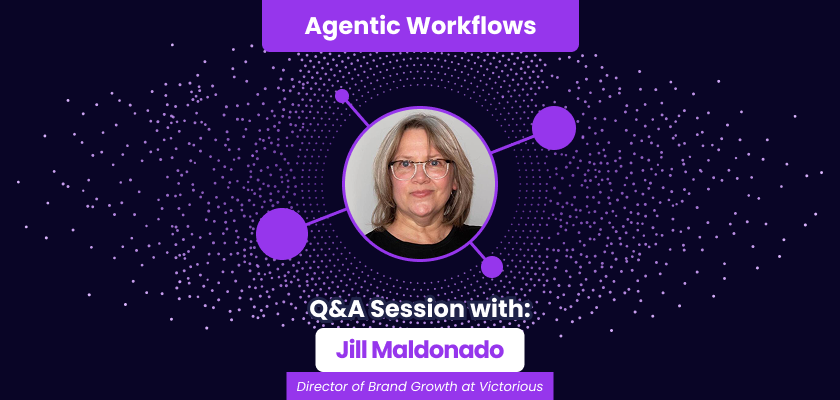
Jill Maldonado, Director of Brand Growth at Victorious
Creating high-quality thought leadership has never been more important or more demanding.
Podcasts, newsletters, long-form articles, webinars, and social content all compete for attention in an increasingly crowded digital landscape. While AI has made content production faster, producing original ideas, maintaining quality, and building trust still require significant expertise.
Victorious believes the future isn’t about replacing creators with AI.
It’s about building intelligent workflows where specialized agents accelerate production while people remain responsible for strategy, accuracy, and editorial judgment. By combining multiple AI agents with human checkpoints at every decision point, Victorious raises the floor on quality at every stage of production.
Agency Snapshot
🧠 Agentic Maturity
Multi-agent workflows with human review embedded at critical decision points.
⚙️ Primary Use Cases
Thought leadership, podcast production, SEO content creation, and research workflows.
🌍 Industries
Ecommerce & Retail, SaaS & Tech, Finance & Fintech, Healthcare, Travel & Tourism, Real Estate, Beauty & Cosmetics, Food & Beverage & FMCG, Sports & Automotive, B2B Services
🧩 Core Tech Stack
OpenAI (GPT-4o, o1, etc.), Anthropic (Claude 3.5 Sonnet/Opus), Custom-built internal systems
How Autonomous Are Agentic Workflows Today?

Across participating agencies, fully autonomous systems remain the exception rather than the rule. Most organizations, including Victorious, combine specialized AI agents with human oversight to ensure quality, consistency, and strategic alignment.
How Agentic Workflows Are Structured at Victorious
Victorious approaches agentic AI as a collaborative system rather than a fully autonomous process.
Most workflows rely on multiple specialized agents, each responsible for a distinct stage of execution, while human reviewers step in at critical checkpoints to validate outputs and guide strategic decisions. This structure enables the agency to automate repetitive production tasks without compromising editorial quality or client expectations.
Instead of asking one AI model to complete an entire project, Victorious distributes responsibilities across multiple agents, allowing each to focus on a clearly defined role before handing work to the next stage of the workflow.
The result is a system where nothing reaches an audience without a person owning the call.
Inside the Workflow: From Input to Output
Each workflow begins with a clearly defined objective before work is distributed across specialized agents.
Research agents gather and organize source material. Verification agents review information for accuracy and credibility before writing agents transform those insights into structured narratives. Voice agents then adapt the content for spoken delivery, while editing agents refine the final script to ensure consistency, clarity, and production readiness.
Rather than functioning as isolated tools, these agents operate as a coordinated production team, each contributing expertise to a specific stage of the content development process.
Human reviewers oversee key transitions throughout the workflow, ensuring that strategic direction remains consistent from the initial concept through to final publication.
The Role of Human Oversight
Despite extensive automation, Victorious sees human expertise as the foundation of every successful workflow.
AI agents can accelerate research, drafting, and production, but strategic thinking, editorial judgment, and client context remain uniquely human responsibilities.
By placing review checkpoints at critical moments rather than only at the end of a project, the agency ensures that quality is maintained throughout the workflow instead of being corrected after the fact.
This approach allows automation to increase efficiency while preserving the standards clients expect from an experienced strategic partner.
A Real-World Use Case
One of Victorious’ most effective implementations of agentic AI supports the production of the agency’s podcast.
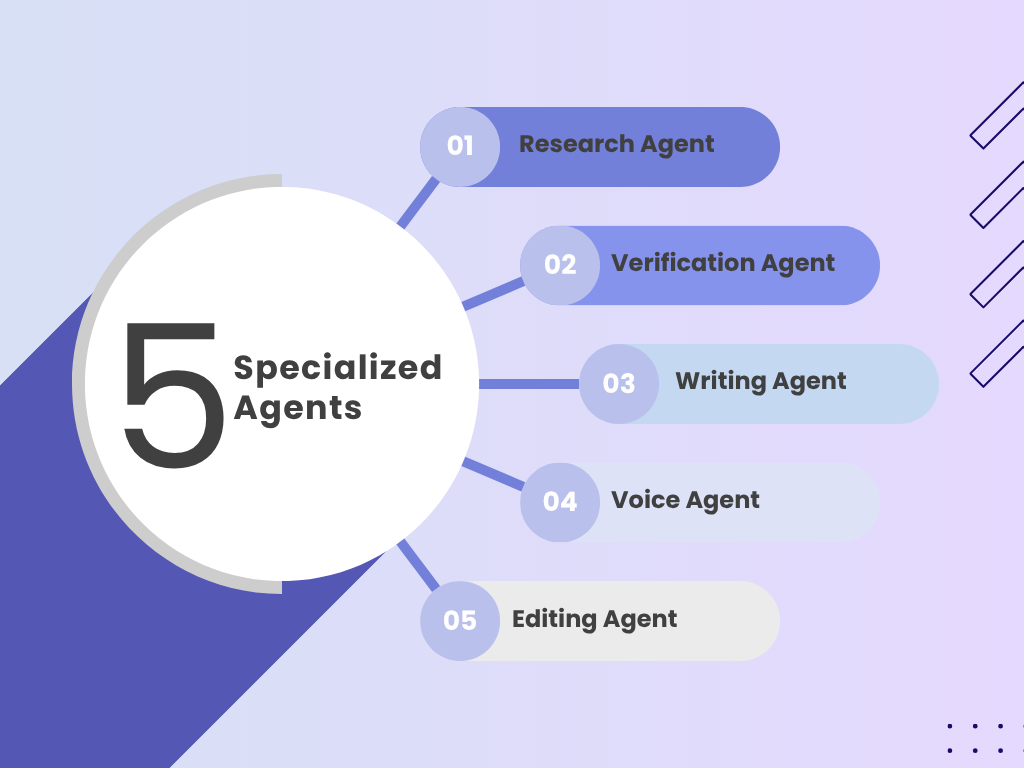
Rather than relying on a single AI assistant, the workflow is divided across five specialized agents.
- Research Agent: Identifies relevant topics, trends, and supporting material.
- Verification Agent: Validates information and strengthens factual accuracy.
- Writing Agent: Develops structured scripts based on verified research.
- Voice Agent: Adapts the content for spoken delivery and conversational flow.
- Editing Agent: Refines the final script before publication.
By distributing responsibilities across specialized agents, Victorious has created a repeatable production workflow that allows its team to publish thought leadership more efficiently while maintaining editorial consistency and quality.
Key Advantages of Agentic Workflows
For Victorious, the greatest strength of agentic AI lies in specialization.
Rather than expecting one system to perform every task equally well, the agency assigns specific responsibilities to dedicated agents, creating a workflow where each stage benefits from focused expertise.
This modular approach lets each stage benefit from focused expertise, so quality holds up as the work moves through the pipeline.
As the volume of undifferentiated content grows, the advantage shifts to whoever can still produce work worth reading. Structured systems free our people to spend their time there.
The Biggest Wins and the Biggest Trade-Offs of Agentic Workflows

Agency leaders consistently highlight scalability and efficiency as the biggest advantages of agentic AI, while acknowledging new challenges around orchestration, governance, and maintaining trust in AI-generated outputs.
Challenges and Limitations
Victorious recognizes that while AI has significantly lowered the barrier to content production, it has also increased the importance of differentiation.
As more organizations gain access to similar technologies, competitive advantage shifts away from execution and toward strategic thinking, originality, and trusted expertise.
This makes editorial judgment more valuable, not less. The challenge is no longer creating content quickly. It’s creating content that genuinely deserves attention.
How Agentic AI Is Reshaping Agency Models
Victorious believes agencies are entering a new era where execution becomes increasingly commoditized while strategic guidance becomes the primary source of value.
As AI simplifies production, clients need trusted advisors who can help them navigate changing search behaviors, evolving AI platforms, and increasingly complex digital ecosystems.
Rather than competing with AI, the agency is investing in the capabilities AI cannot easily replicate: strategic judgment, business understanding, and the ability to translate visibility into measurable growth.
In this future, agencies succeed not because they produce more content—but because they help clients make better decisions.
Conclusion
For Victorious, agentic AI isn’t about replacing creative professionals.
It’s about giving them a better production system.
By combining specialized AI agents with consistent human oversight, the agency demonstrates that scalable content creation and editorial quality don’t have to compete.
Because as AI makes execution easier, the agencies that create the greatest value will be those that continue to provide something technology alone cannot: trusted strategic guidance.