
















Compounding AI chaos: why agencies are moving from the multi-tech stack to an Agency Web Ecosystem
By Graeme Blake, CEO of Blutui
Ask an marketing agency leader where their margin went last year and most will point to pricing pressure or a difficult client. Fewer will point to their tech stack. For a lot of agencies, that’s where a good chunk of it is going.
A typical client website now runs on a patchwork of separate tools for code, hosting, infrastructure, content and, more and more, AI. Each tool is capable on its own. The cost lives in the gaps between them.
The stack wasn’t designed. It accumulated.
One client needed a particular CMS, another a specific host, a third a headless build. Each decision made sense at the time. Together they created an operating model where every project starts by rebuilding the plumbing.
Those gaps get paid for in hours: setup, integration, deployment, plugin updates, security patches, vendor management and firefighting. Those hours are rarely fully billable, and on fixed-fee work they come straight off the bottom line.
The cost shows up in more places than the timesheet:
- Margin. Separate licences, hosting plans and vendor contracts stack up per client, while fixed-fee projects absorb the overrun.
- Talent. Senior developers become system maintainers, and designers and front-end specialists wait on technical dependencies before they can create.
- Risk. Every extra vendor is another login, another security surface and another party to chase when something breaks.
- Control. Platform brands sit between the agency and its client, and clients are often given broad technical access just to change a heading.
None of this is dramatic on its own. The damage comes from repetition: the same setup and the same maintenance, multiplied across every client and every year. Agencies end up running a technology operation alongside their creative one, without being paid for it.
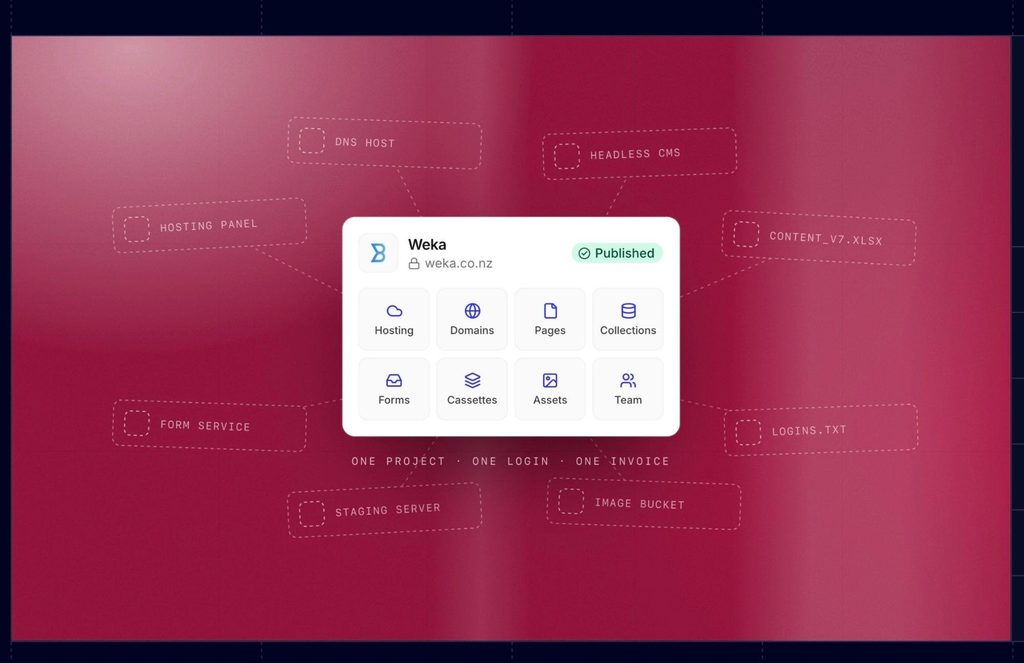
Eight tools to chase, or one project on Blutui
AI is making the tangle worse
AI is amazing. It can take a prototype to production faster than any team could a few years ago. But dropped into an already fragmented stack, it multiplies the fragmentation instead of solving it.
We call it AI spaghetti. Each tool brings its own AI features, prompts and outputs, with no shared structure or production standard. Platform-owned models and token pricing put the agency’s AI costs in someone else’s hands, and those prices can move without warning. Meanwhile, clients can now vibe-code sites themselves, which produces work that’s hard to maintain and chips away at the agency’s role.
The agencies that win the next phase won’t be the ones with the most AI tools. They’ll be the ones that bring AI under control, so it’s structured, cost-predictable and working for their own people. That’s a job for an ecosystem, not another point tool.
A system built for how agencies deliver web work
Businesses run on category systems. A CRM for customer relationships, an ERP for operations, a CMS for content. Agencies have never had one built around how they actually deliver web work.
That’s the gap the Agency Web Ecosystem (AWE) fills. It’s a single, white-label environment for everything an agency needs to design, build, host, run and evolve client web experiences, while the agency keeps control of the client relationship and the craft. It isn’t a CMS, and it isn’t a DIY website builder.
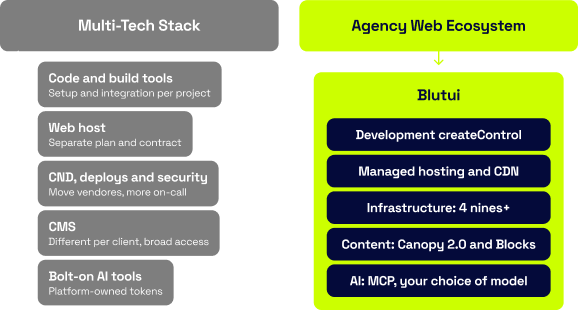
In a multi-tech stack the agency holds every connection itself. In an Agency Web Ecosystem those layers sit inside one environment, with one partner.
On Blutui, that looks like this:
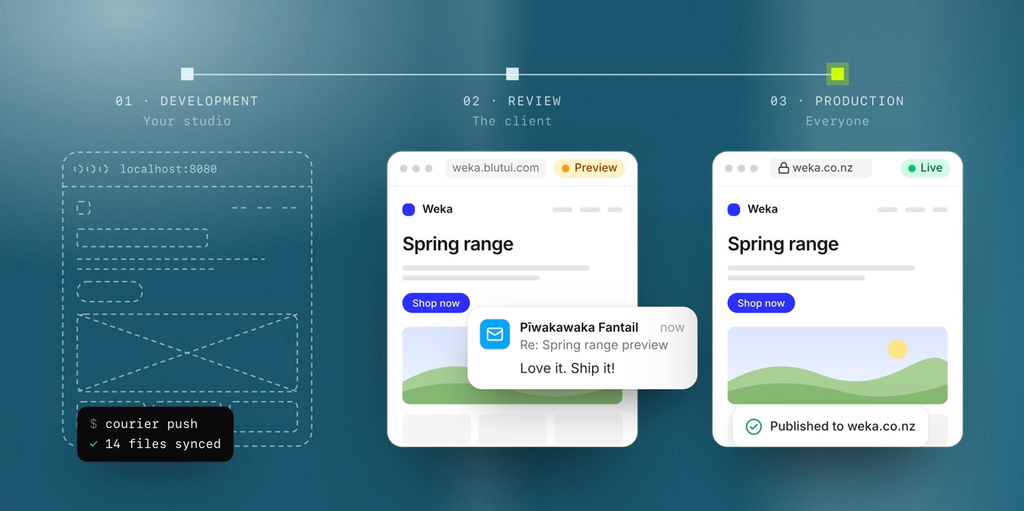
- Development. Front-end teams build with the code and frameworks they already know. Initialisation and deployment are automated, and a design can go from a prototype (e.g. Figma or Paper) to a live site in under three minutes.
- Hosting and infrastructure. Managed hosting, CDN, domains, SSL, SSO and analytics are part of the ecosystem, not separate contracts. The platform has delivered 99.99%+ availability.
- Content. Clients edit through Canopy using components and fields the agency defines, so they get freedom inside guardrails and the design holds.
- AI. Blutui MCP and Agentic Skills bring AI into production with structure. Agencies connect the models of their choice rather than a platform-owned token ecosystem, which keeps costs predictable.
It’s also fully white label. The agency stays the trusted partner while Blutui powers delivery behind the scenes.

The client edits the page in Canopy and the design holds
What it looks like on real projects
John Smith Agency in Brisbane used Blutui to design and publish the Kiltr website, working alongside Kiltr’s CTO, Ben Slater. Because development, hosting and content all sat in one project, agency and client worked in the same environment instead of passing work between systems. The site went from first design to published in a day.
“Love the onboarding, the simplicity of the setup and the MCP integration makes the build and content management so straightforward,” said Ben.
In the UK, Subvert built the website for BIMA, the UK’s digital industry body, on Blutui. With no separate host, CDN or CMS to set up and integrate, the team’s time went into design and build, and the site was delivered in about a third of the planned time.
Across the platform, agencies are seeing up to 97% of production bottlenecks removed and up to four times the productivity. Those gains come from removing work, not from asking teams to work faster.
Every project is an API, with tokens, webhooks and MCP context
Start by taking one project apart
The clearest case is your own numbers. Take a recent web project and work through it:
- List every tool it touched, from code hosting and CMS to forms, analytics, security and AI.
- Count the hours spent on setup, integration, deployment, updates and troubleshooting, separately from design, build and client work.
- Add up the licences, hosting plans and per-site fees, including the ones absorbed into fixed fees.
- Note how much senior developer time went on maintenance, and how often designers were blocked.
- Count the vendors you’d need to call if the site went down tonight.
Steps two and three together are the technology overhead your agency carries, and in a multi-tech model it repeats on every project, every year. Most agencies are surprised by what they find.
Moving doesn’t mean replacing everything at once. Most agencies start with a single new client site, campaign or landing page, measure the difference against their baseline, and bring more projects across as they renew.
The bottom line
The multi-tech stack makes agencies manage technology. An Agency Web Ecosystem lets technology serve the agency, so agency talent goes further.
Read the full BluPaper, Compounding AI Chaos, on the Blutui website.